

What if your team could spend less time moving KYC information between forms and files, and more time applying its expertise where it matters? For Australian accounting firms, reducing manual effort in KYC isn’t about removing people from the process. It’s about making repeatable steps more consistent while keeping staff in control of decisions and exceptions.
Repeated data entry, document handling and unclear hand-offs can slow client onboarding. They can also make it harder to see what’s complete, what needs attention and where supporting records are stored. With AML/CTF Tranche 2 obligations in force since 1 July 2026 for firms providing designated services, a structured KYC workflow is an important part of day-to-day compliance.
This article explains which KYC tasks are suited to automation, where staff judgement should remain central, and how consistent workflows can support accessible, audit-ready records. It also shows how connecting verification, screening, risk assessment and record keeping can reduce administrative friction while preserving oversight and a smoother client experience.
Key Takeaways
- Map your current KYC process and track staff time, hand-offs, rework and unresolved tasks to identify where effort is concentrated.
- Reducing manual effort in KYC means automating repeatable work while keeping staff judgement central to exceptions and decisions.
- Compare workflows by how they handle repeat data entry, consistency, visibility and supporting records, not just by the number of steps.
- Use structured workflows to clarify responsibilities and guide staff from collecting client information through to review.
- Explore how Trancher connects KYC/CDD, screening, risk assessment and record keeping with wider AML/CTF workflow management.
Why reducing manual effort in KYC matters for accounting firms
Manual KYC effort includes handling, entering, checking and transferring client information. It can mean copying details from an intake form, following up for missing documents, recording screening results and saving information in a separate file or system. Each task may seem small, but repeated across client matters, these steps take time away from work that needs staff expertise.
Informal hand-offs can add to the workload. One person may collect information, another conduct checks and a third update the client record. If responsibilities and progress aren’t clear, details may be entered more than once, follow-ups can be missed and staff may struggle to find the supporting records. Start by understanding the Know Your Customer (KYC) principles and how they inform your firm’s own workflow.
Where manual work builds up across the KYC process
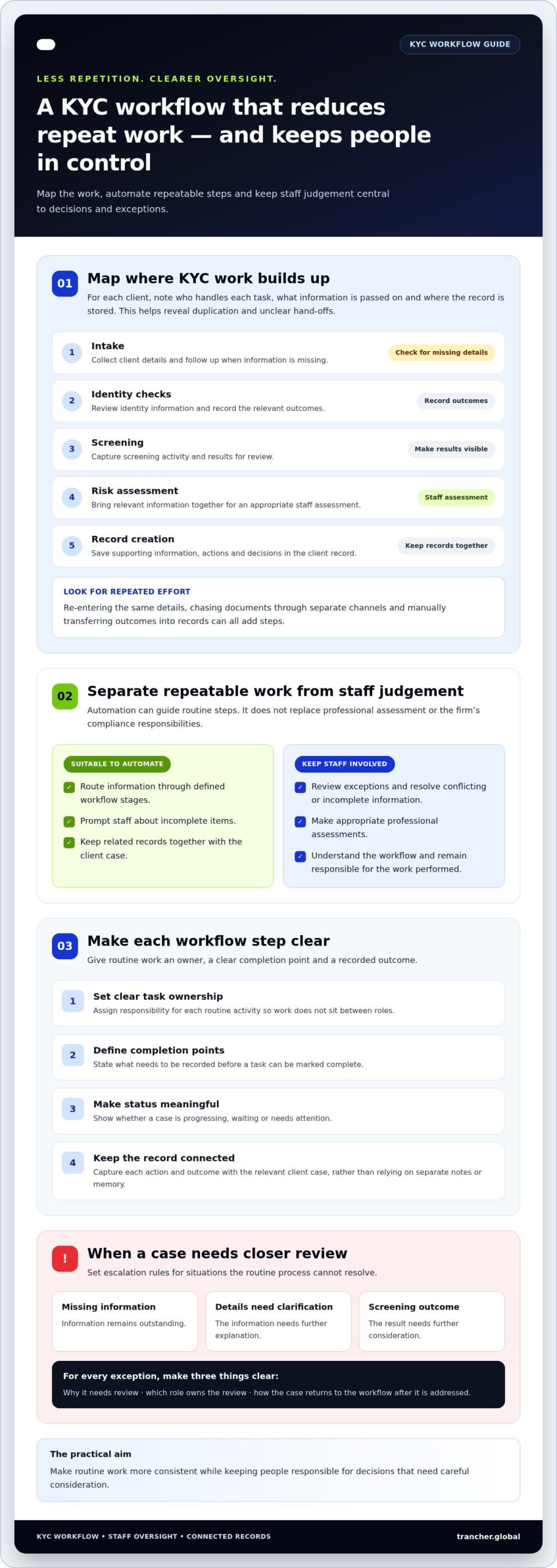
Break the process into stages to see where administration accumulates. For each client, note who handles each task, what information is passed on and where the record is stored. This makes duplication and unclear hand-offs easier to identify, while distinguishing process improvements from decisions that require professional judgement.
- Intake: Client details are collected, and staff follow up if information is missing.
- Identity checks: Staff review identity information and record the relevant outcomes.
- Screening: Screening activity and results are captured for review.
- Risk assessment: Relevant information is brought together for an appropriate staff assessment.
- Record creation: Supporting information, actions and decisions are saved in the client record.
Re-entering the same details at several stages, chasing documents through separate channels and manually transferring outcomes into records all add steps. For the specific Australian requirements, refer to the Australian CDD and KYC requirements guide.
What automation can reduce, and what it cannot replace
KYC workflow automation uses structured steps to collect, route and record repeatable information, while leaving decisions and exceptions for staff review. It can guide routine tasks, reduce repeated entry and make hand-offs easier to track. It isn’t autonomous compliance decision-making, and it doesn’t remove a firm’s compliance responsibilities.
- Suitable for automation: Routing information through defined workflow stages, prompting staff about incomplete items and keeping related records together.
- Keep staff involved: Review exceptions, resolve conflicting or incomplete information, and make appropriate professional assessments.
- Maintain accountability: Make sure staff understand the workflow and remain responsible for the work they perform.
The aim of reducing manual effort in KYC is to free staff from unnecessary administration, not to sideline their judgement. A structured process helps the firm manage routine work consistently while keeping people involved in decisions that need careful consideration.
How KYC automation reduces repetitive work while keeping oversight
A well-designed KYC workflow makes the next action, its owner and the reason for any pause clear. This can help prevent routine cases from stalling in an inbox or moving between staff without a recorded status. Define how work moves, what counts as completion and what staff should do when a case doesn’t follow the expected path.
A useful workflow makes responsibilities and next steps visible, so staff can focus their review where a case needs closer attention.
Automate repeatable KYC tasks in a defined sequence
Design the workflow around clear task states rather than relying on staff to remember what to do next. For each repeatable task, specify who owns it, what information or action is needed to progress, and how completion is recorded. For example, distinguish a case awaiting client information from one ready for staff review. Each status should point to a practical next step.
- Set clear task ownership: Assign responsibility for each routine activity so the work doesn’t sit between roles.
- Define completion points: State what needs to be recorded before a task can be marked complete.
- Make status meaningful: Use workflow labels that show whether a case is progressing, waiting or needs attention.
- Keep the record connected: Capture the action and its outcome with the relevant client case, rather than relying on separate notes or memory.
These steps make the workflow easier to follow consistently and give managers a clearer view of bottlenecks. If cases regularly pause at the same point, review whether task ownership, instructions or the information request needs to change.
Route uncertain cases to staff for considered review
Set escalation rules for circumstances that can’t be resolved through the routine process. These could include missing information that remains outstanding, details requiring clarification or a screening outcome that needs further consideration. Specify which role is responsible for review and how the case returns to the workflow once addressed. Each exception should have a clear owner and a recorded outcome.
- Identify the reason for review: Record what is unresolved so the reviewer can focus on the relevant issue.
- Assign the next action: Make clear who will review, seek clarification or decide how the case should proceed.
- Record the resolution: Capture the outcome and any follow-up needed before the case moves forward.
Firms can align escalation pathways with their risk assessment approach. The Australian AML risk assessment methodology offers further context for structuring this work. To explore how structured workflow automation can support your firm, see Trancher’s KYC/CDD workflow automation.
Compare manual, fragmented and integrated KYC workflows
No single workflow suits every accounting firm. Compare how much coordination each approach requires, how well it fits your existing systems and whether it works for your client mix. Use the table to identify day-to-day trade-offs, then consider which matter most in your practice.
| Workflow aspect | Manual | Fragmented | Integrated |
|---|---|---|---|
| Repeat data entry | Staff may re-enter details as work progresses. | Information may need to be copied between separate tools. | A connected process may reduce duplicate entry. |
| Hand-offs | Progress depends on staff coordinating each transfer. | Transitions between tools or teams can add coordination. | A shared workflow can make transitions more consistent. |
| Consistency | Methods can differ between staff members. | Separate tools may lead to variations in how tasks are handled. | Common workflow steps can support a more uniform approach. |
| Visibility | Progress may need to be checked manually. | Information spread across tools can make the overall picture harder to assemble. | A connected view can make workflow progress easier to follow. |
| Supporting records | Information may be kept in separate files or locations. | Records may be distributed across tools used at different stages. | A connected process can associate relevant records with the workflow. |
Assess the workflow, not just the automation feature
Compare the work needed to operate each approach alongside its headline features. Consider whether its stages match your client onboarding, whether staff can use it within established routines and how much change it would introduce. The guide to audit-ready compliance records provides useful context for assessing how record keeping fits into the wider process.
Make the comparison specific to your firm. A practice with varied client needs may value flexibility, while a team handling similar onboarding activities may prioritise consistency. Consider your existing systems too: an approach that fits your working environment may be more practical than one that adds another disconnected step.
Balance efficiency with traceability and client experience
Consider the process from the client’s perspective as well as the team’s. If clients receive similar requests from different staff or have to repeat information because it hasn’t carried through the process, the experience can feel disjointed. A connected approach can help the firm provide a coherent journey while retaining communication methods that suit its clients.
Use these trade-offs to decide what improvement would be meaningful for your firm. The aim isn’t to choose the most automated option by default. It’s to find an approach that fits your client mix, operating practices and existing systems, while making routine KYC administration easier to manage.
How to implement KYC automation without disrupting your firm
Introducing automation is easier when you understand the existing process first. Map how your firm collects information, completes tasks, passes work between staff and stores records. Then choose a defined workflow to improve, rather than changing every client process at once. This gives your team a clear starting point and helps maintain service while you test changes.
Map the current process and define a useful baseline
Follow a typical client case from the first information request through to the completed KYC record. Note what staff ask for, what they do at each stage, who takes responsibility and where information is transferred. Record the process as it happens, including informal follow-ups and workarounds. These details often reveal where effort builds up.
Before making changes, choose a small set of measures your firm can track consistently. A baseline isn’t a target or an industry benchmark. It’s a reference point for assessing whether the new workflow is helping your team.
- Staff time: Record the time spent on repeatable KYC administration for the workflow being reviewed.
- Hand-offs: Note how often work passes between people or systems, and where ownership becomes unclear.
- Rework: Track repeated entry, corrections or follow-up caused by missing or duplicated information.
- Unresolved tasks: Keep sight of cases awaiting information, review or another action.
Use the same measures after the workflow changes and compare like with like. A clear baseline helps identify practical improvements without assuming every client case will follow the same pattern.
Introduce automation through a controlled pilot
Select a manageable workflow with repeatable steps and clear boundaries. Agree which tasks the process will support, who reviews exceptions, who can resolve them and how outcomes are recorded. Make sure staff know when to pause the workflow and escalate a case rather than trying to force it through a routine path.
During the pilot, ask the team whether instructions are clear, task ownership is easy to follow and client-facing requests make sense. Review completed records and unresolved cases as part of the trial. If staff are unsure what to do next, or exceptions aren’t being captured clearly, refine the process before expanding it.
- Map: Document the current steps and hand-offs.
- Measure: Establish the baseline using reliable indicators.
- Pilot: Apply automation to a defined workflow and clarify staff roles.
- Review: Gather feedback, check records and address unresolved tasks.
- Refine: Adjust the workflow before considering broader adoption.
Once you have a measurement framework, explore compliance activity and ROI tracking to connect operational visibility with how your firm monitors compliance work. A measured rollout makes reducing manual effort in KYC a practical process of learning and refinement, with staff oversight in place.
Explore Trancher’s KYC workflow automation to see how structured compliance workflows can support your firm’s approach.
How Trancher supports lower-effort KYC operations
Trancher provides Australian accounting firms with an AML/CTF compliance platform that brings KYC/CDD screening, client risk assessment, monitoring, record keeping and workflow automation together. This connected approach helps firms manage client verification as part of a broader compliance programme, rather than treating each activity as a separate process.
Connect client verification with the wider compliance workflow
Trancher gives firms a structured way to manage client verification and due diligence alongside screening, ongoing risk monitoring and reporting. Managing relevant activity and documentation in a connected workflow helps teams apply processes consistently and access supporting records when reviewing compliance work.
The platform also includes audit-ready record keeping, onboarding, staff guidance and local Australian support. These capabilities help firms organise implementation and support staff as they adopt new workflows. Trancher guarantees AML/CTF compliance readiness within 30 days. This is a readiness guarantee, not AUSTRAC endorsement.
Turn managed compliance activity into an operational asset
Tracking compliance activity helps firms understand what work has been completed for each client and supports internal service and billing processes. For example, a clear activity record can help a team review the compliance work associated with a client engagement when managing billing. It doesn’t establish a particular fee, revenue outcome or return on investment; those depend on the firm’s own approach.
Firms considering how to manage compliance expenditure can refer to this AML/CTF compliance cost reduction guide. Trancher’s accounting-focused platform connects KYC/CDD with broader compliance activity and implementation support. Discuss your firm’s workflow and implementation needs to explore how this approach could fit your practice.
Make your next KYC improvement count
Decide what a well-managed KYC process should make easier for your firm and its clients. Consider how compliance work fits alongside your service model as the firm grows or client needs change. A workflow should support practical day-to-day oversight, not create another administrative layer for staff to work around.
Reducing manual effort in KYC is an opportunity to build a more sustainable way of working: one that gives staff room to focus on considered decisions and helps the firm manage compliance activity with confidence. Start with how your practice operates, what your team needs and where structured support could make a difference.
Start a conversation with Trancher about a lower-effort KYC approach. With a clear next step, your firm can keep improving its process at a measured pace.
Frequently Asked Questions
Does KYC automation change who is responsible for a firm’s AML/CTF processes?
No. A platform can support how work is organised, but it doesn’t take responsibility for the firm’s AML/CTF processes. For example, a firm can assign a staff member to review an unresolved case and another role to oversee the procedure, with actions recorded according to its internal process. Check current AUSTRAC guidance and seek advice appropriate to your firm’s circumstances when determining specific obligations.
Can a small accounting firm reduce KYC administration without a large technology team?
Yes. Start by identifying where staff repeat tasks, re-enter details or pass work between people, then decide which steps could follow a consistent workflow. A structured compliance platform can help organise those activities without requiring the firm to build its own automation. Keep the rollout manageable: define who handles routine tasks, who reviews exceptions and how staff can raise workflow issues.
How should an accounting firm explain automated KYC checks to clients?
Explain the request in plain language before asking a client to provide information. Tell them what details or documents are needed, why they form part of onboarding and how to submit anything missing. Let clients know who they can speak with if they have questions. Avoid promising that every check will be completed automatically, as some circumstances may need further information or staff attention.
Is automated KYC suitable for clients who prefer face-to-face service?
Yes. A firm can use a structured workflow to organise information and documentation while continuing to guide clients directly. For example, a staff member can explain a request during a meeting, help the client understand the next step and ensure the relevant information is recorded through the firm’s process. Keep communication clear, provide a way to resolve questions and involve staff where a client needs assistance.
What can a firm do when a client declines to provide information through an automated process?
Offer a clear conversation with an appropriate staff member rather than treating the digital request as the only channel. Explain what information is being requested and invite the client to raise concerns or discuss how to provide it. Record the interaction and follow the firm’s documented procedures. A declined request doesn’t have one universal outcome, so staff should consider the circumstances and applicable guidance before deciding what happens next.
How can a firm make automated KYC easier for staff to adopt?
Involve the staff who manage client onboarding before introducing the workflow. Ask them to test a typical case and one with an exception, then note where responsibilities, instructions or records are unclear. Provide practical guidance on which tasks the workflow supports, how to document a review and where to escalate an unresolved issue. Use staff feedback to refine the process before applying it more broadly.