

A blanket document chase can create more work without resolving the risks that matter. A practical KYC remediation project plan gives Australian firms a clearer way to identify gaps, prioritise existing client files and keep everyday client work moving.
If your firm provides designated services covered by Australia’s AML/CTF regime, Tranche 2 obligations commenced on 1 July 2026. That brings existing client records into focus alongside new onboarding. When files vary across teams and risk decisions aren’t consistently documented, remediation can absorb valuable staff time.
The answer is a risk-led programme with clear scope, ownership and repeatable steps. This guide explains how to assess your client population, rank remediation by risk, document evidence and decisions, and track exceptions and outstanding actions. It also shows how to connect remediation with ongoing KYC and risk monitoring, so the work strengthens your processes rather than becoming a one-off exercise. You’ll come away with a practical framework for building a prioritised, clearly owned programme that supports consistent records and more confident compliance operations.
Key Takeaways
- Use your documented AML/CTF risk assessment to shape the KYC remediation project plan, rather than applying universal risk scores.
- Establish a baseline, classify file gaps and record the rationale for each remediation priority.
- Remediation doesn’t automatically mean repeating every check identically; set the scope and depth according to risk, identified gaps and applicable requirements.
- Set clear ownership, work queues and escalation pathways before contacting clients, then use consistent communications to request relevant information.
- Structured KYC/CDD, risk assessment, monitoring and record-keeping workflows can help teams manage tasks and evidence consistently.
What a KYC remediation project plan should achieve for an Australian accounting firm
A KYC remediation project plan turns uneven existing records into a consistent, risk-informed process. Remediation means identifying, assessing and resolving gaps in existing KYC records and related processes. It is distinct from onboarding, which checks a client as a relationship begins, and ongoing monitoring, which continues after initial checks are complete.
For a firm providing designated services covered by Australia’s AML/CTF regime, Tranche 2 obligations commenced on 1 July 2026. The project should help the firm assess existing client due diligence against its AML/CTF arrangements and applicable current requirements, then record why decisions were made. KYC is part of understanding and verifying clients; for a foundational overview, see What is Know Your Customer (KYC)? For the Australian requirements context, see CDD and KYC requirements in Australia.
Remediation isn’t an instruction to repeat every check identically. Establish what is already held, what is missing or unclear, and what action is appropriate in light of the firm’s documented risk assessment and current requirements. This gives teams a practical basis for consistent decisions without assuming every client file has the same gaps.
Which client files and workflows belong in scope?
Start by mapping the designated services the firm provides, the client population connected to those services and the AML/CTF arrangements that apply. Then identify the records and processes to review, including existing KYC/CDD information, risk assessments, supporting evidence and unresolved follow-up actions.
Include the teams, systems and hand-offs involved in collecting, reviewing and updating information. One file may have a clear identity record but an incomplete risk rationale; another may be waiting on evidence. A defined scope makes those differences visible and helps direct effort where it is needed.
What does a defensible remediation outcome look like?
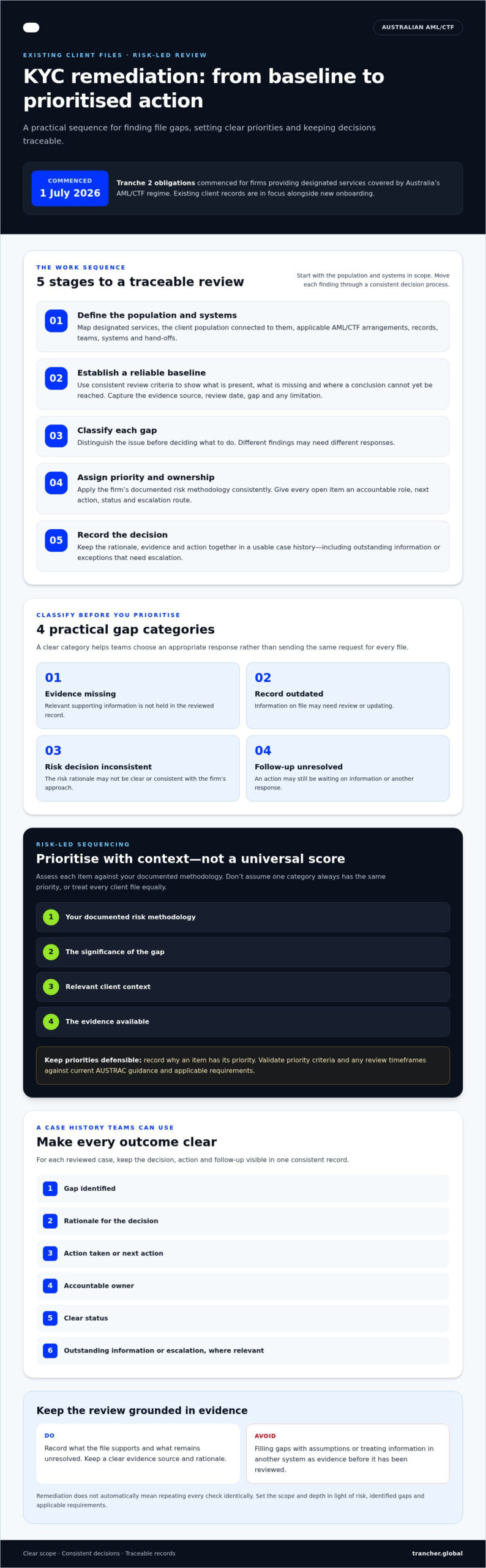
Each reviewed case should show the gap identified, the rationale for the decision, the action taken, the accountable owner and a clear status. If information remains outstanding or an exception needs escalation, record that too. This creates a usable case history rather than a trail of disconnected documents.
At firm level, consistent records help leaders oversee progress, identify recurring process issues and maintain audit-ready documentation. The aim is not simply to close a work queue. It is to make evidence and decisions clear enough that teams can apply the same disciplined approach as client circumstances and monitoring needs evolve.
How to assess KYC gaps and prioritise remediation work
A reliable assessment follows a clear sequence: define the population and systems in scope, establish a baseline, classify gaps, assign priorities and owners, then record decisions. This gives your KYC remediation project plan traceable logic, rather than a queue of files with no consistent basis for action.
Start by separating findings into practical categories. Evidence may be missing, a record may be outdated, risk decisions may be inconsistent, or follow-up may remain unresolved. These distinctions matter: an absent document may need a different response from an unclear rationale or an action already awaiting client information.
Risk-led sequencing is more practical than treating every file equally because it directs attention to the gaps most relevant to your firm’s documented risk assessment and client context. Don’t create universal scores or assume a particular category always has the same priority. Apply your firm’s methodology consistently, and validate priority criteria and any review timeframes against current AUSTRAC guidance and applicable requirements.
How can firms establish a reliable KYC baseline?
Map where client identity, beneficial ownership and risk information are recorded, including relevant systems and hand-offs between teams. Define the review scope and use consistent criteria when sampling or reviewing files. A baseline should show what is present, what is missing and where a conclusion cannot yet be reached.
For each record, capture the evidence source, review date, identified gap and any limitation. If ownership information is unclear, for instance, document what the file supports and what remains unresolved. Don’t fill gaps with assumptions or treat information held in one system as evidence if it hasn’t been reviewed.
How should a firm rank gaps and assign ownership?
Assess each item using your documented risk methodology, the significance of the gap, relevant client context and the evidence available. A missing or conflicting detail may warrant follow-up; an existing record may instead need a clear rationale or an update. Record why the item has its priority, rather than relying on an unexplained label.
Every open item needs an accountable role, a defined next action, a status and an escalation route if it remains unresolved. This makes workload visible and helps teams avoid duplicate requests or stalled cases. For a deeper explanation of how to structure the underlying framework, see this guide to the Australian AML/CTF risk assessment methodology.
Consistent task and evidence workflows can reduce the administration involved in tracking decisions across teams. Learn how Trancher’s AML/CTF workflows support structured remediation and record keeping.
Does KYC remediation require reviewing every client file from scratch?
KYC remediation corrects identified gaps in existing records; it isn’t automatically a repeat of complete client onboarding. A firm may need to revisit particular information or decisions, but the scope and depth of that work should reflect its documented risk assessment, the gaps found and applicable current requirements.
A blanket refresh can create a consistent review process and reveal issues that weren’t apparent in an initial assessment. It can also generate substantial work, including repeated requests for information already held. Targeted remediation can focus effort on known gaps, but it depends on a reliable baseline and clear criteria. If those foundations are weak, a narrowly scoped review may miss inconsistencies.
Neither approach is automatically right for every firm. A KYC remediation project plan should explain why the chosen scope is appropriate, how cases will be assessed and what happens when reviewers identify uncertainty. Sampling may help a firm understand patterns in its records, but don’t assume sampling alone satisfies applicable obligations. Validate the approach, including any review expectations, against current AUSTRAC guidance.
When is targeted remediation a practical approach?
Targeted work may be practical where a documented assessment has identified specific gaps and the firm can rely on its baseline. For example, a review might flag missing evidence in some records while others have clear documentation but an incomplete risk rationale. Record what was reviewed, what wasn’t and why. If reviewers can’t resolve uncertainty, use the firm’s established governance and compliance escalation processes.
When might a broader review be warranted?
Consider expanding the review if records are materially inconsistent or the baseline can’t be relied upon to identify gaps accurately. A broader assessment may also be appropriate where a change in a client’s circumstances or service context could affect the firm’s documented risk view. These are prompts for assessment, not automatic triggers for identical checks across all files.
Set out the basis for any expanded scope and document how the firm reached its decision. Before describing a review interval or method as a regulatory requirement, confirm it against current AUSTRAC guidance and the requirements that apply to the firm. That keeps remediation proportionate while preserving a clear rationale for the work completed and any remaining limitations.
Running KYC Remediation: From Baseline to Closure
A clear delivery process keeps remediation manageable and prevents client requests from becoming disconnected from the review. Before work begins, assign project ownership, confirm the scope, organise work queues and establish escalation pathways. A KYC remediation project plan should also make clear who can approve decisions and how unresolved cases are handled under the firm’s governance arrangements.
Prepare consistent client communications before requesting information. Explain why the firm is getting in touch, what relevant information is needed and how the request fits into its review process. Tailor each request to the gap identified in that client’s record. This helps avoid unnecessary requests and gives staff a consistent way to respond to client questions.
How should teams manage remediation work and exceptions?
Use a central status view to show each case’s owner, progress, missing evidence, outstanding action and unresolved decision. This makes it easier to identify stalled work and allocate follow-up without relying on scattered emails or individual staff memory. Apply consistent templates and staff guidance so similar cases are handled in a repeatable way.
Define escalation and approval responsibilities in line with the firm’s existing governance arrangements. For example, a reviewer who encounters conflicting information should be able to record the issue and route it to the appropriate role, rather than making an unsupported judgement or leaving the case without a clear status.
What evidence should firms retain at project closure?
Close each case with a documented outcome. The record should let another authorised reviewer understand what was assessed, what evidence was considered and how the firm reached its decision. Depending on the case, include:
- the review scope and relevant source evidence
- the assessment rationale and actions taken
- the case owner, status and any quality checks or management oversight
- exceptions, unresolved matters and their next steps
Keep these details within the firm’s established record-keeping process, with a consistent structure that supports firm-wide oversight. For more on designing records to support audit readiness, see this guide to audit-ready compliance records.
Closure is also a useful point to look for recurring issues. If several cases reveal the same unclear hand-off or evidence gap, feed that finding into staff guidance, ongoing monitoring and future client review workflows. Structured AML/CTF workflows can help teams organise remediation tasks and capture decisions and evidence consistently. See how Trancher’s remediation workflows support this process.
How Trancher can support a repeatable KYC remediation workflow
A well-designed remediation process shouldn’t end when the current work queue is closed. Trancher connects client verification and KYC/CDD workflows with risk assessment, ongoing monitoring and audit-ready record keeping, helping Australian accounting firms carry decisions and evidence through a consistent process.
For a KYC remediation project plan, structured tasks help teams see what needs review, who owns the next action and which evidence or decisions have been recorded. This supports consistency across cases and reduces the administrative effort of tracking work across disconnected records. Staff still assess the information and make decisions under the firm’s governance arrangements. Software supports that work, but doesn’t replace professional judgement or oversight.
Where can workflow automation reduce remediation administration?
Organised client information makes it easier for authorised staff to review verification details, document risk decisions and track follow-up. Consistent workflows also help teams record missing information and exceptions in a way that’s easier to review. Role-based guidance and staff training reinforce how to handle common tasks and when to escalate a case, helping reduce variation between teams.
Recorded compliance activity can also help a firm identify work that could be treated as recoverable professional work. That depends on the firm’s own arrangements; tracking activity doesn’t guarantee revenue.
How can firms move from remediation to ongoing control?
Carry relevant findings forward. If remediation identifies an unresolved action or a recurring exception, make sure it informs the appropriate ongoing monitoring or client activity workflow. Reviewing patterns can also highlight where staff guidance, hand-offs or internal processes may need improvement. This is how a one-off project can strengthen the firm’s repeatable controls.
Explore the next operational step in this guide to ongoing risk monitoring software. To see how Trancher supports structured KYC/CDD, risk assessment, monitoring and record keeping in your firm, explore the Trancher platform.
Turn remediation into stronger ongoing controls
A sound KYC remediation project plan gives your firm more than a way to close file gaps. It creates a risk-led process for prioritising reviews, documenting decisions and carrying useful findings into ongoing monitoring. Clear ownership and consistent evidence records help teams manage the work with greater confidence.
Trancher brings together KYC/CDD, risk assessment, monitoring, reporting and audit-ready record-keeping workflows, with dedicated onboarding and local Australian support. The platform is backed by a guarantee of AML/CTF compliance readiness within 30 days of starting.
Build on your remediation framework with workflows that support consistent execution across your firm. Explore Trancher’s AML compliance platform and start a conversation about preparing your firm for ongoing compliance. With a clear plan and the right processes in place, remediation can become a practical foundation for more consistent compliance operations.
Frequently Asked Questions
What is a KYC remediation project plan?
A KYC remediation project plan sets out how a firm will identify, assess and resolve gaps in existing KYC records and processes. It defines the client and workflow scope, explains how gaps will be prioritised, and assigns owners to review and follow-up tasks. It should also show how decisions, evidence, exceptions and outcomes will be recorded, so teams can apply a consistent approach and carry relevant findings into ongoing monitoring.
How do you start a KYC remediation project?
Start by confirming which designated services and client records fall within scope, then review the firm’s AML/CTF arrangements and applicable current requirements. Establish who owns the project, where relevant information is held and how gaps will be assessed. Set up work queues, status tracking and escalation pathways before contacting clients. Check current AUSTRAC guidance as you define the process, and use consistent criteria to establish a reliable baseline.
Do we need to redo KYC checks for every existing client?
No, remediation doesn’t automatically mean repeating every check identically. Review what the firm already holds, identify gaps and determine the appropriate follow-up using documented risk assessments and applicable current requirements. Some files may need targeted updates; others may require broader review if their records are incomplete or unreliable. Sampling can help assess patterns, but don’t assume sampling alone meets applicable obligations. Document the review scope and rationale.
How should a firm prioritise KYC remediation cases?
Use the firm’s documented AML/CTF risk assessment alongside the significance of each gap, the client context and the evidence available. Record why a case has its priority rather than applying universal risk scores. Assign each item an accountable owner, a next action and an escalation route. Validate priority criteria and any applicable review timeframes against current AUSTRAC guidance and requirements, so the approach is consistent and appropriately supported.
What records should a KYC remediation project retain?
Keep a record of the review scope, evidence sources, identified gaps, assessment rationale, decisions and actions taken. Include the case owner, status, quality checks and any unresolved matters or exceptions with their next steps. These details should sit within the firm’s established record-keeping process and make it clear how each outcome was reached. Consistent case records also help management oversee progress and identify recurring issues for process improvement.
How long does a KYC remediation project take?
There’s no single timeframe that suits every firm. Duration depends on the scope, the condition and accessibility of existing records, the number and nature of identified gaps, available staff capacity and how quickly clients provide requested information. Establish a more realistic schedule after the baseline review, then track progress and unresolved actions against it. Confirm any applicable regulatory timeframes against current AUSTRAC guidance rather than assuming a project deadline.
How can software support KYC remediation in an accounting firm?
Software can organise client verification, KYC/CDD, risk assessments, task ownership, evidence capture and follow-up tracking in structured workflows. It can also help firms connect remediation findings with ongoing monitoring, reporting and record keeping. Trancher provides workflows for these activities, alongside dedicated onboarding and local Australian support. The platform supports consistent administration, but staff and firm leaders remain responsible for reviewing information, making decisions and providing appropriate oversight.