

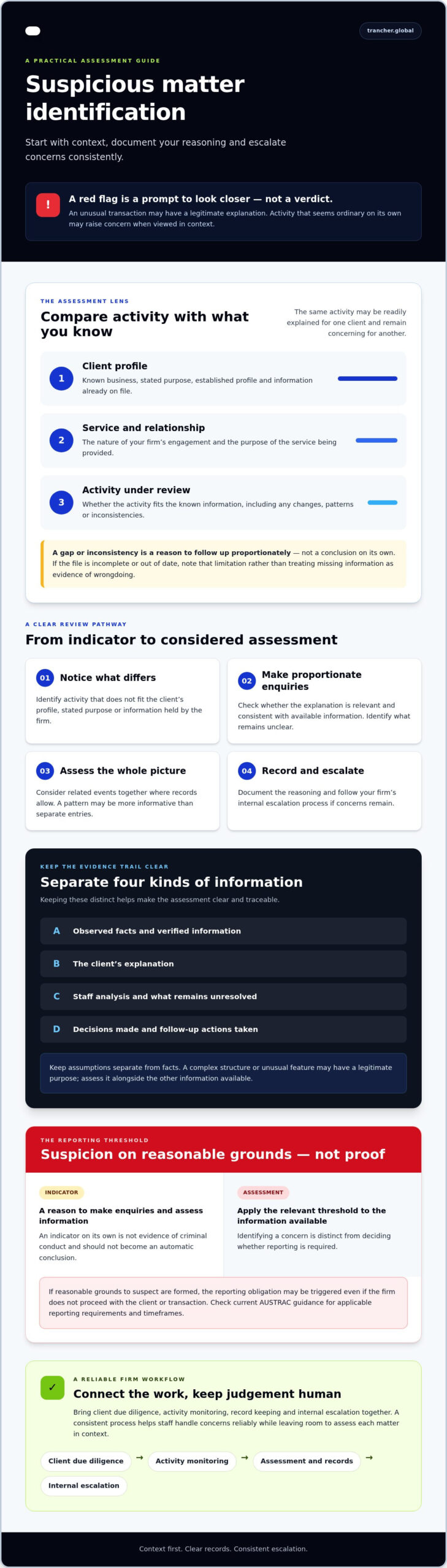
A red flag is a prompt to look closer, not a verdict. Knowing how to identify a suspicious matter means assessing activity against the client, their stated purpose, known source of funds and the wider relationship. An unusual transaction may have a legitimate explanation. Equally, a pattern that seems ordinary in isolation may raise concern when viewed in context.
For accounting firms, that judgement can be difficult. Staff may hold different views, miss relevant information or be unsure when to escalate. AUSTRAC’s threshold for an SMR is suspicion on reasonable grounds, not proof of a crime. A consistent process helps your team recognise when concerns need further review, record the information behind an assessment and distinguish identifying a concern from deciding whether to report it.
This guide sets out a practical way to compare activity with what your firm knows, document the reasoning and actions taken, and escalate concerns through your AML/CTF process. It explains how contextual indicators can guide a review without turning a red-flag list into an automatic conclusion.
Key Takeaways
- Learn how to identify a suspicious matter by weighing activity against the client’s profile, the service provided and information already on file.
- Assess whether an explanation is relevant and consistent, and identify what remains unresolved before drawing conclusions.
- Keep observations, client explanations, staff analysis and decisions distinct so your reasoning is clear and traceable.
- Use a consistent internal escalation process to help staff handle concerns reliably and document follow-up actions.
- Connect client due diligence, activity monitoring and record keeping in a structured workflow that supports professional judgement.
How to identify a suspicious matter: start with context, not a checklist
When does unusual client activity warrant a closer assessment? It depends on what your firm knows about the client, the service being provided and the activity itself. A transaction that differs from a client’s usual pattern may have a straightforward explanation. A familiar-looking transaction may also deserve attention if it conflicts with other information on file.
A suspicious matter is a concern formed on reasonable grounds after assessing relevant activity and information in context, not a conclusion based on one red flag. Under AUSTRAC’s current guidance, the SMR threshold is suspicion on reasonable grounds, not proof that a crime has occurred. An indicator is a reason to make enquiries and assess the available information. On its own, it is not evidence of criminal conduct.
Other jurisdictions use terms such as Suspicious Activity Report (SAR) or Suspicious Transaction Report (STR). These offer useful international context, but Australian firms should apply the Australian suspicious matter reporting framework and current AUSTRAC guidance.
What makes activity unusual for this client?
Start with the client’s known business, stated purpose, established profile and the nature of your firm’s engagement. Ask whether the activity fits that information and whether your records support a clear, plausible explanation. For example, if a client’s profile indicates modest domestic operations but a transaction involves an unfamiliar overseas entity, that difference is a prompt to ask questions, not an automatic conclusion. Identify what is verified, what the client has explained and what still needs clarification.
Why one warning sign rarely tells the whole story
Meaning can emerge from a combination of facts. A complex ownership structure may have a legitimate commercial purpose. Paired with inconsistent explanations or activity that does not fit the client’s stated objectives, it may leave questions unresolved. Keep verified information separate from the client’s account and distinguish both from your team’s analysis. This helps you assess the whole picture without treating an assumption as fact.
When considering how to identify a suspicious matter, use indicators as prompts for professional assessment, not as a pass-or-fail checklist. If concerns remain, staff should follow the firm’s escalation process rather than wait for proof of wrongdoing. Identifying an unusual feature is the start of the assessment. Deciding whether an SMR is required involves applying the relevant threshold to the information available. If reasonable grounds to suspect are formed, the reporting obligation may be triggered even if the firm does not proceed with the client or transaction. Check current AUSTRAC guidance for the applicable reporting requirements and timeframes.
Assess suspicious activity against the client, service and transaction
Once activity prompts a closer look, compare it with what your firm knows rather than assessing it in isolation. Consider three things: the client’s profile, the purpose and nature of the service, and the activity under review. Your KYC/CDD records and relationship information provide a starting point. Check that they are current and relevant to the assessment.
Context determines how much weight an indicator deserves: the same activity may be readily explained for one client and remain concerning for another. A gap or inconsistency is a reason to follow up proportionately, not a conclusion on its own.
Compare observed activity with the known client profile
Review the client’s stated business, relationship purpose and information on file alongside the designated service your firm is providing. Ask whether the activity fits those details and identify which facts support your view. If the file is incomplete or no longer reflects the client’s circumstances, note that limitation rather than treating missing information as evidence of wrongdoing. For a broader overview of records and checks, see this guide to CDD and KYC requirements in Australia.
Look for patterns, changes and unexplained inconsistencies
A change may have a plausible explanation, such as a client expanding their operations. Check whether information available to the firm supports that explanation. Where records allow, review related events together. Several changes in counterparties, timing or transaction purpose may be more informative as a pattern than as separate entries. Treat the pattern as a prompt for assessment, not an automatic finding. For more on maintaining that broader view, read about ongoing risk monitoring software.
A simple comparison can keep the review focused. If a client’s activity changes, record what you expected based on current information, what you observed, what explanation is available and what remains unresolved.
Expected activity: What would you anticipate from the client profile, relationship purpose and service?
Observed activity: What happened, and what information or records confirm it?
Explanation: What has the client said, and is that consistent with information the firm holds?
Unresolved concern: What questions remain, and what proportionate follow-up or internal escalation is appropriate?
Keep facts, explanations and assessment distinct. A structured review can help staff compare activity consistently, while leaving judgement with the people responsible for assessing the information available. Trancher supports Australian accounting firms with connected KYC/CDD, monitoring and record-keeping workflows. Explore AML/CTF workflow support to see how structured processes can assist your team.
Separate a reasonable explanation from an unresolved concern
An unusual event does not automatically mean an SMR is required, and your firm does not need certainty that a crime has occurred before assessing or escalating a concern. Under the Australian framework, the relevant question is whether there are reasonable grounds to suspect. Apply current AUSTRAC guidance to the facts available. Neither an unusual transaction nor a reassuring explanation is decisive on its own.
Weigh information by asking whether it is relevant to the activity, consistent with what the firm already knows and supported by details you can verify. The aim is not to prove or disprove criminal conduct. It is to assess the concern fairly, identify what remains unclear and follow your firm’s procedures.
What makes an explanation credible enough to record?
Suppose a client’s activity appears inconsistent with the business profile on file. The client explains that the business has expanded into a new line of work and provides updated information that aligns with the activity. Depending on the wider context, that may resolve the specific inconsistency. Record what you checked, what the client explained and why the information did or did not address the concern. A plausible explanation deserves consideration, not automatic acceptance.
Keep the assessment focused on the concern you are testing. Did the explanation account for the activity’s purpose, timing or parties involved? Is it consistent with other information held by the firm? If it is only partly supported, record that distinction rather than describing the matter as resolved.
What if questions remain unanswered?
Consider a client who explains a change in activity, but the explanation conflicts with information already held by the firm. If proportionate enquiries do not clarify the discrepancy, the remaining questions may warrant escalation under internal procedures. Record the inconsistency and the steps taken to understand it. Further information gathering can help, but it should not become an open-ended reason to postpone assessment while concerns remain.
These examples do not establish whether an SMR is required. No single scenario determines the outcome for every firm or client. Assess the particular facts against current AUSTRAC guidance, including the reasonable-grounds threshold and applicable reporting requirements. For examples of indicators that may prompt closer assessment, see this guide to money laundering red flags for accountants. Use indicators to guide enquiries, not replace professional judgement.
In practice, how to identify a suspicious matter means neither reporting every unfamiliar event automatically nor waiting until suspicion becomes certainty. It means weighing the available information, documenting what remains unresolved and escalating in line with your firm’s process so the appropriate reporting decision can be made.
Document your assessment and escalate concerns consistently
A clear record helps your firm show how it moved from an observed activity to an assessment and any follow-up. Use a consistent sequence: record the facts, compare them with relevant client and service context, note questions or inconsistencies, escalate internally under your AML/CTF program, then document the actions and decisions taken.
Keep the parts of the assessment distinct. Record what was observed, what the client explained, what staff assessed and what decision or action followed. This helps another authorised team member understand the reasoning without mistaking an allegation or assumption for a verified fact.
What should the internal record capture?
Include the activity reviewed, relevant client context, information considered and questions that remain unresolved. Note who assessed and escalated the matter, when this occurred and what steps were taken under firm procedures. Keep the record factual, clear and detailed enough to explain the assessment. For more on maintaining organised documentation, see this guide to audit-ready compliance records.
How should staff raise a concern?
Make sure staff know the designated internal contact and approved channel for escalating concerns. Their initial report should be prompt and factual. It should describe the activity, relevant context and unanswered questions without speculating about guilt or overstating what is known. Follow your firm’s AML/CTF program and check current AUSTRAC guidance before acting on reporting or communication requirements.
Identifying a concern and submitting an SMR are related but distinct steps. If reasonable grounds to suspect are formed, current AUSTRAC guidance sets the submission timeframe: within 24 hours for a matter relating to terrorism financing, or within three business days for other suspicious matters. The clock is tied to forming the suspicion, not proving a crime. Your firm’s escalation process should support timely assessment and reporting, not create avoidable delay. For more detail, read about when to submit a suspicious matter report.
Be careful about what is communicated outside the internal process. AUSTRAC guidance and the AML/CTF Act set requirements around disclosing that an SMR has been or is being submitted. Do not tell a client that a report is being considered or filed without first checking the applicable rules and your firm’s procedures.
A consistent workflow can make it easier to see who did what and why. If your firm is strengthening its reporting and record-keeping processes, explore AML/CTF reporting workflow support.
Build suspicious-matter identification into a reliable firm workflow
A repeatable process helps staff handle concerns consistently across different clients, services and types of activity. It should not turn professional judgement into a tick-box exercise. Clear responsibilities, practical training and documented procedures give your team a reliable path from an initial observation to an informed internal assessment.
What makes a repeatable identification process workable?
Map how a concern moves through your firm. Staff should know what to record when they notice activity that does not fit, who to contact for internal review and how to document follow-up. Give guidance that reflects each person’s role, so team members understand their responsibilities and when to escalate rather than trying to make decisions outside their remit.
Keep the process connected to the wider client relationship. KYC/CDD information can inform an assessment; ongoing monitoring may identify a change; escalation procedures can direct the concern to the right person; and record keeping preserves the facts and reasoning. Review the workflow as your firm’s services, client base and procedures change. Training helps staff apply it consistently and recognise when to seek guidance.
Where a compliance platform can support the process
A compliance platform can help organise information and connect workflow steps, including client verification, activity monitoring, reporting and record keeping. That structure can help staff see relevant information and track actions. It supports assessment, but it does not decide that activity is suspicious or replace professional judgement.
For Australian accounting firms, Trancher supports AML/CTF workflows across client verification and due diligence, monitoring, suspicious matter reporting and record keeping. If your firm is reviewing how these steps fit together, explore Trancher’s AML compliance platform.
Start with practical improvements: review your current procedures, confirm who receives and assesses internal escalations, and check that staff know where to find current guidance. Then revisit how to identify a suspicious matter within your workflow, ensuring the process supports careful human assessment and clear documentation. Check current AUSTRAC guidance when confirming applicable requirements, and update procedures and staff training where needed.
Make consistent assessment part of your AML/CTF process
Identifying a suspicious matter is not about matching activity to a checklist. It is about assessing what you observe against the client, service and information your firm holds, then deciding whether questions have been resolved or need escalation. A clear record of facts, explanations, reasoning and actions helps your team handle concerns consistently.
To strengthen how to identify a suspicious matter in practice, clarify who staff should contact, keep procedures current and check applicable requirements against AUSTRAC guidance. Technology can help organise client verification, monitoring, reporting support and audit-ready records, while professional assessment remains with your team.
Trancher is designed to support Australian accounting firms with structured AML/CTF workflows and local onboarding. Explore Trancher’s AML compliance platform to see how connected processes can support consistent handling and clearer records. Start a conversation with Trancher about preparing your firm’s AML/CTF workflows.
Frequently Asked Questions
What is a suspicious matter in AML/CTF compliance?
A suspicious matter is an activity or circumstance that raises concern after the relevant facts and context are assessed. An unusual transaction or warning sign alone does not prove wrongdoing. For Australian reporting, the formal threshold is suspicion on reasonable grounds, not proof of a crime. Check current AUSTRAC guidance for the applicable definition and requirements. Identifying a concern is part of the assessment; deciding whether to submit an SMR is a separate step.
How do you identify a suspicious transaction?
Compare the activity with what your firm knows about the client, the service being provided and relevant records. Consider whether the client’s explanation fits the available information, and note any inconsistencies that remain. A single indicator does not automatically determine the outcome. To understand how to identify a suspicious matter, staff should assess the whole context, document their reasoning and follow the firm’s escalation process. Check current AUSTRAC guidance rather than relying on a universal checklist.
Can an unusual transaction be legitimate?
Yes. Activity that differs from a client’s usual pattern may have a reasonable explanation when viewed alongside their circumstances and the information available to your firm. Record what you reviewed and whether the explanation addressed the specific concern. Consider relevant context, including whether it is consistent with information on file, rather than accepting an explanation as conclusive. Equally, an unusual transaction is not, by itself, proof of criminal conduct.
What should an accountant do if a client’s activity seems suspicious?
Record the observable facts, compare them with relevant client information and follow your firm’s internal escalation procedure. Keep verified facts, the client’s explanation and your assessment clearly separate, then document the steps taken. Avoid speculating about guilt or making an improvised reporting decision. Check your firm’s AML/CTF program and current AUSTRAC guidance for the appropriate next steps, reporting requirements and any restrictions on what can be communicated to the client.
Do you need proof of a crime before escalating a suspicious matter?
No. Staff should not wait to prove criminal conduct before raising a concern through the firm’s internal process. Escalation allows the relevant people to assess the available information; it is not a criminal investigation or a finding of guilt. Record the facts and your reasoning, then follow documented procedures. The formal threshold and any reporting obligations are separate matters, so confirm them against current AUSTRAC guidance rather than assuming proof is required.
How should a firm document its suspicious-matter assessment?
Record the activity reviewed, relevant client context, information considered, explanations received, unresolved questions and actions taken. Identify who assessed and escalated the concern under your firm’s process. Keep observed facts distinct from staff analysis and decisions, so the record clearly shows how the assessment developed. Store documentation in line with your firm’s AML/CTF program and applicable requirements, checking current AUSTRAC guidance for relevant record-keeping obligations.
Is identifying a suspicious matter the same as submitting an SMR?
No. Identification involves assessing activity and context; deciding whether an SMR is required and submitting it are separate steps. Follow current AUSTRAC requirements and your firm’s AML/CTF procedures to determine what action applies and when. Keep the assessment and reporting process connected, so concerns are escalated appropriately without confusing an initial observation with a reporting decision. For more detail, read when to submit a suspicious matter report.