
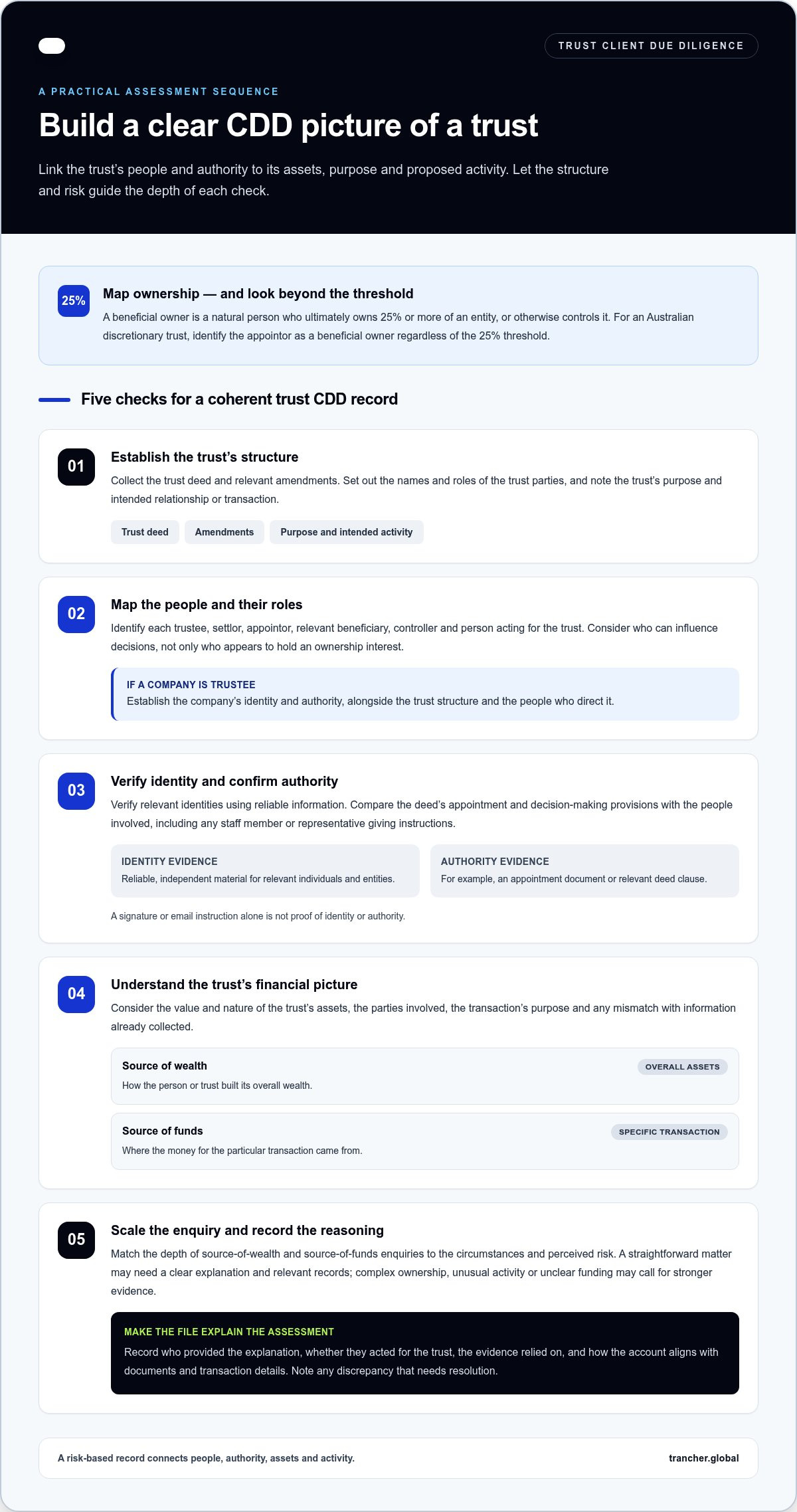
A discretionary family trust isn’t a single-name CDD file. Effective client due diligence for trusts means identifying the relevant people, understanding who controls the arrangement and assessing the trust’s assets and risk; for an Australian discretionary trust, the appointor is treated as a beneficial owner regardless of the 25% threshold. The checks should reflect the trust’s structure and the work being undertaken.
Client due diligence for trusts can be challenging when it is not clear who has authority, who may benefit and how those roles connect, particularly in a family trust with several decision-makers. A risk-based approach helps create a CDD record that explains who was considered, what was established and why.
This article explains how to assess trustees, settlors, appointors, beneficiaries and other controllers; confirm authority; consider source of wealth and higher-risk indicators; and maintain useful records. It also shows how to organise the process so reviews stay consistent as the relationship or trust’s circumstances change.
Key Takeaways
- Map each trust role, including trustees, settlors, appointors, beneficiaries and anyone who controls the arrangement. For a discretionary trust, the appointor is a beneficial owner regardless of the 25% threshold.
- Establish who is authorised to act for the trust and keep a clear record of the authority relied on.
- Match source-of-wealth and source-of-funds enquiries to the trust’s circumstances and risk; a nominal amount used to establish a trust doesn’t explain where significant later assets came from.
- Apply enhanced checks when risk is high, including for politically exposed persons; trust ownership alone doesn’t automatically require enhanced due diligence.
- Record your reasoning, supporting evidence and review dates. Keep initial CDD records for 7 years after the business relationship ends or 7 years after the last occasional transaction.
Identifying people acting for a customer and confirming their authority
For Australian legal practices providing a designated service, CDD includes identifying and verifying clients, applicable beneficial owners and people acting for clients. For a trust, this means linking the customer’s identity to its decision-makers and confirming who is authorised to act.
Collect the trust deed and relevant amendments, the names and roles of trust parties, and documents showing an authorised person’s authority. Record the trust’s purpose and intended relationship or transaction, then verify relevant identities and authority.
Identifying Trust Customers and Beneficial Owners
A beneficial owner is a natural person who ultimately owns 25% or more of an entity or otherwise controls it. For a company customer, identify the people behind its corporate structure, rather than stopping at the company’s registered details.
Control may exist without direct ownership. Holding more than half the voting rights is one way a person may control an Australian customer entity. For a discretionary trust, identify the appointor as a beneficial owner regardless of the 25% threshold. This mapping helps show who can influence decisions and where further identity checks may be needed.
Identifying Trustees, Controllers and Trust Officers
Identify each trustee and anyone who controls the trust or acts for it. If a company is the trustee, establish the company’s identity and authority alongside the trust’s structure and the people who direct it.
Compare the deed’s appointment and decision-making provisions with the people involved in the engagement. If a staff member or representative gives instructions, establish their identity and authority. Record the evidence relied on, such as an appointment document or relevant deed clause, so the file explains why that person could act.
Initial Identity Checks and KYC Information
Initial KYC checks establish who the customer and relevant individuals are, then verify their identities using reliable information. Australian initial CDD requirements are set out in sections 28 and 136-141 of the Act; collecting and verifying KYC information refers to sections 28 and 41 of the Act and section 6-10 of the Rules.
For an individual trustee, collect identifying information and verify it against reliable, independent material. For a company acting as trustee, establish the entity’s identity and identify relevant beneficial owners and representatives. Link the information to the trust matter, rather than treating a signature or email instruction as proof of identity or authority.
Trust Documents and Identification Details
Trust identification documents should show the arrangement, the parties’ roles and the authority behind instructions. Start with the trust deed and amendments, then compare the details with the names of trustees, settlors, beneficiaries and controllers relevant to the CDD assessment.
For a corporate trustee, include information establishing the company’s identity and who is authorised to act. Add appointment or authority records where they clarify a person’s role. Record the trust’s purpose and intended business relationship or transaction, along with any discrepancy requiring resolution. This creates a coherent account of the customer, its structure and its representatives.
Do I need to conduct source of wealth checks on every client?
No. Australian legal practices don’t need detailed source-of-wealth evidence from every client. The depth of enquiry should increase with perceived risk. For a trust, distinguish its overall wealth from the funds involved in a specific transaction.
Source of Wealth and Source of Funds
Source of wealth explains how a person or trust built its overall assets, while source of funds explains where the money for a particular transaction came from. The distinction matters because a plausible payment route does not, on its own, explain the trust’s broader financial position.
For example, a trust may pay from a bank account, but that account alone does not show how substantial assets were accumulated. Assess both questions in context: who generated the wealth, and how did the money for this transaction reach the trust?
Source of Wealth and Funds Enquiries
These enquiries help establish whether the trust’s financial profile makes sense given its structure, relationship and proposed activity. Consider the value and nature of its assets, the parties involved, the transaction’s purpose and any mismatch with information already collected.
Scale the enquiry to risk. A straightforward matter may need a clear explanation and relevant records, while complex ownership, unusual activity or unclear funding may call for stronger evidence. This approach directs attention to money laundering concerns without treating every client as equally risky.
Ask the trustee or authorised officer to explain the origin of significant trust assets and the funds for the matter. Record who provided the explanation, whether they acted for the trust, and how the account aligns with documents and transaction details.
Source of Funds Checks and Proof
A source-of-funds check traces the money used for a specific transaction; proof of funds supports that explanation with evidence. For a property purchase, for instance, the relevant question is where the purchase money came from, not just which account will transfer it.
Request evidence proportionate to the circumstances, then compare it with the stated source. Bank records may show how funds moved, while sale or investment documents may help explain their origin. The evidence should connect the money to the trust and transaction, rather than merely show that a balance exists.
A nominal sum such as A$20 used to establish a trust doesn’t, by itself, establish the source of wealth for significant assets settled later. If a trust deed records a small initial settlement but the trust now holds substantial property, assess evidence explaining how those later assets were acquired.
Document the rationale for the checks, the evidence reviewed and any unresolved inconsistencies. A client verification and due diligence workflow can help organise KYC/CDD information alongside risk-based enquiries, keeping the review focused on the trust and transaction.
Enhanced checks for higher-risk clients and PEPs
Apply customer due diligence in proportion to the assessed money laundering and terrorism financing risk. A high-risk trust relationship calls for enhanced scrutiny, while low-risk customers may qualify for simplified checks.
For discretionary, unit and foreign trusts, assess the actual structure, control, customer and matter rather than assuming one check applies to every trust type. For a discretionary trust, identify the appointor as a beneficial owner regardless of the 25% threshold; for other arrangements, map the relevant controllers and parties.
Australian trust CDD sits within initial customer due diligence requirements in sections 28 and 136-141 of the Act, alongside the Rules. Relevant provisions include sections 28(2) and 111 of the Act and Rules sections 6-21 and 6-23.
Failing to conduct appropriate CDD can expose a business to compliance, financial and reputational risks, and make its decisions harder to explain. The specific penalty depends on the applicable law and circumstances, so a single penalty figure should not be treated as universal.
Risk-Based Due Diligence for Trust Clients
Risk-based due diligence means tailoring the depth of checks to the trust customer’s assessed risk. This matters because complex structures, unclear control or a higher-risk transaction can require closer examination than a straightforward, low-risk relationship.
Enhanced customer due diligence must be applied when money laundering risk is high, including when a person is a politically exposed person (PEP). Assess the PEP connection alongside the trust’s roles, control and transaction, then record why the checks address the identified risk.
Simplified customer due diligence may be used only where the customer’s money laundering and terrorism financing risk is low and enhanced due diligence isn’t required. It still requires customer identification, but not identity verification. Base a low-risk rating on an assessment, not an assumption drawn solely from a familiar family relationship.
Risk Assessment, Nature and Purpose
Assessing risk alongside a trust’s nature and purpose means comparing its structure and intended activity with the customer information collected. This helps determine whether the transaction fits the relationship or calls for closer scrutiny.
Consider who controls the trust, who may benefit, how the arrangement operates and what the transaction is intended to achieve. A company owned by a trust does not, by itself, require enhanced due diligence on either the company or trust. Base the decision on the assessed risk, not trust ownership alone.
Revisit the assessment when a material change affects the customer, control or transaction profile. Record the factors considered, why standard, simplified or enhanced checks were selected, and the evidence supporting that choice. This gives the CDD file a clear rationale rather than a bare risk label.
Trustees, settlors, beneficiaries and beneficial owners
Identify and verify each relevant person by their role, authority and connection to the trust. For a discretionary trust, include the appointor as a beneficial owner regardless of the 25% threshold.
Beneficial Ownership and Control in Complex Structures
Beneficial ownership identifies the natural people who ultimately own or control an entity or trust arrangement. This matters because a chain of corporate owners can obscure who influences decisions or benefits from assets.
Trace each ownership layer until you reach the individuals behind it. For example, if a company acts as trustee and another company owns it, document both entities and identify the people who ultimately control them. Consider voting rights, appointment powers and other practical influence, not just formal share ownership.
In a discretionary trust, map the appointor’s powers alongside trustee decision-making. The appointor is a beneficial owner regardless of the 25% threshold. This helps explain who can change trustees or influence the trust’s direction, even where no individual has a fixed entitlement.
Identifying Trust Roles and Controlling Persons
Build a role-by-role record of trustees, settlors, appointors and anyone else able to control the trust. This matters because the person giving instructions may not be the trustee or ultimate controller.
Use the trust deed and amendments to establish who holds each role, then compare those details with appointment records and instructions. Verify each relevant person’s identity and retain evidence of their authority. For a corporate trustee, identify the company and the individuals authorised to act for it.
Record the settlor’s role in establishing the arrangement, the trustee’s decision-making responsibilities and any protector or other controller’s powers. If a family member gives instructions, distinguish their involvement from formal authority. A clear record explains whose identity was verified and why that person was included in the assessment.
CDD for Trust Beneficiaries
Beneficiary checks establish who may receive trust benefits and how their interests are defined. This matters because a named beneficiary and someone in a broad class of beneficiaries may call for different identification steps.
For a fixed trust with fewer than 10 beneficiaries, record each beneficiary’s name and date of birth. For a discretionary trust, document the beneficiary class and identify individuals where their role, entitlement or risk makes them relevant to the assessment. Link the information to the deed or other records defining the class.
For a foreign foundation, distinguish its structure from an Australian trust. Jersey foundation due diligence covers beneficiaries entitled under its charter or regulations, and certain other people who may benefit at the council’s discretion when identified as higher risk. Keep that distinction clear in the file, especially where a foundation or overseas arrangement forms part of a wider corporate structure.
Trust CDD workflow and record keeping
A useful trust CDD workflow links identity, authority, purpose and risk in one evidence trail. Review and update the file when new information or activity changes the trust’s risk profile.
There’s no single review interval for every trust relationship; set reviews according to risk and reassess when relevant circumstances change. Practical costs depend on the trust’s complexity, available evidence, verification work and review needs. Any service price depends on the case and is provided after a quote request.
Reviewing and Updating Trust Customer Due Diligence
Reviewing CDD means refreshing the customer record when a change could affect the trust’s identity, control, risk or expected activity. This matters because a file that was accurate at onboarding can become outdated as trustees, beneficiaries or transaction patterns change.
Set a review date that reflects the assessed risk, then bring the review forward if a trustee changes, new control information emerges or a transaction differs from its expected purpose. Compare new information with the existing record and document what changed, the supporting evidence and whether further checks are needed.
For ongoing CDD, monitor the relationship and transaction activity against the stated purpose. If the information no longer fits, reassess the risk and update the customer record. Keep initial CDD records for 7 years after the business relationship ends or 7 years after the last occasional transaction.
Practical Steps and Costs of Trust Due Diligence
A practical workflow links each check to a file record, keeping the reasoning clear during review or audit. Begin by identifying the customer using a reliable, independent source and assessing the purpose and intended nature of the relationship or transaction.
Then record the trust’s relevant parties, the authority of anyone acting, the risk assessment and supporting evidence. Document source-of-funds enquiries where relevant, and explain why standard or enhanced CDD was selected. If a trust or company is assessed as not requiring CDD, record the next review date, reviewer’s reasoning and supporting evidence.
Next, compare activity with the expected relationship. Document unusual transactions or behaviours of the kind specified in section 30(5), and follow the applicable reporting process where required. Keep records organised so another reviewer can follow the decision from customer identification through to the outcome.
The effort and cost of a review depend on factors such as ownership complexity, gaps in documents, risk level and the nature of the transaction. A straightforward trust with a clear deed may need less investigation than a layered structure with several controllers and unexplained activity. Factor these differences into workload planning rather than applying the same process to every file.
Strengthen your trust CDD process with audit-ready CDD records and workflows that keep evidence and review decisions together.
Trancher: End-to-End AML/CTF Program Management
Trancher helps Australian businesses manage AML/CTF obligations through end-to-end program management. For trust relationships, its client verification and due diligence capabilities support KYC/CDD and screening, while ongoing risk monitoring helps track changes in client activity.
When a trust’s structure or transaction raises concerns, Trancher’s regulatory and suspicious matter reporting support contributes to the wider compliance process. These features help coordinate verification, monitoring and reporting alongside your organisation’s own assessment and oversight.
If you’re looking to strengthen trust CDD workflows, visit trancher.global to learn more.
Make trust CDD part of a resilient process
Trust structures can change as people take on new roles, circumstances shift and relationships develop. Treating client due diligence for trusts as an ongoing process helps your team keep its approach aligned with the trust’s current profile, rather than relying on an onboarding snapshot.
A practical next step is to review how your current process moves from initial checks to later decisions. Consider whether staff can follow the reasoning behind an assessment, identify when a change warrants attention and maintain a consistent record. Trancher’s End-to-End AML/CTF Program Management supports this wider compliance approach, alongside client verification, due diligence and ongoing risk monitoring.
Build a process your team can use with confidence, while keeping appropriate oversight and judgement in place. Contact Trancher about trust CDD to explore how its support may fit your compliance workflows.
Frequently Asked Questions
What about CDD on a discretionary (family) trust?
Assess the trust’s structure and identify who can influence its decisions, including the appointor. For example, a family member may receive discretionary benefits without directing the trust, while another person may hold appointment powers. Keep those roles distinct in your assessment. The family connection alone does not explain the trust’s control, intended activity or risk, so consider the arrangement and the work involved together.
So what happens when a company is owned by a Trust?
Identify the company customer and trace its ownership and control through the trust to the relevant individuals. A trust owning company shares does not, by itself, mean enhanced due diligence is required for either entity. For example, consider the trust’s role as shareholder, the people who control it and the company’s purpose in your engagement. Base the risk decision on those circumstances, not the ownership link alone.
Trust roles and who needs to be ID verified?
Identify the trust parties relevant to the customer relationship, then determine whose identity and authority need verification. This may include trustees, people authorised to give instructions and individuals who ultimately control the arrangement. For example, if a corporate trustee’s employee manages the engagement, distinguish the company’s role from the employee’s authority to act. Record why each person is included in the checks, rather than treating every named party as having the same role.
What do I need to do about existing clients?
For Australian legal practitioners, the transition rule covers clients as at 1 July 2026. Initial CDD must be completed for an existing client if a suspicious matter report is required, or a significant change raises the relationship’s money laundering, terrorism financing or proliferation financing risk to medium or high. For example, reassess an established trust relationship when new information materially changes its risk profile. Document the trigger and the resulting CDD decision.
What is Client Due Diligence?
Client due diligence is the process of establishing who the customer is, understanding the intended relationship or transaction, and assessing relevant risk. For example, an Australian professional handling a designated service may need to identify and verify a customer and consider applicable beneficial owners or representatives. CDD is more than an identity check: it connects customer information to the purpose of the work and informs the ongoing relationship.
What does client due diligence for trusts mean in Australia?
In Australia, client due diligence for trusts means assessing the trust as a customer arrangement and identifying the people relevant to its ownership, control and authority. The exact checks depend on the designated service and the trust’s circumstances. For example, a firm receiving instructions from a trustee should understand the trust relationship and whether that person can act. CDD records should explain the assessment and the evidence behind the decision.
What beneficial ownership and control information must be established for a trust?
Establish which natural people ultimately own or control relevant entities, and how the trust’s roles and powers operate. For an Australian customer entity, the beneficial ownership threshold is 25% or more ownership, or control by other means. For example, a person may exercise control through voting rights or powers set out in trust documents. Map any corporate layers so the file identifies individuals, not only the entities between them.
What enhanced due diligence is required for high-risk trusts, politically exposed persons or overseas connections?
Apply enhanced customer due diligence when money laundering risk is high, including when a person is a politically exposed person. The checks should address the risks identified in the customer and matter, with the reasoning recorded. Consider an overseas connection in context rather than treating it as an automatic trigger. For example, assess how it relates to the trust’s structure, activity and intended transaction.