
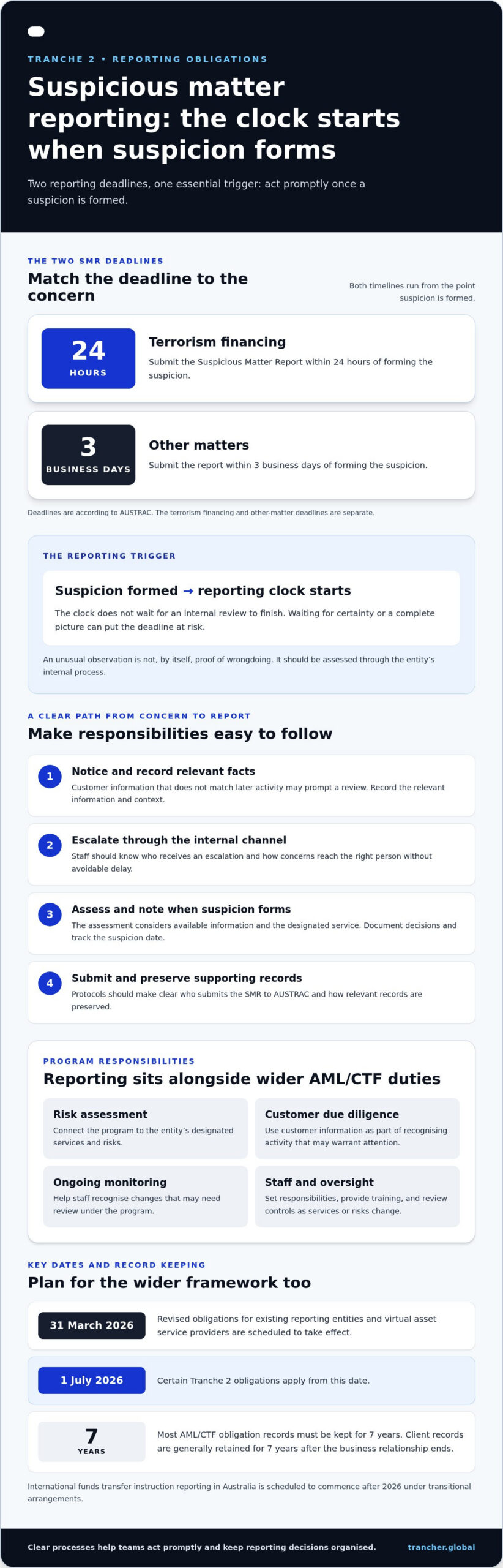
Tranche 2 extends Australia’s anti-money laundering and counter-terrorism financing (AML/CTF) framework to newly covered businesses and professions. For certain Tranche 2 entities, obligations apply from 1 July 2026. The reporting obligations under Tranche 2 include submitting a Suspicious Matter Report within 24 hours of forming a suspicion about terrorism financing, or within 3 business days for other matters, according to AUSTRAC.
These deadlines are important, but they are only one part of the picture. Businesses also need an AML/CTF program and clear internal protocols so staff can recognise concerns, escalate them and support accurate reporting.
This guide explains what Tranche 2 means, when a Suspicious Matter Report is required and how reporting timelines fit alongside risk assessment, customer due diligence, record keeping and program responsibilities. With the key obligations set out plainly, you can see how the requirements connect and what your business needs to prepare for.
Key Takeaways
- Understand which businesses and professional services may fall within Tranche 2, and why the designated service matters.
- Learn how Suspicious Matter Reports fit into reporting protocols, including the deadline for matters other than terrorism financing.
- See how an AML/CTF program connects risk assessment, customer due diligence and staff escalation procedures.
- Recognise when a threshold transaction report is required and how reporting duties sit alongside other compliance obligations.
- Identify practical ways to organise monitoring, reporting and program management so your processes are ready to operate together.
Suspicious Matter Reports
A Suspicious Matter Report (SMR) alerts AUSTRAC to activity that raises a suspicion of money laundering, terrorism financing or another relevant offence. For a reporting entity, the reporting clock starts when suspicion is formed, not when an internal review is complete. That makes a clear escalation process essential for staff providing designated services.
AUSTRAC requires a suspicious matter report for matters other than terrorism financing to be submitted within 3 business days of forming the suspicion. For a suspicion relating to terrorism financing, the deadline is 24 hours. These are separate deadlines, so staff need to identify which concern has arisen and escalate it promptly. Waiting for certainty or a complete picture can put the reporting timeline at risk.
A useful program makes the path from observation to decision clear. For example, a staff member may notice that a client’s instructions appear inconsistent with the stated purpose of a transaction. That observation alone is not a conclusion about wrongdoing. Staff should follow the entity’s internal reporting process so the concern can be assessed and the suspicion date recorded.
Practical protocols should identify who receives an internal escalation, who assesses the information and who submits the SMR to AUSTRAC. They should also explain how to preserve relevant records and document decisions. A consistent process helps distinguish an initial concern from the point at which suspicion is formed, which matters because the statutory deadline runs from that point.
Customer due diligence and ongoing activity monitoring can help staff recognise changes that warrant attention. For instance, a mismatch between customer information on file and later activity can prompt a review under the entity’s program. Staff should record relevant facts, escalate them through the established channel and avoid treating an unusual transaction as automatic proof of money laundering. The assessment should consider the available information and the context of the designated service.
Relevant roles across the business need to understand reporting protocols, not just the person who submits reports. Staff who interact with customers may first encounter concerning activity, while compliance personnel may coordinate assessment and reporting. Training and clear instructions help ensure concerns reach the right person without avoidable delay. Review the process when services, risks or responsibilities change, so the program remains aligned with actual operations.
For Tranche 2 entities, SMR readiness is therefore both a reporting duty and an operational discipline. Define escalation responsibilities, train staff to recognise and report concerns, and maintain a process for tracking the suspicion date and deadline. Those steps help an entity act promptly while keeping its reporting decisions and records organised.
AML/CTF program and reporting protocols
Australia’s AML/CTF framework combines a risk-based program with reporting and record-keeping duties. For Tranche 2 businesses, the key task is connecting those duties to the designated services they provide.
Tranche 2 reporting obligations
Tranche 2 reporting obligations are AML/CTF duties that apply to newly covered businesses when they provide designated services. Australia’s Anti-Money Laundering and Counter-Terrorism Financing Act 2006 is the basis for reporting entity obligations, according to the Federal Register of Legislation. This matters because each entity needs processes that reflect its services, customers and money laundering and terrorism financing risks, rather than relying on general procedures alone.
A working program links risk assessment to customer due diligence, ongoing monitoring, reporting and record-keeping. For example, a real estate business should map its designated services, assess relevant risks and explain how staff escalate unusual activity. The program also needs clear responsibilities, including senior management approval, governing body oversight and a process to review controls as services or risks change.
Differences from existing AML/CTF obligations
Tranche 2 extends the AML/CTF framework to newly covered sectors, while existing reporting entities and virtual asset service providers have their own revised obligations. The distinction matters because a business newly entering the regulated regime must build reporting arrangements around its designated services, while established entities must adapt existing systems. Changes for current reporting entities and virtual asset service providers are scheduled to take effect on 31 March 2026; certain Tranche 2 obligations apply from 1 July 2026.
These dates make implementation planning important. A newly covered service provider can identify who assesses customer information, who approves internal procedures and how transaction reports are prepared. Existing entities can compare revised requirements with current processes and update any gaps, without assuming every sector has identical risks or controls.
International funds transfer instruction reporting in Australia is scheduled to commence after 2026 under transitional arrangements. Tranche 2 businesses should account for that timing in their reporting protocols, while keeping international transfer instructions distinguishable from other transaction activity.
Tranche 2 entities must retain records supporting AML/CTF obligations, including program and customer due diligence records. Most AML/CTF obligation records must be kept for 7 years, and client records are generally retained for seven years after the business relationship ends. A practical records process should connect each file to the relevant customer, service and compliance decision, making it easier to retrieve evidence when needed.
AUSTRAC’s annual compliance report adds another reporting task: entities report on their AML/CTF compliance during the previous year. A reporting calendar can coordinate that annual submission with transaction reporting, program reviews and record management. Assigning responsibility, keeping records current and documenting decisions helps reporting entities apply consistent controls across their operations.
Which businesses and professions are covered by Tranche 2 AML/CTF obligations?
Coverage depends on the designated service a business provides, not simply its professional label. In Australia, the professional services table relevant to lawyers is Table 6 in subsection 6(5B) of the AML/CTF Act. Legal practices should therefore assess the specific work they perform and whether it falls within a listed service.
A legal practice may fall within the regime even if it provides a designated service only once, infrequently or without a separate fee, when that service is connected with carrying on a business. The practical test is the activity and its connection to the business. Do not dismiss occasional work solely because it is rare or included in another engagement.
For a law firm, the assessment starts with mapping services to Table 6. Identify what the practice does for clients, what transactions or arrangements that work advances, and which staff perform it. A firm offering several service types should assess them separately. This makes it easier to distinguish potentially covered activity from work that does not meet the designated-service criteria.
The Act also contains specific boundaries. For real estate transactions, leases of 30 years or less are generally listed as not designated services. For Table 6 item 2, sales of shares and minor interests of less than 25% are generally listed as not designated services. Other carve-outs apply to Table 6 item 3 under subsections 5C and 5D, and to item 7 under subsection 5E.
Legal dispute resolution also needs careful classification. AUSTRAC guidance indicates that it will generally fall outside Table 6 where it does not directly advance a relevant transaction or concerns matters that have already occurred. For example, work resolving a past dispute may differ from work that facilitates a transaction still being arranged. The distinction turns on the service’s purpose and connection to the transaction.
In-house legal teams should assess their organisational position as well as their work. Section 11 of the AML/CTF Act is relevant to determining control when considering whether an in-house team sits outside a firm. Map the team’s structure, reporting lines and relationship with the wider business, then assess the designated services performed. This avoids treating every legal department as automatically covered or automatically excluded.
A practical coverage review can begin with a service register. Record each service, the relevant Table 6 item, the transaction or arrangement it may advance, and any applicable carve-out. Then document why the activity is included or excluded and revisit that assessment when the practice changes its services. This gives Australian legal businesses a clearer basis for deciding whether Tranche 2 obligations apply to their work.
What AML/CTF reporting obligations apply to Tranche 2 entities?
Tranche 2 entities may need to submit suspicious matter, threshold transaction and international funds transfer reports to AUSTRAC. Certain obligations apply from 1 July 2026, so businesses should map their reporting obligations under Tranche 2 to the designated services they provide. Planning the process early helps staff understand which information to capture and who is responsible for each reporting task.
AUSTRAC requires reporting entities to submit a threshold transaction report for any transaction involving physical currency of A$10,000 or more. The report must be submitted within 10 business days after the transaction day. Businesses can prepare by identifying where physical currency may be received, recording transaction details and assigning responsibility for lodging reports within the required timeframe.
International funds transfer instructions create a separate reporting consideration. Australian reporting entities may need to submit an international funds transfer report for instructions to transfer funds into or out of Australia. For Tranche 2 businesses, this reporting is scheduled to commence after 2026 under transitional arrangements. Include relevant instructions in process design so staff can distinguish them from other transaction activity.
Tranche 2 entities must also submit an annual compliance report to AUSTRAC about their AML/CTF compliance in the previous year. This requires an organised record of how the program operated, how risks were managed and how reporting processes were followed. Assigning an owner and maintaining a reporting calendar can make the annual submission easier to prepare and review.
Each report serves a different purpose. A suspicious matter report communicates a formed suspicion; a threshold transaction report concerns physical currency at or above the reporting threshold; and an international funds transfer report relates to specified transfer instructions. Keeping these categories distinct helps staff route information correctly. For example, assess a cash transaction and an international transfer instruction under their respective reporting processes, rather than treating them as one generic report.
A practical workflow links each designated service to the transactions it can generate, the information staff must capture and the person responsible for review. Record submission dates and retain supporting material with the relevant customer and transaction records. These steps help a reporting entity identify missed tasks, respond consistently and maintain an evidence trail for its compliance program.
For covered businesses, reporting obligations under Tranche 2 need to become part of routine operations, not a separate last-minute exercise. Use a reporting calendar, clear responsibility assignments and regular reviews of reporting records. These controls help the business keep its procedures aligned with the services it provides and manage its reporting duties as they apply.
What suspicious matter reporting rules and deadlines apply under Tranche 2?
Tranche 2 reporting entities must be ready to recognise suspicious transactions or interactions connected with their designated services. The reporting decision centres on when a suspicion is formed, so an internal escalation process should make that point visible and recordable.
For suspected terrorism financing, a suspicious matter report must be submitted to AUSTRAC within 24 hours of forming the suspicion. For other matters, AUSTRAC requires submission within 3 business days of forming the suspicion. The different deadlines make accurate triage essential: staff need a clear route to identify the concern, escalate it and start tracking the applicable reporting timeframe.
Suspicion can arise from a transaction, a customer interaction or information gathered during due diligence and ongoing monitoring. For example, a client’s instructions may conflict with the previously stated purpose, or activity may differ from the customer profile on file. These indicators call for assessment under the entity’s program. An unusual pattern alone is not proof of wrongdoing; context and available information matter.
A practical workflow sets out who receives an internal concern, who assesses it and who submits the report. It should capture when the concern arose, when suspicion was formed, what information supported the decision and when the report was lodged. A dated record helps the entity manage the relevant deadline and explain its handling of the matter later.
Staff need to know how to raise concerns without waiting for a complete investigation. For instance, a frontline employee who notices inconsistent transaction activity should know the designated escalation channel and which facts to record. The compliance role can then assess the available details, document the decision and coordinate any report to AUSTRAC. Clear responsibilities reduce avoidable hand-offs.
Confidential handling is also important. Changes to Australia’s tipping-off offence commenced on 31 March 2025, so internal procedures should guide staff on how to handle report-related information appropriately. Keep access to records controlled and make sure staff use approved communication channels. The process should support timely reporting while protecting sensitive information.
Review the workflow against each designated service and the activity it generates. Check whether staff can identify the right escalation contact, capture the suspicion date and distinguish terrorism-financing concerns from other matters. A short scenario exercise can reveal gaps, such as uncertainty about who owns the report or how decisions are recorded. Update procedures when responsibilities or services change.
Strengthen your process with structured suspicious matter reporting support that helps connect monitoring, assessment and reporting steps.
Trancher: End-to-End AML/CTF Program Management
Trancher helps Australian businesses bring AML/CTF program management and reporting processes into a coordinated workflow. Its end-to-end program management can support businesses preparing to apply their obligations across designated services, customer due diligence and ongoing monitoring.
When client checks and activity reviews need to connect with reporting, Trancher brings together client verification, screening, risk monitoring, activity tracking and regulatory reporting. The platform also includes role-based training modules and expert on-call support, helping firms organise key compliance activities and manage suspicious-matter reporting.
Consider Trancher when you’re translating AML/CTF requirements into day-to-day processes, or bringing verification, monitoring and reporting into a more connected approach. Contact Trancher to discuss your AML/CTF program management needs.
Make compliance part of the way you work
Strong AML/CTF readiness is built into everyday decisions, not left until a reporting deadline approaches. Use your next planning review to map who owns each compliance decision, how information moves between teams and where staff can find current procedures. A clear operating model helps turn the reporting obligations under Tranche 2 into defined responsibilities rather than disconnected tasks.
Trancher can help accounting firms organise and connect their compliance activities. Identify where current workflows create friction, such as handovers between customer checks, activity reviews and reporting, then consider what would make those steps easier to manage. A conversation with Trancher can clarify how its compliance solution, including role-based training and expert on-call support, fits your firm’s operational needs.
Build a process your team can understand, follow and maintain as your services evolve. Discuss your obligations with Trancher and explore a clear next step for your AML/CTF operations.
Frequently Asked Questions
What is Tranche 2 of the AML/CTF reform?
Tranche 2 extends Australia’s anti-money laundering and counter-terrorism financing regime to additional businesses and professional services. It brings certain activities into the reporting-entity framework, meaning a business may have obligations because of the designated services it provides. For example, a professional practice should assess its actual client work and transactions, rather than assume its industry label alone determines coverage.
What happens if a law firm or accounting practice does not comply with AML Tranche 2?
Non-compliance can expose a business to regulatory enforcement and penalties. The consequences depend on the breach and the circumstances, so a single penalty figure should not be treated as applying to every firm. AUSTRAC has previously imposed penalties exceeding A$1 billion against major financial institutions for AML/CTF failures. That history illustrates the seriousness of compliance failures, but it is not a prediction of an individual firm’s outcome.
What is Tranche 2 AML/CTF reform in Australia?
It is Australia’s expansion of the AML/CTF regime to additional sectors and services, including relevant legal, accounting and real estate work. The reform focuses on designated services: businesses assess what they do and whether that activity falls within the framework. A firm offering several types of work should consider each service separately, since coverage depends on the activity involved rather than simply the firm’s name or professional category.
When do Australia’s Tranche 2 obligations commence?
Certain Tranche 2 AML/CTF obligations apply from 1 July 2026. Enrolment and service commencement are separate considerations, and businesses should check the requirements that apply to their services. A business preparing its calendar should track both dates and identify when each obligation applies to its services, rather than treating registration and operational compliance as one event.
When must Tranche 2 entities report threshold transactions to AUSTRAC?
AUSTRAC requires reporting entities to submit a threshold transaction report for a transaction involving physical currency of A$10,000 or more. The report is due within 10 business days after the transaction day. For example, a business receiving qualifying physical cash should capture the transaction date and supporting details promptly, so the reporting task can be assigned and tracked within the required timeframe.
How do Tranche 2 businesses enrol with AUSTRAC and submit reports?
Businesses should first identify the designated services they provide, then complete the relevant AUSTRAC enrolment and reporting steps for those activities. Entities providing new designated services may need to complete enrolment. Keep responsibility for enrolment and report preparation assigned, retain supporting records, and update enrolment details within 14 days when they change. This helps keep business information and reporting processes aligned.
What penalties apply for failing to meet Tranche 2 reporting obligations?
Failure to meet AML/CTF reporting duties can lead to regulatory enforcement and penalties. Consequences depend on the circumstances and the nature of the failure; past penalties against major financial institutions do not establish a standard amount for law firms or accounting practices. A practical response is to document reporting decisions, maintain evidence and address process gaps promptly, rather than waiting for an obligation to be missed again.