

What if meeting AUSTRAC requirements wasn’t a non-billable drain on your balance sheet, but your platform’s strongest commercial asset? Implementing robust AML for digital currency exchanges has often felt like a high-friction battle against dense regulatory jargon, particularly when serious non-compliance carries maximum civil penalties of up to $36.4 million for corporations. If staying ahead of these shifting supervisory expectations feels like an exhausting administrative burden that pulls focus from genuine product innovation, you certainly aren’t alone.
The good news is that regulatory readiness doesn’t have to disrupt your momentum or drain internal resources. This 2026 guide provides a clear, reassuring roadmap to help you establish a defensible AML/CTF programme while embedding efficient, automated workflows directly into your client onboarding and monitoring processes. Ahead, we explore what Australia’s transition to the Virtual Asset Service Provider (VASP) model means for your daily designated services, demystify the strict zero-dollar Travel Rule threshold, and outline the practical steps needed to protect your exchange and scale with confidence.
Key Takeaways
- Understand how Australia’s shift to the Virtual Asset Service Provider (VASP) model expands designated services to cover crypto-to-crypto trades, transfers, and safekeeping.
- Discover how to build an audit-ready programme that simplifies AML for digital currency exchanges without overwhelming your day-to-day operations.
- Master key operational obligations, including custodial requirements and the strict zero-dollar threshold enforced under Australia’s Travel Rule.
- Follow a structured, five-step implementation roadmap covering everything from AUSTRAC enrolment to comprehensive business risk assessments.
- Learn how to transform routine due diligence into a professional, value-adding client service supported by automated workflows and clear ROI tracking.
Understanding AML for Digital Currency Exchanges in 2026
Australia’s regulatory framework has shifted dramatically. While the exchange of digital currency for physical money has been subject to AUSTRAC oversight since 2018, the Anti-Money Laundering and Counter-Terrorism Financing Amendment Act 2024 has fundamentally broadened the playing field. For platforms managing digital assets, foundational knowledge of financial crime controls is essential, and understanding money laundering risks helps contextualise why domestic watchdogs have raised the bar. Today, effective AML for digital currency exchanges is no longer just a technical checklist; it is a core operational requirement that underpins market trust and business longevity.
The Evolving Regulatory Landscape in Australia
The 1 July 2026 Tranche 2 commencement marks a definitive alignment with the Financial Action Task Force (FATF) Recommendation 15. Rather than relying on narrow definitions of “digital currency,” the law now embraces the comprehensive “virtual asset” terminology. AUSTRAC expects small and medium enterprises to demonstrate genuine operational readiness from day one. Early preparation prevents the chaotic operational rush that often leads to procedural oversights, system downtime, and regulatory scrutiny. By treating these updates as structural enhancements rather than bureaucratic speedbumps, your platform builds a resilient foundation for long-term growth.
Who is Classified as a Digital Currency Exchange?
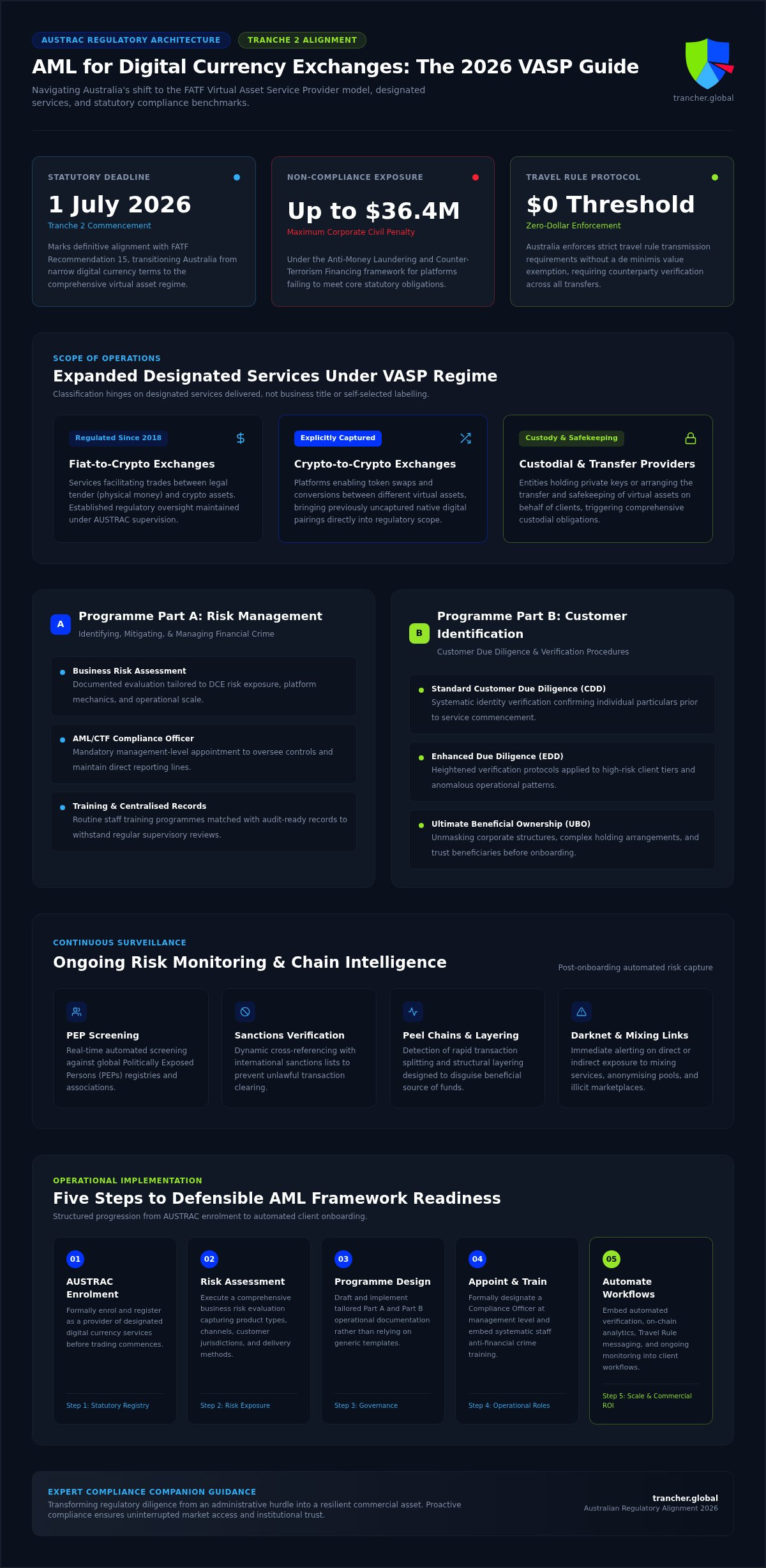
Under the updated regime, classification hinges on the specific designated services you provide rather than your self-selected business title. You must understand where your platform sits under the expanded Virtual Asset Service Provider (VASP) umbrella:
- Fiat-to-Crypto Exchanges: Services facilitating trades between legal tender and crypto assets, which have been captured since earlier reforms.
- Crypto-to-Crypto Exchanges: Platforms enabling token-swaps or conversions between different virtual assets, now explicitly regulated.
- Custodial and Transfer Providers: Businesses holding private keys or arranging the transfer and safekeeping of virtual assets on behalf of clients.
If your firm delivers any of these capabilities, you are providing a designated service under Australian law. Mastering AML for digital currency exchanges ensures your business meets AUSTRAC standards calmly, turning rigorous compliance into a dependable commercial edge.
Essential Pillars of a DCE AML/CTF Programme
A compliant operation rests on a documented AML/CTF programme designed around your platform’s specific risk exposure. Rather than relying on generic templates, AUSTRAC expects a framework split into two distinct components: Part A, which focuses on identifying, mitigating, and managing financial crime risks, and Part B, which details your customer identification procedures. You must appoint a designated AML/CTF Compliance Officer at management level to oversee these controls. Backing this appointment with routine staff training and centralised, audit-ready record keeping creates a defensible posture that protects your business during regular supervisory reviews.
KYC and Customer Due Diligence (CDD)
Identity verification forms the frontline of risk mitigation. Establishing who your customers are before delivering services prevents illicit funds from entering your ecosystem. Standard verification confirms basic individual details, but higher-risk profiles demand Enhanced Due Diligence (EDD). For corporate accounts, your processes must unmask the ultimate beneficial ownership behind intricate holding structures or trust arrangements. Aligning your internal verification workflows with established CDD and KYC requirements Australia ensures client onboarding remains seamless while fully satisfying statutory benchmarks.
Ongoing Risk Monitoring and Reporting
Verification is not a one-off task. Effective AML for digital currency exchanges requires continuous transaction monitoring to capture suspicious anomalies after onboarding. This involves real-time screening against global Politically Exposed Persons (PEPs) lists and sanctions registers, combined with tools to detect high-risk on-chain activity. Key indicators mirror established global intelligence, such as patterns highlighted in FinCEN’s advisory on CVCs regarding rapid layering, peel chains, and links to darknet markets or mixing services.
When unexpected activity cannot be explained, statutory reporting obligations take over:
- Suspicious Matter Reports (SMRs): You must submit an SMR to AUSTRAC within three business days of forming a suspicion, or within 24 hours if the matter links to terrorism financing.
- Threshold Transaction Reports (TTRs): Any transaction involving $10,000 or more in physical cash, such as through over-the-counter desks or physical kiosks, must be reported within 10 business days.
- Record Retention: Maintain complete, audit-ready records of all due diligence findings, transaction histories, and reporting determinations for a minimum of seven years.
If managing manual compliance checks is beginning to slow down your team’s core output, exploring automated end-to-end AML/CTF program management can streamline screening and keep your operations fully audit-ready without draining internal capacity.
Navigating New Designated Services and Virtual Asset Rules
The scope of regulated digital asset activity has expanded significantly. Australian legislation now captures five distinct virtual asset designated services, aligning the domestic regime with global financial standards. These services include exchange between virtual assets and fiat, exchange between one or more forms of virtual assets, safekeeping or administration of virtual assets (custodial wallet provision), transfers of virtual assets on behalf of customers, and participation in or provision of financial services related to an issuer’s offer or sale of a virtual asset (such as token issuances or initial offerings).
One of the most consequential additions is Australia’s implementation of the Travel Rule. Unlike jurisdictions with higher reporting floors, Australia operates a zero-dollar threshold. This means payer and payee details must accompany every single digital asset transfer, regardless of value. Navigating AML for digital currency exchanges under this requirement demands technical capability to extract, package, and securely transmit counterparty identity data between VASPs in real time.
Crypto-to-Crypto Exchanges and Transfers
Swapping Bitcoin for Ethereum or shifting stablecoins across chains is no longer outside the regulatory net. Crypto-to-crypto activity represents a primary channel for potential layering, making transaction tracking vital. To satisfy AUSTRAC, platforms must maintain verifiable records of both the originating and terminating wallet addresses. Practical management involves screening unhosted counterparty wallets before executing transfers, evaluating risk scores, and establishing clear controls to determine when a cross-chain swap requires further transactional inquiry.
Sanctions and Ransomware Obligations
Digital currency platforms face strict obligations under the Australian Autonomous Sanctions Act. Sanctions breaches operate under strict liability, meaning lack of intent is no defence. Facilitating a transfer to a designated entity, or inadvertently processing a ransomware settlement demanded by cyber extortionists, carries severe penalties. Operators must integrate sanctions screening directly into their transaction architecture to flag blocked individuals, prohibited entities, and sanctioned regions automatically before any asset release occurs.
Developing seamless protocols for these complex checkpoints turns AML for digital currency exchanges into a core operational strength. When your screening workflows are integrated and fully responsive, your platform handles high-velocity trading with complete regulatory assurance.
Five Steps to Implementing Your AML Framework
Establishing compliance does not require months of confusion or endless legal consultations. By approaching AML for digital currency exchanges through a structured, step-by-step model, your platform can move systematically from regulatory uncertainty to full operational readiness.
- Step 1: Enrolment and Registration: Formally register your entity on the AUSTRAC Business Portal before launching or expanding any virtual asset designated services.
- Step 2: Business Risk Assessment (BRA): Identify the specific financial crime risks inherent to your products, customer types, delivery methods, and jurisdictional reach.
- Step 3: Document Part A and Part B Programmes: Establish clear governance, employee due diligence, and tailored verification methods that match your actual daily risks.
- Step 4: Automate KYC and Screening: Integrate automated identity verification and screening workflows to eliminate onboarding friction and human error.
- Step 5: Schedule Regular Independent Reviews: Set fixed review cadences to test your systems, update policies, and maintain audit-ready records.
The AUSTRAC Enrolment Process
AUSTRAC demands precise corporate information, including ownership structures and details regarding your designated compliance officer. Missing documentation or inaccurate submissions cause lengthy delays and can expose unregistered operators to daily accruing non-enrolment fines of $18,780. Following a dedicated AUSTRAC enrolment checklist ensures your business collates every required credential correctly the first time, keeping your launch timeline on schedule.
Achieving Compliance Readiness in 30 Days
Operational readiness is fundamentally different from simply storing a static legal binder on a shelf. A defensible framework lives within your software stack, replacing brittle spreadsheets with automated workflows that verify users and track suspicious triggers instantly. Platforms need reliable systems that scale alongside trading volumes rather than adding administrative headcount.
As your expert compliance companion, Trancher delivers local Australian support led by Aaron Soh to take the complexity out of implementation. You can secure guaranteed AML/CTF compliance within 30 days and protect your bottom line. To experience seamless integration firsthand, activate your complimentary 3-month trial today.
Beyond Administration: Making Compliance Profitable
Most operators treat regulatory mandates as an unavoidable overhead that silently eats away at operating margins. That perspective misses a significant commercial opportunity. When managed through modern, structured systems, AML for digital currency exchanges evolves from an administrative burden into a premium trust signal. Clients increasingly seek platforms that guarantee financial integrity, robust asset protection, and zero exposure to bad actors. Reframing your controls as a core component of your value proposition lets you safeguard your business while turning essential processes into recoverable, value-adding activities.
Transforming Compliance into a Billable Asset
Verifying corporate accounts, conducting source-of-wealth investigations, and screening complex counterparty structures consume legitimate professional resources. Transparent frameworks for explaining compliance fees enable platforms to bill for specialised onboarding, premium compliance reporting, and custom corporate onboarding reviews. By monitoring the exact time spent on enhanced due diligence and client verifications, Trancher’s platform captures recoverable activity automatically, turning compliance workflows into an accountable driver of firm revenue.
The Trancher Advantage for Digital Currency SMEs
Navigating supervisory scrutiny does not need to drain your capital or stall operational growth. Trancher provides the strategic infrastructure needed to operationalise AML for digital currency exchanges cleanly and sustainably:
- Guaranteed 30-Day Compliance: Secure a fully documented, audit-ready framework tailored to your specific designated services within 30 days.
- Integrated Revenue and ROI Tracking: Monitor team efficiency, identify billable onboarding tasks, and convert compliance costs into measurable financial returns.
- Accessible Local Leadership: Access ongoing guidance and hands-on onboarding support led by Aaron Soh and our dedicated Australian team.
- Complimentary 3-Month Trial: Experience automated client due diligence, sanctions screening, and programme governance risk-free across your business.
Positioning your business for sustained growth requires moving past reactive paperwork. By adopting structured automation and transparent cost recovery, your exchange meets regulatory expectations with confidence while building a stronger, more profitable enterprise.
Turning Regulatory Readiness into Your Platform’s Strategic Edge
Operating under Australia’s expanded framework doesn’t have to stall your platform’s commercial momentum. Mastering AML for digital currency exchanges simply requires the right operational architecture: clear governance across new designated services, automated onboarding to handle the zero-dollar Travel Rule threshold, and transparent cost-recovery mechanisms that protect your bottom line. Handled effectively, rigorous compliance shifts from an administrative hurdle into your exchange’s most compelling trust signal.
You don’t need to navigate this journey alone. With our 30-day compliance readiness guarantee, a complimentary 3-month trial for Australian firms, and expert guidance led by Aaron Soh, your exchange can achieve complete operational readiness without disruption. Discover how Trancher transforms AML compliance into a profitable professional service, and give your business the clarity, protection, and confidence it needs to thrive.
Frequently Asked Questions
Does my digital currency exchange need to register with AUSTRAC?
Yes. Any business providing designated services in Australia, including exchanging fiat for crypto or facilitating crypto-to-crypto trades, must enrol and register with AUSTRAC before operating. Providing designated services without active enrolment is illegal and exposes operators to severe civil penalties. Registration ensures your exchange operates lawfully, establishes baseline governance, and demonstrates verified operational legitimacy to banking partners and institutional counterparties across Australia.
What is the deadline for Tranche 2 AML compliance in Australia?
Tranche 2 AML/CTF obligations officially commenced on 1 July 2026. This legislative update expanded the Anti-Money Laundering framework to cover professional services and broadened virtual asset designated services. While existing fiat exchanges have faced oversight since 2018, platforms offering expanded services like token transfers, custodial safekeeping, or crypto swaps must ensure their AML/CTF programmes meet full operational compliance immediately to prevent regulatory enforcement.
How much does it cost to implement an AML programme for a DCE?
Implementation costs vary based on transaction volume, operational complexity, and whether you build internally, hire external advisers, or deploy compliance software. Bespoke consultancy can quickly become expensive, whereas automated platforms significantly lower overheads by packaging screening, reporting, and governance into predictable subscriptions. Trancher removes upfront barriers by offering a complimentary 3-month trial, allowing Australian firms to establish their programme and evaluate efficiency before committing capital.
Can I use a manual system for my AML/CTF record keeping?
While manual record keeping via spreadsheets is technically permissible, it creates substantial operational risk for digital currency exchanges. AUSTRAC mandates retaining customer due diligence records, risk evaluations, and transaction histories for seven years. High transaction speeds and real-time counterparty checks make manual logging prone to human error and audit failures. Automated workflows ensure secure, audit-ready digital archives that instantly verify compliance during supervisory reviews.
What are the penalties for non-compliance with AUSTRAC rules?
Non-compliance carries severe legal and commercial consequences. Commonwealth civil penalties can reach up to $36.4 million per contravention for corporations and $7.28 million for individuals. Operating an exchange without enrolling with AUSTRAC can incur daily accruing penalties of $18,780. Beyond financial fines, AUSTRAC can issue enforceable undertakings, mandate independent audits, or cancel your registration entirely, effectively closing down your platform.
What is the “Travel Rule” for digital currency exchanges in Australia?
Australia’s Travel Rule requires Virtual Asset Service Providers to collect, verify, and transmit payer and payee information during digital asset transfers. Australia enforces a strict zero-dollar threshold, meaning every crypto transfer between institutions must carry counterparty details regardless of transaction size. Managing AML for digital currency exchanges requires technical protocols that share this customer information securely and instantly between sender and receiver platforms.
How does Trancher help my firm become AUSTRAC-ready in 30 days?
Trancher simplifies regulatory readiness by replacing fragmented administration with an end-to-end management platform. Led by compliance specialist Aaron Soh, our team provides structured Part A and Part B templates, automated KYC verification, real-time sanctions screening, and ongoing activity monitoring. We back this implementation with a 30-day compliance guarantee and local Australian guidance, helping your exchange launch a defensible, audit-ready programme without operational delays.
Is there an AUSTRAC enrolment checklist for new virtual asset providers?
Yes, AUSTRAC requires specific corporate documentation before accepting enrolments. Key checklist items include your Australian Business Number (ABN), company constitution, details of key management personnel, and your designated AML/CTF Compliance Officer’s credentials. You must also supply a completed Business Risk Assessment detailing your money laundering risk exposure. Using a structured checklist ensures you submit an accurate application and avoid avoidable processing bottlenecks.