

What if the 1 July 2026 Tranche 2 deadline wasn’t a source of administrative stress, but actually the catalyst for your most efficient service line yet? It’s natural to feel concerned about the complexity of AUSTRAC requirements or the potential for penalties if your documentation falls short. You likely already feel the weight of compliance overhead, viewing these obligations as a hurdle to your daily operations. We understand that for many Australian SMEs, the shift toward stricter regulation feels like an invitation for more non-billable hours and confusing jargon. Implementing a robust AML risk assessment tool Australia firms can trust is the first step in reclaiming that lost time.
In this guide, we’ll help you master an AUSTRAC-aligned methodology that turns compliance into a streamlined, professional service. You’ll discover how to move away from manual spreadsheets and toward defensible, automated workflows that protect your business and provide peace of mind. We’ll walk through the 2026 methodology and provide the templates you need to ensure your programme is audit-ready and operationally seamless within 30 days.
Key Takeaways
- Master the AUSTRAC-aligned four-step methodology to identify, assess, control, and monitor risks before the July 2026 Tranche 2 commencement.
- Distinguish between Business Risk Assessments (BRA) for your firm and individual Customer Risk Assessments (CRA) to meet all regulatory obligations.
- Leverage a specialised AML risk assessment tool Australia firms use to convert time-consuming administrative tasks into a recoverable, high-value professional service.
- Recognise the latest 2026 red flags and high-risk indicators to protect your practice from penalties while navigating complex “Tipping Off” regulations.
- Move beyond static spreadsheets to an automated workflow that ensures your compliance programme is defensible, audit-ready, and fully operational within 30 days.
Understanding the AML/CTF Risk Assessment Framework in Australia
Think of your AML/CTF risk assessment as the brain of your entire compliance programme. It’s the central intelligence that informs your due diligence, monitoring, and reporting activities. Without this core assessment, your firm is essentially operating in the dark. While it’s tempting to search for a quick-fix template, a document on its own is insufficient. A template is merely a shell; it requires a robust, underlying methodology to be effective. Relying on a static file without understanding the “why” behind the risks leaves your firm vulnerable to gaps in oversight.
The ultimate goal of this exercise is to create a defensible compliance programme. This means having a clear, documented rationale for every decision you make regarding risk. When you use a sophisticated AML risk assessment tool Australia professional services trust, you’re not just ticking a box. You’re building a system that can withstand an AUSTRAC audit and prove you’ve taken all reasonable steps to protect the Australian financial system. With our 30-day compliance guarantee, we ensure your firm transitions from confusion to confidence well before the deadline.
The Legal Basis: AUSTRAC and the AML/CTF Act 2006
AUSTRAC serves as Australia’s dedicated regulator and financial intelligence unit. Their mandate is clear: they ensure businesses providing designated services have the systems in place to identify, mitigate, and manage money laundering and terrorism financing (ML/TF) risks. Under the AML/CTF Act 2006, this is a mandatory requirement for all reporting entities. Failing to meet these standards isn’t just an administrative oversight. It can lead to severe consequences, including multi-million dollar court-imposed financial penalties and intense regulatory scrutiny that can damage your firm’s standing for years.
The 2026 Regulatory Shift: Why Tranche 2 Changes Everything
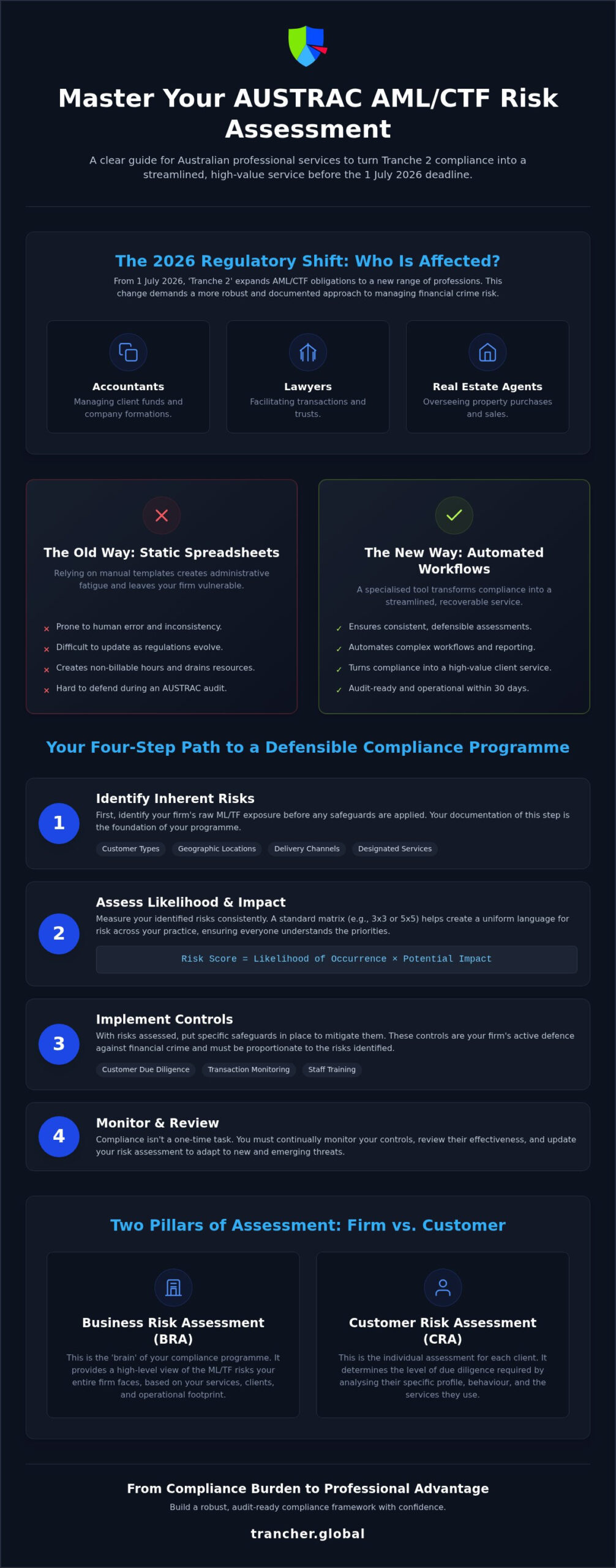
For many years, these strict requirements primarily applied to banks and casinos. However, the 1 July 2026 deadline marks a significant shift for the professional services sector. Tranche 2 is the expansion of AML obligations to non-financial professionals. This includes accountants, lawyers, and real estate agents who provide designated services such as managing client funds, assisting with company formations, or facilitating the purchase of property.
Manual risk assessments become unmanageable at scale for SMEs as client lists grow and regulations evolve. Trying to track these variables in a spreadsheet is a recipe for error and administrative fatigue. By integrating a dedicated AML risk assessment tool Australia firms can automate these complex workflows. This ensures you’re ready for the 2026 commencement without drowning in paperwork, turning a regulatory burden into a streamlined professional service.
A Step-by-Step AML CTF Risk Assessment Methodology
To build a robust compliance framework, you must first understand the concept of inherent risk. This represents the raw threat of money laundering your firm faces before any safeguards are put in place. It’s the baseline of your entire assessment. While every firm is different, the standard methodology follows a repeatable four-step cycle: Identify, Assess, Control, and Monitor. This process shouldn’t be a generic exercise. It must be tailored to your specific firm size and the exact nature of the services you provide. Remember, in the eyes of an AUSTRAC auditor, documentation is everything. If your logic isn’t recorded, your compliance programme essentially doesn’t exist.
Step 1: Identify Your Inherent Risk Factors
First, identify where your firm is most exposed. Categorise your risks by customer type, delivery channel, and geography. For instance, a local individual client presents a different profile than a complex foreign trust. You should also analyse the specific designated services your firm provides, as some carry higher exposure than others. Integrating AUSTRAC’s own risk products and industry-specific indicators into your logic ensures your assessment reflects the latest regulatory priorities. Using a sophisticated AML risk assessment tool Australia firms trust can help automate this categorisation and keep your data organised.
Step 2: The Likelihood and Impact Matrix
Once risks are identified, you need a way to measure them consistently. Risk is calculated by multiplying the likelihood of an event occurring by the impact that event would have on your firm and the broader community. Most successful SMEs adopt a consistent 3×3 or 5×5 matrix to rate these factors. This creates a uniform language for risk across your entire practice. For your methodology to withstand a formal AUSTRAC audit, every rating must be backed by a documented rationale that explains why a particular score was assigned.
Step 3: Documenting Controls and Residual Risk
The final phase involves applying controls to lower your risk profile. These are your practical safeguards, such as Know Your Customer (KYC) procedures, suspicious matter reporting, and regular staff training. After these controls are applied, you’re left with your residual risk. This is the actual level of risk your firm is willing to accept after mitigation. It’s critical to maintain Audit-Ready Compliance Records to show how your controls effectively mitigate the inherent threats you identified. Our platform ensures these links are clear, defensible, and always updated, allowing you to focus on your clients while the system handles the heavy lifting.
Business vs Customer Risk Assessments: Why You Need Both
Understanding the distinction between a Business Risk Assessment (BRA) and a Customer Risk Assessment (CRA) is vital for any SME seeking AUSTRAC compliance. These aren’t just two separate documents to file away. They function as a symbiotic system. While the BRA evaluates the vulnerabilities of your firm as a whole entity, the CRA is a per-client regulatory obligation that applies your firm’s logic to individual relationships. Your BRA effectively sets the “rules of engagement,” informing the specific settings and risk thresholds you’ll apply within your CRA process. Without both, your compliance programme lacks the necessary depth to satisfy a regulatory review.
Using a dedicated AML risk assessment tool Australia professionals rely on ensures these two assessments remain linked. This integration allows your firm-wide risk appetite to flow naturally into every individual client onboarding. It also facilitates the ongoing monitoring required throughout the risk lifecycle. Compliance isn’t a “set and forget” task. It’s a continuous process of ensuring that your firm’s overall risk profile and your clients’ specific activities remain within safe, documented boundaries.
The Business Risk Assessment (BRA) Methodology
Your BRA methodology should focus on organisational vulnerabilities that could be exploited by criminals. This includes internal factors like staff turnover or the inherent risks of remote service delivery, which has become a standard operational model for many Australian SMEs. You must review your BRA at least annually or whenever your business undergoes a significant operational change, such as offering a new designated service or expanding your geographic reach. For 2026, AUSTRAC requires all programmes to include Proliferation Financing as a mandatory consideration. This involves assessing the risk of your services being used to support the manufacture or acquisition of chemical, biological, or nuclear weapons.
The Individual Customer Risk Assessment (CRA)
The CRA is where your methodology meets reality. Every time you take on a new client, you must identify high-risk indicators such as Politically Exposed Person (PEP) status, links to high-risk jurisdictions, or overly complex corporate structures that seem designed to hide beneficial ownership. Your methodology must establish clear triggers for Enhanced Due Diligence (EDD). When a client hits a certain risk threshold, your system should automatically prompt for deeper investigation. To ensure your team follows these steps correctly, it’s helpful to refer to established CDD and KYC Requirements Australia guidelines. Our platform automates these triggers, ensuring that high-risk clients are managed safely and consistently without adding to your manual workload.
Identifying Red Flags and High-Risk Indicators for 2026
Spotting red flags isn’t just about looking for obvious criminal activity. In the professional services sector, it’s about identifying subtle deviations from standard commercial logic. As 2026 approaches, AUSTRAC expects firms to move beyond a “gut feeling” and toward a data-driven approach. This is where an AML risk assessment tool Australia practitioners trust becomes invaluable. It provides the structured logic needed to flag anomalies that might otherwise slip through a manual review, ensuring your firm remains a step ahead of potential threats.
When your assessment leads to a genuine suspicion of money laundering or terrorism financing, you have a legal obligation to file a Suspicious Matter Report (SMR). However, you must handle these situations with extreme care to avoid the “Tipping Off” offence. This occurs if you inadvertently alert a client that they are under regulatory scrutiny or that a report has been filed. Managing high-risk clients safely requires a steady hand and a clear understanding of your reporting duties. We’re here to help you navigate these complexities with confidence, ensuring your firm meets its obligations while maintaining professional discretion.
Customer Red Flags: Beyond the Basics
The first line of defence is knowing exactly who you’re dealing with. Watch for clients who are unusually evasive about beneficial ownership or who provide complex corporate structures that don’t seem to have a clear commercial purpose. Another common indicator is a structuring pattern, where a client attempts to keep transactions just under the A$10,000 reporting threshold to avoid detection. To manage this at scale, your system should screen for Politically Exposed Persons (PEPs) and sanctioned entities in real-time. This ensures that even as your client list grows, your oversight remains rigorous and accurate.
Service and Transactional Red Flags
Transactions themselves often tell a story that goes deeper than the initial client onboarding. You should flag any movements involving high-risk jurisdictions or known tax havens, as these carry an inherently higher threat level. Be particularly wary of “U-turn” transactions, where funds are moved quickly through your firm’s accounts with no clear legal or commercial reason. In these cases, you’ll need to verify both the Source of Funds (SoF) for the specific transaction and the broader Source of Wealth (SoW) of the client. Understanding how a client accumulated their total net worth is a critical part of a defensible risk methodology. Automate your red flag screening today to ensure your firm remains audit-ready without the manual stress of traditional spreadsheets.
Beyond Static Templates: Automating Your Risk Methodology
While many firms begin their journey with Word or PDF templates, these static documents often become an administrative liability. Manual processes are prone to version control issues and simple human error, which can lead to significant gaps in your oversight. Relying on a spreadsheet might seem cost-effective initially, but the long-term cost of manual data entry and “template rot” is substantial. Integrating a sophisticated AML risk assessment tool Australia firms trust allows you to move beyond these limitations. It replaces fragmented paperwork with a centralised, intelligent system that grows with your practice.
Our approach at Trancher is to turn compliance from a non-billable burden into a streamlined, recoverable professional service. We understand the pressure of the 1 July 2026 deadline, which is why we guarantee your firm will be compliance-ready within 30 days. This isn’t just about avoiding AUSTRAC penalties. It’s about refining your internal systems to be more efficient and profitable. By automating the heavy lifting, you free your team to focus on high-value client work while ensuring your regulatory foundations remain unshakable.
From Spreadsheets to Streamlined Workflows
The risk of human error in manual templates cannot be overstated. A single missed field or an outdated risk rating can compromise your entire programme during an audit. Automation ensures every client is risk-rated consistently every time, following your firm’s specific logic without deviation. This consistency is the hallmark of a defensible programme. Beyond risk mitigation, our platform helps you capture the value of your compliance efforts. By using Compliance ROI Tracking Software, you can identify exactly which hours are spent on these essential tasks. This allows you to treat compliance as a billable asset rather than a sunk cost.
The Trancher Advantage: Compliance as a Service
We act as your expert compliance companion, providing the steady guidance needed to navigate changing landscapes. To support Australian accounting firms through this transition, we offer a 3-month complimentary trial of our platform. This allows you to experience the benefits of automated workflows and local expert support without an immediate financial commitment. For early adopters who continue after the trial period, we also provide a 20% discount on ongoing services. Readiness for the 1 July 2026 commencement starts with a proactive decision. Reach out to us today to secure your firm’s future and transform your compliance obligations into a strategic business advantage.
Securing Your Firm’s Future for 2026 and Beyond
The 1 July 2026 deadline represents more than just a regulatory shift; it’s an opportunity to modernise your firm’s internal operations. By moving away from static templates and adopting a robust AML risk assessment tool Australia practitioners trust, you ensure your practice remains both compliant and profitable. Throughout this guide, we’ve explored how a structured methodology and automated workflows transform administrative burdens into recoverable professional services. You now have the roadmap to distinguish between business and customer risks while identifying the red flags that matter most.
We’re here to act as your steady guide through this transition. With our 30-day compliance-ready guarantee and local Australian expert support, you can navigate the path to Tranche 2 readiness with absolute confidence. We’re also offering a 20% discount for early adopters to help you get started on the right foot.
Start your complimentary 3-month Trancher trial today and discover how seamless professional compliance can be. We look forward to supporting your firm’s growth and ensuring your systems are audit-ready well before the deadline.
Frequently Asked Questions
What is the difference between an AML risk assessment and an AML/CTF programme?
An AML risk assessment is the foundational logic that identifies your firm’s specific vulnerabilities. In contrast, an AML/CTF programme is the comprehensive set of written policies, procedures, and controls your firm implements to manage those risks. Think of the assessment as the diagnostic tool and the programme as the treatment plan. Your programme’s effectiveness depends entirely on the accuracy of your underlying risk assessment.
How often should I update my business-wide AML risk assessment?
You should review and update your business-wide risk assessment at least annually. However, you must also refresh it whenever your practice undergoes a significant change. This includes offering new designated services, expanding into new geographic regions, or adopting new delivery technologies. Keeping this document current ensures your controls remain aligned with your actual risk profile and satisfies AUSTRAC’s expectation for a dynamic compliance framework.
Do I need a separate risk assessment for every single client I onboard?
Yes, you must perform a Customer Risk Assessment (CRA) for every client you onboard. This process involves applying the methodology from your Business Risk Assessment to an individual’s specific profile. You’ll evaluate factors like their beneficial ownership, jurisdiction, and transaction patterns. Using a dedicated AML risk assessment tool Australia SMEs trust simplifies this by automating the rating process, ensuring consistency across your entire client list without increasing manual work.
What happens if AUSTRAC finds my risk assessment methodology is inadequate?
If AUSTRAC deems your methodology inadequate, your firm faces significant regulatory risks. The regulator may issue remedial directions, enforceable undertakings, or substantial financial penalties. Beyond the legal consequences, an inadequate assessment leaves your firm vulnerable to criminal exploitation. Having a defensible, documented logic is your best protection during an audit. It proves you’ve taken reasonable steps to identify and mitigate money laundering and terrorism financing threats.
Can I use a free AML risk assessment template for my accounting firm?
While free templates are available, they often lack the sophisticated logic required for a truly defensible programme. They don’t account for version control or provide the automated workflows needed to manage compliance at scale. Most importantly, static templates don’t help you transform administrative time into billable hours. Investing in a professional platform ensures your methodology is always current, audit-ready, and capable of generating a positive return on investment.
What are the specific Tranche 2 obligations for Australian practitioners in 2026?
From 1 July 2026, Tranche 2 entities like accounting and law firms must comply with full AML/CTF obligations. This includes implementing a formal compliance programme, conducting customer due diligence, and reporting suspicious matters to AUSTRAC. You’ll also need to perform regular risk assessments and provide staff training. These changes mean that services like company formation or managing client funds will now require rigorous regulatory oversight and documented risk management.
How do I document my methodology to satisfy an AUSTRAC auditor?
To satisfy an auditor, you must document the specific rationale behind every risk rating. It isn’t enough to simply label a client as “low risk”; you must explain why based on your established methodology. An AML risk assessment tool Australia firms use can automate this documentation, creating a clear audit trail. This ensures that every decision is backed by data and follows a consistent, firm-wide logic that is easily accessible during a regulatory review.
Is it possible to bill clients for the time spent on AML risk assessments?
Absolutely. Many innovative firms now treat compliance as a recoverable professional service rather than an administrative overhead. By accurately tracking the time spent on due diligence and risk assessments, you can justify these costs to your clients. Our platform includes specific features to help you identify these billable hours and track your ROI. This shift turns a regulatory requirement into a transparent, value-add service that supports your firm’s financial health.