

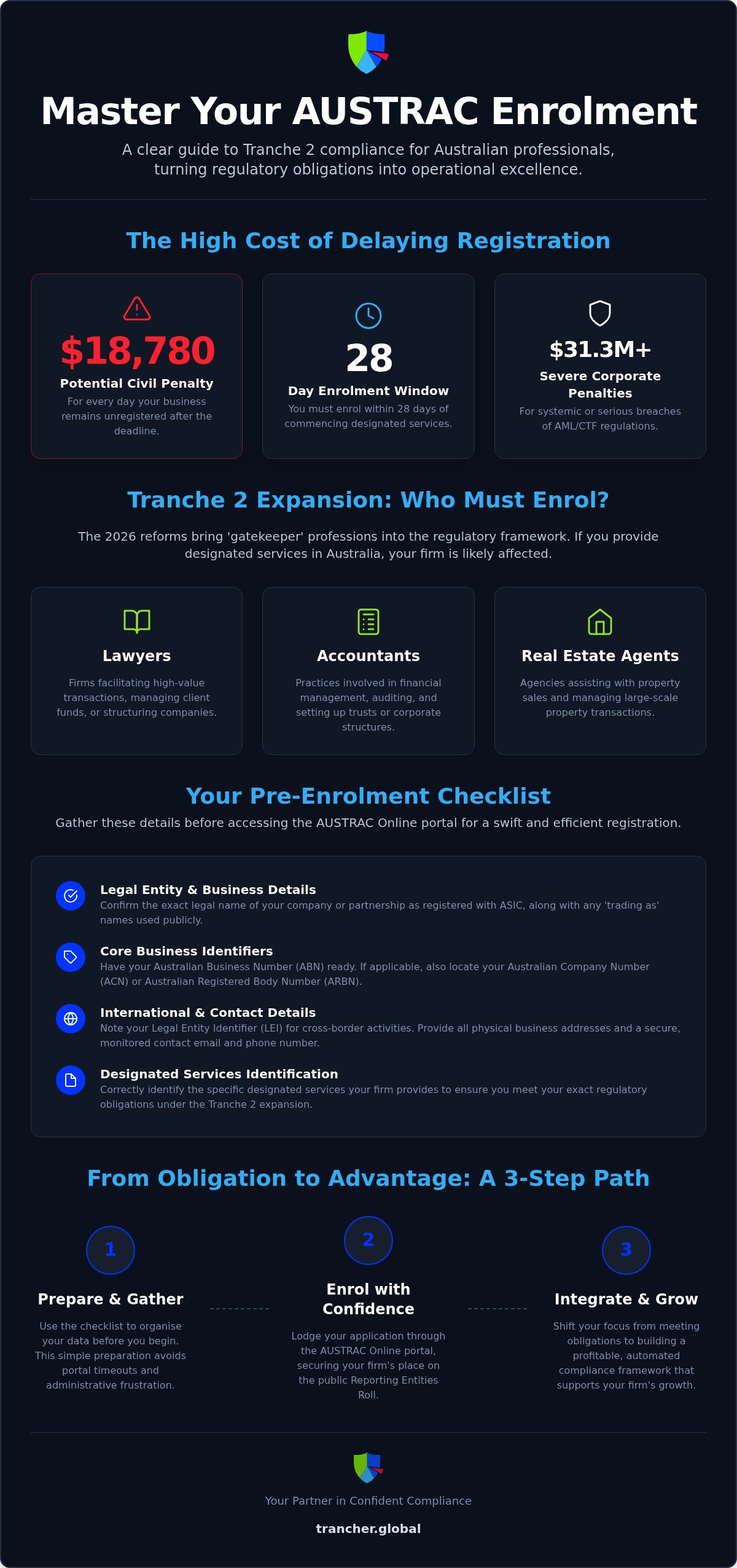
Did you know that failing to enrol with AUSTRAC can result in civil penalties of up to $18,780 for every day your business remains unregistered? For many Australian SMEs, the commencement of Tranche 2 obligations on 1 July 2026 felt less like a milestone and more like a mountain of paperwork. You’re likely feeling the pressure of complex regulatory jargon and the frustration of manual data entry taking you away from your core billable work. It’s a common struggle, but meeting your obligations doesn’t have to be a drain on your resources.
Our comprehensive AUSTRAC enrolment checklist is here to help you master the registration process and move your firm from a state of regulatory obligation to one of operational excellence. We’ll guide you through identifying your specific designated services and gathering the essential details required for the Reporting Entities Roll. By the end of this guide, you’ll have a clear roadmap to secure your enrolment, avoid heavy daily penalties, and start a 30-day path to full compliance that supports your firm’s financial health. We’re going to break down the technical requirements into manageable steps, ensuring your transition into the new AML/CTF landscape is both seamless and profitable.
Key Takeaways
- Understand why being listed on the Reporting Entities Roll is more than a requirement; it’s a public signal of your firm’s professional integrity and regulatory standing.
- Simplify your registration by using our AUSTRAC enrolment checklist to organise all legal entity and business structure data before you access the online portal.
- Correctly identify your specific designated services within the “Professional Services” category to ensure your firm meets its exact 2026 regulatory obligations.
- Navigate the AUSTRAC Online portal with confidence by following a methodical, step-by-step process for account creation and form lodgement.
- Shift your perspective from administrative burden to business growth by learning how to integrate compliance activities into a billable, automated workflow.
Understanding the AUSTRAC Enrolment Requirement for 2026
Enrolling with AUSTRAC is a mandatory registration process for any Australian business providing “designated services.” This isn’t a complex licensing scheme, but rather a foundational step that places your firm on the Reporting Entities Roll. Think of this roll as a public register that confirms your commitment to financial transparency and regulatory integrity. The Australian Transaction Reports and Analysis Centre (AUSTRAC) uses this list to identify which businesses are on the front line of combating financial crime.
The law is quite specific about timing. You must enrol with AUSTRAC within 28 days of starting to provide a designated service. For many SMEs, the critical date was 1 July 2026, which marked the commencement of the Tranche 2 expansion. If your firm provides services like managing client funds or restructuring companies, you’ve likely already triggered these requirements. Using a structured AUSTRAC enrolment checklist helps ensure you don’t overlook this 28-day window, allowing you to focus on your clients while we handle the regulatory heavy lifting.
Who Must Enrol: The Tranche 2 Expansion
The 2026 reforms significantly broadened the regulatory net to include “gatekeeper” professions that were previously exempt. This expansion primarily captures accountants, lawyers, and real estate agents who facilitate high-value transactions. If your business is carried on in Australia or through a permanent establishment here, you meet the “geographical link” requirement and must take action. In the context of the AML/CTF Act, a Reporting Entity is defined as any person or business providing at least one designated service with a geographical link to Australia. Whether you’re assisting with a property sale or setting up a new trust, these activities now mean your firm is a key partner in Australia’s financial security framework.
The Risks of Delaying Your AUSTRAC Registration
Delaying your registration isn’t just an administrative oversight; it carries tangible financial and reputational risks. AUSTRAC can seek court-imposed civil penalties for failing to enrol, which can reach up to $18,780 per day for a firm. For more serious or systemic breaches, corporate entities could face maximum penalties ranging from $31.3 million to $36.4 million. Beyond the numbers, non-compliance can damage your professional standing and may trigger mandatory, costly independent audits of your internal systems.
We see enrolment as a strategic advantage rather than a hurdle. By completing your AUSTRAC enrolment checklist early, you create a smoother transition to full operational readiness. This proactive approach allows you to integrate compliance into your existing workflows, turning what could be a stressful requirement into a predictable, billable part of your service delivery. It’s about moving from a reactive state to one of confident, solution-oriented growth.
Pre-Enrolment Checklist: Gathering Your Business Data
Success in the AUSTRAC Online portal depends entirely on the quality of your preparation. Attempting to navigate the registration process without a structured AUSTRAC enrolment checklist often leads to session timeouts and administrative frustration. By gathering your data upfront, you transform a potentially daunting task into a swift, efficient exercise. It’s about ensuring your firm is ready to hit the ground running from day one of your new obligations.
Your first step is to confirm your exact legal entity names. This includes the name of the company or partnership as registered with ASIC, as well as any “trading as” names your firm uses in the marketplace. You’ll need your Australian Business Number (ABN) and, where applicable, your Australian Company Number (ACN) or Australian Registered Body Number (ARBN). For firms with multi-partner structures, ensure you have the correct identifiers for each relevant entity within your group.
Core Business Identifiers
If your firm operates internationally or engages in cross-border transactions, check for your Legal Entity Identifier (LEI). While not mandatory for everyone, these GLEIF-accredited identifiers are increasingly relevant in the 2026 regulatory landscape. You must also provide all physical business addresses where you provide designated services. AUSTRAC requires a primary contact point, so designate a secure email address and phone number that are monitored regularly. Finally, list any professional associations your firm belongs to, such as your relevant accounting or legal industry bodies, as this adds a layer of verified context to your application.
Personnel and Beneficial Ownership Data
Identifying your primary AML/CTF Compliance Officer is a critical part of the process. This individual will manage the AUSTRAC Online account and act as the main point of contact for the regulator. Beyond the compliance officer, you must identify your “beneficial owners.” These are the individuals who ultimately own or exercise significant control over the business, typically through a 25% or greater interest. For each beneficial owner and key personnel member, prepare their full legal name, date of birth, and current residential address. If you’re dealing with complex trust or corporate structures, you can refer to our guide on how to document beneficial ownership to ensure your data is audit-ready.
Organising this information is the foundation of a robust compliance framework. If you’d like to simplify this data gathering and automate your ongoing requirements, exploring automated workflow integrations can help you stay ahead of the curve while maintaining your focus on client value.
Identifying Your Designated Services for Tranche 2
Selecting the correct activities from AUSTRAC’s pre-defined list is the most critical stage of your registration. Enrolment isn’t a generic “one-size-fits-all” process; it’s a precise mapping of your firm’s activities to the law. When you sit down with your AUSTRAC enrolment checklist, you must distinguish between traditional financial services and the newly regulated “Professional Services” category. This distinction ensures your compliance programme is proportionate to your actual service delivery.
Many Australian SMEs operate as “mixed” businesses, offering a diverse range of professional and financial advice. If your firm provides multiple types of designated services, you must select every relevant category in the portal. Tick all boxes that apply to your current operations. Failing to disclose a service line can lead to gaps in your risk assessment, while over-reporting can create unnecessary administrative work. It’s about finding the exact balance that reflects your business model.
Professional Services for Accountants and Lawyers
The Tranche 2 reforms focus heavily on services that can act as “gatekeepers” to the financial system. If your firm acts as a formation agent for legal entities or trusts, you’re providing a designated service. This includes the creation of companies, partnerships, or complex trust structures on behalf of clients. Similarly, providing a registered office or a business address for a client triggers a mandatory enrolment requirement. If you manage client funds, securities, or other assets as part of your practice, these activities are also captured. These specific triggers are the foundation of your AUSTRAC enrolment checklist and dictate your ongoing reporting obligations. Firms that regularly form and administer trusts or companies should also review the dedicated AML for trust and company service providers Australia guidance to ensure their compliance programme addresses the full scope of their designated services.
Real Estate and High-Value Asset Services
Real estate agents are now central to Australia’s AML/CTF framework due to the high-value nature of property transactions. Any agent involved in the buying or selling of real estate must enrol, as these transactions are frequently targeted for the placement of illicit funds. This requirement also extends to bullion dealers and those trading in precious metals or stones. These sectors face unique challenges in verifying the origins of wealth. To help you manage these specific risks, we recommend reviewing our source of funds guide for property-specific context. Identifying these services correctly ensures your firm remains a trusted partner in the fight against financial crime while protecting your professional reputation.
The Step-by-Step AUSTRAC Online Enrolment Process
Once you’ve ticked off every item on your AUSTRAC enrolment checklist, it’s time to enter the AUSTRAC Online portal. This digital gateway is where your firm’s data becomes a formal regulatory record. The process is logical and methodical, designed to ensure that every reporting entity is accurately categorised and easily reachable by the regulator. By following your AUSTRAC enrolment checklist during the data entry stage, you’ll find the portal experience much more intuitive and significantly faster.
Setting Up Your AUSTRAC Online Account
Your first task is establishing a user account. The person creating this account must undergo identity verification, typically involving standard documents like a passport or driver’s licence to confirm they have the authority to act for the business. We recommend using a secure, firm-wide email address for the primary contact rather than a personal one. This ensures that critical regulatory correspondence isn’t lost if an individual leaves the firm. Once the account is live, you should immediately add a deputy compliance officer to ensure your firm always has access to its compliance dashboard.
Completing and Submitting the Form
With your account active, select the “Enrol a New Business” option. Here, you’ll input the specific business identifiers and designated services identified in your earlier preparation. A helpful feature of the portal is the “save progress” function, which allows you to pause and return to the form for up to 14 days. This is particularly useful for complex firms that need to double-check specific beneficial ownership details or professional association numbers before finalising the lodgement. It’s a free process, but accuracy is paramount to avoid future administrative corrections.
Before the final submission, you’ll reach the declaration step. This is where you confirm that all information provided is true and correct. Take a moment to review every entry carefully. Once you click submit, your business is added to the Reporting Entities Roll. Shortly after, you’ll receive your unique AUSTRAC ID. This number is essential for all future correspondence and reporting, so keep it easily accessible within your firm’s permanent records. Receiving this ID confirms that you’ve successfully transitioned from a state of preparation to one of active compliance.
Completing this registration is the first milestone in your 30-day path to full compliance. To ensure your ongoing reporting is as efficient as your enrolment, you can automate your AUSTRAC workflow with Trancher and turn regulatory requirements into a seamless, billable part of your daily operations.
Beyond the Roll: Building a Profitable Compliance Framework
Completing your AUSTRAC enrolment checklist is a significant milestone, but it’s important to recognise it as the beginning of your journey rather than the finish line. Under the AML/CTF Act, being listed on the Reporting Entities Roll is just one part of your ongoing duties. You’re also required to design and implement a comprehensive AML/CTF programme tailored to your firm’s specific risk profile. While this might feel like an administrative burden, shifting your perspective to “compliance as a service” can turn these requirements into a strategic advantage.
Automation plays a vital role in this transition. By removing the friction from client onboarding and Know Your Customer (KYC) processes, you free up your team to focus on high-value advisory work. Trancher is designed to bridge the gap between registration and full operational readiness, providing a clear path to compliance that respects your firm’s time and resources. It’s about moving from a reactive state to one of confident, solution-oriented growth. For firms that also handle digital assets, automating transaction monitoring for crypto exchanges has become an equally pressing priority under the 2026 reforms.
Transforming Compliance into a Billable Asset
Many firms struggle to justify the time spent on regulatory checks. Trancher solves this by tracking “designated service activity” directly within your workflow, providing the data you need to support accurate client billing. This transparency helps you communicate value to your clients effectively. For practical advice on this, our article on AML cost recovery explains how to introduce compliance fees without damaging client relationships. Our platform’s ROI reporting features even help you identify new advisory revenue streams, ensuring that your investment in compliance delivers a measurable financial return.
The Trancher 30-Day Compliance Guarantee
We understand that the Tranche 2 transition feels urgent. That’s why we offer a 30-day compliance guarantee to ensure your firm is audit-ready within a month of starting with us. Our onboarding process is methodical and supportive, backed by Australian-based expert support to guide you through every nuance of the 2026 regulations. We act as your steady partner, ensuring you have the documentation and systems required to satisfy AUSTRAC’s expectations. If you’re ready to move beyond the AUSTRAC enrolment checklist and build a future-proof firm, we encourage you to start a conversation with us today and take advantage of our complimentary 3-month trial.
Securing Your Firm’s Regulatory Future
Mastering the AUSTRAC enrolment process is more than a simple box-ticking exercise; it’s a strategic step toward building a more resilient and efficient firm. By using a structured AUSTRAC enrolment checklist, you’ve gathered the essential business data and identified your designated services with precision. This foundation allows you to move beyond the initial registration and focus on what you do best: serving your clients with integrity. You’ve now transitioned from administrative preparation to active participation in Australia’s financial security framework.
We’re here to ensure that your transition into the Tranche 2 landscape is both profitable and stress-free. With our local Australian support and expert onboarding, you can navigate these complex changes with total confidence. Our platform’s ROI reports highlight billable compliance activity, proving that meeting your obligations can actually drive business value. It’s time to turn regulatory requirements into a seamless part of your daily operations.
Start your complimentary 3-month Trancher trial and get compliant in 30 days. Our AUSTRAC-aligned compliance guarantee ensures your firm is audit-ready without the usual friction. We look forward to acting as your steady partner in this new era of professional transparency.
Frequently Asked Questions
What is the deadline for AUSTRAC enrolment for Tranche 2 entities?
The final deadline for Tranche 2 entities providing designated services as of 1 July 2026 was 29 July 2026. This date falls exactly 28 days after the commencement of the new regulations. If you start providing a designated service after this date, you must enrol within 28 days of that commencement. Missing this window can lead to daily penalties, so it’s vital to check your registration status immediately.
How much does it cost to enrol with AUSTRAC?
Enrolment with AUSTRAC is free of charge. There are no application fees or ongoing subscription costs paid to the regulator for maintaining your position on the Reporting Entities Roll. While the registration itself doesn’t cost anything, firms often invest in automated systems to manage the ongoing compliance burden efficiently. Focusing your budget on effective workflow integration rather than administrative fees allows for a more sustainable and profitable compliance framework.
Do I need to enrol if I already have an AML/CTF programme in place?
Yes, you must enrol regardless of whether you have an existing AML/CTF programme. Enrolment is the formal process of notifying AUSTRAC that your business is a reporting entity, which is distinct from the internal policies you maintain. Even with robust manual checks in place, your firm isn’t legally compliant until it appears on the Reporting Entities Roll. Completing your AUSTRAC enrolment checklist ensures that this foundational registration step is handled correctly.
Can I enrol multiple businesses under one AUSTRAC Online account?
You can manage multiple business enrolments through a single AUSTRAC Online account. This feature is particularly useful for practitioners who oversee several distinct legal entities or partnerships that provide designated services. During the setup process, the primary user can link various ABNs to their profile, providing a centralised dashboard for regulatory reporting. This structure simplifies the administrative oversight required for complex firm groups while ensuring each entity remains individually compliant.
What happens if I make a mistake on my AUSTRAC enrolment form?
If you discover an error after submission, you can update your details through the AUSTRAC Online portal. It’s important to correct inaccuracies promptly, as your enrolment data must remain current and truthful under the AML/CTF Act. Common mistakes often involve business addresses or the list of designated services provided. Using a precise AUSTRAC enrolment checklist before lodgement reduces the likelihood of these errors, ensuring your firm’s public record is accurate from the start.
Is AUSTRAC enrolment the same as registration for remittance providers?
No, AUSTRAC enrolment and registration are two different requirements. Enrolment is a mandatory step for all reporting entities, including those in the Tranche 2 professional services sector. Registration is a more intensive process specifically required for high-risk businesses like remittance service providers and digital currency exchanges. Most accounting and legal firms only need to complete the enrolment process to satisfy their initial 2026 obligations under the expanded regulatory framework.
How often do I need to update my enrolment details with AUSTRAC?
You must update your enrolment details within 14 days of any significant change to your business information. This requirement covers changes to your legal name, trading name, business address, or the specific designated services you offer. Additionally, you should update the portal if there’s a change in your nominated AML/CTF Compliance Officer. Maintaining an up-to-date record ensures that you receive critical regulatory correspondence and avoid potential penalties for providing outdated information.
Who should be the primary contact person for our AUSTRAC account?
The primary contact should be your firm’s nominated AML/CTF Compliance Officer. This individual is responsible for overseeing the firm’s compliance with the Act and will receive all formal notices from AUSTRAC. It’s also wise to appoint a deputy contact to ensure continuity if the primary officer is unavailable. Choosing a senior staff member who understands your operational risks ensures that your firm can respond to regulatory enquiries with confidence and clarity.