

What if the July 2026 deadline wasn’t a threat to your firm’s productivity, but the catalyst for your next major revenue stream? With the Tranche 2 reforms bringing over 100,000 new entities under AUSTRAC’s supervision, it’s understandable to feel the weight of these administrative changes. You’re likely balancing the need for a robust AML risk management framework against the fear of significant penalties, which can reach A$33 million for corporations. It’s a major transition, and the uncertainty around what “risk-based” compliance looks like in a busy accounting practice is a common concern.
We’re here to show you that compliance doesn’t have to be a drain on your time. This guide provides a clear roadmap to designing a system that satisfies every regulatory requirement while integrating seamlessly with your existing workflows. You’ll discover how to transform mandatory obligations into professional, billable services that add genuine value to your client relationships. We’ll walk through the essential components of a compliant program, from automated identity checks to ongoing monitoring, ensuring your firm remains both protected and profitable as the new regime begins.
Key Takeaways
- Define your firm’s internal “rulebook” to meet the July 2026 deadline and effectively mitigate financial crime risks across all client engagements.
- Design a robust AML risk management framework that accurately evaluates complex entity types, such as family trusts, while identifying your practice’s specific designated services.
- Reduce administrative friction and audit anxiety by transitioning from manual spreadsheets to automated systems that ensure consistent, reliable compliance.
- Secure your practice with a five-step roadmap that establishes clear governance and prepares your team for AUSTRAC’s outcomes-based regulatory approach.
- Transform compliance costs into recoverable revenue by tracking billable activity and identifying high-value advisory opportunities during the risk assessment process.
What is an AML Risk Management Framework in the Tranche 2 Era?
Your AML risk management framework isn’t just a document gathering dust on a digital shelf. It’s the operational nervous system of your practice. Think of it as your internal rulebook that dictates how you identify, assess, and mitigate the threat of financial crime. While a generic policy might list rules, a tailored framework applies those rules to your specific clients, services, and delivery channels. In the context of global Anti-Money Laundering (AML) standards, AUSTRAC expects Australian accountants to move beyond “tick-and-flick” compliance toward an outcomes-based approach.
The July 2026 deadline marks a fundamental change for the profession. Previously, many accounting services sat outside the strict reporting regime. Now, providing “designated services” like assisting with real estate transactions or managing client money triggers full obligations. AUSTRAC acts as the primary regulator, monitoring how well firms implement their frameworks to prevent illicit funds from entering the Australian economy. This shift means your systems must be ready to withstand scrutiny from day one.
The Shift from Tranche 1 to Tranche 2
For years, financial institutions bore the brunt of regulatory scrutiny under Tranche 1. As of July 1, 2026, the spotlight has expanded to include “gatekeeper” professions. Accountants are now viewed as a critical line of defence because your expertise in entity structures and cash flow makes you uniquely positioned to spot red flags. A “set and forget” approach is no longer viable; if your framework doesn’t evolve with your client base, you risk facing the new penalty unit value of A$364, which can quickly compound into millions for corporate non-compliance. In 2026, an AML risk management framework is a living set of controls designed to protect your firm’s reputation and financial health by proactively managing exposure to criminal exploitation.
Inherent Risk vs. Residual Risk
Understanding risk starts with a two-step calculation. First, you must assess your inherent risk. This is the baseline level of exposure your practice faces if you had no controls in place at all. For example, a firm specialising in high-net-worth international trusts naturally has higher inherent risk than one focused on local individual tax returns. You need to look at your client types, the countries you deal with, and the complexity of your service offerings to find this baseline.
Residual risk is what remains after you apply your AML policies and procedures. Your goal isn’t to reach zero risk, which is often impossible, but to reduce exposure to a level your firm and the regulator find acceptable. A common misconception is that long-term “low risk” clients don’t require scrutiny. However, risk isn’t static; even a twenty-year relationship can become high risk if the client suddenly begins moving funds through complex offshore jurisdictions or changes their business structure without clear commercial logic.
Core Components of an Effective AML/CTF Risk Assessment
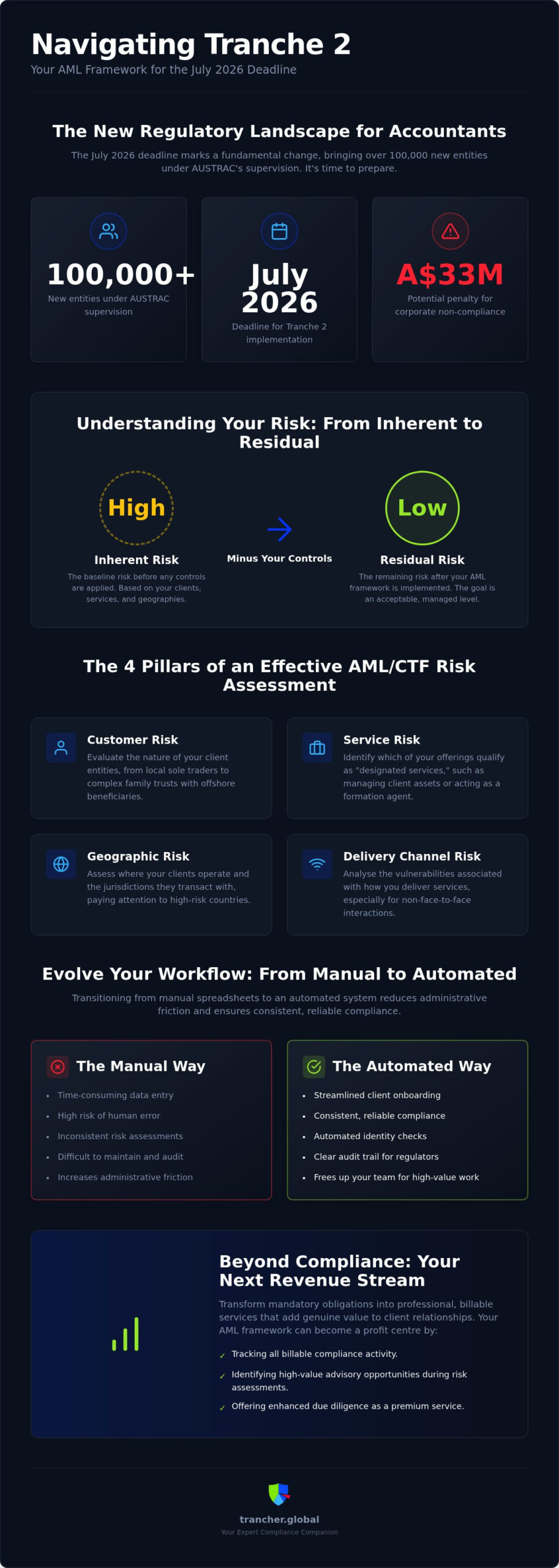
A robust AML risk management framework rests on four foundational pillars: customer, service, geography, and delivery channel. These pillars allow you to move away from guesswork toward a structured, defensible methodology. For an Australian accounting practice, this means looking beyond the balance sheet to understand the “who, what, where, and how” of every engagement. By categorising these factors, you can assign a risk rating that dictates the level of scrutiny required, ensuring your resources are focused where they matter most.
Customer risk involves evaluating the nature of the entity, such as distinguishing between a local sole trader and a complex family trust with offshore beneficiaries. Service risk requires you to identify which of your offerings qualify as “designated services” under AUSTRAC’s 2026 guidance, such as managing client assets or acting as a formation agent. Geographic risk looks at where your clients operate, while delivery channel risk assesses the vulnerabilities of non-face-to-face interactions. Implementing these pillars becomes much simpler when you use a platform designed to automate your compliance workflow.
Identifying Inherent ML/TF Risks
Identifying risks within an accounting context requires a nuanced eye for detail. For instance, insolvency services can be exploited to hide assets, while tax advisory roles might be misused to facilitate sophisticated evasion schemes. Your 2026 framework must also incorporate the latest focus on proliferation financing risk, which involves the movement of funds related to chemical, biological, or nuclear weapons. To build a solid foundation for these assessments, you can refer to our guide on CDD and KYC requirements Australia. This ensures your initial data collection is thorough enough to support your ongoing risk analysis.
Evaluating and Prioritising Risks
Once risks are identified, they must be prioritised using a consistent scoring matrix. A typical matrix for a mid-sized firm multiplies the likelihood of an event by its potential impact, resulting in a low, medium, or high risk rating. High-risk clients, such as Politically Exposed Persons (PEPs) or those from high-risk jurisdictions, automatically trigger Enhanced Due Diligence (EDD) protocols. This process isn’t just about compliance; it’s about defining your firm’s “risk appetite.” You must decide which levels of risk are acceptable and which clients simply don’t align with your firm’s safety standards. Setting these boundaries early protects your practice from taking on engagements that could lead to regulatory friction or reputational damage.
Manual vs. Automated Frameworks: Choosing the Right Model
Spreadsheets are the silent productivity killers of the modern accounting firm. While a “free” manual tracker seems cost-effective, it often leads to a hidden deficit of billable time, human error, and acute audit anxiety. Relying on fragmented files makes it nearly impossible to demonstrate a consistent application of your AML risk management framework when the regulator comes knocking. AUSTRAC has a clear preference for structured, digital record-keeping because it provides a transparent window into your firm’s decision-making process.
Beyond simple data storage, automated systems address the critical concept of model risk management. This ensures your digital tools are actually catching the red flags they’re designed to find. A well-configured system applies the same rigorous logic to every client, removing the subjective bias that often plagues manual assessments. It’s about moving from a reactive “catch-up” mode to a proactive stance where compliance is baked into your daily operations.
The Pitfalls of Fragmented Manual Processes
Manual KYC checks often fail during inspections because they lack a verifiable, time-stamped history of due diligence. It’s one thing to say you’ve verified a client; it’s quite another to prove exactly when and how that verification occurred three years ago. Without dedicated ongoing risk monitoring software, keeping track of changes in client structures or PEP status becomes a logistical nightmare that relies on memory rather than methodology. Automated platforms solve this by creating an immutable audit trail that serves as your firm’s best defence during a regulatory review.
Scaling Your Compliance Without Adding Headcount
The most significant advantage of a modern AML risk management framework is the ability to scale without hiring new staff. Automation allows your existing team to handle Tranche 2 obligations as a seamless part of the onboarding process. By integrating expert support and guided workflows, you remove the friction that usually makes compliance feel like a hurdle. Instead of chasing documents, your team can focus on high-value advisory work, confident that the underlying compliance engine is running smoothly in the background. It’s a shift that turns a regulatory burden into a streamlined, professional standard that clients respect.
5 Steps to Implementing Your Framework Before July 2026
Success in the new regulatory era depends on a structured transition plan. You shouldn’t view the July 2026 deadline as a single hurdle, but as the finish line for a series of logical, manageable steps. Implementing a robust AML risk management framework requires moving from high-level practice assessments to granular staff training. By following a methodical sequence, you ensure that no regulatory requirement is missed while maintaining the operational rhythm of your firm.
- Step 1: Conduct a Practice-Wide Risk Assessment. This is your inherent risk phase where you identify which services, such as managing client assets or assisting with property transfers, create the most exposure.
- Step 2: Designate Your AML/CTF Compliance Officer. You must appoint a specific individual to oversee your program and notify AUSTRAC of this appointment by July 29, 2026.
- Step 3: Develop Your Written AML/CTF Program. This document must include Part A (processes for identifying and managing risk) and Part B (procedures for customer due diligence).
- Step 4: Roll Out Staff Training. Provide role-based guidance so that every team member knows how to spot red flags in their specific area of work.
- Step 5: Establish Review Cycles. Create a system for maintaining audit ready compliance records that are updated through regular internal reviews.
Establishing Your Governance and Culture
A framework only works if it has the full support of your firm’s leadership. Senior management buy-in is essential because it signals to the rest of the team that compliance is a core professional value rather than a secondary chore. You need to clearly define the roles of the AML Officer, who handles daily operations, and the Senior Manager, who provides strategic oversight and resource approval. When every staff member understands their reporting obligations, you create a culture of vigilance that naturally protects the practice from exploitation.
The 30-Day Implementation Strategy
Moving from zero to fully compliant doesn’t have to take months of billable time. You can accelerate the process by leveraging pre-built frameworks that remove the need for drafting complex policies from scratch. This approach allows you to focus on tailoring the controls to your specific client base rather than getting bogged down in legal definitions. We recommend conducting an initial “dry run” audit within your first thirty days to test how your framework handles real-world scenarios. This testing phase identifies potential friction points before they become regulatory issues. To see how your firm can reach readiness quickly, consider our end-to-end AML program management solutions.
Beyond Compliance: Turning Your Framework into a Profit Centre
Compliance shouldn’t be a sunk cost. While the administrative weight of Tranche 2 is significant, a sophisticated AML risk management framework allows you to reclaim lost time and generate new revenue. Many firms view these requirements as an obstacle. Proactive practices see them as a way to formalise and bill for the due diligence they’ve often performed for free. By tracking compliance activities as billable events, you shift the financial weight from your firm’s overhead to a recoverable service fee.
The risk assessment process itself is a goldmine for advisory opportunities. When you dive deep into a client’s entity structure or geographic footprint, you often uncover complexities that require professional intervention. A thorough review of a family trust might reveal the need for restructuring, while an analysis of international fund movements could lead to specialised tax planning. Your framework acts as a diagnostic tool, identifying high-value work that benefits both the client’s security and your firm’s bottom line.
Communicating this value to your clients is essential. Most business owners understand the reality of modern financial crime and value the protection your firm provides. Explain that your robust AML risk management framework isn’t just about satisfying AUSTRAC; it’s about protecting their reputation and ensuring their business dealings remain untainted by illicit activity. When clients see compliance as a protective shield rather than a bureaucratic hurdle, they’re far more likely to accept it as a standard part of your professional service.
Creating Recoverable Compliance Activities
Start by updating your engagement letters to include specific AML/CTF service fees. You can structure these as one-off onboarding charges or recurring annual maintenance fees that cover ongoing monitoring and record-keeping. Providing clients with tangible evidence of the work performed, such as summarised screening reports or verification certificates, makes these fees transparent and justifiable. For firm partners, using ROI reporting to track the time saved through automation versus manual labour proves that the framework is a profitable asset rather than a liability.
Next Steps for Your Practice
The best time to prepare for the July 2026 transition is now. Early preparation is your most effective risk mitigation strategy, allowing you to refine your processes before the regulatory spotlight intensifies. We understand the pressure of shifting to a new regime, which is why we offer a 30-day compliance-ready guarantee to give you total peace of mind. You don’t have to navigate these changes alone; our team is here to act as your strategic guide. Book a demo with Trancher and see how to make compliance profitable while securing your firm’s future.
Secure Your Practice and Unlock New Growth
The transition to the Tranche 2 regime is a defining milestone for the Australian accounting profession. By implementing a structured AML risk management framework, you protect your firm from substantial regulatory penalties while streamlining your internal operations. We’ve discussed how moving from manual spreadsheets to automated systems removes administrative friction and ensures your records remain audit-ready at all times. This shift also allows you to transform mandatory obligations into a profitable service line by tracking billable activity and uncovering high-value advisory opportunities during the risk assessment process.
Our platform is designed by Australian AML specialists to help you navigate these changes with absolute confidence. We provide automated ROI reporting and a 30-day compliance guarantee to ensure your practice is ready for the July 2026 deadline. Ready to be AUSTRAC-compliant in 30 days? Start your free trial with Trancher today. You have the expertise to lead your clients through this new landscape, and we’re here to provide the steady guidance you need to thrive.
Frequently Asked Questions
What is an AML risk management framework exactly?
An AML risk management framework is the documented system of controls your practice uses to identify, assess, and mitigate the risk of financial crime. It functions as the operational backbone of your AML/CTF program, encompassing Part A (risk-based systems) and Part B (customer identification). By formalising these processes, you ensure that every team member knows how to spot and report suspicious activity, protecting your firm from becoming a conduit for illicit funds.
Does my small accounting firm really need a formal AML framework?
Yes, any accounting firm providing “designated services” must have a formal framework, regardless of staff numbers. Tranche 2 reforms apply to sole practitioners and large partnerships alike. If you assist with property transfers, manage client money, or set up companies, you’re legally required to have a written program in place by July 1, 2026. Size doesn’t change the obligation; it only changes the complexity of the risks you’ll need to manage.
When is the deadline for Tranche 2 AML compliance in Australia?
The critical deadline for Tranche 2 commencement is July 1, 2026. By this date, your firm must have a compliant program operational. You then have until July 29, 2026, to officially enrol your practice with AUSTRAC and notify them of your designated AML/CTF compliance officer. Missing these dates can lead to significant daily fines, so it’s best to have your systems tested and ready well before the mid-year transition.
What are the penalties for not having a risk management framework?
Non-compliance carries heavy financial and reputational consequences. As of July 2026, the maximum civil penalty for a corporation is 100,000 penalty units, which is approximately A$33 million. Individuals face up to A$6.6 million. Additionally, failing to enrol with AUSTRAC by the deadline can trigger a daily penalty of A$18,780. Beyond these fines, AUSTRAC publishes enforcement actions, which can cause irreparable damage to your professional standing and client trust.
Can I use a template to build my AML risk management framework?
You can start with a template, but it must be heavily tailored to your specific practice. A generic AML risk management framework that hasn’t been adapted to your client types, service offerings, and geographic footprint will likely fail an AUSTRAC inspection. The regulator expects a “risk-based” approach, meaning your controls must directly address the actual vulnerabilities of your firm rather than following a one-size-fits-all document that lacks practical application.
How often should I review and update my firm’s risk assessment?
You should review your risk assessment at least every 12 to 24 months, or whenever your firm undergoes a major change. This includes launching a new service line, adopting new technology, or shifting your client base toward higher-risk sectors or jurisdictions. Regular reviews ensure your controls remain effective against evolving criminal tactics and reflect the current regulatory environment, keeping your practice both compliant and operationally resilient.
Is an independent audit of my AML framework mandatory?
Yes, AUSTRAC requires that Part A of your AML/CTF program undergoes regular independent review. While the law doesn’t specify an exact timeframe, the frequency should be “risk-based” and proportionate to your firm’s size and complexity. For most accounting practices, an independent review every two to three years is considered best practice. This provides an objective assessment of whether your framework is operating effectively and identifies any gaps before they become issues.
How do I explain AML compliance fees to my long-term clients?
Explain the fee as a mandatory professional standard designed to protect the client’s interests and the firm’s integrity. Most clients value security and will understand that these rigorous checks prevent them from being inadvertently linked to criminal activity. Frame the cost as an investment in high-standard compliance and data protection, ensuring that your firm remains a safe, reliable partner that meets all modern Australian regulatory obligations without compromising on service quality.