

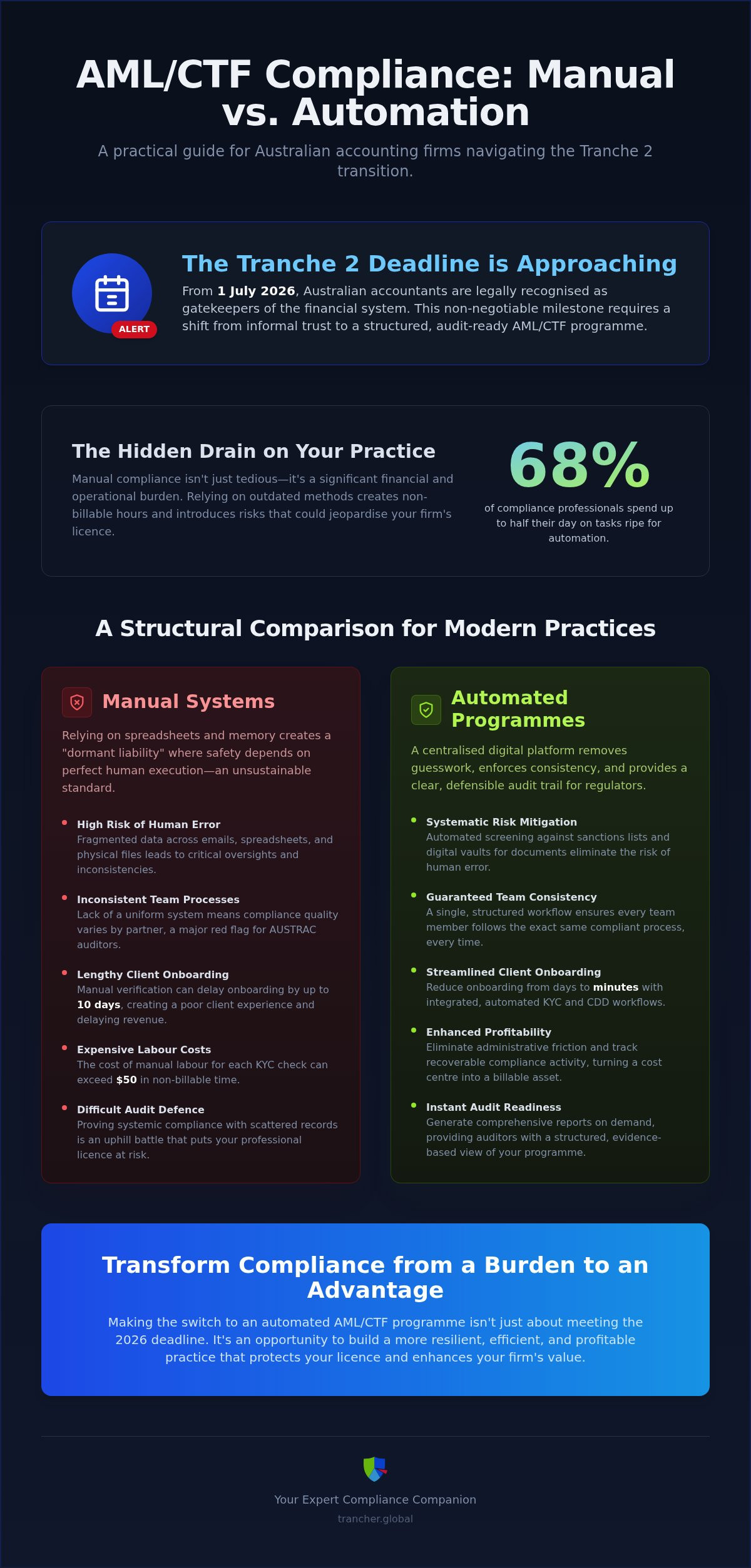
Did you know that 68% of compliance professionals currently spend up to half their working day on tasks they believe could be automated? For many Australian accounting firms preparing for the 1 July 2026 Tranche 2 commencement, the debate over AML CTF manual vs automation often feels like a choice between the familiarity of spreadsheets and the perceived complexity of new systems. We understand that the pressure to meet AUSTRAC requirements while maintaining a profitable practice is a significant weight to carry.
You have likely felt the frustration of mounting non-billable hours and the quiet concern that a single manual oversight could jeopardise your professional licence. This article will show you how to transition from risky, fragmented workflows to a streamlined, automated programme that protects your firm and enhances your bottom line. We will explore practical ways to reduce time spent on KYC and CDD, ensure team-wide consistency, and ultimately transform compliance from a heavy administrative burden into a strategic advantage for your practice.
Key Takeaways
- Understand why the 1 July 2026 Tranche 2 deadline is a non-negotiable milestone and how proactive preparation protects your practice’s licence.
- Evaluate the critical structural differences in AML CTF manual vs automation to see how digital vaults and automated screening eliminate the risks of human error.
- Learn how to reduce client onboarding from days to minutes by replacing fragmented spreadsheets with integrated, automated KYC and CDD workflows.
- Discover how to transform regulatory obligations into a billable asset by tracking recoverable compliance activity and removing administrative friction.
- Follow a practical 30-day roadmap to transition your firm from manual administrative drain to a streamlined, audit-ready compliance programme.
Navigating the Tranche 2 Landscape: Why the Old Ways are Changing
The landscape for Australian accounting practices is undergoing its most significant regulatory shift in decades. For years, the AML/CTF Act primarily applied to the financial sector and Tranche 1 entities. However, the expansion to Tranche 2 entities means that from 1 July 2026, accountants are legally recognised as gatekeepers of the financial system. This transition isn’t merely an administrative update; it’s a call to modernise how your firm manages risk and client relationships.
The 1 July 2026 deadline is a non-negotiable milestone. AUSTRAC opened enrollment on 31 March 2026, and all firms providing designated services must be fully compliant by the mid-year cutoff. These services include managing client money, securities, or other assets; facilitating property transactions; and the creation or management of legal persons like trusts and companies. If your practice offers these core services, the time to decide your approach to AML CTF manual vs automation is now.
Understanding Your Tranche 2 Obligations
Compliance under the new regime requires more than a simple checklist. Every firm must develop and maintain a written AML/CTF Programme that outlines how they will identify, mitigate, and manage money laundering and terrorism financing risks. This involves implementing robust CDD and KYC requirements Australia, which ensure you truly understand who your clients are and the nature of their business. You’ll also be responsible for ongoing monitoring and reporting suspicious matters to AUSTRAC. While this might sound daunting, many firms are turning to Anti-money laundering (AML) software to handle these complex tasks. These digital solutions allow you to focus on high-value advisory work while the system manages the heavy lifting of verification and risk screening.
The Shift from Informal to Structured Compliance
In the past, many practitioners relied on long-standing personal relationships to “know” their clients. While trust remains a vital part of professional practice, it’s no longer sufficient to meet regulatory standards. AUSTRAC requires a structured, evidence-based approach that can withstand a rigorous audit. This shift replaces informal handshake compliance with a regime of independent reviews and annual compliance reports. The dilemma many partners face is how to implement these rigorous standards without drowning in paperwork. Choosing between AML CTF manual vs automation will determine whether your firm views 2026 as a year of administrative friction or an opportunity for operational excellence. Moving toward a structured digital framework isn’t just about avoiding penalties; it’s about building a more resilient, transparent, and future-ready practice.
The Hidden Fragility of Manual AML/CTF Systems
Relying on manual spreadsheets might feel like a cost-effective choice in the short term, but it often conceals a growing liability for your practice. When we evaluate AML CTF manual vs automation, the primary difference lies in the structural integrity of your compliance programme. Manual systems are inherently fragmented. They rely on individual staff members to remember specific steps, file documents in the correct folders, and manually check names against sanctions lists that change daily. This creates a “dormant liability” where your firm’s safety depends entirely on perfect human execution, a standard that’s rarely sustainable in a busy accounting environment.
Inconsistency is the most common byproduct of these manual efforts. In a typical firm, one partner might be diligent with identity verification, while another, under the pressure of a deadline, might accept a scanned copy without proper certification. This lack of uniformity is a significant red flag for AUSTRAC. During an audit, regulators don’t just look for a single compliant file; they look for a systemic, repeatable process. If your record-keeping is scattered across emails, physical folders, and disparate Excel files, proving the effectiveness of your programme becomes an uphill battle that puts your licence at risk.
The Administrative Burden of Manual Record-Keeping
The true cost of manual compliance is often hidden within your payroll. Industry data indicates that the cost of manual labour per Know Your Customer (KYC) check can exceed $50, with manual verification processes leading to onboarding delays of up to 10 days. For a growing firm, this isn’t just an administrative chore; it’s a significant drain on your capacity. When your senior team spends half their day on non-billable document chasing, you aren’t just losing time; you’re losing the ability to provide high-value advisory services. Realising AML CTF compliance costs reduction starts with acknowledging how much billable potential is currently leaking through these manual cracks.
Regulatory Exposure and the Risk of Human Error
Manual screening for Politically Exposed Persons (PEPs) and sanctioned individuals is perhaps the most fragile part of a paper-based system. Human error is almost inevitable when staff are asked to search through vast, complex databases manually. Missing a single suspicious matter report because a spreadsheet wasn’t updated can lead to severe financial penalties or even criminal investigations. This creates a constant undercurrent of regulatory uncertainty for practice owners. If you’re ready to move beyond these risks, exploring automated compliance workflows can provide the steady hand and peace of mind your practice needs. Automation ensures that every client is screened against the most current data, removing the psychological weight of wondering if a critical detail was missed in a manual search.
Manual vs Automated: A Structural Comparison for Modern Practices
Choosing between AML CTF manual vs automation isn’t just about selecting a tool; it’s about defining the operational architecture of your firm. A manual system is built on individual effort, whereas an automated system is built on a resilient, repeatable process. For an accounting practice managing various designated services, from trust formations to large-scale asset management, the structural differences between these two approaches become clear when you look at how they handle growth and regulatory pressure.
The contrast in daily operations is stark. Consider these four pillars of practice management:
- Onboarding Speed: Manual processes often involve a 10-day delay while documents are chased and certified. Automation reduces this to minutes, allowing you to begin billable work almost immediately.
- Record-Keeping: Physical folders and scattered PDFs are difficult to search and easy to lose. Digital vaults provide a single source of truth that’s encrypted and instantly accessible.
- Screening Accuracy: Manual checks are “point-in-time” and quickly become outdated. Automated monitoring runs in the background, alerting you the moment a client’s risk profile changes.
- Scalability: Manual compliance requires more headcount as your client list grows. Automation allows you to scale your firm’s revenue without a proportional increase in administrative overhead.
Efficiency Gains in KYC and Screening
Modern identity verification (IDV) removes the friction of physical document handling. Instead of asking clients to bring certified copies of their passports to your office, automated systems allow them to complete verification securely from their own devices. This standardises the risk assessment process across your entire team. Whether a junior staff member or a senior partner is onboarding a client, the system ensures that every check is performed to the same high standard. Integrated PEP and sanctions screening further eliminates the guesswork, as the software cross-references global databases in real-time to ensure you aren’t inadvertently dealing with high-risk individuals.
Maintaining an Audit-Ready Posture
Regulators don’t just want to see that you’ve done the work; they want to see the evidence. This is why audit ready compliance records are the cornerstone of a successful practice. In a manual environment, preparing for an AUSTRAC review can take weeks of stressful document retrieval and reconciliation. An automated platform allows you to generate comprehensive reports with a single click, demonstrating a proactive “culture of compliance.” This transparency builds trust with regulators and provides you with the confidence that your practice is fully protected, regardless of when an audit notice arrives. By shifting the burden of proof to a reliable digital system, you ensure your firm remains focused on its primary goal: serving your clients with excellence.
Making the Switch: A 30-Day Roadmap to Automated Readiness
Transitioning your practice from manual spreadsheets to a digital framework is a manageable process when broken into weekly milestones. In the AML CTF manual vs automation debate, the most effective path forward is one that prioritises operational ease and regulatory certainty. By following a structured 30-day roadmap, your firm can achieve full compliance readiness well ahead of the July 2026 deadline. This proactive approach ensures that your transition is a catalyst for modernisation rather than a source of stress.
- Week 1: The Internal Audit. Review your client list to identify which “designated services” you currently provide. This is the time to gather existing client data for a clean migration to your new system.
- Week 2: System Selection. Select an AUSTRAC-aligned platform and customise your written AML/CTF Programme. This document must reflect your firm’s specific risk profile and operational reality.
- Week 3: Team Alignment. Train your staff on the new automated workflows. Standardised client communication templates are vital here to ensure a professional and consistent message when requesting updated identity documents.
- Week 4: Integration and Launch. Connect your compliance platform to your existing practice management software and go live. This final step ensures that compliance becomes a natural part of your daily workflow.
Assessing Your Current Workflow Gaps
Identifying bottlenecks is the first step toward a more profitable practice. For most firms, the biggest administrative drain is “document chasing” and manual data entry. Chasing clients for certified copies of passports often leads to onboarding delays and frustration for both your team and your clients. Gathering your existing client data now allows for a clean migration, preventing the risk of carrying over incomplete records. Securing partner buy-in is often easier when you frame the transition as a way to recover lost billable hours. When the leadership team sees that automation removes the risk of human error in sanctions screening, the decision to modernise becomes a clear business advantage.
Implementing a Scalable Automation Strategy
A successful transition relies on role-based training. Every team member needs to understand their specific obligations within the new system, from the person greeting clients to the senior partner signing off on high-risk files. Establishing a clear routine for reviewing automated alerts ensures that no suspicious activity slips through the cracks. To remove implementation anxiety, you can leverage a 30-day compliance-ready guarantee to ensure your firm is fully prepared without the stress of a long, drawn-out setup. This structured approach ensures that by the time July 2026 arrives, your practice isn’t just compliant; it’s thriving. Automation allows your firm to scale without a proportional increase in administrative headcount, turning a regulatory requirement into a foundation for growth.
Beyond Compliance: Why Automation is Your New Revenue Stream
For many practitioners, the initial reaction to Tranche 2 is to view it as a non-billable administrative burden. However, shifting your perspective reveals that the choice between AML CTF manual vs automation is actually a choice about your firm’s profitability. While manual systems represent a pure cost centre, an automated framework allows you to capture and recover the value of your compliance work. By moving away from “doing paperwork” and toward providing high-level “AML advisory services,” you position your firm as a strategic partner rather than just a service provider.
The transition to a digital workflow provides the data necessary to justify your fee structure. Instead of absorbing the costs of verification and screening, you can provide clients with transparent reporting on the rigorous safety measures protecting their interests. This transparency builds trust and allows you to report on the return on investment (ROI) of your compliance software, turning a regulatory hurdle into a clear business advantage. When your compliance programme is efficient, it stops being a drain on resources and starts contributing to your firm’s growth.
Tracking Billable Compliance Activity
Trancher is designed to identify specific compliance tasks that can be billed back to the client, ensuring your team’s time is always accounted for. Using evidence-based record-keeping allows you to demonstrate the exact work performed during the onboarding and monitoring phases. When you communicate the value of “safe and compliant” services, clients understand they aren’t just paying for a form; they’re paying for the security of their assets and the integrity of your professional relationship. This methodical approach to billing ensures that compliance remains a sustainable and profitable part of your practice operations, supported by clear data rather than guesswork.
Creating New Advisory Revenue Streams
The Tranche 2 era offers a unique opportunity to lead the market by helping your own clients navigate their complex AML obligations. Positioning your firm as an expert guide allows you to offer premium advisory services that go beyond traditional accounting. This proactive stance significantly enhances the overall valuation of your practice, as prospective buyers or partners look for firms with robust, automated systems already in place. By embracing technology now, you ensure your firm is recognised as a leader in the Australian market, ready to turn the challenges of 2026 into a foundation for long-term financial health and operational excellence.
Step into the Future of Compliance Readiness
The 1 July 2026 deadline represents more than a regulatory shift; it’s an opportunity to modernise your practice for a new era. We’ve explored how moving beyond fragmented spreadsheets removes the “dormant liability” of human error while reclaiming hundreds of non-billable hours. When you evaluate AML CTF manual vs automation, it’s clear that digital workflows provide the transparency and scalability required to thrive under AUSTRAC scrutiny. By choosing a structured path today, you’re not just avoiding penalties; you’re building a more resilient and valuable firm.
You don’t have to navigate these changes alone. We’re here to ensure your transition is seamless, supportive, and ultimately profitable. Start your complimentary 3-month trial of Trancher today to secure your practice. Our local Australian team provides full onboarding support, and we guarantee you’ll be compliance-ready within 30 days. Trial participants also receive an exclusive 20% discount on their ongoing subscription. It’s time to replace administrative friction with operational ease and focus on high-value advisory work. We’re excited to partner with you as you lead your firm into this new era of professional excellence.
Frequently Asked Questions
Is manual AML compliance still legal in Australia after July 2026?
Manual AML compliance remains legal in Australia after 1 July 2026, provided your programme meets all AUSTRAC standards for effectiveness. However, the regulator increasingly focuses on how well your systems actually identify and mitigate risk. Proving that a manual spreadsheet is as effective as automated screening is becoming significantly more difficult as financial crime grows more complex. Most firms find that the administrative weight of manual upkeep makes it an unsustainable long-term choice.
How much time does it take to switch from spreadsheets to an automated AML platform?
You can complete the transition from spreadsheets to an automated platform in as little as 30 days. This timeline involves auditing your current client data, customising your written programme, and training your staff on the new digital workflows. By following a structured roadmap, you can replace years of fragmented manual records with a cohesive system without disrupting your firm’s daily operations or billable client work.
What are the main risks of continuing with a manual AML/CTF programme?
The primary risks include human error in screening, inconsistent record-keeping across the team, and a heavy administrative drain on senior staff. When debating AML CTF manual vs automation, you must consider the danger of using outdated sanctions lists. Missing a single suspicious matter because of a manual oversight can lead to heavy financial penalties. Manual systems often lack the systemic rigour required to pass a formal AUSTRAC audit confidently.
Can automation software help with AUSTRAC annual compliance reporting?
Automated software significantly simplifies the process of AUSTRAC annual compliance reporting by centralising all your data throughout the year. Instead of manually reconciling disparate spreadsheets and physical files, you can generate comprehensive reports with a single click. This ensures your submissions are accurate and timely, reflecting a proactive culture of compliance. It removes the end-of-year stress of document retrieval and provides a clear audit trail for regulators.
How do I explain AML compliance fees to my existing accounting clients?
Frame compliance fees as a necessary investment in protecting your clients’ financial integrity and assets. You can explain that these measures are part of a broader commitment to professional standards and regulatory safety. By using automated systems, you can provide clients with tangible evidence of the rigorous screening performed on their behalf. This transforms a perceived overhead into a high-value advisory service that ensures their business remains safe and compliant.
Does AML automation integrate with my existing practice management software?
Most modern AML automation platforms are designed to integrate seamlessly with popular practice management software used by Australian accountants. These integrations ensure that client data flows naturally between systems, removing the need for double data entry and reducing the risk of clerical errors. This creates a frictionless workflow where compliance checks become a built-in step of your standard onboarding process, rather than a separate, time-consuming administrative hurdle.
What happens if my firm is audited by AUSTRAC and we only have manual records?
If your firm is audited while relying on manual records, you must be able to demonstrate that your programme is systemic, repeatable, and effective. AUSTRAC looks for evidence that every client has been screened consistently and that risks are managed proactively. Fragmented manual files often make it difficult to prove this level of rigour. If gaps are found in your documentation, your practice faces increased regulatory scrutiny and potential fines.
Is a 30-day implementation timeline realistic for a small accounting firm?
A 30-day implementation timeline is highly realistic for small accounting firms when using a structured onboarding process. Because smaller practices often have more direct control over their internal workflows, the transition from AML CTF manual vs automation can be even faster than in larger organisations. With local Australian support and a clear implementation roadmap, your team can be fully trained and compliance-ready without needing to hire additional administrative staff.