

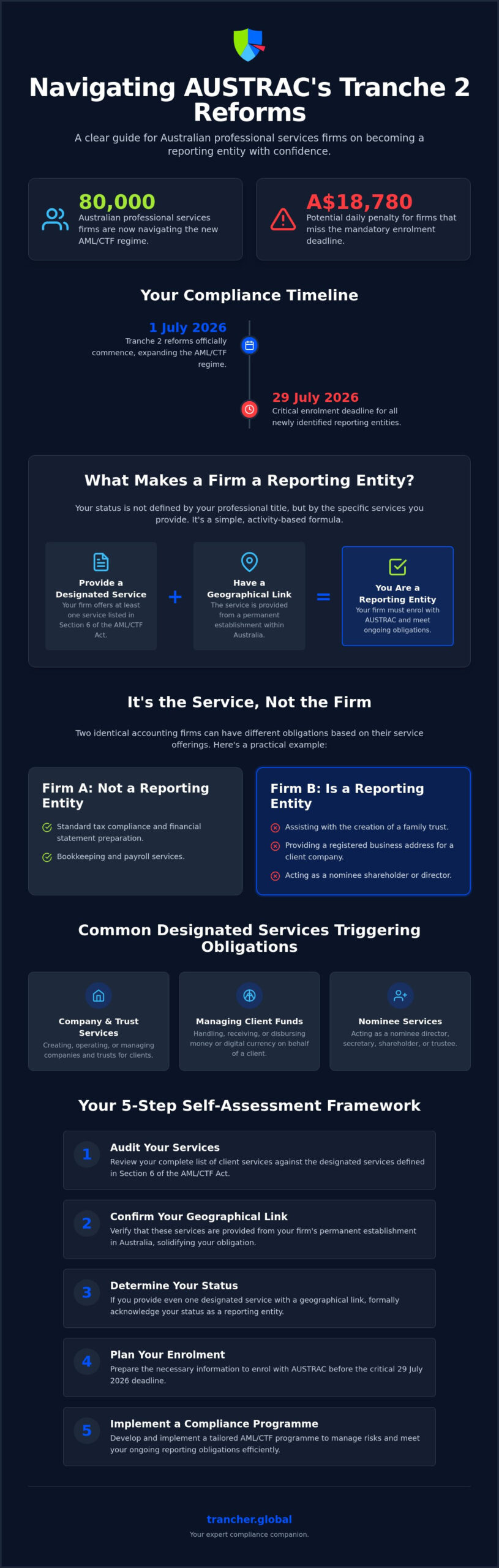
Approximately 80,000 Australian professional services firms are now navigating a significant shift in their regulatory landscape. As of 1 July 2026, the Tranche 2 reforms have officially expanded the AML/CTF regime, leaving many practitioners asking: what is a reporting entity to AUSTRAC? While the term may sound like it belongs in a high-level banking manual, the reality is that many everyday accounting services, such as setting up a family trust or providing a registered business address, now trigger these formal obligations.
You likely feel the weight of this transition, especially with the prospect of daily penalties reaching A$18,780 for firms that miss the enrolment deadline. It’s completely natural to view these new requirements as a complex administrative hurdle that threatens your billable hours and adds layers of confusing jargon to your daily workflow.
We’re here to help you transform this regulatory requirement into a manageable and even advantageous part of your practice. This guide provides a clear framework to determine your status and outlines exactly how to meet your obligations with total confidence. You’ll discover how to identify designated services, manage enrolment by the 29 July deadline, and implement a compliance program that protects your firm without draining your resources.
Key Takeaways
- Understand exactly what is a reporting entity to AUSTRAC by identifying the specific designated services, such as trust creation or fund management, that trigger these new obligations.
- Recognise the critical 1 July 2026 commencement date and the subsequent enrolment deadlines to ensure your practice remains fully compliant from day one.
- Implement a practical 5-step self-assessment framework to audit your current service list against the updated Section 6 requirements of the AML/CTF Act.
- Discover how to transition from an unregulated firm to an AUSTRAC-ready practice within 30 days while turning compliance into a billable activity.
- Learn to navigate the shift from tax agent to regulatory gatekeeper with a structured approach that removes administrative friction and protects your firm’s reputation.
Understanding the AUSTRAC Reporting Entity Definition
The Anti-Money Laundering and Counter-Terrorism Financing Act 2006 (AML/CTF Act) provides the legal framework for identifying who must comply with strict financial monitoring rules. To answer the question of what is a reporting entity to AUSTRAC, we must look beyond professional titles. A reporting entity is simply any individual or business that provides at least one “designated service” with a geographical link to Australia.
This definition is the cornerstone of the Australian Transaction Reports and Analysis Centre (AUSTRAC) regulatory regime. While the terminology can feel heavy, it exists to safeguard your practice from being exploited by criminal networks. By identifying as a reporting entity, you’re not just ticking boxes; you’re acting as a vital guardian of the Australian financial system. We view this shift not as a burden, but as a commitment to professional integrity that strengthens the security of your client relationships.
Activity-Based Regulation vs. Entity Type
Your status as a reporting entity isn’t determined by whether you’re a sole practitioner or a mid-tier firm. Instead, it’s defined entirely by the specific activities you perform for your clients. For example, two identical accounting firms on the same street could have different obligations. If Firm A only provides standard tax compliance and financial statement preparation, they likely won’t be a reporting entity. However, if Firm B assists with creating a company or acting as a nominee shareholder, they’re providing designated services.
AUSTRAC regulates the service, not the person. If your workflow includes managing client funds or facilitating the sale of a business, you fall under the regulatory umbrella. Reporting entity status is a manageable transition with the right systems in place. By focusing on the specific services you offer, you can clearly define your compliance perimeter without overcomplicating your entire business model.
The Geographical Link Requirement
For an obligation to exist, there must be a “geographical link” to Australia. This requirement is generally met if the designated service is provided through a permanent establishment in Australia. It doesn’t matter if the client is based in London or Singapore; if the service is delivered by your Australian office, the Act applies. Understanding what is a reporting entity to AUSTRAC requires this domestic focus, ensuring that all financial gateways within our borders are secured.
Many firms now utilise offshore processing centres for data entry or preliminary tax work. While the “back-office” work might happen overseas, the reporting entity status usually remains with the Australian firm that holds the client relationship and provides the final service. Maintaining clear records of where services are controlled is essential for audit readiness and operational clarity. We’re here to help you map these service flows so you can remain confident in your compliance standing, regardless of where your team is located.
Designated Services: The Trigger for Reporting Entity Status
Understanding what is a reporting entity to AUSTRAC begins with a deep dive into Section 6 of the AML/CTF Act. This specific part of the legislation lists the “designated services” that act as the regulatory tripwire. If your firm provides even one of these services, you’re legally a reporting entity. While Tranche 1 has regulated the financial and gambling sectors for years, the 2026 Tranche 2 expansion brings professional services into the fold to address Money Laundering and Terrorism Financing (ML/TF) risks.
AUSTRAC monitors these activities because professional “gatekeepers” can inadvertently facilitate the movement of illicit wealth. Criminals often seek the perceived legitimacy that an accountant’s letterhead or trust structure provides. Identifying these triggers in your workflow isn’t just about compliance; it’s the first step toward building an automated system that protects your firm’s reputation and operational integrity.
Common Accounting Services in Scope
Many practitioners are surprised to learn how many daily tasks qualify as designated services. Under the 2026 framework, these include creating or restructuring companies and trusts, acting as a nominee director or trustee, and providing a registered office or business address. Managing client funds, assets, or digital assets also triggers these formal obligations.
Setting up and administering Self-Managed Super Funds (SMSFs) frequently crosses into this territory because it involves the creation of a trust structure. Once a designated service is identified, you must follow strict CDD and KYC requirements Australia to verify your clients’ identities and understand their source of wealth. This process ensures you have a clear picture of who you’re doing business with at all times.
The 2026 Expansion: Virtual Assets and Professional Services
The regulatory landscape shifts significantly on 31 March 2026, when the portal opens for enrolment. Accountants who manage, exchange, or transfer crypto-assets on behalf of clients are now firmly classified as reporting entities. This inclusion is a core component of the Tranche 2 umbrella, which finally aligns accountants, lawyers, and real estate agents with international financial standards.
While the scope is broad, adopting a structured compliance framework can ensure these new obligations don’t disrupt your core practice or drain your billable hours. By categorising your services early, you can prepare your team for the 1 July 2026 commencement date with total clarity and confidence. This proactive approach transforms a regulatory requirement into a standard of excellence that your clients will value.
Tranche 2 and the 2026 Landscape for Accounting Firms
The countdown to 1 July 2026 marks a fundamental shift in the Australian accounting profession. You’re moving from being a traditional tax agent to a regulatory gatekeeper, a role that aligns your practice with global anti-money laundering standards. Understanding exactly what is a reporting entity to AUSTRAC is the first step toward this new professional identity. While some practitioners might worry that these new obligations are a distraction, we view them as a standard of excellence. Embracing your role as a reporting entity is about protecting your firm’s reputation and the integrity of the Australian financial system.
The financial stakes for overlooking these duties are significant. AUSTRAC can impose civil penalties of up to A$31.3 million per breach for corporate entities and A$6.26 million for individuals. Additionally, firms face a daily penalty of A$18,780 if they remain unenrolled after the 29 July 2026 deadline. We believe that framing compliance as a professional standard, much like professional indemnity insurance, helps transform it from a perceived cost into a vital business asset. What is a reporting entity to AUSTRAC isn’t just a legal definition; it’s a commitment to a higher level of operational security.
The 1 July 2026 Deadline: What Changes?
By the commencement date of 1 July 2026, your firm must have a fully documented AML/CTF programme in place. This isn’t a generic template; it must be a risk-based document tailored to your specific services. Your programme consists of two parts. Part A focuses on identifying and managing risks, while Part B covers the specific KYC procedures for your clients. You’ll also need to implement regular staff training and schedule independent reviews to ensure your systems remain robust. Achieving audit-ready compliance records from day one is the best way to demonstrate a genuine effort to comply.
Why Early Preparation is a Strategic Advantage
Starting your transition early allows you to integrate new requirements into your existing workflows without the stress of a last-minute rush. It gives you the time to communicate clearly with your clients about why you’re asking for additional identification or source of wealth information. When these conversations are handled with confidence, they reinforce your position as a thorough and professional advisor. Utilising tools like ongoing risk monitoring software can automate the heavy lifting of background checks and risk assessments. This ensures your firm remains compliant while your team stays focused on delivering high-value advice to your clients.
Assessing Your Status: Are You Providing Designated Services?
Determining your firm’s status shouldn’t involve guesswork or late-night manual audits of every client file. To clearly define what is a reporting entity to AUSTRAC within your own practice, you need a methodical approach. We’ve developed a practical five-step framework to help you self-assess with total confidence and ensure you’re ready for the 2026 requirements.
Step 1: Audit your service list. Compare your current offerings against the professional designated services list. This includes company formations, trust setups, and acting as a nominee shareholder. Step 2: Identify your client types. Focus on clients that involve complex structures like discretionary trusts, proprietary companies, or high-net-worth individuals, as these often require designated services. Step 3: Review your geographical link. Confirm if these services are provided through your Australian office, which triggers the Act’s jurisdiction. Step 4: Check for financial activities. Determine if you perform any financial designated services, such as making payments or managing bank accounts on behalf of a client. Step 5: Document your findings. Maintain a formal record of this assessment to prove to AUSTRAC why you have, or have not, enrolled as a reporting entity.
The “Designated Service” Audit
A common misconception is that you only become a reporting entity if a large percentage of your revenue comes from these activities. In reality, providing even a single designated service just once makes you a reporting entity under the law. Use this quick checklist to evaluate your daily operations:
- Do you assist in the sale or transfer of a business?
- Do you provide a registered office address for a client’s company?
- Do you act as a trustee or arrange for another person to do so?
- Do you manage client funds or digital assets?
If you answered “yes” to any of these, you are likely a reporting entity. If a specific service falls into a grey area, it’s always best to seek expert support rather than leaving your firm exposed to potential penalties. You can book a readiness assessment with Trancher to clear up any uncertainty and ensure your service mapping is accurate.
Enrolment vs. Registration with AUSTRAC
Once you’ve identified your status, you must understand the administrative path forward. For most accounting firms, the requirement is “enrolment.” This is a straightforward process of notifying AUSTRAC that you are providing designated services. This differs from “registration,” which is a more rigorous process reserved for sectors like remittance or digital currency exchange.
If you are already providing services on 1 July 2026, you must enrol by 29 July 2026. For any new services started after this date, you have 28 days to notify the regulator. Trancher facilitates these regulatory reporting requirements seamlessly, ensuring your firm meets every deadline without the administrative friction of manual portal entries. By automating this process, you can move from “unregulated” to “AUSTRAC-ready” while keeping your team focused on billable work.
Managing Your AUSTRAC Obligations with Confidence
Once you’ve clarified what is a reporting entity to AUSTRAC and identified your firm’s status, the focus naturally shifts to implementation. Many practitioners worry that these new duties will become an unmanageable administrative burden that eats into their billable hours. Trancher is designed to change that narrative. We act as your expert compliance companion, providing a solution that transforms regulatory requirements into a structured, billable asset. With our 30-day compliance-ready guarantee, we move your practice from “unregulated” to “AUSTRAC-ready” in just one month.
Our platform is built specifically for the Australian accounting profession by specialists who understand your unique operational needs. We don’t just provide a template; we provide a steady hand to guide you through the transition. By framing your new status as a professional standard of excellence, we help you project confidence to your clients while ensuring your internal systems are robust and future-proof. What is a reporting entity to AUSTRAC shouldn’t be a source of stress, but rather an avenue for improved internal systems and firm growth.
Automating the Administrative Heavy Lifting
The most significant challenge for any new reporting entity is the sheer volume of documentation required. Our End-to-End AML/CTF Program Management features take the guesswork out of compliance. We automate the primary friction points, such as KYC verification and client risk assessments, ensuring that your onboarding process remains smooth and professional. This automation removes the need for manual data entry and reduces the risk of human error during the due diligence phase.
Regulators value transparency and consistency. Trancher generates audit-ready documentation automatically, meaning you’re always prepared for an AUSTRAC review without a last-minute scramble. By integrating these workflows directly into your practice, you maintain a high standard of regulatory health while keeping your team focused on delivering high-value advice. It’s about removing friction and creating a seamless experience for both your staff and your clients.
Turning Compliance into a Professional Service
We believe that your expertise in managing regulatory risk is a valuable professional service that deserves to be recognised. Trancher introduces a “Compliance as a Profit Centre” model by tracking compliance activity as a billable event. Instead of losing hours to manual spreadsheets, our system allows you to track and report on the time spent on AML/CTF tasks. This ensures you maintain a strong ROI while fulfilling your legal duties.
Moving away from manual processes to a structured, automated system is the most efficient way to protect your firm’s reputation and bottom line. You can provide your clients with the peace of mind that their affairs are being handled by a firm that takes security and integrity seriously. To see how we can streamline your transition, start your complimentary 3-month trial and get AUSTRAC-ready today. We’re here to ensure you navigate the 2026 landscape with total confidence and operational ease.
Securing Your Practice for the 2026 Regulatory Landscape
The transition to the Tranche 2 regime represents a significant milestone for the Australian accounting profession. By now, you should have a clear understanding of what is a reporting entity to AUSTRAC and how specific designated services like trust creation or fund management trigger these new obligations. While the 1 July 2026 deadline brings new responsibilities, it also offers a unique opportunity to refine your internal systems and demonstrate a higher standard of professional integrity.
You don’t have to navigate these changes alone. We provide the steady guidance and automated tools needed to remove administrative friction and protect your firm’s reputation. With our 30-Day Compliance Readiness Guarantee and expert Australian-based support, you can transition with total confidence and operational ease.
Take the first step toward a more resilient practice today. Get AUSTRAC-Ready in 30 Days with Trancher and take advantage of our complimentary 3-month trial for accounting firms. We’re excited to act as your partner in turning these requirements into a strategic advantage for your practice.
Frequently Asked Questions
Is my small accounting firm really a reporting entity to AUSTRAC?
Yes, the size of your accounting firm doesn’t exempt you from these regulations. If your practice provides even one designated service, such as trust formation or managing client funds, you’re required to comply with the AML/CTF Act. AUSTRAC focuses on the specific risk associated with the service provided rather than the number of staff in your office or your annual turnover. This ensures all financial gateways remain secure.
Can I be a reporting entity if I only provide tax advice?
Tax advice alone doesn’t typically trigger these obligations, provided it remains strictly focused on preparing tax returns or financial statements. However, if your advice leads to you setting up a company structure or managing assets for a client, your status changes immediately. It’s essential to review your full service list to determine exactly what is a reporting entity to AUSTRAC within your specific practice and service model.
How much does it cost to comply with AUSTRAC reporting entity obligations?
Compliance costs vary depending on the complexity of your services and whether you choose manual or automated systems. While there are initial costs for developing a compliance programme and staff training, automation significantly reduces the ongoing administrative burden. Many firms find that the cost of non-compliance, including potential audits and penalties, far outweighs the investment in a robust, integrated system that protects their reputation.
What happens if I don’t register as a reporting entity by July 2026?
Failing to enrol by the 29 July 2026 deadline exposes your firm to significant financial risks and daily penalties. AUSTRAC can impose daily fines of A$18,780 for corporate entities and A$3,756 for individuals for every day you remain unenrolled after the deadline. Beyond the fines, your firm risks reputational damage and increased regulatory scrutiny, which can disrupt your operations and damage the trust you’ve built with your clients.
What are the main obligations of a reporting entity under the AML/CTF Act?
Your primary obligations include developing a written AML/CTF programme, conducting Know Your Customer (KYC) checks, and reporting suspicious matters. You must also maintain detailed records for seven years and appoint a fit and proper compliance officer. These steps ensure you have a clear framework to identify and mitigate the risks of money laundering within your practice while meeting your legal duties under the Act.
Do I need a dedicated AML officer if I am a reporting entity?
You must appoint an AML/CTF Compliance Officer, but this role doesn’t necessarily require a new, full-time hire. In smaller firms, a senior partner or manager often takes on this responsibility alongside their existing duties. The key requirement is that the officer must pass AUSTRAC’s fit and proper person test and have the authority to manage your compliance programme and report directly to the firm’s leadership.
How do I enrol with AUSTRAC once I identify as a reporting entity?
Enrolment is a straightforward process completed through the AUSTRAC Online portal, which opened for Tranche 2 entities on 31 March 2026. You’ll need to provide basic details about your business, the designated services you offer, and your appointed compliance officer. Understanding what is a reporting entity to AUSTRAC is the first step, followed by this formal enrolment to ensure your firm is recognised and compliant.
Can I charge my clients for the compliance work I do as a reporting entity?
You can certainly charge your clients for the compliance work you perform, as it is a professional service that adds value to their security. Many firms choose to incorporate these costs into their fee structures or charge them as a separate compliance fee. Using a system to track the time spent on these tasks makes it easier to justify these charges and maintain your profit margins.