

What if your most daunting regulatory hurdle became your firm’s most efficient revenue stream? With the 1 July 2026 deadline for Tranche 2 reforms fast approaching, many Australian accounting firms feel the weight of administrative dread. However, implementing the right AML CTF policy development software doesn’t just satisfy AUSTRAC; it transforms a complex obligation into a streamlined, billable professional service. We understand the anxiety surrounding non-billable hours and the technical definitions of designated services. It’s a significant shift for the industry, and the fear of heavy penalties is a valid concern for any practice partner.
We’re here to help you navigate this transition with confidence rather than stress. This guide will show you how to automate your AML/CTF program development, ensuring you’re fully compliant within 30 days while recovering your costs through smart workflow integration. You’ll discover how to meet your obligations with ease, moving from regulatory confusion to operational excellence well before the 29 July 2026 enrolment deadline. By framing these requirements as a chance to improve internal systems, you can secure peace of mind and turn compliance into a genuine strategic advantage.
Key Takeaways
- Understand why the 1 July 2026 deadline necessitates a comprehensive, firm-wide program to manage money laundering and terrorism financing risks effectively.
- Discover how AML CTF policy development software automates initial risk assessments and keeps your documentation current with shifting Australian regulations.
- Compare the efficiency of guided digital platforms against manual templates to eliminate version control issues and significantly reduce non-billable administrative time.
- Learn the essential steps for AUSTRAC alignment, from establishing a robust governance framework to nominating a dedicated Compliance Officer within your practice.
- Shift your perspective on compliance by using tools that track billable activity, turning regulatory requirements into a recoverable and profitable professional service.
Navigating the Tranche 2 Landscape: Why Policy Development is Changing
The AML/CTF program is much more than a compliance tick-box; it’s the governing document that defines how your firm identifies and manages financial crime risks. For Australian accounting firms, the 1 July 2026 deadline marks a fundamental shift in professional responsibility. On this date, obligations under the Tranche 2 reforms officially commence, requiring practices to move beyond informal checks toward a structured, documented framework. Relying on a static PDF template downloaded years ago is no longer a viable strategy for modern firms. AUSTRAC now expects a “living” policy that evolves alongside your client base and the shifting threat landscape.
What Constitutes an AML/CTF Program for Accountants?
Every compliant programme is divided into two distinct sections. Part A focuses on your firm’s internal systems, controls, and governing policies designed to identify and mitigate money laundering and terrorism financing risks. Part B is dedicated to Customer Due Diligence (CDD), outlining how you verify the identity of your clients and their beneficial owners. Central to this framework is the appointment of an AML/CTF Compliance Officer. In an SME firm, this individual must have the authority to implement the programme and report directly to the partners. Your policy must specifically address “designated services” which include tax planning, insolvency advice, and certain trust or company service provider activities. Without a clear link between these services and your risk controls, your documentation won’t stand up to scrutiny during an audit.
The Risks of Inadequate Policy Documentation
The consequences of failing to maintain a robust programme go beyond simple administrative errors. AUSTRAC has the power to impose significant penalties, ranging from court-ordered fines to enforceable undertakings that can disrupt your firm’s daily operations for years. Beyond the financial impact, the reputational damage of being cited for non-compliance can be devastating in a profession built on trust and integrity. Utilising dedicated AML CTF policy development software provides a layer of protection that manual systems simply cannot match. By adopting Anti-money laundering (AML) software, firms can automate the update process, ensuring that their policies reflect current legislation and specific client risk profiles. This proactive approach eliminates the version control nightmare often found in spreadsheet-based compliance and provides a steady hand as you navigate these new regulatory waters.
Core Capabilities of Modern AML CTF Policy Development Software
Modern AML CTF policy development software serves as the digital foundation for a contemporary accounting practice. It replaces the fragmented, often unreliable approach of manual spreadsheets with a cohesive, automated system. By leveraging these sophisticated tools, your firm can move away from the persistent stress of administrative guesswork toward a structured environment where compliance is naturally integrated into your daily workflow. The primary advantage lies in the software’s ability to interpret complex regulatory requirements and translate them into clear, actionable steps for your entire team.
Dynamic policy generation is a particularly valuable capability. As Australian legislation shifts, the software updates your governing documents in real-time. This ensures your firm remains compliant without requiring dozens of hours of manual research or expensive external legal consultations. Centralised dashboards provide a clear, high-level view of your compliance health, allowing partners to manage governance and schedule mandatory independent evaluation cycles with total confidence. Smooth integration with your existing practice management tools, such as Xero or GreatSoft, reduces friction by eliminating manual data entry and ensuring that client information flows directly into your risk assessment engine.
Integrated Risk Assessment Frameworks
Identifying high-risk clients, including Politically Exposed Persons (PEPs) and individuals on global sanctions lists, becomes an automated background process rather than a manual chore. This software standardises how you evaluate “designated services” across your entire firm, ensuring total consistency whether you are handling routine tax planning or complex insolvency matters. By adhering to the latest AUSTRAC guidance for accountants, you move from subjective risk guessing to a precise, data-driven scoring model. This transition not only protects your practice but also provides a professional, transparent framework that you can confidently present to your clients.
Record Keeping and Audit Readiness
The ability to maintain audit-ready compliance records is essential for long-term operational ease. Modern platforms automatically archive every policy iteration, providing time-stamped evidence that is invaluable during independent reviews or formal AUSTRAC inspections. This rigorous level of organisation ensures that you are always prepared to demonstrate your compliance history without the need for frantic, last-minute manual filing. If you are looking to simplify these complex requirements and secure your firm’s future, adopting an automated compliance management platform is a proactive step toward total readiness.
Evaluating Software vs. Manual Templates for Accounting Firms
Choosing between a DIY manual approach and specialised AML CTF policy development software is a pivotal decision for any practice partner. While drafting a 50-page compliance manual might seem like a way to save on subscription costs, the sheer volume of billable hours consumed by research and writing often exceeds the price of a professional platform. Guided software provides a structured pathway that ensures no regulatory detail is missed, allowing your team to stay focused on high-value advisory work rather than administrative drafting.
Relying on manual spreadsheets and Word documents inevitably leads to a version control nightmare. When an audit occurs, being able to produce the exact policy in effect on a specific date is crucial. Software provides a single source of truth with automated alerts for policy reviews, replacing unreliable manual calendar reminders. While expensive external consultants might offer a one-off solution, they often lack the ongoing, dynamic updates required as your client risk profiles change over time.
The Hidden Costs of “Free” Templates
It’s tempting to use generic templates, but these often fail to reflect the specific nuances of the 2026 Tranche 2 requirements. Reviewing the latest AUSTRAC guidance on Tranche 2 reforms reveals that a tailored approach is non-negotiable. A “set and forget” template can create a false sense of security that quickly evaporates during an AUSTRAC inspection. The true cost of a “free” template is found in the risk of non-compliance and the hundreds of hours your senior staff will spend trying to customise a document that wasn’t built for your firm’s unique workflows.
Efficiency Gains through Workflow Automation
The real value of a digital platform is how it simplifies complex tasks like AUSTRAC reporting obligations. By automating the data collection process, you reduce friction during client onboarding without compromising your professional standards. Modern software also integrates role-based AML CTF staff training directly into the policy framework. This ensures your team isn’t just reading a policy, but actively building the skills needed to protect the firm. This integrated approach turns compliance from a stagnant document into a dynamic, practice-wide strength.
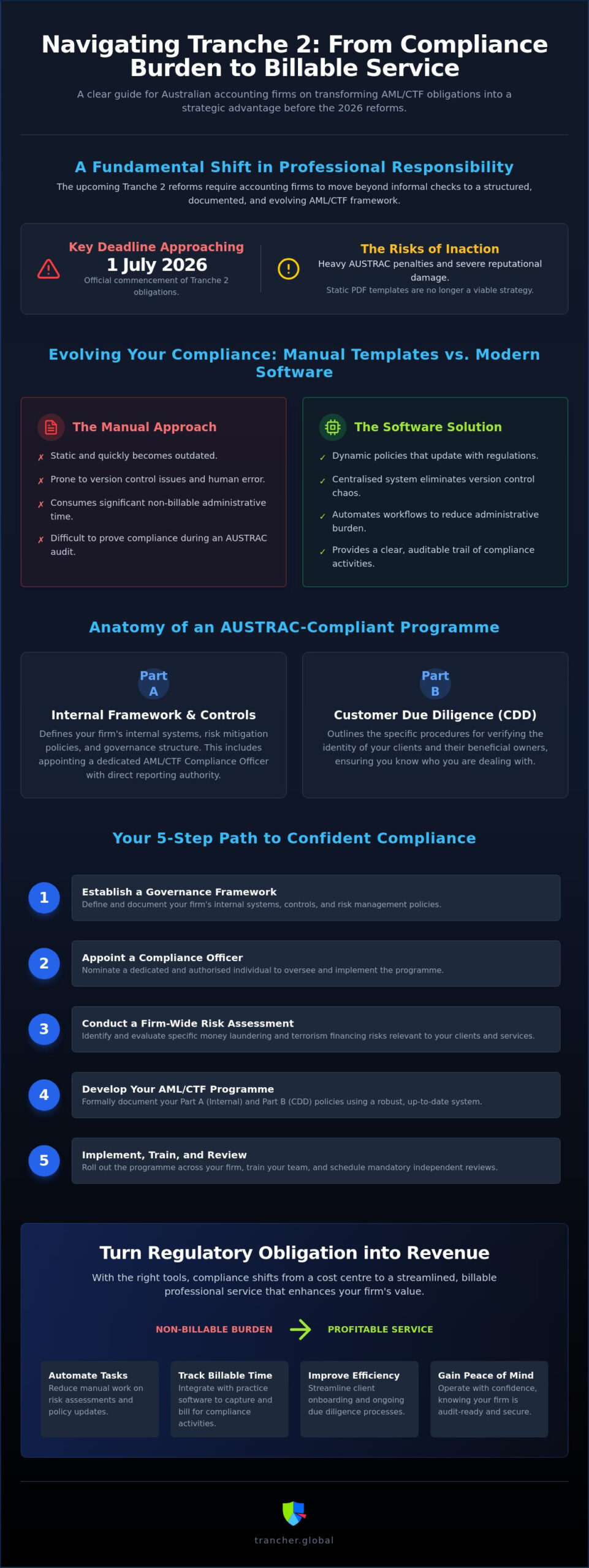
Five Steps to Designing an AUSTRAC-Aligned Compliance Program
Building a compliant framework requires a logical, step-by-step approach that moves from high-level governance to granular daily tasks. While the requirements might initially seem overwhelming, breaking them down into manageable phases ensures your firm builds a resilient programme. Implementing AML CTF policy development software at the start of this journey provides a structured environment, ensuring you don’t miss critical regulatory markers as you progress.
- Step 1: Governance and Accountability. Nominate a Compliance Officer at the partner level to oversee the programme. This role is responsible for the day-to-day management of your AML/CTF obligations and acts as the primary point of contact for AUSTRAC.
- Step 2: Firm-Wide Risk Assessment. Evaluate the specific money laundering and terrorism financing risks your practice faces. This involves looking at your client types, the regions you operate in, and the specific delivery channels you use.
- Step 3: Policy Documentation. Draft your Part A (risk management systems) and Part B (customer identification) procedures. These documents must be tailored to your firm’s specific risk profile rather than being generic templates.
- Step 4: Employee Training. Roll out a specialised training programme to ensure all staff understand their obligations and can identify potential “red flags” in client behaviour.
- Step 5: Review and Reporting. Establish a cycle for independent evaluations, which must occur every three years, and prepare for your annual compliance reporting.
Identifying Your Firm’s Designated Services
Not every service an accountant provides is captured under the AML/CTF Act. You must identify which of your offerings are “designated services,” such as tax planning, insolvency advice, or acting as a company secretary. It’s essential to document the reasoning behind your risk ratings for each service. For example, a complex offshore trust structure carries a naturally higher risk profile than a standard individual tax return. Tailoring your programme to these nuances shows AUSTRAC that you have a deep, practical understanding of your firm’s specific vulnerabilities.
Operationalising Your Program
The most effective programmes move beyond paper-based policies and become part of the firm’s daily rhythm. By using automated prompts within your workflow, you can guide staff through suspicious matter reporting without them needing to be legal experts. This integration ensures that the AUSTRAC annual compliance report becomes a simple by-product of your daily work rather than a stressful end-of-year project. If you’re ready to secure your practice and streamline your path to 1 July 2026, you can start your 30-day compliance journey with us today.
The Trancher Advantage: Converting Regulatory Burdens into Revenue
While many firms view the 1 July 2026 deadline with understandable apprehension, Trancher reframes this transition as a significant commercial opportunity. We provide the only AML CTF policy development software specifically engineered to track billable compliance activity. This means the time your team spends on due diligence, risk assessments, and reporting is no longer a lost administrative cost. Instead, it becomes a transparent, recoverable professional service that adds tangible value to your client relationships. We back this transition with a 30-day compliance readiness guarantee, giving you a clear, stress-free path to meeting your AUSTRAC obligations with total confidence.
Our approach moves beyond simple automation. We act as your expert compliance companion, offering comprehensive support during onboarding and ongoing expert guidance from specialists who understand the Australian accounting landscape. This ensures you aren’t just using a tool, but mastering a new, profitable service line. By standardising your workflows, you eliminate the friction of administrative overhead and replace it with a structured, high-margin advisory offering that protects both your firm and your clients.
Tracking Recoverable Compliance Activity
One of the most persistent challenges for accounting practices is justifying the time spent on regulatory requirements. Trancher solves this by generating clear, time-stamped evidence of work performed, making it simple to support client billing for compliance-related activities. Beyond simple cost recovery, the platform uncovers new advisory revenue streams by providing deep insights into client risk profiles and corporate structures that might otherwise go unnoticed. At the conclusion of your complimentary 3-month trial, we provide a formal ROI report. This document demonstrates exactly how much time has been saved and how much revenue has been recovered, proving the financial health of your new compliance framework before you commit to a long-term plan.
Starting Your 30-Day Compliance Journey
Achieving total readiness doesn’t have to be a long or painful process. We invite SME accounting firms to access our complimentary 3-month trial to experience the benefits of automated policy management firsthand. For firms that choose to continue their journey with us after the trial period, we offer a 20% discount when transitioning to a 12-month subscription. This is a practical, cost-effective way to ensure your practice is fully prepared for the 2026 deadline without the need for expensive external consultants. Don’t let regulatory changes weigh your practice down. Start a conversation with Aaron Soh and the Trancher team today to discover how we can help you turn compliance into a strategic advantage.
Securing Your Practice for a Compliant Future
The transition to the Tranche 2 regime doesn’t have to be a source of administrative anxiety. By moving away from static templates and embracing AML CTF policy development software, your firm can replace manual guesswork with automated precision. You now understand how integrating these workflows allows you to reclaim billable hours while satisfying AUSTRAC’s rigorous expectations. It’s about transforming a regulatory requirement into a structured, profitable professional service that strengthens your firm’s internal systems and client trust.
We’re committed to acting as your expert companion throughout this journey. You can rely on our guaranteed AML/CTF compliance within 30 days and access dedicated local Australian support whenever your team needs guidance. Secure your firm’s future with a complimentary 3-month trial of the Trancher AML platform and take advantage of a 20% discount on 12-month subscriptions if you continue after the trial. We’re here to ensure you feel supported, confident, and fully prepared for the road ahead.
Frequently Asked Questions
What is AML CTF policy development software?
AML CTF policy development software is a specialised digital platform designed to help firms create, implement, and maintain a legally compliant AML/CTF program. These tools automate the drafting of governing documents and risk assessments, ensuring your policies align with Australian legislation. By using such software, your firm replaces manual paperwork with a dynamic system that evolves alongside regulatory changes and your specific client risk profiles.
Do Australian accounting firms really need specialised software for Tranche 2?
While not a strict legal requirement, specialised software is becoming essential for managing the complexities of Tranche 2 obligations effectively. Manual systems often lead to version control issues and significant non-billable administrative burdens. Digital platforms provide a structured framework that ensures no regulatory detail is missed, offering a level of audit readiness and operational ease that manual spreadsheets simply cannot provide for a busy practice.
How long does it take to develop a compliant AML/CTF program?
Developing a fully compliant programme manually can take months of intensive research and drafting; however, with the right digital tools, this timeframe is significantly reduced. Trancher offers a 30-day compliance guarantee, providing a guided pathway to ensure your practice is ready well before the 1 July 2026 commencement date. This streamlined approach allows you to focus on your clients while the software handles the heavy lifting of policy architecture.
Can I use a generic AML policy template for my accounting practice?
Using a generic template is risky because AUSTRAC requires your programme to be specifically tailored to your firm’s unique risk profile and the “designated services” you provide. A “one-size-fits-all” document often fails to address the nuances of accounting workflows, such as tax planning or insolvency advice. Dedicated AML CTF policy development software ensures your documentation is bespoke, reflecting the actual risks present in your practice rather than a theoretical average.
How much does AML/CTF compliance software cost in Australia?
The cost of compliance software in Australia varies based on the size of your firm and the level of automation required. While market options offer different structures, such as annual subscriptions or monthly user fees, it’s important to consider the return on investment rather than just the initial price. many firms find that the cost of software is quickly offset by the reduction in non-billable hours and the ability to track compliance as a recoverable professional service.
What happens if my firm is not compliant by 1 July 2026?
Failing to comply by the 1 July 2026 deadline exposes your firm to significant regulatory risks, including heavy court-imposed fines and enforceable undertakings from AUSTRAC. Beyond the financial impact, non-compliance can lead to severe reputational damage within the professional community. It’s vital to begin your enrolment and programme development early, as the deadline for AUSTRAC enrolment following the commencement date is 29 July 2026.
Does Trancher help with the AUSTRAC annual compliance report?
Yes, Trancher is designed to make the AUSTRAC annual compliance report a simple by-product of your daily operations rather than a stressful annual project. The platform automatically captures the data and evidence required for the report throughout the year. This proactive approach ensures that when reporting season arrives, you have all the necessary documentation at your fingertips, ready for submission without frantic, last-minute manual data gathering.
How does software turn compliance into a billable activity?
Modern software turns compliance into a billable activity by providing built-in tracking for all recoverable compliance tasks performed for a specific client. It generates clear evidence of due diligence and risk assessment work, allowing your firm to support professional service fees for these mandatory activities. This shifts compliance from an unrecoverable overhead into a transparent, value-added service that contributes directly to your firm’s financial health and ROI.