

Your AML/CTF compliance obligations shouldn’t be a drain on your firm’s billable hours, but rather a sophisticated new pillar of your advisory services. With the July 1, 2026, deadline now behind us, many Australian accounting practices are feeling the weight of their new status as reporting entities. We understand that the sudden influx of regulatory jargon and the fear of AUSTRAC penalties can be overwhelming. Implementing effective AML CTF staff training Australia wide is often viewed as a hurdle to productivity, yet it’s the most reliable way to protect your firm’s reputation and financial health.
This guide will help you master the essential requirements for AML/CTF staff training to ensure your practice is fully prepared for its Tranche 2 obligations. We’ll provide a clear roadmap for staff readiness, showing you how to maintain audit-ready training records while keeping disruptions to a minimum. You’ll discover how to integrate these mandatory updates into your existing workflows, turning a complex transition into a manageable and even advantageous evolution for your team. By the end of this article, you’ll have the confidence to lead your firm through these changes with steady, professional guidance.
Key Takeaways
- Understand why the July 2026 deadline makes mandatory staff training a non-negotiable requirement for Australian accounting firms providing designated services.
- Identify the specific money laundering and terrorism financing risks unique to the accounting sector through tailored training modules.
- Discover how to implement role-specific AML CTF staff training Australia wide to ensure everyone from junior admin to senior partners meets AUSTRAC’s effectiveness standards.
- Transition from manual spreadsheets to automated compliance platforms that maintain audit-ready records without compromising your firm’s daily operations.
- Learn how to frame compliance as a strategic asset that enhances your internal systems and supports long-term practice growth.
Understanding AML CTF Staff Training Requirements in Australia
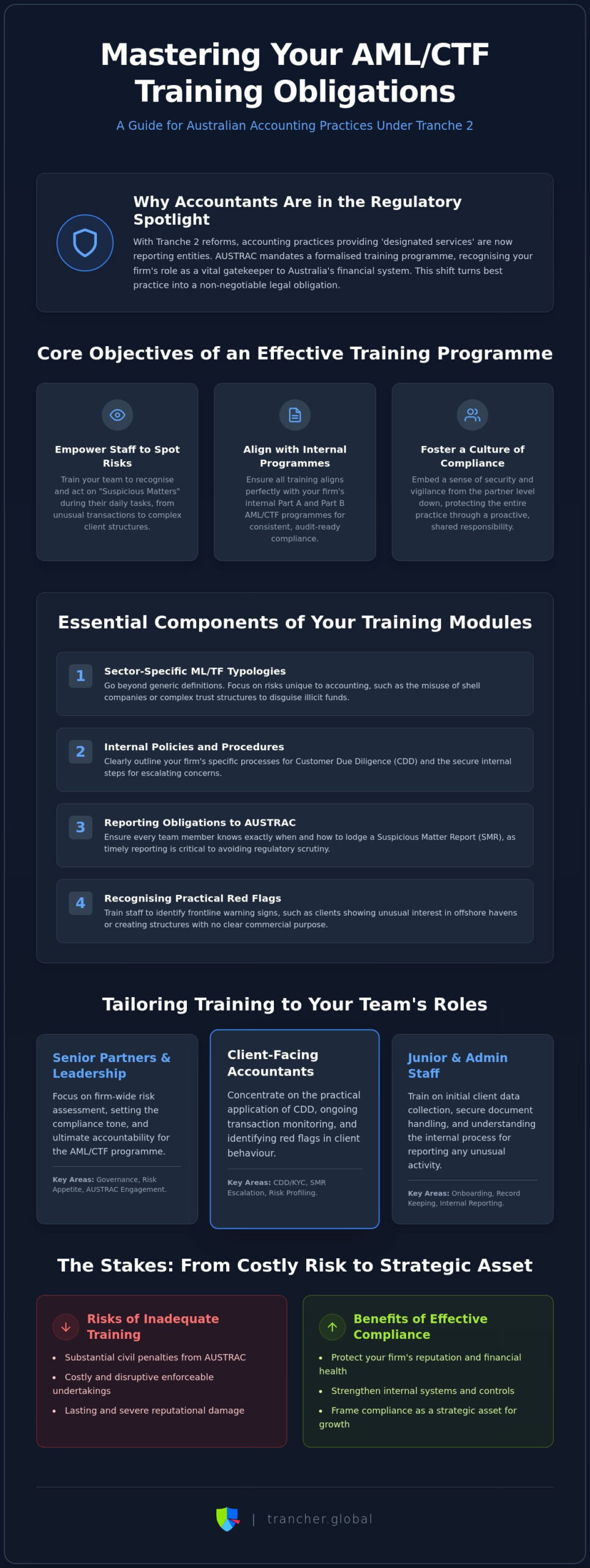
Effective AML CTF staff training Australia wide is no longer an optional extra for accounting firms. Since the Tranche 2 reforms took effect on July 1, 2026, the regulatory landscape has shifted permanently. Every practice providing designated services must now maintain a formalised training programme. This is an AUSTRAC-mandated requirement designed to ensure your team can recognise and mitigate the specific money laundering and terrorism financing risks your firm faces. It isn’t a one-off event; it’s a foundational part of your firm’s operational health.
The Australian Transaction Reports and Analysis Centre (AUSTRAC) oversees these requirements with a clear focus on accountability. If your firm provides services like tax planning, business advisory, or trust formation, you’re likely providing designated services. Failing to meet these standards carries heavy costs. Beyond the risk of substantial civil penalties, inadequate training can lead to enforceable undertakings or lasting reputational damage. We view these obligations as an opportunity to strengthen your internal systems rather than a hurdle to overcome.
Your training must follow a risk-based approach. This means your modules shouldn’t be generic. They must reflect your firm’s specific client profile, the types of services you offer, and the delivery channels you use. A firm specialising in high-net-worth international structures faces different risks than a suburban practice focused on local small businesses. Tailoring your education ensures that your team isn’t just compliant, but genuinely prepared.
Why Accountants are Now in the Regulatory Spotlight
Accountants act as gatekeepers to the Australian financial system. You’re often the first point of contact for clients looking to move funds or restructure assets. Tranche 2 formalises this role. It turns what used to be voluntary best practice into a mandatory legal obligation. AUSTRAC recognises that your professional expertise is a vital line of defence against financial crime. This shift from voluntary to mandatory compliance means that every staff member must understand their role in this national security effort.
The Core Objectives of an Effective Training Programme
A successful programme empowers your staff to spot “Suspicious Matter” during their daily tasks. Whether it’s a junior accountant noticing unusual transaction patterns or a partner identifying a complex structure with no clear commercial purpose, the training must be practical. It should align perfectly with your firm’s internal Part A and Part B programmes. When a culture of compliance starts at the partner level, it creates a sense of security that protects the entire practice. This proactive stance ensures your team remains focused on growth while we handle the complexities of regulatory readiness.
The Essential Components of Your AML/CTF Training Modules
Generic training modules often fail because they don’t address the day-to-day realities of an accounting practice. To be truly effective, your AML CTF staff training Australia programme must go beyond broad definitions. It needs to focus on specific Money Laundering and Terrorism Financing (ML/TF) typologies that target the accounting sector. For instance, staff should understand how shell companies or complex trust structures can be misused to disguise the origin of illicit funds. This depth of knowledge ensures your team isn’t just ticking boxes, but actively protecting the firm’s integrity.
Every training module should clearly outline your firm’s internal policies. This includes specific procedures for reporting and the exact steps required for Customer Due Diligence (CDD). Understanding your reporting obligations is vital. Your team needs to know exactly when and how to lodge a Suspicious Matter Report (SMR) with AUSTRAC. This isn’t just about identifying a crime; it’s about recognising when a transaction or client interaction doesn’t feel right and knowing the secure internal process to follow. Timely reporting is essential, as delays can lead to increased regulatory scrutiny for the entire firm.
Recognising Red Flags in Accounting Workflows
Practical red flags are the frontline of your compliance strategy. Your team should be alert to clients who show an unusual interest in offshore tax havens or complex trust structures without a clear business purpose. These arrangements often lack transparency and can be used to obscure the ultimate beneficiary of the funds. Sudden, unexplained changes in a client’s transaction patterns or source of wealth are equally significant. If a long-term client suddenly begins moving large sums of cash through their business accounts, your staff must feel empowered to flag this for review. Inconsistent or unverifiable identification documents are another immediate warning sign that requires further investigation.
KYC and CDD: Beyond Simple ID Checks
Modern compliance requires more than just sighting a driver’s licence. Training must equip your staff to verify Beneficial Ownership within intricate company structures. This is where the real risk often hides. To help your team master these processes, we’ve developed a comprehensive CDD and KYC Requirements Australia: The 2026 Accountant’s Guide. When dealing with high-risk clients, your staff must also understand how to apply Enhanced Due Diligence (EDD). This involves deeper background checks and more frequent monitoring to mitigate potential threats. Using a platform that integrates these checks into your existing workflow, such as Trancher’s automated compliance tools, can significantly reduce the administrative burden while ensuring total accuracy.
Tailoring Training to Your Accounting Team’s Roles
A generic approach to compliance education is more than just inefficient; it’s a regulatory liability. AUSTRAC’s effectiveness test requires that your AML CTF staff training Australia programme is directly relevant to the specific duties of each employee. If a junior staff member is only exposed to high-level theory they never use, your firm remains vulnerable to operational errors. We believe that when education is tailored to a person’s actual daily tasks, it transforms from a dry administrative burden into a practical tool for practice excellence.
Your AML/CTF Compliance Officer requires a different level of expertise altogether. This individual serves as your firm’s primary contact with AUSTRAC and must undergo advanced training that covers legislative updates, reporting thresholds, and programme oversight. They are the steady hand guiding your practice through the evolving regulatory landscape. Providing them with the right resources ensures they can lead with confidence and clarity.
Role-Based Training Framework for SME Firms
Breaking down training by responsibility ensures that no team member is overwhelmed by irrelevant data. This structured approach creates a more efficient learning environment and a more resilient firm.
- Admin Staff: These team members are often the first point of contact. Their training should focus on the accurate collection of KYC documents and identifying basic behavioural red flags during initial client interactions.
- Client Managers: As the primary relationship holders, these staff members require a deep dive into risk assessment and ongoing monitoring. They must understand how to ensure client profiles remain accurate as circumstances change.
- Partners and Directors: Training for leadership centres on governance, oversight, and strategic risk management. It’s about understanding the firm’s overall risk appetite and maintaining a culture of compliance from the top down.
Ongoing Education vs. One-Off Induction
Compliance isn’t a “set and forget” exercise. While a thorough induction is essential for every new hire, ongoing education ensures your team stays sharp as new financial crime threats emerge. We recommend integrating AML updates into your regular team meetings or monthly CPD sessions. This keeps the conversation alive and ensures that when AUSTRAC releases new threat bulletins, your staff are already prepared to respond. Using automated triggers to manage training deadlines removes the manual stress of record-keeping. It allows you to maintain a rhythm of readiness that protects your firm’s future without disrupting your daily operations.
Implementing Training Without Disrupting Practice Efficiency
Managing AML CTF staff training Australia wide manually is a recipe for administrative exhaustion. We’ve seen many firms struggle with fragmented spreadsheets that fail to provide a clear picture of team readiness. Transitioning to a centralised, automated platform allows you to track progress in real-time. This ensures your practice remains audit-ready at all times, removing the stress of manual record-keeping. For a deeper look at maintaining these standards, explore our guide on Audit-Ready Compliance Records: The 2026 Guide for Australian Accounting Firms.
The goal is to move away from non-revenue activities that eat into your billable hours. Automation allows you to monitor completion rates across your entire team with a single click. When an AUSTRAC auditor requests proof of training, you won’t need to scramble through emails or paper files. You’ll have a digital trail that demonstrates your firm’s commitment to compliance and operational excellence. This proactive approach protects your reputation and provides peace of mind for the partners.
Automation: The Key to SME Compliance
Integrated software is the most effective way for SME firms to handle the Tranche 2 workload. It reduces the “admin heavy” burden by automating reminders and centralising documentation. We understand that time is your most precious resource. That’s why Trancher’s 30-day compliance-ready guarantee is designed to get your firm up to speed quickly and without friction. You can automate your compliance workflow with Trancher to ensure your team stays focused on high-value client work.
Compliance as a Profit Centre
We believe compliance should be a profit centre, not just a cost. When your staff are trained to look deeper during the KYC process, they identify new advisory opportunities that others might miss. This transforms a regulatory hurdle into a premium professional service for your clients. By using Compliance ROI Tracking Software: Transforming Regulatory Obligations into Billable Assets, you can measure the financial health of your compliance activities. It’s about framing these new obligations as an avenue for growth and improved internal systems.
How Trancher Simplifies Your AML/CTF Staff Training
Trancher isn’t just a software provider; we’re your dedicated partner in navigating the complexities of the Tranche 2 reforms. Our platform offers role-based training modules designed by AML expert Aaron Soh specifically for the Australian accounting sector. This ensures your AML CTF staff training Australia is relevant, practical, and highly efficient. Instead of wrestling with generic content that doesn’t apply to your practice, your team receives education that mirrors their daily workflows, from initial client onboarding to partner-level oversight. We focus on making the transition feel manageable and even advantageous for your firm’s internal systems.
We understand that documentation is often the most stressful part of an AUSTRAC audit. Trancher’s automated record-keeping captures every training completion and policy update in real-time. This creates a permanent, tamper-proof audit trail that satisfies even the strictest regulatory scrutiny without requiring manual intervention from your staff. If you ever encounter a complex client scenario or a high-risk structure that requires a second opinion, our expert on-call support is available to provide the steady guidance you need to move forward with confidence. We act as an extension of your team, ensuring you’re never left to interpret vague regulations on your own.
Start Your 3-Month Complimentary Trial
We want you to experience the clarity and operational ease of our platform without any initial pressure. That’s why we offer a 3-month complimentary trial for SME firms. This gives you full access to our specialised modules and automated tracking features. During this period, you’ll receive a formal ROI report that details the efficiency gains and billable time saved by your team. If you decide to continue after the trial, you’ll also claim a 20% discount for your first year. It’s a risk-free way to see how compliance can support your firm’s growth and improve your overall financial health.
The Trancher Guarantee: Audit-Ready in 30 Days
Our 30-day compliance-ready guarantee removes the guesswork from your AML/CTF programme design. We don’t just hand you a login; we step through the entire onboarding process with you. A dedicated specialist will help you configure the platform to suit your practice’s specific risk profile and service offerings. This structured path ensures that your firm is fully prepared for its obligations well ahead of the July 2026 milestones. To start your journey toward seamless compliance and turn your regulatory burdens into strategic assets, organise a conversation with Aaron Soh today.
Future-Proof Your Practice with Strategic Compliance
Mastering your regulatory obligations is about more than avoiding penalties; it’s about building a more resilient and sophisticated accounting firm. We’ve explored how role-based education ensures every team member is prepared, and how automation removes the friction from your daily operations. By implementing a structured approach to AML CTF staff training Australia wide, you protect your firm’s reputation while identifying new advisory opportunities for your clients. Transitioning to these new standards doesn’t have to be a burden when you have the right partner by your side.
Trancher is designed specifically for SME accounting firms, offering a 30-day compliance-ready guarantee and local Australian expert support. We’re here to act as your steady guide, ensuring you navigate the post-July 2026 landscape with complete confidence. You can start your 3-month complimentary Trancher trial today to see how we transform complex requirements into manageable, automated workflows. Let’s work together to turn your compliance obligations into a strategic advantage for your practice. We’re ready to help you every step of the way.
Frequently Asked Questions
Is AML/CTF training mandatory for all accounting staff in Australia?
Training is mandatory for every staff member involved in the delivery of “designated services” as defined by AUSTRAC. This includes anyone from administrative assistants who collect client identification to senior partners who approve complex business structures. Your AML CTF staff training Australia programme must be tailored to ensure that each person understands how to recognise and mitigate the specific risks associated with their particular role.
How often do we need to provide AML/CTF refresher training?
AUSTRAC requires that training is “ongoing” rather than a one-off event, though it doesn’t prescribe a strict calendar frequency. Most accounting firms find that an annual refresher is the minimum necessary to keep staff updated on evolving financial crime typologies. You should also provide immediate training whenever your firm’s risk profile changes, such as when you offer new services or when the government updates relevant legislation.
What happens if our firm fails an AUSTRAC audit on staff training?
Failing to maintain a compliant training programme can result in significant civil penalties or an enforceable undertaking. Since the Tranche 2 deadline on July 1, 2026, AUSTRAC has the authority to take formal enforcement action against firms that willfully ignore their obligations. Beyond the financial impact, the resulting reputational damage can be a far greater threat to your practice’s long-term growth and client trust.
Can we outsource our AML/CTF staff training to a third party?
You can use specialised third-party providers or digital platforms to deliver your training, which often ensures a higher standard of industry-aligned content. However, the legal responsibility for the programme’s effectiveness always remains with your firm’s partners and the AML/CTF Compliance Officer. Using a dedicated platform simplifies this by providing expert-led modules that are specifically designed for the accounting sector’s unique risk environment.
What records do we need to keep to prove our staff are trained?
You must maintain detailed records that include the names of staff members who received training, the dates the sessions occurred, and a summary of the content covered. These records must be kept for seven years and be readily available for inspection during an AUSTRAC audit. Automated platforms are particularly useful here, as they generate digital logs and completion certificates that serve as definitive proof of your firm’s compliance.
Does the July 2026 Tranche 2 deadline apply to solo practitioners?
The July 2026 deadline applies to all practitioners who provide designated services, regardless of the size of their practice. Solo practitioners must enrol with AUSTRAC and have a documented AML CTF staff training Australia process in place just like larger firms. While the scale of the programme may be smaller, the requirement to understand and document your risk management procedures is exactly the same.
How can we make AML training billable to our clients?
Forward-thinking firms frame compliance as a premium advisory service that adds value to the client’s own risk management strategy. By educating your team to identify advisory opportunities during the KYC process, you can transform a mandatory task into a billable advisory capability. This allows you to include compliance-related activity in your engagement letters, ensuring the firm is fairly compensated for its professional expertise and regulatory diligence.
What is the difference between Part A and Part B training requirements?
Part A training focuses on your firm’s overarching risk management systems, including how you identify and report suspicious activity. Part B is more granular, covering the specific procedures for Customer Due Diligence (CDD) and verifying beneficial ownership. Your staff training must cover both components so that your team understands not just the “how” of checking a driver’s licence, but the “why” behind the firm’s broader security obligations.