

Did you know that Australian accounting practices using manual systems are currently losing up to 60 non-billable hours every month to administrative overhead? Since Tranche 2 obligations commenced on 1 July 2026, many partners feel a valid sense of anxiety regarding AUSTRAC audits and the complexity of verifying intricate trust structures. You likely agree that the old way of handling compliance isn’t sustainable, yet knowing exactly how to implement an AML program that doesn’t erode your profit margins can feel like a moving target.
It’s time to reframe this regulatory shift as a strategic advantage rather than a hurdle. This guide provides a structured roadmap to mastering your compliance requirements while improving your firm’s operational health. We’ll show you how to move from manual spreadsheets to automated KYC workflows, ensure your framework is entirely defensible, and most importantly, how to transform compliance activity into a recoverable, professional service. You’ll gain the confidence to manage AUSTRAC expectations with a calm, solution-oriented approach that protects your practice and your bottom line.
Key Takeaways
- Understand why the 1 July 2026 Tranche 2 commencement requires accounting firms to formalise their AUSTRAC enrolment and compliance frameworks immediately.
- Discover exactly how to implement an AML program using a five-pillar approach that addresses both risk management and customer identification requirements.
- Build a defensible foundation by identifying specific risks within your client base and service delivery channels to prevent regulatory friction.
- Learn how to transform compliance from a non-billable administrative burden into a recoverable professional service that adds value to your firm.
- Achieve full operational readiness within 30 days by adopting automated KYC workflows and integrated ROI tracking systems.
Understanding the Tranche 2 AML Landscape in 2026
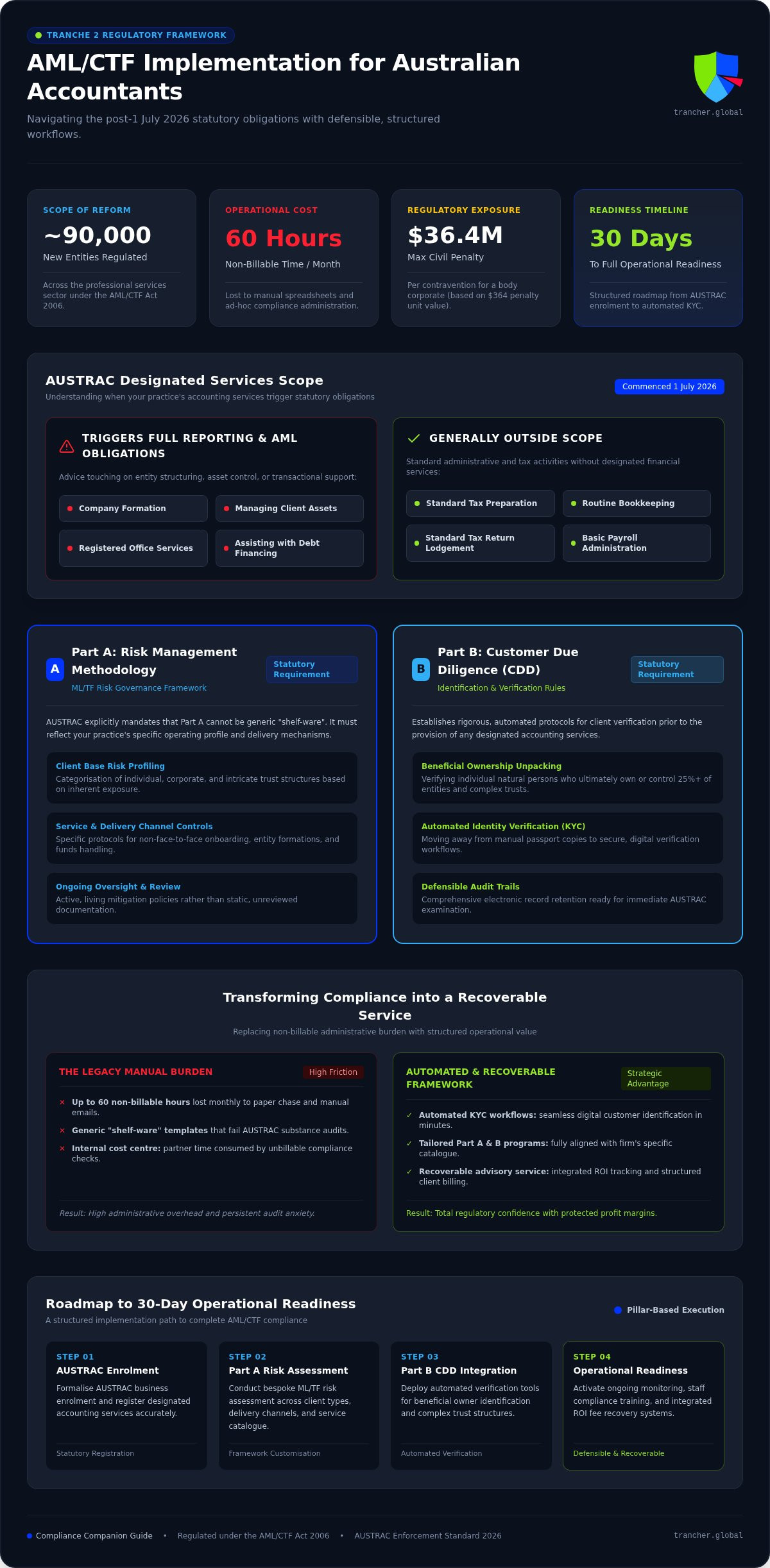
The regulatory environment for Australian accountants shifted permanently on 1 July 2026. This date marked the formal commencement of Tranche 2 obligations, extending the reach of the AML/CTF Act 2006 to approximately 90,000 new entities across the professional services sector. For many practitioners, the primary challenge isn’t just understanding the law; it’s figuring out how to implement an AML program that integrates with existing workflows without causing friction. You’re no longer just a tax agent or an auditor. In the eyes of the law, you’re now a frontline defender against financial crime.
The Australian Transaction Reports and Analysis Centre (AUSTRAC) oversees this regime as the national financial intelligence unit. In 2026, their enforcement priorities have sharpened significantly. They’re looking beyond simple enrolment to the substance of your compliance activities. This means your firm must accurately identify “designated services” within your catalogue. Activities such as company formation, managing client assets, providing a registered office, or assisting with debt financing all trigger full reporting obligations. Standard tax return preparation and routine bookkeeping generally fall outside this scope, but the moment your advice touches on entity structuring or asset control, the rules apply in full.
The Shift from Voluntary to Mandatory Compliance
Compliance is no longer a matter of professional “best practice” or a voluntary badge of quality. It’s a strict statutory requirement. The stakes are undeniably high. Under the current penalty unit value of $364, a body corporate faces civil penalties of up to $36.4 million per contravention. While these figures highlight the regulator’s seriousness, the real risk for most boutique firms lies in the unrecoverable administrative hours lost to manual, ad-hoc processes. Mastering how to implement an AML program early allows you to replace regulatory anxiety with a structured, defensible framework that protects your partners and your licence.
Why 2026 is the Year of Operational Readiness
Moving past the “wait and see” approach is the most effective way to protect your firm’s reputation. Proactive implementation signals to your clients and the regulator that you take financial integrity seriously. Early adoption isn’t just about avoiding fines. It’s about organising your practice for a new era of regulated advisory. Trancher assists firms in navigating this transition by providing a clear, supportive path to operational readiness. We guarantee your practice will be AML/CTF compliant within 30 days of starting, moving you from regulatory uncertainty to total confidence. Our approach focuses on removing the heavy lifting, ensuring your transition to Tranche 2 is both manageable and commercially advantageous.
The 5 Essential Pillars of a Defensible AML/CTF Program
Building a robust compliance framework requires more than just a signed policy document gathering dust on a shelf. Since the 1 July 2026 commencement, AUSTRAC expects to see a living, breathing system that actively identifies and mitigates financial crime risks. Understanding how to implement an AML program is less about ticking boxes and more about establishing five functional pillars that protect your firm from both regulatory scrutiny and criminal exploitation.
A defensible program is divided into two distinct parts. Part A focuses on your risk management methodology, specifically how you identify, mitigate, and manage money laundering and terrorism financing (ML/TF) risks. Part B details your Customer Due Diligence (CDD) procedures, outlining how you verify the identity of your clients and their beneficial owners. You can find detailed requirements in AUSTRAC’s AML/CTF reform guidance, which provides the legislative context for these obligations.
Designing Your Compliance Framework
Customising your program to your firm’s specific size and risk profile is a statutory necessity. AUSTRAC explicitly warns against “shelf-ware” or generic templates that don’t reflect your actual service catalogue. Your Part A must include a thorough ML/TF risk assessment that considers your client types, the nature of your designated services, and your delivery channels. If you provide entity structuring or manage client money, your risk profile is naturally higher than a firm focused solely on domestic tax compliance. A tailored approach ensures your controls are proportionate to the risks you actually face.
The Role of the AML Compliance Officer
Appointing a senior staff member to lead your compliance efforts is a mandatory requirement. This individual must have the authority and resources to oversee the program effectively. Clear communication is vital, as they must be able to report directly to the board or partners. Reviewing the responsibilities of an AML compliance officer helps ensure your lead is equipped to handle everything from enrolment to reporting. Expert support from Trancher empowers your internal lead by automating the heavy lifting of verification and record-keeping, allowing them to focus on strategic oversight.
Beyond governance, your program must include three other critical components. First, you need an ongoing staff training program that fosters a genuine culture of compliance. Second, you must establish an independent review schedule to test your program’s effectiveness. Third, you must manage your reporting obligations. This includes filing Suspicious Matter Reports (SMRs) within 24 hours for suspected terrorism financing (or 3 business days for other matters) and Threshold Transaction Reports (TTRs) for cash transactions of $10,000 or more. When researching how to implement an AML program, remember that all records, from KYC checks to risk assessments, must be retained for at least 7 years. If you’re unsure where your current documentation sits, you can explore our end-to-end program management options to close the gaps.
Assessing Risk: The Foundation of Your Compliance Framework
A defensible program isn’t built on guesswork. It’s built on a granular understanding of the specific threats your practice faces. AUSTRAC requires a risk-based approach, meaning your controls must be proportionate to the level of risk identified. Learning how to implement an AML program effectively begins with distinguishing between inherent risk and residual risk. Inherent risk is the raw threat posed by your clients, services, and delivery channels before any controls are applied. Residual risk is the exposure that remains after your mitigation strategies, such as automated screening and staff training, have been implemented.
Your assessment must be dynamic, evolving as your client base grows or your service catalogue expands. The FATF Guidance for a Risk-Based Approach for the Accounting Profession provides the international benchmark for this process, emphasising that risk is not static. For many Australian SMEs, using a dedicated AML risk assessment tool Australia is the most efficient way to maintain this methodology without needing a forensic accounting department.
Customer Risk Profiling for Accountants
Not every client requires the same level of scrutiny. Standard Due Diligence (SDD) is typically sufficient for low-risk individuals, but certain triggers mandate Enhanced Due Diligence (EDD). You must have clear procedures for managing high-risk entities, particularly complex trust structures where identifying the natural persons who ultimately own or control 25% or more of the entity is mandatory. Your framework must also include automated checks for Politically Exposed Persons (PEPs) and sanctioned individuals. These profiles carry a higher risk of bribery or corruption, requiring more frequent monitoring and senior management approval before the business relationship proceeds.
Service and Channel Risk Factors
The nature of your services significantly impacts your firm’s risk profile. While standard tax returns are lower risk, services like entity restructuring, managing client money, or acting as a nominee shareholder are high-risk triggers. Similarly, the way you interact with clients matters. Non-face-to-face onboarding has become common, but it introduces higher identity fraud risks compared to in-person verification. To satisfy AUSTRAC record-keeping standards, you must document your rationale for every risk rating assigned. This audit trail is your primary defence during a regulatory review, proving that your decisions were based on a structured, objective methodology rather than ad-hoc assumptions.
Step-by-Step Implementation: From Enrolment to Operational Readiness
Moving from the conceptual pillars of regulation to a live, operational system is where many firms encounter friction. Practical implementation isn’t merely about ticking boxes on a government portal; it’s a structural evolution of how your firm handles client data and risk. If you’re wondering how to implement an AML program that actually works, the secret lies in a methodical, phased approach that prioritises internal readiness before external reporting.
Operational readiness follows a logical sequence of five critical steps:
- Step 1: Conduct a Gap Analysis. Review your current onboarding workflows to identify where manual processes or missing data points exist. This isn’t just about what you have, but about identifying the friction points that could slow down your team.
- Step 2: Formalise Documentation. Draft your Part A and Part B programs. These must be approved by your partners and reflect the actual risks identified in your practice-level assessment.
- Step 3: Enrol with AUSTRAC. The online portal opened on 31 March 2026. If your firm was already providing designated services by 1 July 2026, you must complete your enrolment by 29 July 2026. This includes formalising the appointment of your AML/CTF Compliance Officer.
- Step 4: Team Training. Equip your staff to recognise “red flags,” such as unusual transaction patterns or reluctance to provide identity documents. They must understand the 24-hour reporting window for suspected terrorism financing.
- Step 5: Deploy Monitoring Tools. Use an automated AML program checklist Australia to manage ongoing Customer Due Diligence (CDD) and ensure no client falls through the cracks.
Streamlining Client Onboarding
Automation is the most effective way to maintain a positive client experience while meeting strict statutory requirements. By simplifying client onboarding for law firms and accounting practices, you remove the administrative burden from your professional staff. Modern systems can automatically collect Ultimate Beneficial Ownership (UBO) data, verifying individuals who own or control 25% or more of an entity without manual back-and-forth emails. This allows you to maintain a seamless experience for low-risk clients while focusing your energy on complex structures that require enhanced due diligence.
The 30-Day Compliance Guarantee
Trancher provides a clear, supportive path to total operational readiness. We understand that accounting partners are focused on client outcomes, not administrative hurdles. Our platform moves your firm away from disconnected spreadsheets and into an integrated compliance ecosystem. We guarantee that your practice will be AML/CTF compliant within 30 days of starting our implementation framework. During your first month, you’ll see your non-billable hours drop as biometrics, PEP screening, and sanctions checks are handled automatically. You can start your 3-month complimentary trial today to see exactly how we turn a complex regulatory transition into a manageable, structured success.
Transforming Compliance from a Cost Centre into a Profitable Service
Many firms view the 1 July 2026 commencement as an inevitable drain on resources. However, the most successful practices are reframing this transition. Instead of absorbing the costs, they’re discovering that knowing how to implement an AML program with a commercial mindset can actually improve firm profitability. When you automate the heavy lifting, you’re not just “ticking boxes”; you’re organising your firm for a new era of high-value, regulated advisory.
The KYC process is often the most thorough “client discovery” phase you’ll ever undertake. As you verify beneficial owners and complex trust structures, you’ll naturally identify gaps in your clients’ estate planning, corporate governance, or asset protection. These aren’t just compliance data points; they’re triggers for high-value advisory conversations that might have otherwise remained hidden. By treating the onboarding phase as a strategic review, you turn a mandatory requirement into a source of new billable opportunities.
The ROI of Automated Compliance
Manual due diligence is a productivity killer. Industry tracking indicates that practices relying on disconnected spreadsheets often lose over 40 non-billable hours every month to administrative tasks. By using compliance ROI tracking software, you can precisely measure the time saved through automated biometrics and screening. This transparency allows partners to see the direct correlation between automation and recovered billable capacity. A subscription-based platform provides a fixed, predictable cost that’s significantly lower than the opportunity cost of having senior accountants manually chasing identity documents.
Billing for Compliance Activities
Your clients already value security and integrity. Positioning your firm as a premium, regulated partner justifies a structured approach to compliance fees. Many practices now include a “Regulatory Verification & Onboarding” fee in their engagement letters. This covers the cost of biometric KYC, PEP and sanctions screening, and the ongoing risk monitoring required for designated services. When you explain that these checks protect both the firm and the client from financial crime, the surcharge becomes a sign of professional standards rather than an arbitrary cost.
Understanding how to implement an AML program isn’t just a defensive move. It’s a way to demonstrate that your firm is a modern, secure, and highly competent partner. With Trancher’s 3-month complimentary trial, you have a risk-free window to establish these billing models and prove the ROI before your first subscription payment. You’ll move from regulatory anxiety to a position where compliance is a seamless, profitable part of your professional service offering.
Securing Your Firm’s Future in a Regulated Landscape
The transition to Tranche 2 doesn’t have to be a source of constant administrative pressure. By reframing these obligations as a chance to refine your internal systems, you’re positioning your practice for long-term growth and enhanced client trust. You’ve seen that the path forward involves moving away from manual spreadsheets and adopting a structured approach to risk and verification. Learning how to implement an AML program is ultimately about creating a more resilient, profitable, and secure firm.
You don’t have to navigate these complexities alone. With our 30-Day Compliance-Ready Guarantee and expert AUSTRAC-aligned support, we ensure your firm is fully prepared without the usual stress. Start your complimentary 3-month Trancher trial today to experience the benefits of automated KYC and ROI tracking firsthand. After your trial, you’ll also enjoy a 20% discount on your first 12-month subscription. We’re here to act as your steady guide, helping you turn regulatory requirements into a distinct professional advantage.
Frequently Asked Questions
How much does it cost to implement an AML program for a small firm?
Implementation costs generally include software fees and the internal time required for staff training and program setup. While many firms worry about the financial burden, the focus should be on recovering these costs through structured compliance fees. Trancher provides a 3-month complimentary trial that includes a formal ROI report; this allows you to prove the commercial viability of your compliance framework before any subscription payments begin. It’s about turning a requirement into a billable asset.
Do I need a dedicated AML officer if I am a sole practitioner?
Every reporting entity, including sole practitioners, must formally appoint an AML/CTF Compliance Officer. If you’re a sole practitioner, you’ll naturally take on this responsibility yourself. This role involves overseeing the day-to-day operation of your program and serving as the primary liaison with AUSTRAC. While it adds a layer of responsibility, using automated tools ensures that the actual administrative heavy lifting doesn’t distract you from your core client advisory work. It ensures you remain compliant without the stress.
What is the difference between an AML program and a risk assessment?
An AML/CTF Program is the complete governance framework required by law, consisting of Part A (risk management) and Part B (customer identification). A risk assessment is a foundational component within Part A. It’s the process where you identify and document the specific money laundering and terrorism financing threats your firm faces. Understanding how to implement an AML program starts with this assessment, as it dictates the level of controls you’ll need to apply to your practice.
Can I use my existing KYC documents for Tranche 2 compliance?
Your existing documents might provide a starting point, but they rarely meet the strict statutory standards required under Tranche 2. The 2026 regulations demand specific verification of beneficial owners and natural persons who own or control 25% or more of an entity. Most standard engagement letters lack the biometric checks and PEP screening necessary for a defensible program. Transitioning to an automated system ensures your KYC data is both current and audit-ready for AUSTRAC review.
How often does my AML/CTF program need to be independently reviewed?
AUSTRAC requires that your program is subject to regular independent reviews to ensure it remains effective and compliant. While the legislation doesn’t mandate a specific timeframe, most firms schedule a review every two to three years or whenever a significant change occurs in their service catalogue. These reviews test whether your staff are following the program and if your risk assessments accurately reflect your current client base and delivery channels. It’s a vital part of maintaining governance.
What happens if I miss the 1 July 2026 AUSTRAC deadline?
Failing to meet the 1 July 2026 commencement date places your firm at significant regulatory and reputational risk. AUSTRAC’s enforcement toolkit includes civil penalties, which can reach up to $36.4 million for corporate entities. Beyond financial fines, non-compliance can lead to enforceable undertakings or the suspension of your registration. Starting early allows you to build a defensible framework calmly, ensuring you’re operationally ready well before the regulator begins their first inspection cycle for accounting practices.
Is my firm required to submit a suspicious matter report for every red flag?
A red flag is an indicator that requires further investigation rather than an automatic reporting trigger. You’re required to submit a Suspicious Matter Report (SMR) only when you have reasonable grounds to suspect a transaction or client activity involves criminal proceeds or terrorism financing. Your program should include clear workflows for escalating these flags to your Compliance Officer. They then determine if a report to AUSTRAC is legally necessary within the required 24-hour or 3-day timeframes.
How does Trancher help with AUSTRAC audit readiness?
Trancher organises your compliance activity into a structured, central repository that is specifically designed for regulatory review. We provide the tools to maintain a 7-year audit trail of all KYC checks, risk assessments, and staff training records. By automating the evidence-gathering process, we ensure you can confidently demonstrate how to implement an AML program that is active and effective. This proactive approach removes the stress of an AUSTRAC audit by ensuring your documentation is ready.