

An accounting firm’s title doesn’t determine whether its work is captured by Australia’s AML/CTF rules. The engagement does. To understand what is a designated service AUSTRAC may regulate, look at the specific work performed and whether it fits a relevant description and its conditions. This matters when a firm handles both routine accounting work and transaction-related tasks for the same client.
Broad service descriptions can be difficult to apply to varied accounting work, and a transaction-related task can be easy to miss when reviewing an engagement. This practical comparison explains how to assess the work, distinguish routine tasks from those that may need closer review, and record the facts behind a scope decision. It also sets out a repeatable review process and explains how designated service tracking can support consistent records across your firm.
Key Takeaways
- For what is a designated service AUSTRAC, focus on the activity being provided, not the firm’s professional title.
- Compare the engagement’s actual work and transaction context with the relevant service description and its conditions.
- Separate routine accounting tasks from transaction-related work, and flag engagements that need closer review.
- Record the work performed, the service description considered, applicable conditions and the reasoning behind the scope decision.
- Use consistent intake prompts and designated service tracking to support clear records, alongside current AUSTRAC guidance and legislation.
What is a designated service under AUSTRAC?
In plain terms, a designated service is an activity identified in the Anti-Money Laundering and Counter-Terrorism Financing Act 2006 (AML/CTF Act), where the applicable statutory conditions, including the geographical link requirement, are met. The key is to assess the service and the law’s conditions, rather than assume that a particular type of business is automatically in or out of scope.
Quotable definition: Under the AML/CTF Act, a designated service is a service identified by the Act that meets the applicable statutory conditions, including the geographical link requirement.
This definition is a starting point, not a shortcut to a decision. The service description may apply to particular activities or circumstances. Compare the engagement facts with the wording of the Act and relevant AUSTRAC guidance before recording a conclusion.
What does the term mean in practical terms?
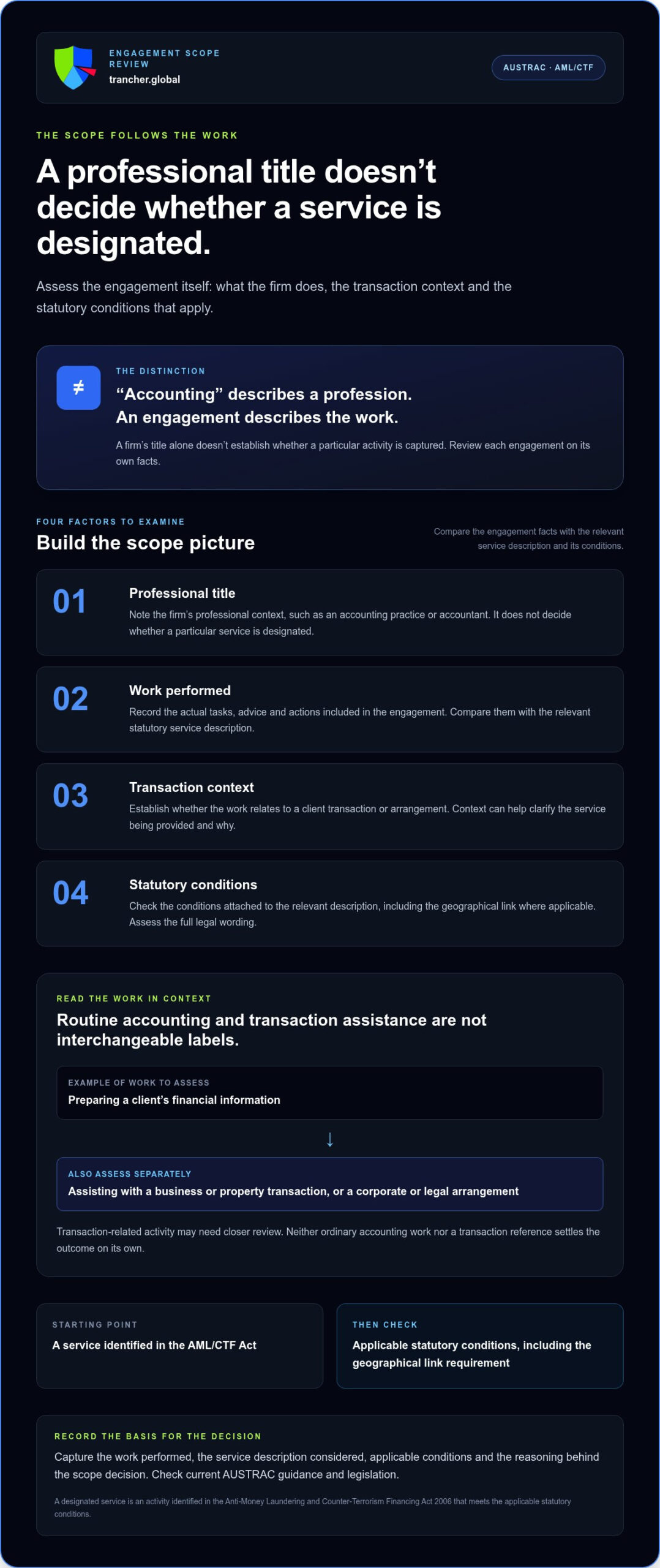
A firm’s occupation is broad; a designated service is specific. “Accounting” describes a profession, while an engagement sets out what the firm does for a client. For scope review, focus on the tasks actually agreed and carried out.
For example, an accounting firm might prepare a client’s financial information and also assist with a transaction. Assess those activities separately against the relevant statutory descriptions. The firm’s professional title alone doesn’t establish whether either activity is captured.
For each engagement, identify the work performed, its purpose and the surrounding circumstances. Then compare those facts with the statutory service description and any conditions that apply. Similar labels in engagement letters can conceal different tasks, while different labels can describe similar work. The service name is useful context, but it can’t replace checking what the firm actually undertakes.
Why does AUSTRAC refer to a geographical link?
The geographical link forms part of AUSTRAC’s glossary definition of a designated service. Identifying an activity that resembles a service description isn’t the whole assessment. The relevant geographical link must also be considered under the applicable legal framework.
Don’t infer the requirement from a client’s location, the firm’s address or a transaction’s destination without checking the current guidance. Those details may be relevant, but they don’t replace applying the legal wording to the circumstances.
Check current AUSTRAC guidance and the legislation for how the geographical link applies to the engagement. If there are cross-border elements or the connection to Australia is unclear, record the known facts and the question that needs review. This gives your firm a clear basis for assessing scope without relying on assumptions or treating an internal workflow as a legal interpretation.
Designated service or professional title: what makes the difference?
An accounting qualification describes a firm’s profession, not the regulatory status of every engagement it accepts. The same firm may provide routine accounting support for one client and undertake transaction-related work for another. Assess each engagement on its own facts: the service description, the firm’s activities, the transaction context and any applicable statutory conditions.
Scope depends on the service provided and the applicable statutory conditions, not on a professional title alone.
| Factor | What to examine | Why it matters |
|---|---|---|
| Professional title | The firm may identify as an accounting practice or accountant. | This provides context, but doesn’t decide whether a particular service is designated. |
| Work performed | Record the actual tasks, advice and actions included in the engagement. | The tasks can be compared with the relevant statutory service description. |
| Transaction context | Establish whether the work relates to a client transaction or arrangement. | Context can help clarify what service the firm is providing and why. |
| Statutory conditions | Check the conditions attached to the relevant description, including the geographical link where applicable. | A possible match needs to be assessed against the full legal wording. |
For firms asking what is a designated service AUSTRAC may treat as captured, the useful comparison is engagement by engagement, not firm by firm. Preparing financial information may differ from assisting with a transaction. Neither the familiar label “accounting” nor a transaction reference in a file settles the outcome on its own. Review the agreed work and how it relates to the relevant statutory description.
When the work itself may bring an engagement into scope
AUSTRAC’s professional services guidance describes services involving transaction-related activity. At a high level, an accountant may help a client with a business or property transaction, or with a corporate or legal arrangement. Identify the firm’s role and compare its actual tasks with the relevant service description and conditions. A broad engagement label won’t make that comparison for you.
Why an accounting engagement may not be captured
A professional relationship doesn’t establish that a designated service was provided. An engagement focused on ordinary accounting work may differ in purpose and scope from one involving transaction assistance. That distinction is a reason to examine the facts, not an automatic exemption. Record what the firm agreed to do and what it did, then assess those details against current AUSTRAC guidance and legislation.
Clear engagement records help staff apply the same review process across different types of client work. Designated service tracking can support consistent recording of scope decisions, while keeping the interpretation of the law within the appropriate review process. Trancher’s designated service tracking workflows help firms organise those records as part of their AML/CTF compliance processes.
Compare client engagements: captured, not captured or needs closer review?
Side-by-side examples can help your team spot engagements that need a closer look. They’re indicators for review, not legal determinations. The outcome depends on the service description, the facts and any applicable conditions. For detailed service categories, compare the engagement with the relevant Table 6 description in the AML/CTF Act and current AUSTRAC material.
| Engagement facts | Relevant service description | Unresolved questions |
|---|---|---|
| Routine-work indicator: The firm prepares financial statements or lodges a tax return, with no other transaction-related work described. | AUSTRAC identifies routine accounting activities as generally not designated services. Still, assess the actual engagement rather than relying on the service label. | Does the firm also perform other tasks for the client? Is there a separate transaction or arrangement to review? |
| Transaction-related review indicator: The firm assists a client with buying or selling a business or real estate. | Compare the firm’s role and activities with the relevant professional services description. | What assistance does the firm provide? How does it relate to the transaction, and do applicable conditions apply? |
| Transaction-related review indicator: The firm helps establish or restructure an entity or arrangement. | Consider whether the work corresponds to a service description relating to creating, restructuring or planning an entity or arrangement. | What is the purpose of the work? Which parts does the firm undertake, and which description may be relevant? |
| Closer review: The firm receives, holds or manages a client’s property in connection with a transaction. | Check the relevant description concerning client money or property and the conditions attached to it. | What property is involved, what does the firm do with it, and how is that activity connected to the transaction? |
These examples aren’t automatic inclusions or exclusions. A transaction appearing in the file doesn’t, by itself, settle whether the firm provided a designated service. Equally, describing work as bookkeeping or accounting doesn’t answer whether additional activities form part of the engagement. The practical question, “what is a designated service AUSTRAC may capture here?”, should lead back to the actual tasks and relevant statutory wording.
What facts can change the comparison?
Start with the work, not the engagement title. Record the client’s purpose, the tasks the firm agreed to perform and the firm’s role in any transaction or arrangement. Separate documented facts from assumptions, such as a presumed connection between accounting advice and a transaction. That distinction helps reviewers see what’s known and what still needs checking.
How should firms handle an unclear example?
Identify the specific statutory description that may apply, then compare the engagement facts with current AUSTRAC guidance, including any stated conditions or exclusions. If interpretation remains uncertain, document the issue and route it through the firm’s appropriate review process. Record the question and reasoning so the matter can be revisited consistently.
How to assess whether an accounting engagement involves a designated service
A consistent review helps your firm explain why an engagement was considered in or out of scope, or why it needs further interpretation. Keep the assessment focused on the service being provided. It isn’t a substitute for reviewing your wider AML/CTF program, carrying out customer due diligence or meeting other obligations that may apply.
A repeatable engagement-scope review
Apply the same sequence to each engagement. The question “what is a designated service AUSTRAC may capture?” should lead to the Act and current AUSTRAC guidance, then back to the facts of the work. An engagement label or software workflow is not a legal determination.
- Map the work. Describe the engagement’s purpose and the specific activities the firm agrees to perform. If the work changes, update the description so the assessment reflects the current scope, not just the original proposal.
- Identify possible service descriptions. Compare those activities with the relevant wording in the AML/CTF Act. Use AUSTRAC’s professional services guidance and examples to identify descriptions that may need closer consideration.
- Check the conditions. Read the full statutory description and any conditions or exclusions that apply. Consider the engagement facts against those requirements, including the geographical link where relevant. Use current legislation and AUSTRAC guidance rather than relying on a past interpretation or a general industry label.
- Record the reasoning. Note the assessment outcome, the key facts that informed it and the sources reviewed. If a point remains uncertain, document the question and route it for appropriate further interpretation instead of recording an assumption as settled.
What records help explain the decision later?
A useful scope record is concise but specific enough for another reviewer to understand the decision. Include the engagement purpose, activities considered, potentially relevant service description, conditions reviewed, source material and unresolved points. Keep that rationale distinct from customer due diligence files, reporting records and broader AML/CTF program documents. These records serve related but different purposes.
Firms can use an AML program checklist to organise wider implementation work and an audit-ready records guide to develop consistent documentation practices. Keep engagement-scope notes connected to the relevant engagement so reviewers can follow the reasoning without treating a workflow as a substitute for interpreting legislation or AUSTRAC guidance.
Structured designated service tracking makes it easier to record scope decisions consistently across client work. Explore designated service tracking workflows to support your firm’s engagement review and record-keeping processes.
Prepare your firm to track designated services consistently
A consistent process needs to work beyond initial onboarding. Client instructions can change, new tasks can be added and responsibility can pass between staff. Set clear points for revisiting an engagement’s scope, such as a change in the agreed work or a new transaction-related request. This helps keep the review aligned with the service the firm is actually providing.
Build consistency into engagement workflows
Keep the review proportionate to the work. Intake prompts can help staff capture the engagement’s purpose, the activities requested and circumstances that may affect the assessment. Make it easy to flag a matter for further review, and clarify who considers it and how the outcome is shared with the team.
Consistency doesn’t mean every engagement needs identical treatment. It means staff know how to raise scope questions and where decisions are recorded. When work changes, revisit the assessment rather than assuming the original view still applies. A short internal guide can help teams follow the same process while leaving room to consider the facts of each matter.
Review the process with the people who use it. Can staff recognise when a change in scope needs attention? Do referrals reach the right reviewer? Can someone who wasn’t involved in the original decision understand the recorded rationale? Use the answers to refine prompts and responsibilities.
Where Trancher can support operational readiness
As your firm puts its process into practice, keep the boundary between operational administration and legal interpretation clear. Digital workflows can organise internal steps and help staff follow an agreed review pathway. They don’t determine whether an engagement is legally captured, so include a way to refer uncertain questions for appropriate interpretation.
Operational readiness also depends on staff understanding how to use the process. Give practical guidance on when to raise a scope question, what context to include and how to handle changes to an engagement. Trancher’s AML/CTF platform supports structured workflows, designated service tracking, staff training and audit-ready record-keeping. These tools can help make the process part of day-to-day practice while your team grounds scope decisions in current legislation and AUSTRAC guidance.
Make scope review part of your operating rhythm
Scope decisions are most useful when they’re part of how your firm opens, manages and reviews engagements, rather than a one-off exercise. Build a process your team can return to as client work evolves, and keep the reasoning clear enough to support future review. For firms considering what is a designated service AUSTRAC may capture, a steady approach makes complex questions easier to manage.
Trancher’s platform includes designated service tracking and structured AML/CTF workflows to support consistent processes and records. Dedicated onboarding and local Australian support help your firm put those workflows into practice, while your team continues to refer to current legislation and AUSTRAC guidance when interpreting scope.
Ready to strengthen your engagement-scope workflow? Start a conversation with Trancher about designated service tracking and explore a practical next step for your firm. With a clear process and operational support, your team can approach its AML/CTF work with greater consistency and confidence.
Frequently Asked Questions
Are all accounting services designated services?
No. A firm shouldn’t treat every accounting engagement as designated simply because it provides accounting services. Keep an overview of the types of work the firm offers, then use it to spot engagements that include additional activities requiring review. Treat the overview as a prompt for assessment, not a blanket decision about every client or service under that heading.
Does a professional title determine whether a service is designated?
No. A professional title alone doesn’t establish the status of an engagement. A staff member’s title may stay the same while their responsibilities on a particular client matter differ. Keep engagement records specific to the work assigned and completed rather than using job titles as a proxy. This gives reviewers a clearer account of the firm’s actual role if the engagement is revisited.
How can I check whether a client engagement involves a designated service?
Gather the engagement documents that show what the client requested and what the firm agreed to do. Useful material may include the proposal, instructions, relevant correspondence and records of work completed. Note when the scope changed and what prompted the change. This creates a clearer history for review than relying on a short service label or a staff member’s recollection. If applying the legal wording remains uncertain, document the issue and route it for appropriate review.
What is the geographical link requirement for a designated service?
It’s an element that must be considered under the relevant legal rules, and its application depends on the circumstances. Don’t treat a client’s address or the location of a meeting as a complete answer on its own. If relevant facts are unclear, note precisely what information is missing and keep it distinct from confirmed engagement details. Check current AUSTRAC guidance and legislation when assessing how the requirement applies.
When did AUSTRAC Tranche 2 obligations commence for newly regulated businesses?
Tranche 2 obligations commenced on 1 July 2026. For a firm reviewing its position now, distinguish the commencement date from the separate question of whether its activities fall within scope. Keep a record of the services the firm provides and review that position against current AUSTRAC guidance and legislation. If timing or transition arrangements affect the firm’s circumstances, verify the relevant details rather than relying on a general summary.