

A digital identity check is only as defensible as the evidence and decisions behind it. For Australian accounting firms, verifying client identity remotely isn’t simply a matter of collecting details or asking a client to upload documents. Since 1 July 2026, AML/CTF obligations for Tranche 2 entities have been in force, making a consistent, well-documented process an operational priority.
It’s understandable to be unsure which checks suit different clients, whether digital verification leaves gaps, and how to record exceptions without adding unnecessary administration. A risk-aware workflow connects identity information, independent checks, decisions and follow-up, keeping the process practical for clients and clear for your team.
This guide explains how to build that workflow, distinguish collecting information from verifying it, choose proportionate remote checks and keep records that show what was reviewed and how issues were resolved. You’ll also see how structured KYC/CDD workflows can make onboarding more consistent and support ongoing due diligence without turning every client interaction into a manual exercise.
Key Takeaways
- Separate the client information you collect from the checks you use to verify it, and document both clearly.
- When verifying client identity remotely, match the checking approach to the client’s circumstances and your firm’s risk assessment.
- Compare in-person checks, remote document review and digital verification by the evidence they provide, the review they need and their limitations.
- Set consistent onboarding steps, staff responsibilities and escalation points so exceptions are handled and recorded reliably.
- Connect identity-check evidence to client due diligence, risk decisions and later reviews to support a more complete compliance workflow.
What does verifying client identity remotely mean for Australian accounting firms?
Verifying client identity remotely means establishing who a client is without relying on an in-person interaction. The firm collects and reviews identity information and evidence through digital channels, then records how it reached its decision. The channel may change, but the purpose remains the same: reach a reasoned view about identity and keep a clear record of how that view was reached.
For Australian accounting firms, the process also needs to fit the work being undertaken. Tranche 2 AML/CTF obligations commenced on 1 July 2026 for businesses providing relevant designated services. Whether particular obligations apply depends on the services and circumstances involved, so firms should refer to current AUSTRAC guidance when assessing their position. A consistent, documented process helps staff apply the firm’s approach reliably and explain decisions later.
Identity verification, KYC and CDD: how the terms fit together
Know Your Customer (KYC) means understanding who a client is and verifying their identity as part of an appropriate client relationship. The broader Know Your Customer (KYC) principles sit within anti-money laundering controls. Identity checks are one part of customer due diligence (CDD), not a substitute for it. CDD can also involve understanding the client relationship, considering risk and keeping relevant information under review. For a fuller explanation, see our article on CDD and KYC requirements in Australia.
Why firms use remote identity checks
Remote checks can make onboarding practical when a client is engaging with the firm online, working from another location or unable to attend an office. They can also help teams follow a shared process instead of relying on individual staff members to decide what to request and how to record it.
Convenience still requires sound review. A digital submission is evidence to assess, not an automatic conclusion. Staff need to consider whether it is clear, consistent and appropriate to the client’s circumstances. If details don’t align or the evidence raises questions, the firm should have a defined way to pause, seek clarification or escalate the case.
No single channel is right for every client. A sound approach allows for different circumstances while preserving consistent decision-making and record-keeping. This means treating remote verification not as a one-size-fits-all technology choice, but as part of a connected KYC/CDD process.
How to verify a client’s identity remotely: a clear, evidence-led workflow
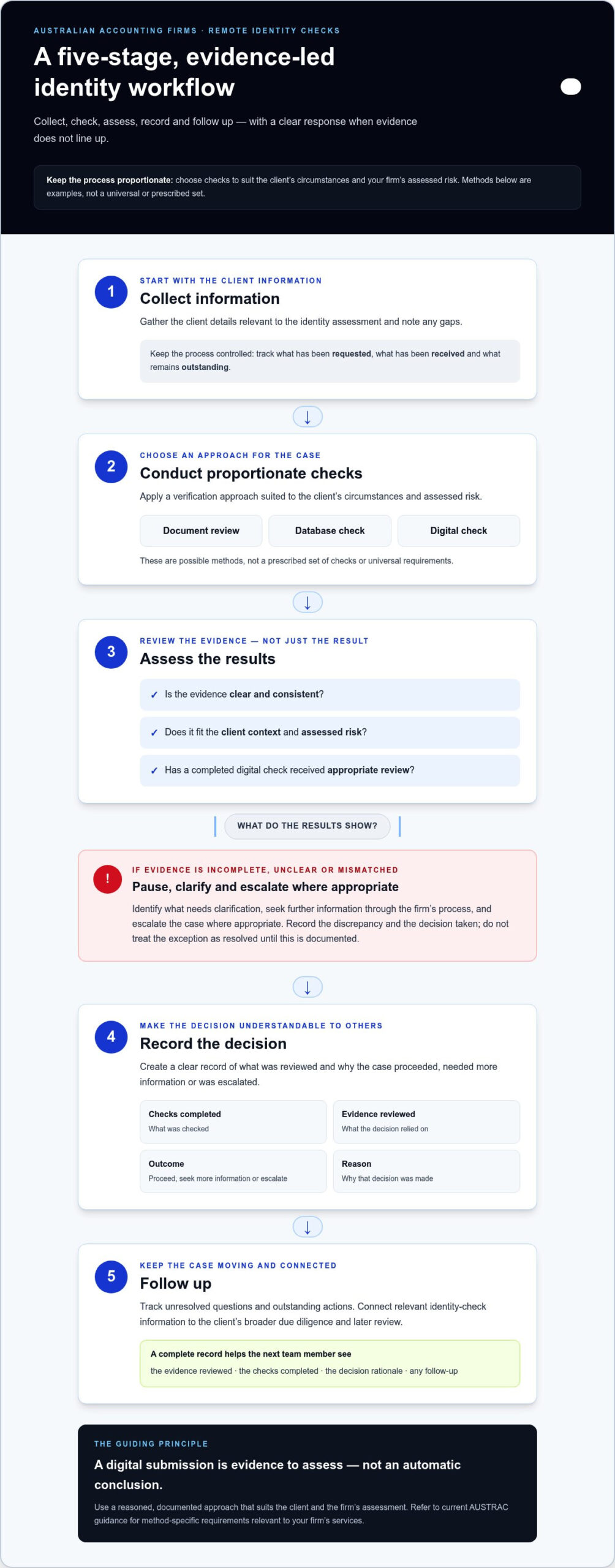
A repeatable process helps staff know what to collect, how to review it and what to do when something doesn’t line up. The checks should reflect the client’s circumstances and assessed risk, as well as any applicable requirements. Treat document review, database checks and digital verification tools as possible methods, not universal requirements. Check current AUSTRAC guidance for method-specific requirements relevant to your firm’s services.
Collect information and conduct proportionate checks
Explain the onboarding steps to the client, collect the information needed for the assessment, then apply checks suited to the case. Keep the process controlled so staff can see what has been requested, what has been received and what remains outstanding.
- Collect information. Gather the client details relevant to the identity assessment and note any gaps.
- Conduct checks. Use an appropriate verification approach, such as reviewing documents or using a database or digital check. These are examples, not a prescribed set of methods.
- Assess the results. Consider whether the evidence is clear and consistent, and whether it fits the client context and assessed risk. A completed digital check should still receive appropriate review.
- Record the decision. Note what was checked, what evidence was reviewed, the outcome and the reason for proceeding, seeking more information or escalating the case.
- Follow up. Track unresolved questions and outstanding actions, and connect relevant information to the client’s broader due diligence and later review.
Review outcomes, resolve exceptions and record decisions
Pause the process if evidence is incomplete, results are unclear or details don’t match. Identify what needs clarification, seek further information through the firm’s process, and escalate the case where appropriate. Don’t treat an exception as resolved until the discrepancy and the decision taken are recorded.
A well-documented remote identity check records the evidence reviewed, the checks completed, the decision rationale and any follow-up, without assuming that one method is sufficient for every client.
Good records help another team member understand what happened without reconstructing the onboarding from scattered messages. They also make it easier to connect identity verification with CDD and risk assessment. For practical guidance on keeping this evidence organised, see our article on audit-ready compliance records.
A structured workflow can make these steps easier to apply consistently. Trancher brings client verification, CDD, risk assessment and record-keeping workflows together to help reduce manual administration. Explore Trancher’s connected AML/CTF workflows.
Are remote identity checks reliable? Compare methods and their limitations
Remote does not automatically mean unreliable, and digital does not automatically mean sufficient. Each approach provides different evidence and needs appropriate review in the context of the client and the firm’s assessed risk. Reliability depends on the quality of the evidence, the care taken to review it and the decisions recorded afterwards.
The comparison below is a practical guide, not a ranking. A method’s suitability depends on the circumstances, and examples should not be mistaken for mandatory checks. Refer to current AUSTRAC guidance when confirming requirements that apply to your work.
| Approach | Evidence it may provide | Workflow fit | Review needs and potential limitations |
|---|---|---|---|
| In-person checks | Identity information and documents presented during a face-to-face interaction. | May fit onboarding where the client and firm can meet in person. | Staff still need to assess the evidence and record the outcome. An in-person meeting alone doesn’t establish that every detail is accurate or resolve inconsistencies. |
| Remote document review | Images or copies of identity documents supplied through a remote process. | Can support onboarding when the client and firm aren’t in the same place. | Staff need to consider whether the material is complete, legible and consistent with information collected. A document image may leave questions that require clarification. |
| Digital verification tools | A result produced by a digital check, which the firm can consider alongside other client information. | May help structure verification within an online onboarding workflow. | The result needs to be interpreted and recorded. Firms shouldn’t assume that a digital outcome answers every question or is appropriate for every client. |
What each approach can and cannot show
Documents can provide information for review, digital tools can return verification results, and direct interaction can help staff clarify details with a client. None should replace consideration of the full context. For example, if a name or address differs across submitted information, investigate the mismatch rather than overlooking it because one check returned a result.
When a standard check may need further review
Set out a firm procedure for incomplete evidence, inconsistent details or results that need clarification. Staff might pause onboarding, identify what remains unresolved, request further information through the established process and escalate the case where appropriate. Record the issue, the review and the reason for the decision. A clearly assigned process can also reduce friction in client onboarding, including in law firms, while keeping exceptions visible and manageable.
How to build remote identity verification into client onboarding
A reliable onboarding process shouldn’t depend on which staff member happens to handle a file. Set out who owns each step, where evidence is stored and who can make or review decisions. A clear workflow makes remote checks easier to apply consistently and helps prevent unresolved questions from being lost between onboarding tasks.
AML/CTF obligations for Tranche 2 entities commenced on 1 July 2026. Whether particular obligations apply depends on the services a firm provides and the circumstances involved. Use current AUSTRAC guidance to inform your procedures, and revisit them when relevant guidance or the firm’s work changes.
Make the process consistent across staff and client files
Document the workflow from information collection through review, decision and follow-up. Assign ownership for each step, identify decision points and specify where the resulting evidence and notes belong in the client file. Staff should know how to handle an incomplete check, conflicting details or a result that needs clarification, including when to refer the case to an appropriate reviewer.
Consistency doesn’t mean treating every client identically. It means staff follow the same decision framework, record exceptions and can explain how they were handled. Use an AML programme checklist for Australian firms alongside your documented process to consider how verification fits into the broader programme.
Connect verification to risk assessment and ongoing review
Identity information contributes to understanding a client, but it doesn’t replace a broader risk assessment or customer due diligence. Keep the verification outcome connected to relevant client context, the risk decision and any follow-up, so staff can understand the basis for the onboarding decision and find the supporting record later.
Relevant changes in client information or activity may prompt further review under your firm’s procedures. Define how staff flag those changes, who assesses them and how resulting decisions are documented. Review process consistency and staff understanding as part of your firm’s ongoing compliance management, without relying on an arbitrary review timetable.
For related guidance, see our resource on ongoing risk monitoring software for Australian accounting firms. To bring verification, CDD, risk assessment and record-keeping into a connected workflow, explore Trancher’s AML/CTF platform.
Manage remote client verification with a connected AML/CTF workflow
A remote identity check is most useful when its evidence, decision and next steps stay connected. Ask whether your team can see what was checked, why the decision was made, where the record is kept and what follow-up remains. If those details sit across disconnected files, inboxes and spreadsheets, hand-offs can become difficult to track.
For accounting firms, a structured AML/CTF workflow can bring client verification together with customer due diligence, screening, risk assessment, monitoring and record-keeping. That connection helps staff understand how an identity-check outcome informs the wider client file, without treating verification as a substitute for professional judgement or broader due diligence. Technology can support consistency and reduce manual administration, but your firm remains responsible for reviewing evidence and making reasoned decisions.
What a connected verification workflow helps a firm manage
Start by mapping how a client moves through onboarding. Identify where information is collected, who reviews checks, how exceptions are referred and where decisions and supporting records are stored. Then look for repeated manual hand-offs, such as transferring details between forms and separate files, or chasing outstanding evidence without a clear owner.
A connected process makes it easier to follow the chain from verification and screening through to risk assessment and any later monitoring or review. It also gives staff a consistent structure for recording actions and outstanding questions, rather than relying on memory or informal messages.
Prepare your firm to manage the process consistently
Use the workflow map to clarify staff responsibilities and decision points. Provide practical guidance for routine cases and for situations that need further review, so team members understand when to pause, document an issue or escalate it. Review whether staff are following the process and understand how their records connect to client due diligence. Keep procedures aligned with current AUSTRAC guidance and the obligations that apply to your firm’s services.
Trancher supports Australian accounting firms with client verification, KYC/CDD workflows, risk assessment, monitoring and audit-ready record-keeping. Dedicated onboarding and Australian support help firms put connected workflows into practice. Trancher guarantees AML/CTF compliance readiness within 30 days of starting. A structured platform supports the process; it doesn’t replace your firm’s review and decision-making.
If you’re looking to reduce disconnected hand-offs and manage verification within a more consistent AML/CTF workflow, explore Trancher’s AML/CTF platform.
Make remote verification a consistent part of your workflow
Verifying client identity remotely is more defensible when each check connects to a reasoned decision, a clear record and any necessary follow-up. Choose methods with the client’s circumstances and assessed risk in mind, and make sure staff know how to handle incomplete evidence or inconsistencies.
A documented workflow can also connect identity checks to customer due diligence, screening, risk assessment and ongoing monitoring. This gives your team a clearer view of the client file and helps reduce avoidable manual hand-offs, while keeping professional judgement central to decisions.
Trancher supports Australian accounting firms with client verification tools for KYC, screening and risk assessment, alongside structured workflows for monitoring, reporting and audit-ready records. Dedicated onboarding and Australian support help firms put these processes into practice. Trancher guarantees AML/CTF compliance readiness within 30 days of starting.
Explore Trancher’s AML/CTF workflow platform to see how connected workflows can support a more manageable, consistent approach to client verification. With clear processes and reliable records, your firm can move forward with confidence.
Frequently Asked Questions
Can a client’s identity be verified remotely for AML/CTF purposes?
Yes, remote verification can form part of a firm’s client due-diligence process, provided the method and evidence suit the circumstances and applicable requirements. Verifying client identity remotely doesn’t mean a digital check is automatically sufficient. Record what was checked, how the result was assessed and how any uncertainty was addressed. Before treating a particular method as mandatory, check current AUSTRAC guidance relevant to your firm’s services.
What is the best way to verify a client’s identity online?
There’s no single method that’s best for every client or situation. Build a consistent workflow for collecting information, conducting appropriate checks, reviewing outcomes and recording decisions. For example, staff should know how to recognise inconsistent details and when to escalate a case under firm procedures. The method should suit the client’s circumstances and applicable requirements. Check current AUSTRAC guidance before describing a particular tool or method as a regulatory requirement.
Are video calls enough to verify a client’s identity?
A video call may support remote onboarding, but shouldn’t automatically be treated as complete identity verification. Consider what evidence your firm needs, what the interaction can establish and whether further checks are appropriate for the client’s circumstances. Record the steps taken and the reasoning behind the outcome. Avoid presenting video calls as universally sufficient: check applicable AUSTRAC guidance before making claims about whether a particular approach meets requirements.
What should an accounting firm record after verifying a client remotely?
Record the client information and evidence reviewed, the checks performed, the result and the reasoning for the decision. Include inconsistencies, follow-up questions and any escalation under your firm’s procedures. Keep these details together in a structured client record, so another team member can understand what happened and why. Confirm the record-keeping requirements that apply to your firm using current AUSTRAC guidance, rather than relying on a generic checklist.
What should a firm do if remote identity checks do not match?
Treat a mismatch as a reason to pause and understand the discrepancy, not as an automatic conclusion about the client. Follow your firm’s escalation process, seek clarification or further evidence where appropriate, and document the steps and decision. Consider the issue alongside the wider client-risk context. A clear procedure helps staff respond consistently instead of improvising, and makes it easier to see how unresolved questions were handled before the onboarding decision.
Do Tranche 2 obligations apply to remote client identity verification in 2026?
Tranche 2 obligations commenced on 1 July 2026 for affected firms providing designated services. Whether particular obligations apply depends on the firm’s circumstances and the current regulatory framework. Don’t assume every accounting firm or client interaction is covered. Check the latest AUSTRAC guidance and applicable requirements before making a specific legal or regulatory claim, and use that guidance to inform your firm’s remote-verification procedures.
Can AML software automate remote client identity verification?
AML platforms can help organise verification tasks, information, decisions and records, depending on their features and configuration. Trancher provides client verification tools for KYC, screening and risk assessment, with workflows for monitoring, reporting and structured record-keeping. These tools can support a connected process, but software doesn’t remove the need for staff oversight, judgement or procedures for unclear outcomes. Consider how verification fits with CDD and your wider compliance workflow.
How does remote identity verification fit into customer due diligence?
Identity verification is one part of customer due diligence, not a substitute for the wider process. Firms can connect identity information with client risk assessment, screening and relevant ongoing review, considering how those elements inform the overall client relationship. A clear record helps explain the decision and any follow-up. Appropriate steps depend on the client’s circumstances and current requirements, so consult AUSTRAC guidance before stating specific obligations.