

What makes monitoring useful is not simply the alerts it generates, but how clearly your team can review activity, make a decision and explain what happened next. For Australian accounting firms searching for “Transaction monitoring software Australia”, the right system should connect activity with client context and support a consistent, well-documented review process.
Manual reviews can be difficult to manage consistently, especially when they need to sit alongside KYC, client risk assessments and reporting. Tranche 2 AML/CTF obligations commenced on 1 July 2026 for firms providing designated services. A clear, traceable workflow can help make ongoing activity reviews more manageable. Software supports that workflow, but it does not replace your firm’s judgement or the other parts of its AML/CTF program.
This article explains what monitoring software can and cannot do, and how to compare options based on review workflows, decision records and integration needs. It also shows how monitoring fits into a broader compliance process, so your firm can strengthen operational readiness with practical, well-documented steps.
Key Takeaways
- Monitoring supports the review of client activity in context. It complements, rather than replaces, identity checks, screening, risk assessment and reporting.
- Use a clear workflow to move from activity review to a recorded decision, escalation and appropriate next step.
- Compare Transaction monitoring software Australia options by workflow coverage, review ownership, escalation processes and record-keeping.
- Map existing procedures, assign responsibilities and train staff to introduce software without duplicating established work.
- Trancher brings ongoing risk monitoring and client activity tracking together with escalation workflows, reporting support and audit-ready records.
What transaction monitoring software does for an Australian accounting firm
AML transaction monitoring software helps a firm organise the ongoing review of client activity against relevant client information and risk context. It can support a workflow for recording what was reviewed, the decision made and any follow-up or escalation. It does not determine whether activity is suspicious or replace professional judgement.
Monitoring is one part of an AML/CTF workflow, not a substitute for the processes that establish a client’s identity, assess risk or meet reporting obligations. Transaction monitoring software Australia firms consider should fit alongside those processes, rather than operate as a disconnected stream of alerts.
How monitoring differs from KYC and client risk assessment
KYC and customer due diligence (CDD) establish client identity and gather relevant information. A client risk assessment documents the firm’s exposure and informs its approach to that client. Screening is a separate check, such as checking relevant parties against applicable sanctions information.
Monitoring is ongoing. It helps the firm review activity in the context of what it knows about the client and the services provided. For example, a reviewer may consider whether activity appears consistent with the client profile on record. The software can organise information and preserve evidence of the review, while the firm sets its procedures and staff make decisions.
Reporting is a distinct step. Monitoring may help identify activity for further consideration and keep a record of how it was handled. It does not, by itself, decide whether a report is required or submit one automatically. The firm’s reporting process remains separate and should align with its AML/CTF program and applicable requirements.
For Australian accounting firms, applicability depends on whether the firm provides designated services. Tranche 2 obligations for newly regulated entities commenced on 1 July 2026. Monitoring tools can support the operational workflow for firms managing applicable obligations, but software alone does not establish compliance.
Why accounting firms need an organised review workflow
When client details sit in one system, activity records in another and follow-up notes in email, it can be difficult to see whether a concern has been reviewed or who owns the next step. A structured workflow clarifies responsibilities and connects decisions to the evidence and client context considered.
A practical review process should make it possible to:
- assign a review to an appropriate staff member;
- record the information considered and the decision reached;
- escalate concerns for further assessment; and
- document any follow-up or reporting action taken.
This creates a more traceable record without removing the need for sound judgement. For further context on how monitoring fits into ongoing client oversight, explore this ongoing risk monitoring software guidance.
How transaction monitoring software supports activity review and escalation
A reliable review process gives each concern a clear path from initial context to an appropriate next step. Software can help organise that path by assigning work, recording decisions and making escalation visible. It should support the firm’s AML/CTF program, not impose a one-size-fits-all procedure or treat a system prompt as proof of suspicious conduct.
From activity context to a documented review
Activity needs to be considered alongside relevant client information and risk context. Without that context, a prompt or unusual detail may be hard to interpret. A reviewer should be able to see what information informed the assessment, who completed it and why the decision was reached. Firms define their own review procedures in line with their AML/CTF program and applicable requirements.
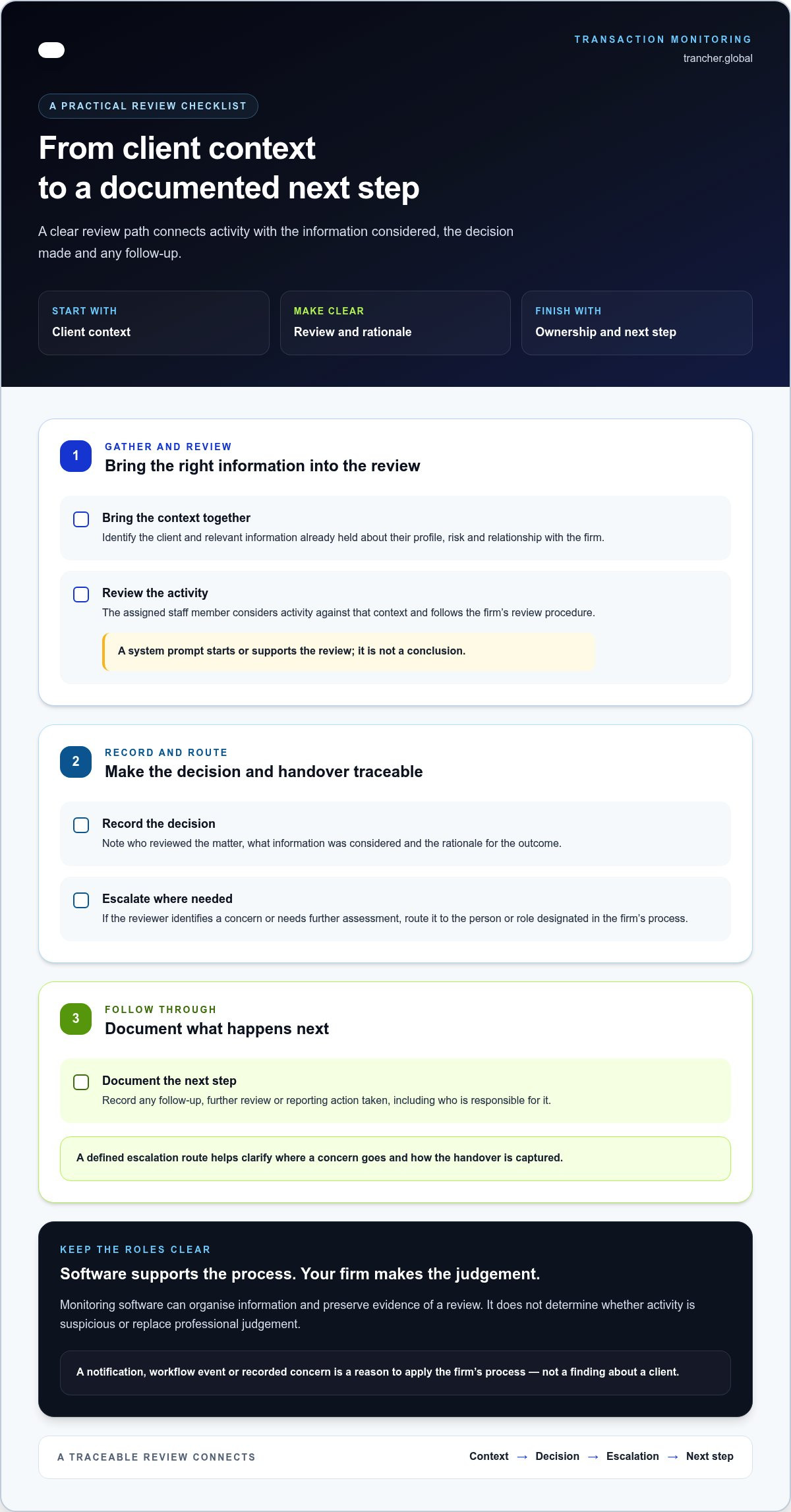
A practical workflow can follow these steps:
- Bring the context together. Identify the client and relevant information already held about their profile, risk and relationship with the firm.
- Review the activity. The assigned staff member considers the activity against that context and follows the firm’s review procedure. A system prompt starts or supports the review; it is not a conclusion.
- Record the decision. Note who reviewed the matter, what information was considered and the rationale for the outcome. This makes the decision easier to understand later.
- Escalate where needed. If the reviewer identifies a concern or needs further assessment, route it to the person or role designated in the firm’s process.
- Document the next step. Record any follow-up, further review or reporting action taken, including who is responsible for it.
Monitoring software supports review and record-keeping, but it does not replace professional judgement or automatically decide whether conduct is suspicious. A notification, workflow event or recorded concern is a reason to apply the firm’s process, not a finding about a client.
Escalation, reporting and records
Escalation works best when staff know where to direct a concern and how to capture the handover. A defined route helps prevent an unresolved review from being lost among emails or left without clear ownership. It also creates a record of how the matter progressed, while leaving assessment and decisions with the responsible people in the firm.
Reporting support can help organise relevant information and document the firm’s process. It should not be treated as an automatic determination that a report is required or as a legal conclusion. The firm must apply its procedures to the circumstances. For more on the decision-making considerations, see this guidance on when to submit a suspicious matter report.
When assessing Transaction monitoring software Australia options, walk through a sample review. Check whether the system can record ownership, rationale, escalation and follow-up in a coherent way. A structured platform such as Trancher’s AML workflow platform can bring monitoring, escalation and documentation into a connected process.
How to compare transaction monitoring software for Australian firms
Compare software against the work your firm needs to manage, rather than judging a long list of features in isolation. A good fit makes monitoring part of a connected AML/CTF workflow, with clear responsibilities and records staff can follow. Ask whether the system connects activity review, escalation and evidence in a way that fits your firm’s procedures.
Use the same criteria for each option. A demonstration or workflow walkthrough helps your team assess how a review moves through the system, from assignment to decision and follow-up.
| Evaluation area | What to assess |
|---|---|
| Workflow coverage | Can the workflow show review progress and the next action, rather than presenting activity without a clear process? |
| Review ownership | Can staff understand who is responsible for a review and who handles an escalation? |
| Decision history | Can the firm follow what was considered, the decision recorded and any subsequent action? |
| Record-keeping | Can records support the firm’s own documentation and review procedures? |
| Connections to other processes | How does monitoring relate to KYC/CDD, client risk assessment and reporting? Identify what is connected and what remains a separate process. |
| Implementation and guidance | What onboarding and staff guidance will help the team use the workflow consistently? |
Workflow, evidence and reporting support
Check whether a reviewer can quickly understand a matter’s status, owner and decision history. Documentation should make the review traceable and align with the firm’s record-keeping approach. Reporting support may help organise the workflow, but it is not an automatic decision that a report is required. Software cannot guarantee regulatory compliance or remove every risk.
For a closer look at the role of records in a documented compliance process, explore this audit-ready compliance records guidance.
Integration, implementation and team support
Integration can reduce repeated handling, but the details matter. Map where client information, risk assessments and reporting records currently sit, then identify which hand-offs the software supports and which remain manual. Consider onboarding and staff guidance too. A well-designed workflow is most useful when people understand their responsibilities and can apply them consistently.
Transaction monitoring software Australia firms assess should fit existing procedures, not force unnecessary duplication. Compare how each option supports the real review journey, including where staff need to record information outside the monitoring workflow. Trancher brings ongoing risk monitoring, client activity tracking, escalation workflows, reporting support and audit-ready records together in an AML compliance platform. Explore Trancher’s AML workflow platform as one way to consider a connected approach.
How to implement transaction monitoring software without adding admin
Implementation should make existing review work easier to follow, not create a second set of records. Start with the process your team uses now, then configure the software to support its steps. This keeps the project focused on activity monitoring rather than turning it into a wholesale redesign of the firm’s AML/CTF program.
For Australian firms, the scope of implementation depends on the services they provide. Tranche 2 obligations commenced on 1 July 2026 for newly regulated entities providing designated services. Assess your firm’s applicability and procedures, then align monitoring workflows with the obligations that apply to you.
Map current reviews and assign responsibility
Before configuring a system, trace where relevant client activity information enters the firm’s work and how it moves between people or systems. Note where staff currently record reviews, decisions and follow-up. This can reveal repeated data entry, unclear handovers and administrative tasks a structured workflow may help organise.
Use a practical sequence to plan implementation:
- Map the current process. Document the points at which activity is received, reviewed, recorded and, where appropriate, escalated.
- Set ownership. Identify who is responsible for each review task, who records its outcome and who receives an escalation under the firm’s procedures.
- Align the workflow. Configure responsibilities and review stages to reflect established processes, rather than duplicating them in parallel spreadsheets or email trails.
- Guide the team. Provide role-based instruction so staff understand their tasks, what information to record and where to direct a concern.
- Review how it works. Check whether records show the review decision and any follow-up clearly, then refine steps that remain unclear or repetitive.
Clear ownership and a consistent workflow turn compliance activity into records the firm can understand and use. Implementation is not complete simply because the software is configured. Staff need to understand how the workflow fits their responsibilities, and the firm should review whether it supports consistent practice.
Prepare staff and review workflow performance
Keep guidance practical. A reviewer needs to understand how to handle an assigned task; a person receiving an escalation needs to know the route and information to consider. Use examples based on the firm’s own procedures, and make responsibilities clear without suggesting that a software prompt determines whether conduct is suspicious.
Review a sample of completed records to see whether another team member could follow what was reviewed, who made the decision and what happened next. Look for duplicated entries, unclear ownership or follow-up that is difficult to locate. These checks help identify workflow friction and improve how the system supports the firm’s process.
Monitoring is one component of readiness, alongside broader AML/CTF program arrangements. Use this AML program checklist for Tranche 2 readiness to consider how the pieces fit together. To put a structured monitoring workflow into practice, explore Trancher’s AML compliance platform.
How Trancher brings transaction monitoring into a complete AML workflow
Transaction monitoring is most useful when it connects with the wider compliance process. Trancher provides an AML compliance platform for Australian accounting firms, bringing ongoing risk monitoring and client activity tracking together with escalation workflows, reporting support and audit-ready records.
This connected approach helps firms manage review activity as part of an organised workflow rather than as a standalone stream of alerts. Designed for small to medium-sized accounting firms, Trancher places monitoring alongside client verification and due diligence, screening and risk assessment. These functions support different parts of the firm’s process, while decisions about a client or activity remain with the firm.
A connected monitoring and compliance workflow
As staff review client activity, the platform’s tracking and escalation workflows help organise how a matter is handled and recorded. Reporting support and structured records contribute to a more traceable process, while the firm remains responsible for applying its AML/CTF procedures and making reporting decisions.
Recorded compliance work can also help a firm identify activity it may recover through its own billing processes. A clearer account of work completed supports internal tracking, although it does not guarantee that any particular activity will be billable or recovered.
Trancher guarantees AML/CTF compliance readiness within 30 days of starting. This is a readiness commitment, not a claim that software makes decisions for the firm or guarantees an outcome in every compliance matter.
Assess the fit for your firm and take the next step
Implementation includes dedicated onboarding, local Australian support and staff guidance. These elements help your team understand how monitoring, escalation and documentation fit into its established procedures. As you assess fit, consider whether the workflow reflects how your firm assigns reviews, records decisions and follows up on activity.
A complimentary trial lasting 3 months is currently available to a limited number of accounting firms. Trial participants receive a formal ROI report at the end of the 3-month period. Firms that continue after the trial receive 20% off their first 12-month subscription. The report helps firms consider the operational and financial value of tracked compliance activity alongside their own requirements and processes.
For firms comparing Transaction monitoring software Australia options, Trancher brings monitoring into a broader AML workflow rather than treating it as a separate task. Explore Trancher’s AML compliance platform to see how its monitoring, escalation and documentation capabilities support your firm’s compliance operations.
Turn your next step into lasting readiness
Monitoring is not a one-off setup task. As your firm’s services, client relationships and internal processes change, review whether your workflow still supports clear ownership and reliable follow-up. That ongoing attention helps keep compliance work grounded in how your firm operates.
When assessing Transaction monitoring software Australia, look beyond initial setup. Consider whether the approach will remain practical for your team, with processes staff can understand and records that make sense when revisited. A useful next step is to identify the part of your current workflow that creates the most friction, then consider how a connected AML platform could support it.
Explore Trancher’s AML compliance platform and see how it can support your firm’s operational readiness. Start a conversation with Trancher about putting a clear, connected monitoring workflow in place.
Frequently Asked Questions
What is transaction monitoring software in AML compliance?
It is software that helps an organisation manage the review of client activity as part of its AML/CTF processes. For example, a firm might use a workflow to link a review to the relevant client file, assign responsibility and retain the outcome. Transaction monitoring software Australia firms assess can vary in how it supports those tasks, so consider whether its workflow suits your firm’s services and procedures.
Can transaction monitoring software automatically decide whether activity is suspicious?
No. A system prompt or recorded concern is not, by itself, a conclusion that activity is suspicious. Staff need to assess the circumstances using the firm’s procedures and relevant information. For example, a reviewer may need to clarify an apparent inconsistency before deciding what to do next. Software can help organise the review and its records, but the decision remains with the firm.
Does transaction monitoring software replace KYC and customer due diligence?
No. KYC and customer due diligence establish and maintain information about a client, while monitoring supports ongoing consideration of activity in that context. A client file might contain identity details and due diligence information, while a separate monitoring record captures a later review. Keeping these functions distinct helps staff understand what information is already held and what the current activity review needs to consider.
Can transaction monitoring software submit a suspicious matter report automatically?
Do not assume it can or should. Software may support the organisation of information and reporting workflows, but it cannot make the firm’s determination that a report is required. Staff should follow the firm’s escalation and reporting procedures, including any applicable timeframes. A clear handover to the person responsible for assessment helps ensure the matter is considered and the action taken is recorded.
What records should an accounting firm keep about an activity review?
Keep a record that lets someone later understand the review and its outcome. This may include the client or matter reference, review date, staff member responsible, information considered, decision rationale, escalation details and any follow-up. Record enough context to make the decision understandable without relying on a reviewer’s memory or disconnected messages. Apply the firm’s record-keeping procedures and relevant requirements to how records are maintained.
How does transaction monitoring software fit with an existing accounting workflow?
It should sit alongside existing client and practice processes, with responsibilities and handovers made clear. Map where relevant information is held and how staff currently record compliance work before introducing a new workflow. Some platforms support integrations, while others may require separate steps, so avoid assuming information will transfer automatically. The aim is to organise monitoring without entering the same details repeatedly or disrupting established work.
Do Australian accounting firms need transaction monitoring software from 1 July 2026?
Not every accounting firm is automatically subject to Tranche 2 AML/CTF obligations, and the commencement date does not mean every firm must use a particular software product. The obligations apply to firms providing designated services. Firms should assess whether their services bring them within scope and establish processes suited to their obligations. Software may support those processes, but choosing a tool is separate from determining applicability.