

What if managing AML compliance with a small team depended less on adding people and more on making responsibilities clear? For accounting firms providing designated services, AML/CTF obligations for Tranche 2 entities commenced on 1 July 2026. That is a substantial operational change, especially when compliance tasks need to fit around client deadlines and billable work.
It is understandable if the work feels difficult to coordinate. When one person carries too much responsibility, or checks and records are spread across the firm, follow-up can become inconsistent. A practical operating model makes the workload more manageable without removing accountable staff judgement.
This guide explains how to divide ownership to suit your firm’s size, then build repeatable workflows for due diligence, ongoing monitoring, escalation and record keeping. You will also see where automation can reduce manual administration and where human oversight remains essential. The aim is a clear, workable approach that helps your team manage recurring AML/CTF tasks consistently while keeping client work moving.
Key Takeaways
- Managing AML compliance with a small team starts with assigning clear owners and matching each process to the firm’s designated services and current AUSTRAC guidance.
- Map each client’s journey from intake and verification through risk assessment, ongoing review, escalation and documented completion.
- Compare spreadsheets, shared procedures and dedicated platforms by how well they support consistent work, visibility and manageable administration.
- Set a review rhythm that suits your firm, with clear queues for overdue reviews, unresolved alerts and decisions awaiting human attention.
- Assess whether a platform can bring verification, risk workflows, monitoring, reporting, records, training and activity tracking into a connected process.
Why managing AML compliance with a small team needs a defined operating model
In a lean accounting practice, compliance work has to fit alongside client service, reporting deadlines and other operational priorities. Without clear ownership and repeatable steps, important tasks can depend on who remembers them or who happens to be available. A defined operating model gives this work a reliable place in the firm’s routine, without assuming that every task needs a separate role or a large team.
AML/CTF obligations for Tranche 2 entities commenced on 1 July 2026. Whether particular obligations apply to your firm depends on the designated services it provides, so use current AUSTRAC guidance to assess your circumstances. A general introduction to the subject is available in Understanding Anti-Money Laundering (AML), but it should not replace Australian regulatory guidance when determining your firm’s position.
Capacity pressure is real, but it does not make applicable obligations optional. The practical response is to make recurring work visible and manageable. AML/CTF program management is ongoing: a policy or initial setup is only a foundation. Processes need to keep operating, decisions need appropriate attention, and records need to reflect what the firm actually does.
What makes AML/CTF work difficult for a lean accounting practice?
Client deadlines can take priority, while compliance tasks are spread between people who already have other responsibilities. If ownership is informal, a verification request may sit between intake and review, or follow-up may be delayed because the next step is unclear. Staff may also rely on knowledge held by one experienced colleague rather than a shared process.
These gaps become especially visible during handovers. If a client file does not show what has been completed, what remains outstanding and who should act next, due diligence and record keeping can lose continuity. The answer is not to assume a particular team size or create unnecessary layers. Document the handovers that matter, including the task status, next action and responsible person.
What does a workable small-team model look like?
A workable small-team AML/CTF model assigns one accountable program owner and distributes defined tasks through repeatable processes, with clear routes for decisions and escalation.
The program owner maintains oversight of the operating model, checks that responsibilities are understood and ensures unresolved issues reach the right decision-maker. Routine administrative steps, such as collecting information or recording completed checks, can be allocated to suitable staff and supported by consistent instructions. This helps avoid placing every task on one person while keeping accountability visible.
Keep judgement distinct from administration. A staff member may complete a routine step, but an unusual result or unresolved concern should follow a defined escalation path rather than being treated as a box to tick. Record who made the decision and why, in line with the firm’s process. This structure supports reliable handovers and gives the team a practical basis for refining workflows as services, risks or guidance change.
How to organise AML compliance tasks without adding unnecessary administration
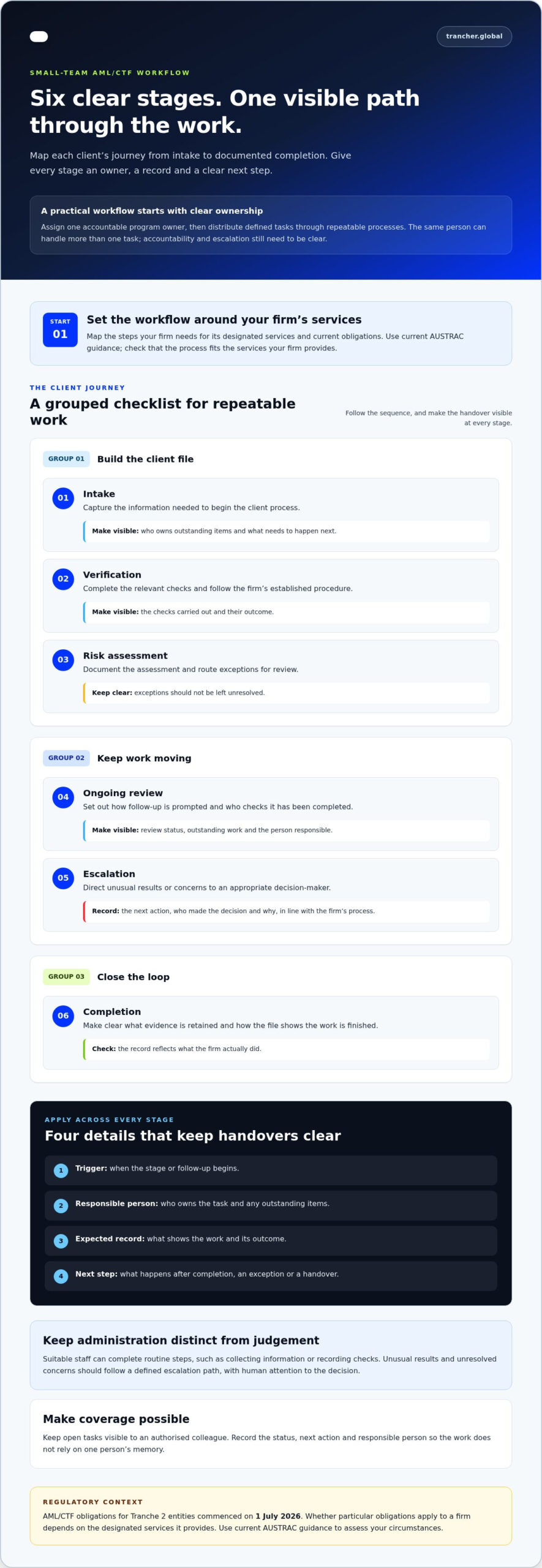
A clear workflow makes compliance easier to carry out consistently without turning every client matter into a separate project. Start by mapping the steps your firm needs for its designated services and current obligations. Use current AUSTRAC guidance to inform that mapping, and avoid adopting a generic process without checking whether it fits the services your firm provides.
For each stage, define the trigger, the person responsible, the expected record and what happens next. Staff can then see what to do, while the program owner can identify where a file is waiting or needs attention. A template should prompt the right action, not create paperwork for its own sake.
- Intake: Capture the information needed to begin the client process and assign responsibility for outstanding items.
- Verification: Record the relevant checks and their outcome, following the firm’s established procedure.
- Risk assessment: Document the assessment and route exceptions for review rather than leaving them unresolved.
- Ongoing review: Set out how follow-up is prompted and who checks that it has been completed.
- Escalation: Direct unusual results or concerns to an appropriate decision-maker, and record the next action.
- Completion: Make clear what evidence is retained and how the file shows the work is finished.
Assign owners, handovers and escalation points
Give each stage a responsible role, even if the same person handles more than one. Distinguish routine tasks, such as requesting missing information, from decisions that require review. Specify who considers exceptions and where the decision is recorded. To support coverage, make open tasks visible to an authorised colleague, with a clear status and next action, so the work does not rely on one person’s memory.
Use short templates for recurring steps. A consistent request, a place to record the outcome and a field for the next action can prevent staff from reinterpreting the process each time. Assigned actions should show who owns them and whether they remain open. This simple structure can reduce repeated follow-up without adding unnecessary layers.
Create a repeatable workflow from client intake to review
Place identity checks, due diligence and risk assessment in the client journey where they belong under your firm’s process. For a deeper explanation of the Australian context, consult a CDD and KYC requirements Australia guide; an AML Program Checklist Australia guide can help with broader program structure. Keep the workflow focused on your own services and current guidance.
Prompts and task tracking can surface missing information, reviews due and items awaiting a decision. The goal of managing AML compliance with a small team is not to automate judgement, but to make the next step visible and the record straightforward to complete. A platform such as Trancher’s AML/CTF workflow support can help bring recurring tasks and documentation into a more organised process.
Manual processes, shared responsibilities or AML software: compare the options
The right approach depends on how your firm handles recurring work, handovers and evidence. A spreadsheet may be enough to track a simple queue, while shared procedures can help staff follow consistent steps. A dedicated platform can bring task status and records together. These options can also work in combination: software can support repeatable tasks while written procedures guide review and decisions.
Compare the options by the work they make visible, not by assumed savings. The table highlights typical trade-offs. The best fit is the approach your team can maintain and oversee.
| Approach | Consistency | Visibility | Administrative effort |
|---|---|---|---|
| Spreadsheets | Can use standard fields, but relies on staff updating them consistently. | Shows recorded items; open actions may be harder to follow across files. | Requires manual updates, checks and record organisation. |
| Shared procedures | Sets out common steps, though staff still need to apply and document them. | Clarifies how work should move; task status may sit elsewhere. | Needs procedure maintenance and a separate way to track work. |
| Dedicated platform | Can support repeatable workflows and prompts. | Can centralise task status and records for team oversight. | Requires setup and ongoing attention to keep workflows relevant. |
For broader efficiency considerations, the AML CTF compliance costs reduction guide can complement this comparison. Look at where manual work is repeated, where status is difficult to see and where evidence is stored. These are useful signals for deciding whether a process needs a clearer procedure, a better tracker or automation.
Which compliance tasks are suitable for automation?
Automation is most useful for predictable steps: prompting staff to complete identity verification or screening, reminding them about follow-up, organising documents and showing whether a task is open or complete. A central status view can help the team spot a missing item before a file moves forward. These tools support execution and evidence; they do not resolve every risk or reporting decision.
Where should people retain review and decision-making?
Keep contextual assessment, exception review and escalation within accountable staff workflows. If a result needs interpretation, the record should identify the reviewer, the rationale and the supporting information, so another authorised person can understand the decision later. Automation can prompt and organise compliance tasks, but accountable staff retain professional judgement and responsibility for decisions.
For a small firm, the aim of managing AML compliance with a small team is to choose tools that reduce friction without obscuring ownership. Start with tasks that are repeated, easy to define and prone to being missed. Retain human review wherever context matters.
Build a manageable review rhythm for monitoring, records and staff coverage
A review rhythm helps a small team keep monitoring work moving without relying on memory or arbitrary calendar reminders. Define it around your firm’s designated services, documented risks and current AUSTRAC guidance. The timing and triggers should make sense for your work and obligations, rather than follow a one-size-fits-all schedule.
Make open work visible. A shared view should show who owns each action, its current status and what needs to happen next. Separate the work into queues so staff can see where attention is needed:
- Overdue reviews: identify which review is outstanding, its owner and the next step.
- Unresolved alerts: show what needs follow-up and who is responsible for reviewing it.
- Human decisions pending: make exceptions awaiting assessment or escalation easy to distinguish from routine tasks.
Use these queues to direct attention, not to replace assessment. A prompt is useful only if someone owns the follow-up and the outcome is recorded.
Make ongoing monitoring visible to the whole team
A central task view can help staff understand what is underway, due for action or awaiting escalation. Assign a clear owner to each review or alert, and make reassignment part of the process when workloads shift. That prevents follow-ups from becoming orphaned in an inbox or file. Set review triggers and timing in line with your firm’s services, documented risks and current AUSTRAC guidance.
Specialist monitoring detail belongs alongside this operating rhythm. The ongoing risk monitoring software guide can help frame what to consider in monitoring tools, while your team remains responsible for applying its documented process and following up on results.
Protect continuity when workloads or staff availability change
Continuity depends on useful handover notes, not just access to a task list. Record the matter’s status, relevant context, actions already taken and the next decision or follow-up. Provide role-based training so staff understand their part in the workflow, and keep training and refresher records organised. These practices help essential knowledge stay with the firm rather than one person.
Schedule a periodic internal check of workflow completion and record quality. Select a sample of completed and open items, then check whether ownership is clear, actions are traceable and decisions have supporting context. Use what you find to refine templates or clarify handovers. Keep records organised so the firm can follow the sequence of activity without copying the same information into multiple places.
For a small firm, managing AML compliance with a small team means balancing visibility with a rhythm the team can sustain. A structured platform can bring monitoring activity, task status and records into a more organised workflow while leaving decisions with accountable staff. Explore Trancher’s AML/CTF monitoring and workflow support to see how it can support your team’s review process.
Use an AML compliance platform to support a small team’s next steps
Once your firm has defined how work is owned, completed and reviewed, a platform can make that operating model easier to follow. Assess options against the actual workflow your team needs, rather than choosing by feature count alone. The aim is to bring recurring tasks and supporting records into a clear process while keeping the firm’s governance and staff judgement in place.
What to look for in a platform for a lean accounting team
Check whether the platform can support the stages your team has mapped, from client verification and risk workflows through ongoing monitoring, reporting and record keeping. Look for clear task ownership and status, so staff can tell what is complete, what remains open and where a decision is needed. Consider how workflow automation and platform integrations could fit with your existing processes, without assuming every task should be automated.
Good evaluation questions focus on daily use: Can the team follow a consistent workflow? Can relevant records be kept alongside the activity they support? Can staff see who owns the next action? These criteria help distinguish a connected operating tool from another place to store information. A platform should support the firm’s work, not create parallel processes that add avoidable administration.
Trancher supports accounting firms with client verification and due diligence, risk workflows, ongoing monitoring, regulatory and suspicious matter reporting, records, staff training and compliance activity tracking. These capabilities help organise recurring work and make activity more visible. Accountable staff remain responsible for oversight and professional decisions.
Move from fragmented tasks to a consistent operating system
Adoption depends on more than switching on a tool. Onboarding, practical staff guidance and documented workflows help the team understand how existing responsibilities translate into platform-supported steps. Clear procedures also give staff a reference point when work is handed over or an exception needs escalation. Trancher provides dedicated onboarding and local Australian support to help firms establish their approach.
Trancher guarantees AML/CTF compliance readiness within 30 days of starting. This is a readiness guarantee, not a claim that software replaces firm governance, ongoing work or judgement. A platform can help structure processes and records, while the firm remains accountable for how its operating model is applied.
For firms managing AML compliance with a small team, the next step is to connect workflow, ownership, records and integrations to the way the practice operates. Explore Trancher’s AML compliance platform and its support for Australian accounting firms.
Make your AML/CTF model easier to sustain
Treat the operating model as part of how the practice develops, not as a document to finish and set aside. As your services, client mix or internal processes change, consider whether the approach still gives staff a clear path from work started to work completed. Small adjustments can keep compliance connected to daily operations rather than letting it become a separate administrative burden.
That perspective is central to managing AML compliance with a small team. A practical system should help the firm understand how compliance work fits alongside client service and where processes could be clearer. Use what your team learns from applying the model to refine procedures and support confident, consistent work, while keeping oversight and accountability within the firm.
Assess how a platform could support your firm’s operating model and recurring work. Start a conversation with Trancher about supporting your AML/CTF processes. With a considered approach and tools suited to your workflow, your team can build a model that feels manageable and can grow with the practice.
Frequently Asked Questions
Is every Australian accounting firm covered by AML/CTF obligations?
No, not automatically. Applicability depends on the services a firm provides and whether they fall within the designated-service framework. Consider the actual activities performed for clients rather than relying on the firm’s description of itself as an accounting practice. Compare those activities with current AUSTRAC guidance, and seek appropriate professional advice if interpretation is needed. This helps the firm focus its processes on obligations relevant to its work.
Can a small accounting firm manage AML compliance without a dedicated compliance team?
Yes, a small firm can organise the work without creating a separate compliance department. The structure should suit its services, risks and capacity, rather than follow an assumed staffing formula. For example, a partner might oversee the program while staff complete assigned administrative steps and route exceptions for review. Managing AML compliance with a small team still requires clear accountability, suitable oversight and a reliable way to cover open work when responsibilities shift.
What should a small team automate first for AML compliance?
Begin with repetitive administrative tasks that follow a consistent pattern, such as reminders for outstanding information, document organisation and workflow status tracking. Depending on the firm’s process and system, verification and screening tools may also support routine handling. Before automating a step, define what a completed task looks like and what should happen if information is missing or a result needs attention. Automation should make follow-up easier to see, not make decisions without review.
Can AML compliance software replace human review?
No. Software can support verification, organise tasks and bring records together, but the firm still needs accountable people to oversee its process. If a screening result or client circumstance needs context, staff should review the relevant information and record the decision through the firm’s procedure. For instance, a system prompt can flag an item for attention, while an authorised person assesses what it means and determines the next step. Technology supports governance; it does not replace it.
How often should a small accounting firm review AML risks?
There is no universal interval to apply without considering the firm’s circumstances and current guidance. Set the review approach around the firm’s designated services, documented risks and relevant changes, then make ownership and follow-up clear. For example, a change in a client relationship or service may prompt staff to check whether the existing assessment remains appropriate under the firm’s process. Use current AUSTRAC guidance when setting the rhythm, rather than relying on an arbitrary calendar rule.
Is Tranche 2 AML/CTF regulation already in effect in Australia?
Yes. Tranche 2 AML/CTF obligations commenced on 1 July 2026. That date does not mean every accounting firm has the same obligations: applicability depends on the services and circumstances involved. A practical first step is to list the services the firm provides and assess them against current AUSTRAC guidance. Then align internal procedures with the requirements that apply to the firm, and revisit the assessment if its services or circumstances change.
What records help a small team show how it manages AML compliance?
Organise records that show how the firm has carried out relevant steps under its applicable program. Depending on the firm’s obligations and processes, these may include evidence of checks, risk assessments, decisions, staff training and follow-up actions. For example, a file note can connect a decision to its rationale and supporting information. This is a practical starting point, not a complete legal checklist; use current guidance to determine the records relevant to your firm.