

Could a cash offer, an intermediary or a rapid resale be ordinary property activity, or a reason to look closer? Recognising money laundering red flags for real estate starts with that distinction: an unusual feature is a prompt to understand the context, not proof of wrongdoing.
Property transactions can be complex, and behaviour that warrants a question in one situation may have a straightforward explanation in another. Clear guidance helps your team decide what merits attention, how to assess it fairly and how to record concerns consistently.
This checklist covers behaviour-based indicators across a property transaction, how to consider them in context and how to document your assessment. It also outlines escalation and reporting considerations. For businesses providing designated services, Australian AML/CTF obligations commenced on 1 July 2026. A consistent approach to recognising and recording concerns is an important part of meeting those obligations.
Key Takeaways
- Use money laundering red flags for real estate as prompts for proportionate enquiry, not as proof of wrongdoing.
- Look across the transaction, from initial enquiries and ownership details to funding, settlement and later activity.
- Assess unusual features alongside the transaction purpose, parties, ownership structure and information available.
- Record what you observed, what you clarified and why the concern was escalated or resolved.
- Use clear responsibilities and review steps to make concern handling more consistent across your firm.
Money laundering red flags for real estate: what the indicators mean
A red flag is an observable feature of a client or transaction that warrants closer, proportionate assessment. It is a reason to ask what is happening and consider the available context, not a finding that a person has committed a crime. Treating every unusual detail as proof risks unfairly judging legitimate activity. Dismissing unexplained features, however, can leave important questions unanswered.
Property transactions can involve substantial assets, several parties, layered ownership arrangements and payments through different accounts or entities. These features can make it harder to understand who ultimately controls a property or where funds originated. They can also have legitimate explanations, such as ordinary business structures or practical transaction arrangements. Complexity alone does not establish wrongdoing.
This checklist is intended to support Australian accounting firms and advisers working with clients in relevant designated-service contexts. Australia’s Tranche 2 AML/CTF obligations commenced on 1 July 2026 for entities providing covered services. Whether a particular activity is covered depends on what the business does, so use current AUSTRAC guidance when interpreting your obligations. A general explanation of laundering concepts is available in What is Money Laundering?; it is background reading, not Australian regulatory guidance.
Use the indicators below as prompts for thoughtful enquiry. Focus on observable conduct and transaction details, not assumptions about a person’s nationality, occupation, age or other personal characteristics. Apply your firm’s procedures and the requirements relevant to the service being provided.
Why property transactions can attract money laundering concerns
Property combines value, ownership and payment in a way that can create opportunities to obscure control or the path of funds. For example, a purchase involving a company or trust may call for a clearer understanding of who owns or controls that structure and how the transaction is funded. These arrangements can also have clear, legitimate purposes. General sector risk is context for proportionate controls, not evidence against any particular buyer, seller or deal.
What a red flag can tell you, and what it cannot
One indicator calls for context, not an automatic suspicion or conclusion. Seek a reasonable explanation and compare it with the transaction purpose, parties, ownership and available information. If several indicators align, or key details remain unexplained, a closer review may be appropriate under your firm’s procedures and applicable requirements. Record the facts and your reasoning rather than turning an impression into an allegation.
A red flag is a risk signal to assess, not proof of criminal conduct. The money laundering red flags for real estate that follow are most useful when applied consistently, in context and with a clear record of what was considered.
Property transaction red flags to notice across the deal
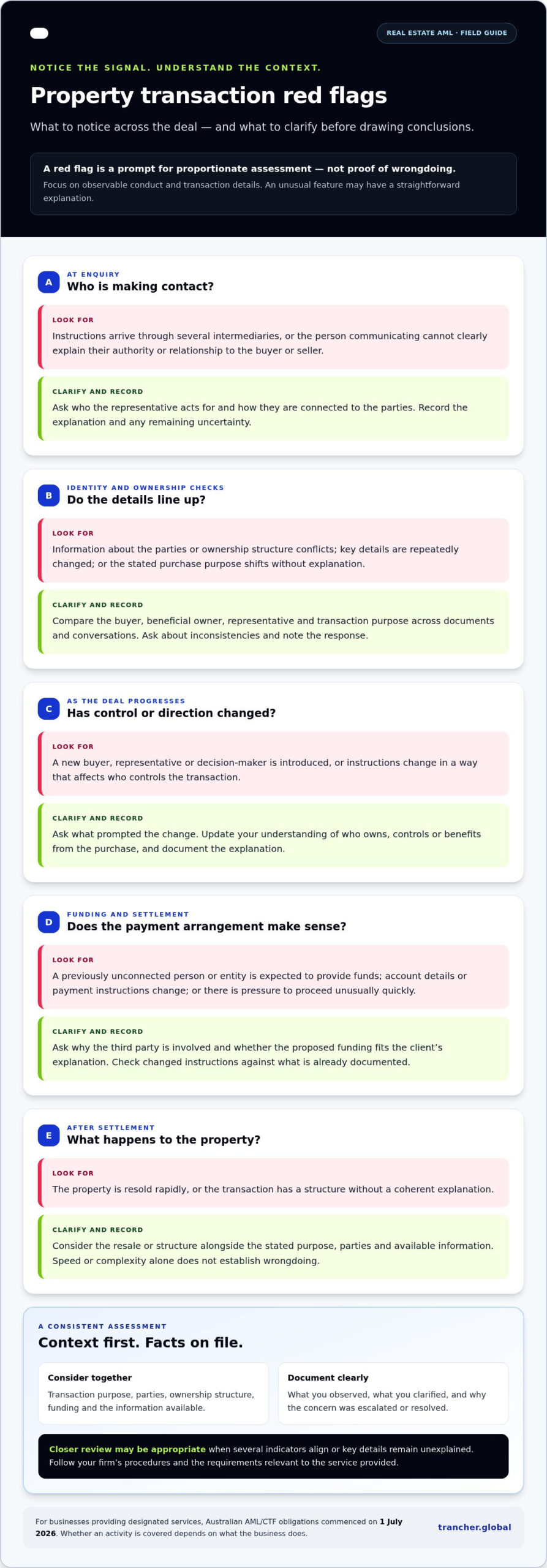
Look at what happens from the first enquiry through to activity after settlement. A detail that seems straightforward on its own may need clarification if it differs from earlier information or does not fit the stated purpose of the transaction. Focus on what you observe, what you ask and what the client or representative explains. These examples prompt proportionate enquiry and documentation; they are not automatic grounds to reject a client or transaction.
Across the transaction lifecycle, note changes and connections: who makes contact, who gives instructions, who owns or benefits from the property, how funds are provided and what happens after the purchase.
Identity, ownership and representation indicators
Pay attention if a client is reluctant to explain who ultimately owns, controls or benefits from a purchase, or if a representative’s role is unclear. Compare information about the buyer, beneficial owner, representative and transaction purpose across documents and conversations. Inconsistencies may have a reasonable explanation, but clarify and record them rather than silently overlooking them.
- At enquiry: Instructions come through several intermediaries, or the person communicating cannot clearly explain their authority or relationship to the buyer or seller.
- During identity and ownership checks: Details about the parties or ownership structure conflict, key information is repeatedly changed, or the stated purpose of the purchase shifts without explanation.
- As the deal progresses: A new buyer, representative or decision-maker is introduced, or instructions change in a way that affects who controls the transaction. Ask what prompted the change and document the response.
Funding, settlement and resale indicators
Review whether the proposed funding and settlement arrangements fit the client’s explanation. Unexplained third-party payments, changing account details or payment instructions, and unclear sources of funds can warrant questions. Pressure to proceed unusually quickly or a transaction structure without a coherent explanation may also merit review. Neither speed nor complexity alone establishes wrongdoing.
- Funding: A person or entity not previously connected to the transaction is expected to provide funds, or the reason for their involvement is unclear.
- Settlement: Payment arrangements change late in the process, instructions differ from those already documented, or a party presses for an unusual structure without explaining its purpose.
- After settlement: The property is resold rapidly or the sale price appears notably different from expectations based on available transaction information. Consider the circumstances and any explanation; price or timing alone is not proof of illicit activity.
Use consistent questions across staff: What changed? Who benefits? Where are the funds coming from? Does the explanation align with information already held? Record the answers and any remaining uncertainty. Reviewing indicators across the full transaction lifecycle can reveal relevant connections without turning an isolated feature into a conclusion.
Accounting firms supporting clients in designated-service contexts can use structured AML/CTF compliance workflows to organise verification, monitoring and records alongside their approved procedures.
Assess property red flags without jumping to conclusions
A sound assessment considers the whole transaction, not a single detail in isolation. Compare the feature that prompted attention with the client’s explanation and the available information about the transaction purpose, parties, ownership and funding. A clear explanation may help resolve a concern, but it is not automatically decisive. Consider whether it is consistent with information on file and relevant supporting material. An unanswered question is a reason to follow your firm’s process, not to speculate about motive.
Apply a proportionate, consistent approach under your firm’s procedures and the requirements relevant to the activity. The questions below can structure an enquiry and make the reasoning easier for another team member to review.
Questions that help establish transaction context
Start with what you can verify. Ask what explains the buyer’s role, the ownership structure and the stated purpose of the transaction. Clarify how the proposed funds relate to the parties and purchase, using the checks required by your procedures. Compare answers with existing client information and transaction records. If details conflict or questions remain open, record them plainly without assigning intent.
| Indicator to assess | Useful context questions | Information to document |
|---|---|---|
| Ownership or control is unclear | Who ultimately owns, controls or benefits from the purchase? What is each entity’s role? | Parties identified, ownership information obtained, explanation provided and any gaps. |
| The transaction purpose or party details differ across records | What accounts for the difference? Does the explanation fit the stated purpose and known client information? | Conflicting details, clarification sought, response and supporting information reviewed. |
| Funding arrangements are unexplained or have changed | Who is providing the funds, how are they connected to the parties, and what explains the change? | Funding details available, the client’s explanation and any unresolved questions. |
| A representative or instruction changes | What is the new representative’s authority and why have instructions changed? | Relevant instructions, authority or relationship explained, and the reason for the change. |
When an explanation does not resolve the concern
If information remains inconsistent or a material question is unanswered, follow your firm’s internal escalation process. Separate what you verified from what the client said and from your assessment of the remaining risk. This keeps the record fair, clear and useful for review. Do not label conduct criminal or assume that one document, explanation or unusual feature settles the matter.
A concise record can note:
- Verified facts: the information checked and the source or record reviewed.
- Client explanation: what was said, by whom and when, distinguishing it from independently verified information.
- Assessment and next step: why the concern appears resolved or remains open, and the action taken under firm procedures.
This approach makes money laundering red flags for real estate easier to assess consistently: clarify the facts, weigh the explanation against available information and document the reasoning without reaching beyond the evidence.
A practical checklist for responding to real estate AML concerns
A consistent response helps staff move from noticing an unusual feature to taking a reasoned next step. The sequence below is a practical framework, not a substitute for your firm’s approved procedures or the requirements that apply to the service and transaction.
- Notice: Describe the observable feature in neutral terms. Record what happened rather than making assumptions about why.
- Clarify: Ask focused questions about the transaction purpose, parties, ownership or funding, as relevant. Note the response and any information provided.
- Compare: Check the explanation against information already held and the transaction details. Identify what aligns, what differs and what remains unclear.
- Document: Create a clear record of the facts, enquiries, responses and your assessment. Keep it factual and consistent with firm procedures.
- Escalate: Refer unresolved concerns through the internal route set by your firm. Do not make a reporting decision alone unless your role and procedures require it.
- Check current guidance: Confirm applicable AUSTRAC guidance and requirements, including any relevant reporting obligations, before deciding what action is required.
This process keeps money laundering red flags for real estate in perspective while helping staff respond consistently. Reporting decisions and timelines depend on current requirements and the circumstances. Verify them against AUSTRAC guidance and follow appropriate internal review. Avoid relying on remembered deadlines or applying a rule without confirming that it covers the activity in question.
What to record when an indicator arises
Make the file useful to someone reviewing the concern later. Include the observed facts, relevant dates, people involved and transaction stage. Record questions asked, responses received and any documents or other information considered. If details conflict or remain unanswered, identify the gap plainly. Your record should show why the matter was escalated or closed under firm procedures, without speculating about motive.
How to escalate while protecting the process
Know the appropriate internal escalation route before a concern arises, including who reviews the information and how it should be passed on. Keep access to sensitive records in line with your firm’s processes. Do not tell a client about a report or review where current rules prohibit disclosure. Check the applicable requirements and seek internal guidance if you are unsure. Avoid promising that a particular indicator automatically requires a report, or that one explanation removes the need for further review.
For accounting firms supporting clients in designated-service contexts, structured workflows can help keep concerns, decisions and follow-up actions organised. Explore Trancher’s guide to when to submit a suspicious matter report as a starting point, then verify the applicable requirements and reporting timelines against current AUSTRAC guidance.
Build a consistent real estate AML workflow across the firm
Consistent handling depends on more than individual judgement. Staff need to know how to record an observation, who reviews it, what information to consider and how to capture decisions. A shared workflow makes it easier to respond proportionately and helps the firm see whether a concern is isolated or connected to other client or transaction activity.
For accounting firms supporting clients in relevant designated-service contexts, keep the process practical and clearly owned. For example, a staff member who notices a change in transaction instructions can record the facts and alert the nominated reviewer. The reviewer can compare the observation with due diligence information, consider whether follow-up is needed and document the outcome in the appropriate client record.
Turn isolated observations into a repeatable process
Set a clear route from staff observation to review, including who receives an escalation and who records the decision. Link the concern to relevant client due diligence and transaction information so reviewers can consider it alongside prior activity. Where ongoing monitoring applies, later changes can be assessed against an accurate record rather than staff memory or scattered notes.
- Assign ownership: Make clear who records concerns, who reviews them and who decides the next internal step.
- Use a consistent record: Capture the observation, relevant client or transaction details, enquiries made, responses and review outcome.
- Connect relevant information: Keep records organised so authorised staff can consider changes over time and understand what was known when a decision was made.
- Review the process: Use staff feedback and recurring workflow issues to identify where guidance or hand-offs need clarification.
This structure supports fairer, more consistent decisions. It also helps staff distinguish a documented fact from an explanation or assessment, without treating a single alert as a conclusion.
Prepare people, records and systems for Tranche 2
As firms prepare for and manage Tranche 2 requirements, confirm which activities and obligations apply to the services involved using current AUSTRAC guidance. Build staff guidance around practical scenarios, approved procedures and clear escalation routes. Structured records and repeatable workflows help make those expectations part of everyday operations, rather than leaving each team member to interpret a concern independently.
A compliance workflow can bring client verification, risk assessment, monitoring, reporting processes and supporting records into a more organised sequence. The setup should reflect the firm’s activities and internal responsibilities. It supports operational consistency but does not replace professional judgement or legal advice. Review the process periodically so staff instructions and records remain aligned with current guidance and the firm’s approved approach.
For accounting firms seeking a more structured way to manage these activities, Trancher’s platform supports AML/CTF program management and related workflows. Explore the guide to ongoing risk monitoring software to consider how monitoring can fit into a documented, firm-wide process.
Make consistent AML practice part of the way your firm works
The next step is to make sound judgement repeatable, so staff know how to raise a concern and reviewers can see how it was assessed. A clear process helps turn money laundering red flags for real estate from isolated observations into a considered part of client and transaction oversight, without treating an unusual feature as a verdict.
For accounting firms supporting clients in relevant designated-service contexts, Trancher provides AML/CTF workflows designed for Australian firms, with structured support for verification, risk assessment, monitoring and reporting. Australian onboarding and local support can help your team organise these activities within a consistent operational approach.
Explore how Trancher helps accounting firms organise AML compliance and consider how clearer workflows can support confident, consistent decision-making. Start a conversation with Trancher about preparing your firm’s AML/CTF processes and making compliance activity easier to manage and track.
Frequently Asked Questions
Does one real estate red flag prove that money laundering is taking place?
No. One indicator does not establish that money laundering is occurring. It can point to a detail that needs checking, such as a change in instructions later explained by an updated purchase arrangement. Consider the explanation alongside available information and your firm’s procedures. Money laundering red flags for real estate are prompts for careful assessment, not grounds for making an unsupported allegation about a client.
Is a cash-funded property purchase automatically suspicious?
No. The use of cash alone does not show that funds are illicit. Consider whether the funding method fits the transaction and the information available about the parties, then follow your firm’s applicable checks. For example, if the proposed source or handling of funds differs from what was previously explained, clarify the difference and record the response. Check current AUSTRAC guidance for any reporting requirements relevant to the activity.
Can a company or trust buying property be a red flag?
Not by itself. Companies and trusts can be used for legitimate purposes, so their involvement is not proof of wrongdoing. The practical question is whether the firm can understand the structure and identify the relevant people who own, control or benefit from it, in line with applicable procedures. If the details provided do not align with the transaction purpose or other information on file, seek clarification and document what remains uncertain.
What if a client refuses to explain an unusual transaction?
Record what you asked, the client’s response and which information remains unavailable, then follow your firm’s escalation process. Avoid filling gaps with assumptions about motive. A refusal may leave a concern unresolved, but it does not by itself establish criminal conduct or determine what action is required. If a reporting question arises, have it reviewed through the appropriate internal channel and check current AUSTRAC requirements before deciding next steps.
Do real estate AML red flags matter before a transaction is completed?
Yes. A concern can arise during enquiry, due diligence, funding arrangements or settlement preparation, so staff should not assume it only matters after completion. Raise it through the firm’s process when it becomes apparent. The appropriate response depends on the activity, available information and current requirements. Do not rely on an assumed reporting timeframe; check current AUSTRAC guidance and obtain internal review where your procedures call for it.
Should firms review earlier client activity when a new property concern arises?
Where applicable under the firm’s procedures, reviewing relevant earlier information can help establish whether the new detail is isolated or connected to previous activity. For example, compare current transaction instructions with the client’s recorded purpose and prior explanations. Keep the review focused on information relevant to the concern, and note which records informed the assessment. If the activity or information is outside your role, use the firm’s internal escalation route.