

How can a legal practice strengthen AML controls without making client service slower or more difficult? Mitigating money laundering risks in legal practices starts with understanding how clients, matters and payment flows connect, rather than applying the same checks in every situation.
The concern is understandable. Legal work varies, teams are busy, and broad or inconsistent controls can create friction without making decisions clearer. Since Australia’s AML/CTF Tranche 2 obligations commenced on 1 July 2026, practices providing designated services need practical ways to identify and manage relevant exposure.
This guide explains where vulnerabilities may arise across legal work, how to apply proportionate due diligence, and when to escalate or review concerns. It also covers how consistent workflows and clear records can help your team explain decisions and support effective governance. The aim is a measured approach: controls that respond to risk, support professional judgement and fit into day-to-day client service.
Key Takeaways
- Check whether the work involves a designated service, and use current AUSTRAC guidance to understand how AML/CTF requirements apply.
- Assess the client, matter purpose, parties and movement of funds together to build a clearer picture of exposure.
- Mitigating money laundering risks in legal practices means matching controls to the assessed context, not relying on blanket checks or weakening safeguards.
- Make risk controls workable by mapping tasks, assigning owners, briefing staff and recording decisions at each stage.
- Connect assessment, verification, monitoring, escalation and records in a governed workflow to strengthen continuity and make evidence easier to review.
Where do money laundering risks arise in legal practices?
Exposure depends on the work a practice performs and the transaction it facilitates, not simply on its professional label. A matter involving advice alone raises different questions from one where the practice may help move client funds, deal with assets or establish an entity. Start by identifying the service being provided, then consider how the client, matter and flow of value fit together.
Risk-based mitigation means identifying the exposure in a particular service or matter and matching checks, controls and review to that context. It doesn’t mean treating an unusual feature as proof of wrongdoing. It means pausing to understand the feature and documenting the reasoning. For foundational context on laundering methods and stages, see Understanding Money Laundering.
How legal work can create money laundering exposure
Legal services can intersect with the movement or ownership of value in several ways. A matter might involve funds passing through a client account, a property transaction, an asset transfer, or the establishment or management of a company or trust. These examples are prompts for assessment, not a claim that every such activity is automatically a designated service or indicates misconduct.
Consider the practice’s role rather than making assumptions about a client’s intent. Where relevant to the work, ask what the funds are for, where they came from, who ultimately owns or controls the assets, and whether the transaction fits its stated context. The answers may be straightforward. If they aren’t, the information gap is a reason to make further enquiries or escalate under the practice’s procedures.
- Funds: What is the payment intended to achieve, and does its route fit the matter?
- Assets: Who owns or controls them, and what transfer or transaction is being arranged?
- Structures: What purpose does an entity or arrangement serve in this specific matter?
These questions connect the legal work to the movement of value without presuming that complexity, unfamiliarity or an inconsistency alone establishes criminal intent.
Which legal practices should assess their AUSTRAC position?
AUSTRAC obligations depend on whether a practice provides a relevant designated service, not on every legal activity or firm automatically. General legal work should not be treated as captured simply because it is performed by a law practice. Equally, a firm’s usual focus does not settle the position if it also undertakes work that may fall within a designated service.
Tranche 2 obligations commenced on 1 July 2026. To assess applicability, identify the services the practice actually provides and compare them with current AUSTRAC guidance on designated services and relevant obligations. Revisit the assessment when the practice changes its work or transaction processes. This gives the firm a reasoned basis for deciding where controls apply, rather than relying on assumptions about its sector or a single matter feature.
How to connect client, matter and funds in a risk assessment
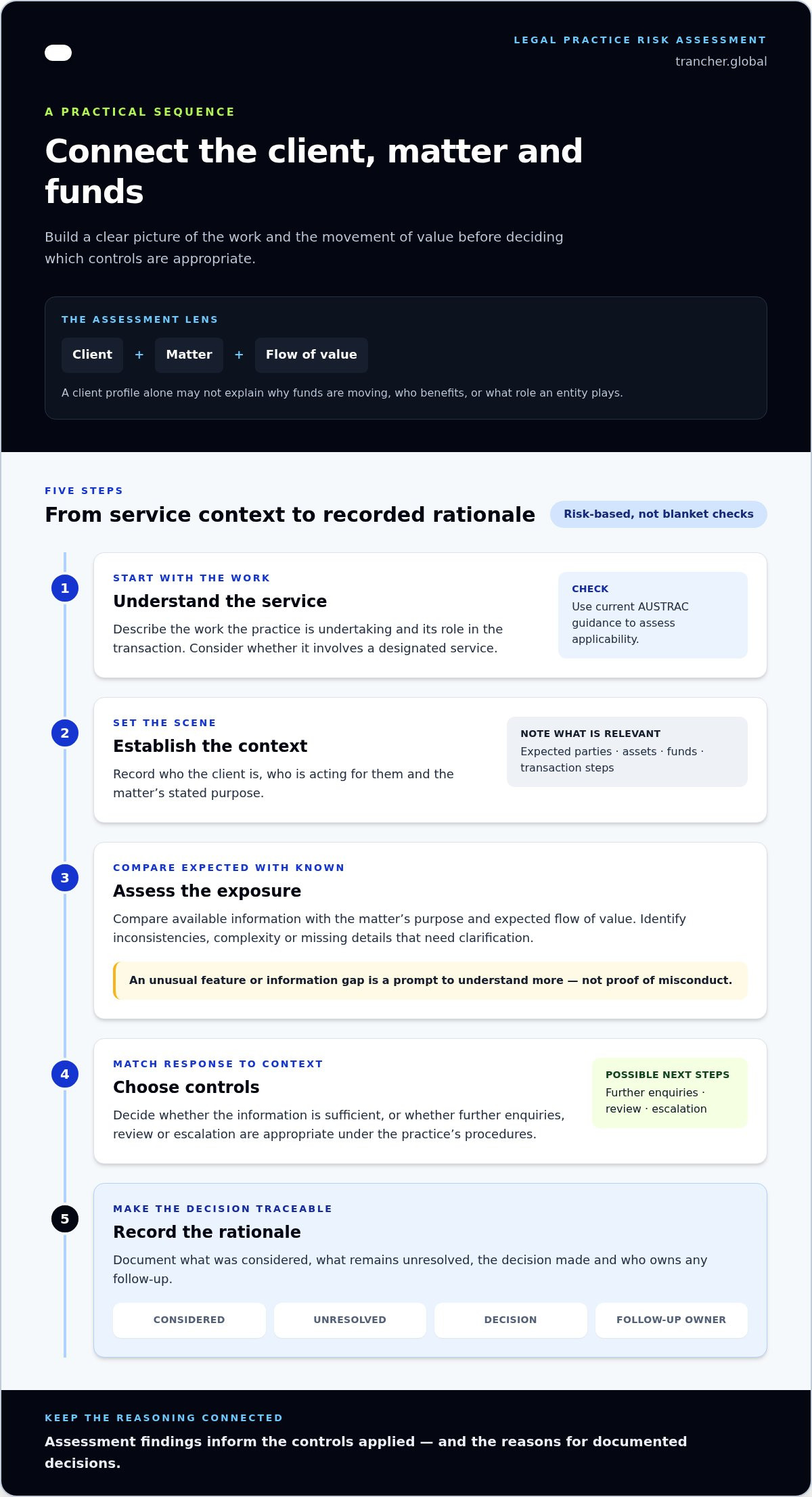
A useful assessment links the client to the specific legal work and the value moving through it. A client profile alone may not explain why funds are being transferred, who benefits from a transaction or what role an entity plays in the matter. Build the picture in sequence, then record how it informs your response.
Assessment findings should inform the controls applied and the reasons for documented decisions. This makes the process easier for a team to follow and supports a consistent explanation if the matter is reviewed later.
- Understand the service. Describe the work the practice is undertaking and its role in the transaction. Consider whether it involves a designated service, using current AUSTRAC guidance to assess applicability.
- Establish the context. Record who the client is, who is acting for them and the matter’s stated purpose. Note the expected parties, assets, funds and transaction steps relevant to the work.
- Assess the exposure. Compare the available information with the matter’s purpose and expected flow of value. Identify inconsistencies, complexity or missing details that need clarification, without treating them as proof of misconduct.
- Choose controls. Decide whether the information is sufficient or whether further enquiries, review or escalation are appropriate under the practice’s procedures.
- Record the rationale. Document what was considered, what remains unresolved, the decision made and who owns any follow-up.
Build a client and matter picture before choosing controls
Keep client-level information distinct from matter-level facts. Client information can describe the person or entity receiving the service and anyone acting on its behalf. The matter record should explain the purpose of the work, the relevant parties, the assets or funds involved and how the proposed transaction is expected to proceed.
Ownership and control may be relevant when an entity or arrangement forms part of the matter. Record what is known about who owns or controls the entity, and note any information gaps. Don’t assume a structure is improper simply because it’s layered or unfamiliar. Explain how it relates to the stated purpose and whether more information is needed. For identity and due diligence considerations, use the practice’s applicable procedures and AML risk assessment methodology.
Turn assessment findings into proportionate decisions
Further enquiries should respond to the circumstances identified, not follow automatically from a single unusual feature. For example, if the parties or source of funds aren’t clear in a transaction, the team can seek relevant clarification and assess whether the explanation fits the matter. A decision to proceed, pause for review or escalate should have a recorded basis and a named follow-up owner.
Keep the assessment grounded in the Australian context by referring to current AUSTRAC guidance and the practice’s procedures when handling a concern. A repeatable process helps staff connect the information considered with the decision and any follow-up. Structured AML/CTF workflows can help make those steps visible while leaving professional judgement with the practice.
How can firms apply controls without creating unnecessary client friction?
Effective controls should make the next step clear for staff and clients. In mitigating money laundering risks in legal practices, proportionate checks aren’t weaker checks. They’re selected in response to the assessed matter, with a consistent process for requesting information, reviewing answers and recording decisions.
Three broad approaches can feel quite different in practice. The comparison below focuses on consistency, effort and traceability, rather than assuming one approach is right for every firm.
| Approach | Consistency | Effort | Traceability |
|---|---|---|---|
| Ad hoc manual checks | Can vary between staff or matters | Depends on individual judgement and follow-up | May rely on separate notes or records |
| Blanket procedures | Uses the same steps broadly | May request information that isn’t relevant to every matter | Can show that a standard step was completed |
| Risk-informed workflows | Uses shared criteria while allowing context-based decisions | Focuses enquiries on identified information needs | Can connect the assessment, decision and follow-up record |
This is a practical comparison, not a claim that every manual check or standard procedure is ineffective. The aim is to make decisions understandable and repeatable while allowing the firm to respond to the details of the work.
Choose checks that respond to the matter’s assessed context
Before making a request, staff should be able to explain what information is needed and how it relates to the matter. If a transaction’s purpose is clear but a relevant party’s role isn’t, ask about that gap rather than sending a broad request for unrelated documents. A single unusual feature isn’t conclusive evidence of money laundering; it’s a prompt to consider the full context.
If an important gap remains unresolved, staff should know when to pause routine processing and refer the matter for review or escalation under the firm’s procedures. Clear criteria help avoid repeated requests and premature conclusions. The guide to simplifying client onboarding for law firms explores how thoughtful information requests can support a smoother onboarding experience.
Make escalation consistent and explainable
Give staff a defined route for raising concerns, such as a designated internal decision-maker or the role set out in the firm’s procedures. Clarifying who receives the concern, what context to include and how the outcome is recorded helps prevent issues from sitting unresolved or being handled differently across teams.
Distinguish routine clarification from matters requiring formal assessment under current procedures. Communicate requests plainly: explain what’s needed, why it relates to the legal work and how the client can provide it. Assign follow-up responsibility internally so the client isn’t asked for the same information by different people. Structured workflows can help organise these steps and keep decisions visible. AML/CTF workflow tools can support operational consistency without replacing professional judgement.
How to put legal-practice risk controls into daily workflows
Risk controls work best when staff can follow them as part of ordinary matter handling, not as a separate exercise that depends on memory. A practical implementation sequence moves from understanding the work to checking that procedures operate as intended.
- Map the work: identify the services and matter stages where client information, transactions or decisions need review.
- Assign owners: clarify who gathers information, reviews concerns, approves decisions and maintains records.
- Document procedures: set out the steps, decision points, escalation route and records expected at each stage.
- Brief staff: explain how the process applies to their role, using realistic scenarios as well as written guidance.
- Review operation: check whether staff follow the steps, identify gaps and update procedures when services, workflows or relevant official guidance change.
Clear ownership, recorded reasoning and consistent follow-up turn individual checks into a process the practice can explain and improve.
Assign clear responsibilities and prepare staff
Define responsibilities at each point in the workflow. A staff member may collect client information, while an appropriate reviewer considers an unresolved concern and an authorised decision-maker determines the next step under firm procedures. Make clear who records the outcome and who follows up. These roles should reflect the practice’s governance arrangements, rather than relying on an informal assumption that someone else will act.
Training should connect policy to the decisions staff actually face. Use scenarios to practise recognising missing information, recording a rationale and routing a concern. Refresh the guidance when the practice changes its services or procedures, or when relevant AUSTRAC guidance changes. Clear examples help staff apply the process consistently without treating every matter as identical.
Record decisions and review the process
Keep records useful and connected to the stage of work. At client level, note relevant identification and due diligence information. At matter level, capture the service, purpose, relevant parties and transaction details considered. If an issue is escalated, record the concern, information reviewed, decision, decision-maker and any follow-up owner. The guide to audit-ready compliance records covers record-keeping considerations in more detail.
Test the process through file reviews or checks of how a matter moved through the workflow. Look for missing details, unclear ownership, inconsistent decisions or follow-up that wasn’t completed. Record each gap, assign an accountable owner and track the action through to resolution. If the review identifies a reporting question, use current official requirements and the practice’s procedures; the suspicious matter reporting guide addresses that separate topic.
Use what you find to refine the workflow, not just to close individual gaps. For an overview of structured AML/CTF workflows and compliance activity tracking, see how Trancher’s platform supports compliance workflows.
Sustain money laundering risk mitigation with connected systems and governance
Controls need to stay connected after a risk assessment is complete. If client verification sits in one place, review decisions in another and follow-up in someone’s inbox, it can be difficult to see what has happened or what remains outstanding. A governed workflow links assessment, verification, monitoring, escalation and record-keeping, so staff can follow the process and decision-makers can review its operation.
Choosing a system is not a substitute for defining the firm’s procedures. First decide who owns each step, what information and decisions need to be captured, and how staff should act on outstanding tasks. Then consider which tools make those responsibilities and records easier to manage consistently.
What to look for in a connected compliance workflow
Compare common approaches against the same practical criteria. The table describes considerations, not guaranteed outcomes: how well any approach works depends on the firm’s processes and how people use it.
| Approach | Ownership | Continuity | Evidence visibility |
|---|---|---|---|
| Spreadsheets | Responsibility may depend on named users and local conventions | Updates and handovers need to be managed | Information may be spread across files or versions |
| Disconnected tools | Responsibilities can sit across separate processes | Staff may need to move information between systems | Records may need to be brought together for review |
| Structured platform | Workflows can help make assigned steps visible | Connected processes can support handovers and follow-up | Records and compliance activity can be easier to track together |
Assess whether the system supports consistent handling of client information, risk decisions, follow-up tasks and records. Consider whether staff can access role-relevant guidance, reviewers can see outstanding actions, and the firm can understand how a decision was reached. Technology can support repeatable administration, but it doesn’t replace professional judgement or the need to follow current AUSTRAC guidance. No platform alone guarantees compliance or prevents money laundering.
Turn compliance activity into a managed business process
Connected tracking can help the firm see where work sits, who is responsible and which actions still need attention. That visibility can support governance and help identify where a process needs clarification. It can also help a practice understand the time and activity involved in delivering compliance work. Whether any of that activity is recoverable as a client service depends on the firm’s own service model; it shouldn’t be treated as guaranteed revenue.
Trancher provides an AML/CTF program management platform designed for Australian accounting firms. Its structured workflows support client verification, risk assessment, ongoing monitoring, reporting and record-keeping, alongside staff guidance and compliance activity tracking. These capabilities illustrate how a connected platform can bring compliance steps and evidence together.
For firms assessing their operational needs, early preparation can make responsibilities, processes and evidence easier to organise. Explore Trancher’s AML/CTF program management approach to see how structured workflows support accounting firms’ compliance activity.
Make your next compliance steps deliberate
Use your next review to identify one practical improvement: a clearer handover, a more consistent decision record or a simpler way to track follow-up. Small, well-owned changes can make mitigating money laundering risks in legal practices part of sound operational governance, rather than a process that only receives attention when a concern arises.
For Australian practices considering how to organise compliance activity, Trancher provides local Australian onboarding and support. Trancher also offers a 30-day AML/CTF compliance-readiness guarantee. This relates to compliance readiness, not a guaranteed regulatory outcome.
Take a considered next step: explore Trancher’s AML/CTF program management approach and consider how structured support could fit your organisation’s needs. A clear starting point can make the work ahead feel more manageable.
Frequently Asked Questions
Does every Australian legal practice need to comply with AUSTRAC Tranche 2 obligations?
No. An Australian legal practice isn’t automatically covered simply because it is a law firm. Applicability depends on whether its work includes a designated service under the current AML/CTF framework. Build an inventory of services actually delivered, including work handled by different teams, then compare each against AUSTRAC’s current guidance. Where the application is unclear, document the issue and use current official guidance to inform the firm’s assessment.
What is the difference between a money laundering risk indicator and proof of wrongdoing?
A risk indicator is a reason to look more closely, not proof that a client has done anything wrong. For example, a change in payment instructions may warrant clarification if it doesn’t fit the matter’s documented context. Consider the surrounding facts before deciding what to do, and avoid treating one feature as conclusive. A clear record of how the concern was assessed helps distinguish a considered decision from an assumption.
How should a legal practice handle a client who cannot readily explain the source of funds?
Assess the information gap in context rather than drawing an automatic conclusion about the client. First consider whether the source of funds is relevant to the service and transaction. If it is, make a focused request for clarification and follow the practice’s internal review procedures if uncertainty remains. Record what was requested, the client’s response or lack of response, and why the practice chose its next step.
Can a firm rely on existing professional standards to manage money laundering risks?
Existing professional standards can provide useful safeguards, but they shouldn’t be assumed to address every applicable AML/CTF requirement. For mitigating money laundering risks in legal practices, map existing procedures to the services the firm provides and the relevant current AUSTRAC guidance. For example, a conflicts process may serve a different purpose from client due diligence. Identify any gaps, assign responsibility for addressing them and record the firm’s reasoning.
How often should a legal practice review its AML/CTF risk controls?
Set out a review approach in the practice’s procedures and revisit controls when services, workflows or assessment findings change, or relevant official guidance is updated. For example, a new service may change the practice’s exposure and require a fresh look at existing processes. Check current AUSTRAC guidance for any specific timing requirements.
Can AML/CTF software make a legal practice compliant automatically?
No. Software can help organise tasks and records, but it can’t replace suitable governance, trained staff, professional judgement or attention to current requirements. A practice still needs to ensure its procedures reflect the work it actually performs and that staff use the system appropriately. Trancher provides an AML/CTF program management platform designed for Australian accounting firms, with workflows for verification, risk assessment, monitoring, reporting and record-keeping.
What date did Australian Tranche 2 obligations commence?
Australian AML/CTF Tranche 2 obligations commenced on 1 July 2026. That date alone doesn’t establish that every legal practice or every legal activity is covered. A practice should check current AUSTRAC guidance and compare its actual services with the designated services under the framework. Where application is unclear, document the question and assess the practice’s services against the relevant requirements.