

What if the strongest case for compliance technology isn’t avoiding penalties, but understanding what your current process is costing the firm? For Australian accountants, justifying investment in compliance technology starts with a practical question: what does compliance work demand from your people, and what value could a more consistent workflow deliver? AML/CTF obligations for Tranche 2 entities commenced on 1 July 2026, making ongoing operational readiness a present-day consideration.
It’s reasonable to see compliance as overhead when staff time, administration and business benefits are difficult to measure. A sound business case doesn’t rely on broad promises or penalty avoidance alone. Use your firm’s own workload and financial data to assess the effort involved, identify friction and consider where documented compliance activity may support transparent client billing.
This guide will help you compare manual, fragmented and integrated approaches against clear business criteria. You’ll learn how to weigh readiness, efficiency, implementation and revenue opportunities alongside your firm’s costs, then use that evidence to assess technology options. The result is a grounded next step towards consistent workflows and sustainable service delivery, without adding unnecessary administrative burden.
Key Takeaways
- Map which of your firm’s services may fall within the AML/CTF regime before estimating the technology needed.
- Build a credible case for justifying investment in compliance technology by measuring staff time, hand-offs, rework and record retrieval against a clear baseline.
- Compare manual, disconnected and integrated workflows using the same criteria, including monitoring, reporting and record consistency.
- Assign decision-making and implementation responsibilities so your evaluation reflects how the technology will work in practice.
- Consider how linked KYC/CDD, risk assessment, monitoring and activity records can support consistent workflows and clearer client billing conversations.
Why Australian Accounting Firms Are Assessing Compliance Technology Now
Compliance technology is more than software for storing forms. It refers to systems that help firms carry out repeatable compliance workflows, retain supporting evidence and maintain oversight of work in progress. This sits within the broader field of Regulatory technology (RegTech), where technology supports regulatory and compliance processes.
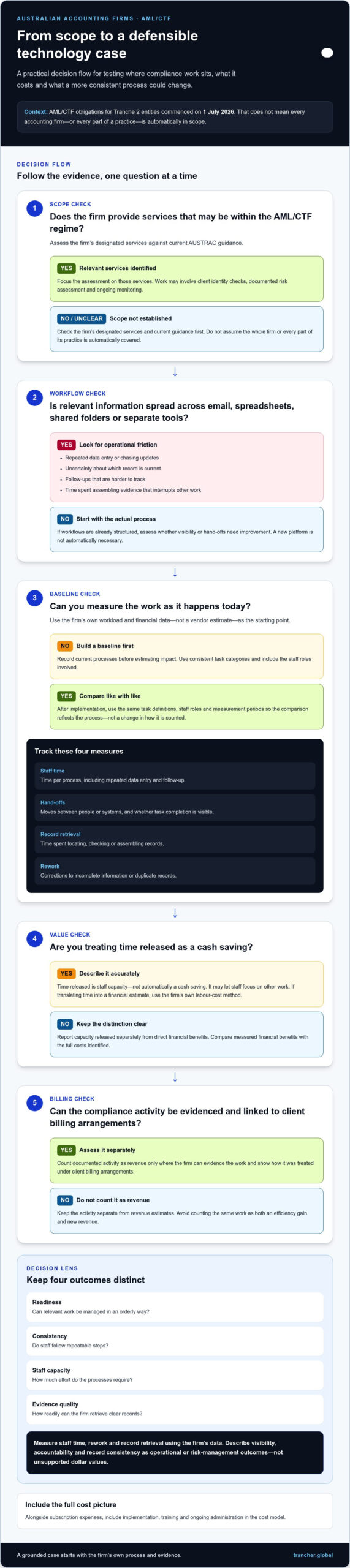
For Australian accounting firms, the starting point is understanding which services the firm provides. AML/CTF obligations for Tranche 2 entities commenced on 1 July 2026, but that doesn’t mean every accounting firm or every part of its practice is automatically in scope. Assess applicability against the firm’s designated services and current AUSTRAC guidance. For firms performing relevant services, work may involve client identity checks, documented risk assessment and ongoing monitoring.
Which firm pressures make the investment question relevant?
Those activities need clear ownership and reliable records. When information sits across email, spreadsheets, shared folders and separate tools, staff may have to repeat data entry, chase updates or work out which record is current. Follow-ups can be harder to track, and assembling evidence may interrupt other work.
Firms are not all starting from the same place. Some already have structured workflows and are assessing whether technology can improve visibility or reduce hand-offs. Others are still identifying gaps in how tasks, records and responsibilities are managed. Both can make a sound decision by examining their actual processes rather than assuming a new platform is necessary.
What should a defensible investment case demonstrate?
Assess four value dimensions separately: readiness, or whether relevant work can be managed in an orderly way; consistency, or whether staff follow repeatable steps; staff capacity, or how much effort processes require; and evidence quality, or how readily the firm can retrieve clear records. These dimensions help decision-makers identify what needs to improve before comparing technology options.
Then distinguish measurable financial benefits from qualitative risk-management benefits. Staff time, rework and record retrieval effort can be measured using the firm’s own data. Better visibility, clearer accountability and more consistent records are valuable too, but should be described as operational or risk-management outcomes rather than assigned unsupported dollar values.
Compliance technology creates business value when it helps a firm manage relevant work consistently, use staff capacity deliberately and produce clearer evidence of what has been done.
That framing keeps justifying investment in compliance technology grounded in the firm’s operating reality. The decision becomes less about buying software to avoid a possible penalty and more about whether a defined approach can support readiness, reliable delivery and oversight.
How to Measure the Operational and Financial Value of Compliance Technology
A credible investment case starts with a baseline, not a vendor estimate. Record how the firm currently handles relevant compliance work, then compare like with like after implementation. Use the same task definitions, staff roles and measurement periods so any change reflects the process, not a change in how it’s counted.
Which measures belong in the business case?
Choose a small set of measures that reflects the work your firm actually performs. For example, track:
- Staff time spent on each process, including repeated data entry and follow-up.
- Hand-offs between people or systems, and whether task completion is visible.
- Time spent locating, checking or assembling records.
- Rework, such as correcting incomplete information or updating duplicate records.
Use consistent categories for compliance tasks and client-related activity. This makes it easier to distinguish time spent completing a compliance process from activity that may be recoverable through client billing. Include implementation, training and ongoing administration in your cost model, alongside subscription expenses. CPA Australia’s Business Technology Report offers broader context on business technology adoption; your firm’s own measures should remain the foundation of the case.
How can a firm calculate value without overstating ROI?
Estimate labour capacity released by comparing the time required for a defined task before and after implementation. Apply your firm’s own labour-cost method if you’re translating that time into a financial estimate. Be precise about what the result means: capacity released is not automatically a cash saving. It may instead allow staff to focus on other work.
Assess documented, potentially billable compliance activity separately from time saved. Count it as revenue only where the firm can evidence the work and show how it was treated under its client billing arrangements. This avoids counting the same activity as both an efficiency gain and new revenue.
Finally, compare any measured financial benefits with the full costs you’ve identified. Record improved readiness, clearer oversight and stronger evidence as operational value unless you have a defensible way to assign them a monetary value. That distinction makes justifying investment in compliance technology more transparent and useful to decision-makers.
For a related framework, explore this guide to compliance ROI tracking software.
Manual Processes, Point Solutions or Integrated Compliance Technology?
There’s no single operating model that suits every firm. Compare the approaches against the same criteria, then weigh the differences against your firm’s services, existing systems and capacity to manage change. Manual processes may be clear and workable for a limited scope; point solutions can address a specific task; integrated workflows can connect more steps. The question is where your current model creates friction and what needs to improve.
| Criterion | Manual processes | Disconnected point solutions | Integrated workflows |
|---|---|---|---|
| Workflow scope | Steps are managed through staff procedures and separate records. | Individual tools support particular tasks, with hand-offs between them. | Related tasks can be managed within a connected workflow. |
| Record consistency | Consistency depends on staff following agreed procedures. | Records may be held across separate tools and locations. | Related activity can be recorded in a more joined-up process. |
| Monitoring | Staff track progress through the firm’s chosen methods. | Progress may need to be checked in each tool. | Workflow visibility can bring related activity together. |
| Reporting | Information may need to be gathered and compiled manually. | Reporting may draw on separate sources. | Connected records can support a more coherent view of activity. |
| Integration | Processes rely on staff moving information between steps. | Connections between tools may vary. | Integration aims to reduce fragmentation across relevant steps. |
Where do manual and fragmented approaches create friction?
Duplicating client details across a spreadsheet, email and separate tool can make it harder to see which information is current and whether a follow-up is complete. Records spread across locations can also take longer to assemble. These are risks to assess, not proof that every manual process is ineffective. A well-owned procedure may work well for a firm’s scope; examine the actual hand-offs, delays and dependencies before deciding.
Consider continuity, too. If a process depends on one person’s knowledge, document how others can take over and keep decisions consistent. Clear ownership and staff guidance matter in every model, including technology-supported workflows.
What should an integrated platform demonstrate?
Look for a coherent path linking client verification, risk assessment, monitoring and reporting, alongside record keeping, training and designated service tracking. Assess whether staff can understand their tasks, whether relevant records are accessible, and who oversees completion. Automation can support repeatability, but it doesn’t replace accountable people, sound procedures or firm oversight.
As you compare options, justifying investment in compliance technology means testing how well each approach fits the work, not assuming the most automated model is automatically the best. For more on the evidence each approach should support, consult a guide to audit-ready compliance records.
A Practical Framework for Building and Presenting the Investment Case
A clear proposal shows how the firm moved from a defined need to a considered decision. Use a sequence that makes the reasoning easy to review:
- Scope the work. Identify which services may be relevant to the firm’s AML/CTF requirements, using current AUSTRAC guidance to assess applicability.
- Map the workflow. Document the people, systems, hand-offs and records involved in each relevant process.
- Set a baseline. Use the firm’s own measures for staff time, rework, task visibility and evidence retrieval.
- Compare options. Assess manual processes, point solutions and integrated approaches against the same criteria.
- Review the evidence. Separate measured results from assumptions, and identify any questions that still need resolution.
Before comparing shortlisted approaches, name who approves the investment and who will lead implementation. Include the people responsible for compliance oversight, operations, technology and staff adoption as relevant to your firm. Clear roles help prevent the proposal from treating implementation as a task that belongs to no one.
How should decision-makers set evaluation criteria?
Prioritise workflow coverage, usability, evidence quality, support and fit with existing processes. Weight each criterion according to the firm’s designated services, client mix and operating model. For example, test a typical client onboarding scenario: can staff understand the steps, record the required information, manage follow-ups and retrieve the resulting evidence? Record assumptions, evidence sources and unresolved questions in the proposal, rather than presenting estimates as established outcomes.
For a separate readiness task, use an AUSTRAC Tranche 2 readiness checklist alongside your technology evaluation. Keep readiness and platform selection distinct: a checklist can help organise the firm’s review, while the investment case should explain how each shortlisted approach addresses the operational needs identified.
How can the firm make implementation measurable?
Carry your baseline into implementation planning. Decide who will review progress and how the firm will assess staff participation, workflow completion and documentation quality. Use the same definitions established at the outset, and note any changes in scope or process that affect comparisons. This gives decision-makers a practical way to review adoption and identify where further guidance or process adjustments may help.
Once your criteria are clear, explore Trancher’s AML/CTF workflow approach as one option to assess against them. A defensible case for justifying investment in compliance technology connects the firm’s own needs and evidence to the approach selected, with responsibilities for ongoing oversight clearly assigned.
How Trancher Can Support a More Defensible Compliance Technology Decision
Once your firm has defined its priorities, compare Trancher against those criteria rather than judging it by a feature list alone. Consider whether its end-to-end AML/CTF workflow platform aligns with the services in scope, the hand-offs identified in your process map and the evidence your firm needs to maintain.
Which platform capabilities map to the business case?
Trancher brings together capabilities that can support connected compliance workflows, including:
- Client verification and due diligence: KYC/CDD and screening support for relevant client checks.
- Risk assessment and monitoring: tools for recording risk and tracking ongoing client activity.
- Reporting and records: support for regulatory and suspicious matter reporting, alongside audit-ready documentation and record keeping.
- Training and activity tracking: staff guidance and records of compliance activity, including designated service tracking.
Assess how these capabilities fit together in the firm’s actual workflow. For example, can staff move from a client check to recording risk, completing follow-up activity and retaining related evidence in a consistent process? Review how training and guidance support staff in following that process, and how managers retain oversight. The platform can support the firm’s people and procedures, but accountability for the firm’s compliance work remains with the firm.
Activity tracking can also make work performed more visible. A clear record may help the firm assess whether particular compliance tasks are recoverable under its client arrangements and support a transparent billing conversation. It doesn’t establish that work is billable or guarantee additional revenue; the firm must assess the activity and its billing treatment.
What is a sensible next step after the comparison?
Bring the decision back to the evidence you’ve gathered: the priority outcomes, baseline measures, evaluation criteria and responsibilities for implementation and oversight. Use those points to discuss how Trancher’s capabilities fit your firm’s AML/CTF workflows, where they may address identified process gaps and what your team would need to adopt the approach effectively.
That keeps justifying investment in compliance technology grounded in your firm’s needs, not assumptions about savings or outcomes. Trancher offers a complimentary three-month trial to a limited number of accounting firms. Firms that continue after the trial receive 20% off their first 12-month subscription. The trial includes a formal ROI report at the end of the three-month period, and Trancher guarantees AML/CTF compliance-readiness within 30 days of starting.
Start a conversation with Trancher about how its AML/CTF workflow platform could fit your firm’s processes and evaluation criteria.
Build a business case your firm can stand behind
A defensible decision starts with your firm’s own evidence. Identify which services are in scope, measure current staff effort and process friction, then compare manual, fragmented and integrated approaches against consistent criteria. Separate measurable financial benefits, such as documented capacity released, from operational value like clearer oversight and more accessible records.
Justifying investment in compliance technology isn’t about assuming a platform will remove every challenge or produce a guaranteed return. It’s about deciding whether a defined approach can support more consistent workflows, stronger evidence and sustainable service delivery. Trancher’s end-to-end AML/CTF platform for accounting firms includes compliance activity tracking, which can help your firm assess and discuss work that may be recoverable from clients. Its complimentary three-month trial includes a formal ROI report at the end of the trial period.
Use your evaluation criteria to guide the next conversation. Start a conversation with Trancher about your firm’s compliance workflows and explore how the platform may fit your priorities. A measured, practical approach can help your firm move forward with confidence.
Frequently Asked Questions
How do you justify investment in compliance technology?
Justify the investment by comparing your firm’s current processes with the operational improvements a technology option could support. Start by identifying relevant services and workflow gaps, then measure staff effort, hand-offs, rework and record retrieval. Compare shortlisted approaches against those baseline measures and include implementation, training and ongoing costs. Treat readiness and stronger oversight as operational value unless you have a defensible method for expressing them in financial terms.
What should an accounting firm include in a compliance technology business case?
Include the firm’s relevant services, existing workflows, baseline measures, shortlisted options and full cost assumptions. Identify decision-makers and who will lead implementation, training and ongoing oversight. Set evaluation criteria such as workflow coverage, usability, evidence quality and fit with existing processes. Separate measured financial benefits from qualitative outcomes, and record the sources behind estimates and any questions still to resolve. This gives decision-makers a clear basis for reviewing the proposal.
How can a firm calculate ROI on compliance software?
Use the firm’s own data to estimate measurable value. Compare staff time for defined tasks before and after adoption, but don’t treat time released as a cash saving unless it reduces costs or is put to productive use. Assess documented compliance activity that may be recoverable from clients separately, counting revenue only where the work and billing treatment are evidenced. Compare these amounts with implementation, training, subscription and administration costs, avoiding double-counting.
Is compliance technology worth it for a small accounting firm?
It can be worth assessing if the firm performs designated services and needs a more consistent way to manage related workflows. Firm size alone doesn’t determine value. Consider the services in scope, client mix, staff capacity, record-keeping effort and how much work is spread across separate processes. A smaller firm may find a focused manual process sufficient, or may identify a case for integrated support. Base the decision on its actual workload and needs.
Can compliance software replace an AML compliance officer?
No. Compliance software can support workflows, records, monitoring and reporting, but it doesn’t replace accountable people, decision-making or firm oversight. Assign responsibility for managing the firm’s compliance processes and reviewing work, and ensure staff understand their roles. Technology can help make tasks and evidence more visible; it should operate within the firm’s governance arrangements, not be treated as a substitute for them.
What is the difference between compliance software and a point solution?
A point solution is designed to address a particular task, such as a client check or screening activity. Compliance software may cover a broader set of connected workflows, such as verification, risk assessment, monitoring, reporting and record keeping. The distinction is about scope and how processes connect. Compare both against the firm’s needs, including hand-offs, record consistency, reporting and integration with existing processes.
How long does it take to become AML/CTF compliance-ready with technology?
There’s no single timeframe that applies to every firm. Readiness depends on the services in scope, the current state of processes and records, decision-making, staff participation and implementation work. Technology can support structured workflows, but adopting a platform alone doesn’t establish readiness. Map responsibilities, prepare staff guidance and review whether processes and documentation work as intended. Trancher guarantees AML/CTF compliance-readiness within 30 days of starting.
When should an Australian accounting firm invest in compliance technology?
Assess the need now if your firm provides services that may be designated under Australia’s AML/CTF framework. Tranche 2 obligations commenced on 1 July 2026, so the focus is ongoing applicability and operational management, not a future commencement date. Check current AUSTRAC guidance against your services, then review workflow gaps and evidence needs. Firms outside the relevant scope can still assess process efficiency, but shouldn’t assume the regime applies to every practice.