

What would your board see if it asked not just whether AML/CTF tasks were completed, but whether the controls are working? For Australian accounting firms, proving compliance effectiveness to the board means connecting evidence across client checks, risk monitoring, staff workflows and follow-up, rather than presenting a list of completed activities.
That can be difficult when records sit across different systems and teams, and routine reporting makes compliance look administrative. Directors need a concise view of how controls operate, what they identify, how issues are addressed and where further attention or resourcing is needed. With Tranche 2 obligations in force since 1 July 2026, clear reporting can support informed oversight without adding noise.
This guide shows how to build an evidence-led account of performance, connect monitoring and follow-up to governance decisions, and present trends and gaps in a way directors can act on. You’ll see how structured workflows, reliable records and activity tracking can turn scattered compliance work into a practical picture of operational effectiveness and business value.
Key Takeaways
- Define effectiveness by whether controls are designed, consistently used, monitored and improved, not simply documented.
- Trace key AML/CTF controls to the records that show how they operate, from client due diligence through to escalation.
- Choose a focused set of risk-relevant measures that reveals quality, timeliness, exceptions and remediation.
- Make proving compliance effectiveness to the board clearer with a concise report on evidence, material changes, unresolved issues and decisions required.
- Assign ownership and standardise evidence and review processes to make effectiveness reporting easier to maintain.
Proving compliance effectiveness to the board starts with the right question
“Have we completed the required tasks?” is a useful operational question, but it doesn’t tell directors whether the firm’s AML/CTF controls are working as intended. A stronger question is: “What evidence shows that our controls address relevant risks, operate consistently and lead to appropriate action when something needs attention?” That shift moves reporting beyond activity totals towards a clear account of performance.
For Australian accounting firms, this focus is timely. Tranche 2 AML/CTF obligations commenced on 1 July 2026. A documented programme provides a foundation, but the board-level narrative also needs to show how its processes work in practice. Corporate Governance principles offer a useful context: oversight is more meaningful when decision-makers receive information that helps them understand performance, risks and where action may be needed.
What does compliance effectiveness mean in practice?
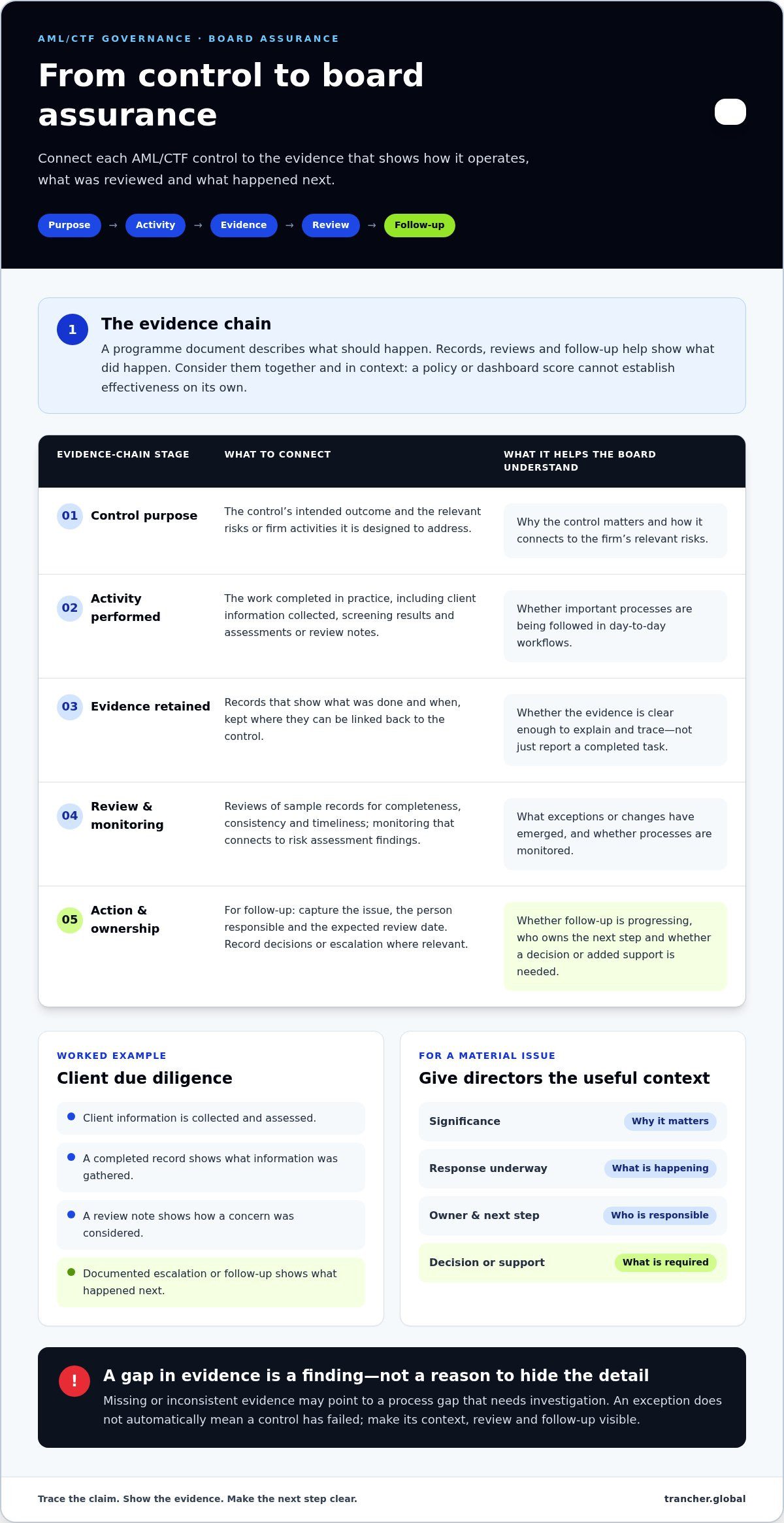
Effectiveness is supported by a chain of evidence: controls are designed to address relevant risks, staff follow the processes, activity is monitored, and issues prompt review or improvement. A programme document describes what should happen. Records, reviews and follow-up help show what did happen. Neither a policy nor a dashboard score can establish effectiveness on its own; the evidence needs to be considered together and in context.
For example, a client due diligence process may require information to be collected and assessed. A completed client record shows what information was gathered; a review note can show how a concern was considered; and a documented escalation or follow-up can show what happened next. If evidence is missing or inconsistent, that is useful information too. It may point to a process gap that needs investigation, rather than being concealed by an overall completion figure.
What should the board be able to understand?
A useful report helps directors see how the firm’s programme connects to its relevant risks and day-to-day workflows. It should make clear whether important processes are being completed, what exceptions or changes have emerged, and whether follow-up is progressing. The aim isn’t to place every operational detail in front of the board. It’s to provide enough evidence and context for informed oversight.
Directors should be able to distinguish routine activity from matters that may warrant attention. For each material issue, explain its significance, the response underway, who owns the next step and whether a decision or additional support is required. This keeps the discussion proportionate: routine work remains visible, while unresolved issues are not lost in a long list of completed tasks.
A practical approach to proving compliance effectiveness to the board is to make every claim traceable. Link statements about controls to records and reviews, then explain what the evidence means for the firm. That gives directors a more useful basis for discussion and helps turn compliance reporting into a tool for prioritising attention and resources.
Build an evidence chain from AML/CTF controls to board assurance
A board report is more persuasive when each conclusion can be traced back to the work behind it. For an accounting firm, that means connecting a control’s purpose to the activity performed, the evidence retained, the review completed and any action taken. This practical chain helps directors see not just that a process exists, but how it operates across the firm’s AML/CTF workflows.
An evidence chain links a control’s purpose to records of its operation, review and follow-up, so decision-makers can understand what the evidence shows. This is a useful foundation for proving compliance effectiveness to the board, particularly when information is spread across people, systems and client files.
Map controls to records, ownership and review
Start with the controls that matter most to the firm’s activities and risks. For each one, record what it is intended to achieve, where supporting evidence is kept, who performs the work and who reviews or follows up. The aim is not to create paperwork for its own sake. It is to make the route from a control to its evidence clear and repeatable.
Consider client verification and due diligence. Evidence might include the information collected, screening results, an assessment or review note, and a record of any decision or escalation. Risk assessment findings should also connect to the monitoring that follows: show what is being watched, how an exception is captured and who is responsible for reviewing it. Audit-ready compliance records make these links easier to retrieve and explain, while structured workflows can help keep related activity together. Trancher’s compliance workflows and records help firms organise evidence and follow-up in a practical process.
Make ownership visible in the record. A completed task without a reviewer, decision or next step may show activity, but it leaves important questions unanswered. Where follow-up is needed, capture the issue, the person responsible and the expected review date. This gives the board a clearer view of whether exceptions are being managed, without implying that every exception represents a control failure.
Test whether the evidence shows controls operating
Review a sample of records to see whether the evidence is complete, consistent and timely enough to support the intended control. Check that the file shows what was done, when it happened and how an exception was handled. A tick beside “review completed” is not the same as a record of what the review considered or what resulted from it.
For example, a risk assessment may identify a reason for closer monitoring. The evidence chain should make it possible to follow that finding into the relevant monitoring activity, any exception identified, the review or escalation, and the resulting action or rationale. If one link is absent, note the gap and establish whether it reflects a record-keeping issue, a workflow issue or a need for further review.
A board reporting resource can prompt useful questions about the quality and relevance of information presented to directors. Apply that lens when reviewing your evidence: can a reader understand the control, see what occurred and follow the reasoning behind the response?
Choose measures that show performance, not just compliance activity
A useful board report doesn’t need a long list of metrics. It needs measures that help directors understand whether key processes are working, where attention is required and whether follow-up is making a difference. Completed tasks still matter, but they describe activity. Pair them with evidence about quality, timeliness, exceptions and remediation to give that activity meaning.
Completed tasks show that work was recorded, not that a control was effective. This distinction is central to proving compliance effectiveness to the board. A training register, for example, can show who attended a session. It cannot, by itself, show whether staff understood the relevant process or applied it consistently. The measure is useful, but its limits should be clear.
Separate activity indicators from effectiveness evidence
For each activity indicator, consider what additional evidence would help explain performance. A count of completed reviews may be paired with a sample-based quality review, information about overdue work, or a summary of exceptions and their status. The aim isn’t to turn every task into a complex measurement exercise. It’s to avoid presenting volume as proof of a control’s full outcome.
Measures should reflect the question being asked. If the board needs to know whether issues are being addressed, the number of tasks completed is less informative than the number still open, how long they have remained unresolved and whether assigned actions are progressing. Where those details aren’t tracked reliably, say so and treat improving the data as a practical next step.
Select measures directors can interpret
Choose a small set tied to the firm’s risk profile and operating processes. Measures might include overdue actions, unresolved exceptions, recurring process issues or the timeliness of a review. Define each one plainly: what is counted, which period it covers and what a change may indicate. Avoid unexplained dashboards or comparisons with industry benchmarks that the firm can’t substantiate.
Build a baseline from the firm’s own records, then compare like with like over time. If an indicator changes, explain the context: perhaps a workflow changed, records became more complete, or a review identified a recurring issue. A rise in recorded exceptions, for instance, may reflect better identification rather than deteriorating control performance. The number alone can’t establish which explanation applies.
Also make data limitations visible. If records are incomplete or a measure captures only part of a process, state that alongside the result. Directors can then judge how much weight to place on it and whether better tracking should be prioritised.
Compliance activity tracking can also help firms understand the effort involved in managing controls and identify activity that may be recoverable. Present this as operational context, not a promised financial result. Keep the connection between recorded effort and business value transparent, and explain what the information does and doesn’t demonstrate. A focused, well-defined set of measures will give the board more to work with than a larger collection of figures without context.
Turn compliance evidence into a concise, useful board report
A board report should help directors understand the firm’s current position and decide where their attention is needed. It doesn’t need to reproduce every operational record. Instead, present a brief narrative that links the evidence to the implications: what is working, what has changed, where uncertainty remains and what action is underway. That structure makes proving compliance effectiveness to the board practical, rather than a data-dump exercise.
Use a repeatable board-report structure
Open with a concise overall position and highlight material changes since the previous report. Identify any matters that need board attention early, rather than leaving them buried in supporting detail. Then summarise selected measures, explaining what each one indicates and where its supporting evidence can be found. Close with actions, accountable owners and the next review point, including any decision or resourcing input sought from directors.
A simple report sequence can help maintain consistency:
- Status: What is the overall position, and what has materially changed?
- Evidence: Which records or reviews support the key conclusions?
- Exceptions: What remains unresolved, and what is known about its significance?
- Response: What action is underway, who owns it and when will it be reviewed?
- Decision: Is direction, prioritisation or additional support needed from the board?
Keep source records available behind reported summaries. A board paper might state that a review identified a recurring process issue; the underlying records should make the finding traceable without filling the report with case-level detail. Note any limitations in the information, such as incomplete records or a measure that captures only part of a workflow. This lets directors interpret the summary with appropriate context.
Communicate gaps with calm, clear context
Be direct about gaps. State what the firm knows, what evidence is incomplete and what is being done to address it. For example, if a review finds that some records don’t show a clear follow-up, explain whether the team is checking the files, improving the workflow or reviewing responsibility for the next step. Avoid implying a cause or outcome before the evidence supports it.
A green status can be useful shorthand, but it shouldn’t stand in for analysis or imply that every control has been tested and found effective. Pair status labels with a short explanation of what was assessed, the evidence considered and any open actions. Use the same terms and reporting approach from one board pack to the next so directors can follow changes over time.
After the discussion, retain a clear record of board decisions, requested actions and assigned owners alongside the report. This closes the loop between evidence and governance, and gives the next reporting cycle a reliable starting point. Trancher’s structured compliance reporting brings workflows, records and follow-up into a more organised process.
Make effectiveness reporting a repeatable part of AML/CTF governance
Board reporting is easier to maintain when evidence gathering is part of the firm’s everyday AML/CTF work, not a separate exercise assembled just before a meeting. A repeatable process helps keep records connected to the activity they support and makes it easier to identify gaps before they become difficult to explain. Over time, this creates a more consistent basis for proving compliance effectiveness to the board.
Embed evidence gathering into everyday workflows
Assign an owner to each key workflow and agree what evidence it should produce. Capture records as client verification, due diligence, risk reviews and monitoring take place, rather than relying on staff to reconstruct events later. Make exceptions visible through clear follow-up ownership and status tracking, so unresolved items don’t disappear between teams or reporting periods.
A practical sequence is to assign responsibility, standardise the records collected, review a focused set of indicators, then report findings and decisions. Apply the same approach across the firm, while allowing evidence to reflect the control and workflow involved. This reduces fragmented records and gives staff a clearer understanding of what needs to be recorded and reviewed.
Prepare for the next board discussion
Set a reporting cycle that fits the firm’s governance arrangements and gives owners time to review information before it reaches directors. Bring forward the evidence behind key conclusions, explain meaningful trends and limitations, and identify decisions or oversight needed. Keep detailed operational records available as supporting material, but focus the board discussion on what the information means and what should happen next.
Consistency matters more than building an elaborate reporting process. If an indicator changes, be ready to explain whether the underlying workflow, the quality of record-keeping or the level of follow-up has changed. If the information has limitations, record them and identify who will address them. This lets directors compare reporting periods with care and gives the team a clear reference point for the next review.
Structured compliance workflows can support this rhythm by bringing activity, records and follow-up into a more organised process. Trancher supports Australian accounting firms with compliance workflows, audit-ready record-keeping and compliance activity tracking. These capabilities can help firms organise evidence for review and make operational activity easier to explain, without treating a system or dashboard as proof on its own.
Use each reporting cycle to improve the next one: confirm who owns evidence gathering, check whether records are being captured consistently, review whether indicators remain useful, and carry board decisions into the next set of actions. Connect this reporting routine to the firm’s wider programme and supporting processes.
If your firm is looking to organise compliance workflows and prepare for consistent board reporting, start a conversation about Trancher’s platform and onboarding support.
Make the next board cycle your starting point
Choose one upcoming board discussion as a practical starting point. Identify the evidence directors need to make a decision, then work backwards: who will prepare it, where the supporting records sit and how any follow-up will be carried forward. A manageable first cycle can reveal what’s already working and where a small process change could make the next report clearer.
Over time, this routine can help make proving compliance effectiveness to the board part of sound governance, rather than a last-minute reporting task. The aim isn’t to create more administration. It’s to make the information your firm already generates more useful for oversight and planning.
Trancher supports Australian accounting firms with AML/CTF compliance workflows and local Australian support. If you’re ready to make reporting more manageable, start a conversation with Trancher about your firm’s AML/CTF reporting. A clear next step can help turn board assurance into a practical, repeatable part of how your firm works.
Frequently Asked Questions
What does compliance effectiveness mean to a board?
To a board, compliance effectiveness means having a sound basis to judge whether the firm’s controls are achieving their intended purpose in practice. Directors should be able to distinguish a process that exists on paper from one supported by consistent records and appropriate responses. For example, a client review process is more meaningful when the board can see that reviews occur, exceptions are considered and responsibility for any next action is clear.
How can an accounting firm show that its AML/CTF controls are working?
An accounting firm can show this by connecting its control procedures to real operational evidence and checking whether that evidence is consistent. For proving compliance effectiveness to the board, a practical starting point is to review a sample of client files across relevant workflows. Check whether each file contains the expected verification, assessment and review records, and whether any exception has a documented outcome or an assigned next step.
Which compliance measures should be included in a board report?
Include measures that help directors assess control performance and decide where attention is needed. Depending on the firm’s processes, these might cover overdue reviews, unresolved exceptions, repeated record gaps, follow-up progress or the timeliness of key activities. Define the period and basis for each measure. A figure is easier to interpret when the report explains what it includes, what it leaves out and why a change may matter.
How often should AML/CTF effectiveness be reported to the board?
Set a reporting rhythm that fits the firm’s governance arrangements and allows directors to consider meaningful changes without receiving unnecessary operational detail. The appropriate cadence may depend on the firm’s activities, risk profile and board meeting schedule. Agree when routine updates will be provided and how material developments will be raised between them. Consistency helps directors compare reports and follow whether previously discussed actions have progressed.
Can a compliance dashboard prove that a programme is effective?
No. A dashboard can organise information and make patterns easier to spot, but it can’t establish effectiveness on its own. Its value depends on the quality and meaning of the underlying records. A high completion rate, for instance, may not show whether reviews were adequately conducted or exceptions resolved. Use dashboard indicators as prompts for investigation, supported by source records, review notes and explanations of any data limitations.
What should a firm report when evidence shows a control gap?
Describe the gap plainly and separate confirmed facts from anything still being investigated. Explain which process or records are affected, the potential operational significance, who is assessing it and what follow-up is planned. Avoid labelling a gap as resolved until the supporting evidence shows that the agreed action is complete. If the issue needs further board attention, state the decision or support sought and bring an update to a later report.
How can firms connect AML/CTF compliance activity with business value?
Firms can record the time and work associated with compliance activities, then use that information to understand operational effort and identify activity that may be recoverable. For example, tracking time spent on client verification or follow-up can help explain where staff capacity is being used. Treat this as management information, not a guaranteed financial outcome. Clear records can support thoughtful decisions about workflows, resourcing and how compliance services are managed.