

The lowest software price doesn’t necessarily mean the lowest AML implementation cost. For Australian accounting firms, the cost of implementing AML program requirements also includes staff time, processes and ongoing oversight. With Tranche 2 obligations in effect since 1 July 2026, firms need a clear view of the work involved, not just the technology spend.
If you’re unsure how much internal time implementation will take, or whether compliance will become an unrecoverable administrative burden, that’s a reasonable concern. The workload depends on how your firm organises the work, which tasks it can streamline and how it records compliance activity.
This guide breaks down one-off and ongoing people, process and technology costs, then compares DIY, software-supported and specialist-guided approaches. You’ll also find a practical framework for building a defensible budget, tracking the effort involved and assessing which compliance work may be recoverable from clients. The aim is to help you plan clearly and choose an operating model your firm can sustain.
Key Takeaways
- Assess the cost of implementing AML program requirements across initial setup and ongoing operations, not just software or setup expenses.
- Map the people, processes and systems involved to distinguish specialist judgement from repeatable administrative work.
- Compare DIY, software-supported and specialist-guided approaches by internal workload, consistency, documentation and ongoing support.
- Build a defensible budget by scoping relevant services, mapping activities, assigning owners, estimating effort and reviewing actual costs.
- Track compliance activity to understand the work involved and assess which activities may be recoverable from clients.
What determines the cost of implementing an AML program for an accounting firm?
The cost of implementing AML program requirements includes the resources a firm needs to establish and operate a working program. It goes beyond initial setup: firms also need to plan for recurring activities such as monitoring, staff training, review and record keeping. Separating these costs makes the ongoing workload easier to see and manage.
Firm size alone won’t tell you how much effort is involved. Two firms with similar headcounts may have different client profiles, service mixes and workflows. A practice providing services that could fall within the designated services framework may need different processes from one whose work is largely outside that scope. The number of hand-offs between teams, how client information is collected and how consistently work is documented also affect the resources required.
Which cost categories belong in an AML implementation estimate?
For a useful estimate, map the work across the program rather than treating compliance as a single project. Include staff time for governance and oversight, client onboarding, risk assessment, monitoring and reporting. Account for the supporting work too: designing processes, training staff, maintaining documentation and reviewing how the program operates.
Technology and integrations are another category to assess. Systems used for AML compliance software can support repeatable tasks and record keeping, but the cost of an operating model also includes the people who make decisions, manage exceptions and oversee the work. Estimate technology costs against your firm’s requirements and relevant vendor information, rather than assuming one price applies across the market.
Separate specialist judgement from routine administration. For example, assessing a client’s risk may require informed review, while collecting and organising records may be more standardised. This distinction helps identify where skilled staff time is essential and where a consistent process or system may reduce repeated effort.
Why does the 2026 Australian context matter to firms?
AUSTRAC-administered Tranche 2 AML/CTF obligations took effect for newly regulated professions, including accounting, on 1 July 2026. For budgeting, start by assessing which services your firm provides and whether any are designated services under the Australian framework. Don’t assume every activity is in scope, or that firm size alone determines the answer.
This framework helps you organise and estimate implementation work; it is not a universal price or legal interpretation. Regulatory details can change, so use current AUSTRAC guidance when determining how the framework applies to your services. Once you have defined the scope, build your estimate around your firm’s processes, responsibilities and expected ongoing workload.
Which people, processes and systems drive AML program implementation effort?
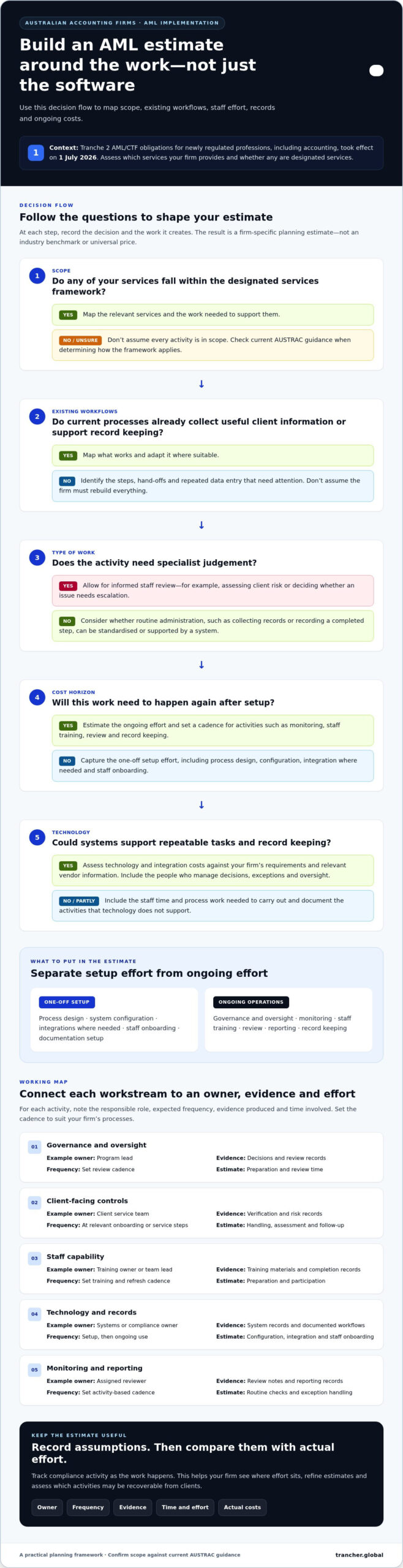
A practical estimate connects each compliance activity to the person responsible, how often it happens, the evidence it produces and the time it takes. This makes the cost of implementing AML program requirements easier to understand in day-to-day operations, rather than treating it as a single setup task.
Start with your existing workflows. Client onboarding may already collect information that supports verification, while your practice management or document systems may provide a foundation for record keeping. Map the steps, hand-offs and repeated data entry before deciding what needs to change. Adapt workable processes where possible rather than assuming the firm needs to rebuild everything.
Map ownership, frequency and effort
Assign clear owners for governance, client verification, risk assessment, escalation, reporting, record keeping and staff training. Some activities involve professional judgement, such as reviewing a risk assessment or deciding whether an issue needs escalation. Other tasks, such as routing a file or recording a completed step, may be standardised.
Use a working table to turn that map into an estimate. Record your assumptions, including expected frequency and the staff roles involved. These are planning estimates for your firm, not industry benchmarks.
| Workstream | Example owner | Frequency | Evidence | Effort to estimate |
|---|---|---|---|---|
| Governance and oversight | Program lead | Set review cadence | Decisions and review records | Preparation and review time |
| Client-facing controls | Client service team | At relevant onboarding or service steps | Verification and risk records | Handling, assessment and follow-up |
| Staff capability | Training owner or team lead | Set training and refresh cadence | Training materials and completion records | Preparation and participation |
| Technology and records | Systems or compliance owner | Setup, then ongoing use | System records and documented workflows | Configuration, integration and staff onboarding |
| Monitoring and reporting | Assigned reviewer | Set activity-based cadence | Review notes and reporting records | Routine checks and exception handling |
Include systems and documentation work
Assess what your firm needs to support KYC/CDD workflows, risk assessment, activity monitoring and reporting. Include time to configure processes, integrate systems where needed, onboard staff and establish structured record keeping. Documentation should make clear what was done, who handled it and where supporting evidence is retained.
Estimate effort by activity and frequency, then compare the estimate with actual time as the program operates. This feedback helps refine the budget and identify avoidable duplication. A structured platform such as Trancher’s AML workflow management can help organise compliance activity alongside the firm’s governance, ownership and oversight.
How do DIY, software-supported and specialist-guided implementation approaches compare?
The right approach depends on your firm’s capacity to design, coordinate and maintain its processes. Compare each option across the full operating model, not just the initial outlay. The cost of implementing AML program processes includes internal time, documentation, ongoing administration and the support needed to keep work consistent.
Self-directed implementation: more control, more coordination
A DIY approach may suit a firm with staff who can take clear ownership of program design, workflow updates and ongoing oversight. The team needs enough capacity to interpret relevant guidance, document decisions and coordinate client-facing processes. Existing procedures may provide a strong starting point, but assess whether they cover the work your firm needs to manage and who will maintain them over time.
Account for the time spent creating and updating processes, training colleagues, organising evidence and handling exceptions. A lower technology outlay may not mean lower total effort if staff must coordinate each step manually or enter the same information across multiple systems.
Software-supported implementation: standardise repeatable work
A software-supported approach can help organise recurring workflows and records, while leaving professional judgement and oversight with the firm. Assess whether the system supports the activities relevant to your operating model, including client verification, risk assessment, monitoring, reporting and record keeping. Factor in implementation tasks such as staff onboarding and any required integrations.
Consistency is a key comparison point. Consider whether the workflow makes responsibilities and activity visible, and whether it can adapt as your processes change. Software can support repeatable administration, but it doesn’t remove the need for governance, staff capability or review.
Specialist-guided implementation: support for design and decisions
Specialist guidance can help a firm structure its implementation, examine workflows and identify gaps in documentation or ownership. It may be useful where the service mix or operating model is complex, or where the team needs support to make informed design decisions. Define what the guidance covers, what remains the firm’s responsibility and how the approach will be maintained after the initial work.
Compare the options using the same questions:
- Internal workload: Who coordinates the work, and how much staff time does it require?
- Consistency and evidence: How are processes applied and records maintained?
- Adaptability and support: How will workflows respond to change, and what ongoing guidance is available?
Estimate initial and recurring effort for each model using your firm’s own assumptions. The comparison will show whether a self-directed, software-supported or guided approach best fits your capacity, complexity and need for consistent documentation.
How can an accounting firm build a defensible AML implementation budget?
A defensible budget starts with your firm’s actual services and workflows, then improves as you learn how much work implementation and ongoing operations require. Don’t rely on generic figures alone. Document the assumptions behind your estimates so partners can understand what’s included and adjust the plan when circumstances change.
Use this five-step method:
- Scope services. Identify the services your firm provides and assess which may be designated services under the Australian framework. This sets the boundaries for your planning.
- Map activities. Break the work into practical tasks, such as setting up procedures, handling client verification, assessing risk, monitoring activity, training staff and maintaining records.
- Assign owners. Name a role for each task, including oversight and escalation. Clear ownership helps prevent work from being missed or duplicated.
- Estimate effort. Estimate staff hours for each task using your knowledge of current processes, client workflows and capacity. Record assumptions, dependencies and uncertainties alongside each estimate.
- Review actuals. Track completed work and time spent, then compare actual activity with the plan. Update estimates as processes become clearer.
Separate setup from ongoing operations
Keep one-off implementation tasks distinct from recurring program work. Setup may include documenting workflows, configuring systems and preparing staff. Ongoing operations can include client-facing checks, monitoring, training, review and record keeping. Separating these categories shows the full lifecycle and makes it easier to see whether a budget covers both getting started and maintaining the program.
Build an evidence column into your budget or tracking sheet. For each activity, record the owner, estimated and actual time, completion status, supporting record and any relevant client communication. If an estimate depends on a process that hasn’t been finalised, label it provisional rather than presenting it as a fixed figure.
Assess client-facing work carefully
Not every compliance task is automatically recoverable from a client. Distinguish general administrative overhead from structured work performed as part of a client service. Clear activity records and communications can help the firm understand what work was undertaken and assess whether it may be appropriate to reflect that work in client billing arrangements. Don’t assume or promise that every activity is billable.
A consistent record of effort can help your firm compare planned and actual workload, identify process friction and make more informed decisions about recoverable work. For a practical way to track this activity, explore Trancher’s compliance activity tracking.
How can Trancher help firms manage AML implementation effort?
Once you’ve mapped your firm’s services, responsibilities and expected workload, a structured platform can help bring repeatable compliance activity into clear workflows. Trancher supports Australian accounting firms with client verification, risk assessment, monitoring, reporting, staff training and record keeping. These capabilities help organise the work, while governance, decisions and oversight remain part of the firm’s operating model.
Which implementation activities can Trancher support?
Trancher’s workflows bring key activities together, from client due diligence through to ongoing monitoring and reporting. Structured records help staff capture work and supporting evidence consistently. Platform integrations and workflow automation support the way tasks move through a firm, while dedicated onboarding and local Australian support help organise implementation.
The platform also tracks compliance activity. This gives firms a clearer record of work performed, which can support internal workload reviews, client billing processes and revenue or ROI analysis. Activity records don’t determine whether work is billable, but they help a firm assess the effort involved and make informed decisions about how compliance work is reflected in client arrangements.
For budgeting, this makes it easier to compare planned effort with recorded activity. A firm can review where time is going, identify repeated administration and assess whether workflows are operating as intended. Technology supports the process; it doesn’t replace staff capability, governance or ongoing oversight.
What is a practical next step for a firm assessing implementation?
Start with a concise map of your current workflow. Note which services you provide, where client information is collected, who owns each step, what records are retained and where hand-offs or duplicate entry occur. Then identify the gaps you want to address and the internal roles that will remain responsible. This gives you a practical basis for assessing whether a platform fits your firm’s needs and helps manage the cost of implementing AML program processes.
A complimentary three-month trial is available to a limited number of accounting firms. Trial participants receive an ROI report covering time saved, compliance readiness and billable activity. Trancher also offers a 30-day AML/CTF compliance-readiness guarantee. These measures help firms assess implementation effort and readiness alongside their own workflow and budget assumptions.
Start a conversation with Trancher about organising your AML workflows and tracking the effort involved.
Make your AML budget a practical plan
A realistic view of the cost of implementing AML program requirements starts with your firm’s services, workflows and people. Separate one-off setup from ongoing operations, assign clear owners and record actual effort. This turns a broad compliance obligation into a budget you can review and refine.
Choose an approach by comparing more than its initial cost. Consider the internal coordination it requires, how consistently it supports repeatable work and whether it gives your team clear records of compliance activity. Tracking that activity can also help you assess workload, client billing processes and potential business value.
Trancher offers a 30-day AML/CTF compliance-readiness guarantee. A complimentary three-month trial is available to a limited number of accounting firms, with an ROI report at trial end covering time saved, compliance readiness and billable activity.
Start a conversation with Trancher about AML program implementation and take the next step towards a clearer, more manageable operating model. With a considered budget and structured workflows, your firm can approach its AML responsibilities with confidence.
Frequently Asked Questions
How much does it cost to implement an AML program in Australia?
There isn’t one figure for the cost of implementing AML program requirements across every Australian accounting firm. The Office of Impact Analysis estimated upfront setup costs of A$4,460 to A$85,550 and ongoing annual costs of A$6,020 to A$82,660, depending on business turnover. These are broad government estimates, not a quote or firm-specific forecast. Your budget will depend on your services, workflows, client profile, internal capacity and technology needs.
What costs should an accounting firm include in an AML program budget?
Include staff time for governance, client verification, risk assessment, monitoring, escalation and reporting, as well as process design, training, review and record keeping. Assess technology, integrations and staff onboarding too. Separate one-off implementation tasks from recurring operations so your budget reflects the full lifecycle. Assign an owner and record estimated effort for each activity, then compare those assumptions with actual work as your processes become established.
Is AML compliance software worth it for a small accounting firm?
It can be, particularly if it helps reduce repeated administration and makes workflows and records more consistent. The value depends on your firm’s services, client activity, existing systems and available staff capacity. Compare the software’s workflow coverage and ongoing effort with the time your team would spend coordinating tasks manually. Software can support repeatable work, but it doesn’t replace firm governance, professional judgement or oversight.
Can accounting firms recover the cost of AML compliance work from clients?
Some structured, client-specific compliance activity may be considered as part of a client service, but not every compliance task is automatically recoverable or billable. Distinguish work performed for a client from general administrative overhead. Keep clear records of the activity, time spent and relevant client communications, then assess billing in line with your engagement arrangements and firm policies. Activity tracking can inform that assessment without guaranteeing recovery.
How long does it take to implement an AML program?
Implementation time depends on the services in scope, the maturity of existing processes, internal ownership and the systems or workflows that need to be organised. Map these factors before setting a timeframe, and separate initial setup from ongoing program operations. Trancher offers a 30-day AML/CTF compliance-readiness guarantee. This is a specific Trancher guarantee, not a universal timeframe for every firm’s implementation.
What is the difference between AML implementation costs and ongoing costs?
Implementation costs relate to establishing the program, such as mapping workflows, assigning responsibilities, documenting processes, configuring systems and preparing staff. Ongoing costs arise from operating and maintaining it, including monitoring, client-facing activity, training, review and record keeping. Keeping these categories separate helps avoid a budget that covers setup but misses the continuing workload. Track actual effort over time to refine estimates as your operating model develops.
Do accounting firms need specialist support to implement an AML program?
Not necessarily. A firm may manage implementation internally if it can assign clear ownership and has the capacity to design, document and maintain its workflows. Specialist guidance can support firms that need help structuring processes or assessing implementation gaps. Compare approaches by internal workload, consistency, documentation and ongoing support. Regardless of the approach, the firm needs appropriate internal governance and oversight of its AML/CTF program.