

What if the key to AML/CTF Tranche 2 compliance isn’t adding checks to every engagement, but identifying which services bring your firm into scope? For aml ctf tranche 2 accountants, that distinction matters: obligations are linked to designated services, not simply to an accounting title. The rules commenced on 1 July 2026, so firms providing covered services need a clear, workable approach.
It’s understandable to be concerned that client checks, risk assessments and record-keeping could add layers of administration. A consistent process can make those tasks easier to manage and evidence, without treating every client or engagement the same way.
This practical guide explains how to identify relevant designated services and understand the responsibilities that may follow. It covers repeatable workflows for client due diligence, risk assessment, monitoring, reporting and records, as well as tracking compliance activity when considering recoverable work. The aim is a system your team can apply consistently, with documented evidence to support sound judgement and day-to-day operations.
Key Takeaways
- Tranche 2 commenced on 1 July 2026, and a firm’s obligations depend on the designated services it provides, not simply its professional title.
- Map relevant services and assign clear responsibility so your team can follow consistent steps for checks, decisions and records.
- Use the practical guidance for aml ctf tranche 2 accountants to shape workflows, and confirm specific duties and timeframes against current AUSTRAC requirements.
- Assess manual and structured processes for consistency, traceability and the effort they require from staff.
- Trancher supports verification, risk assessment, monitoring, reporting, staff training and audit-ready records.
AML/CTF Tranche 2 for accountants: which services bring a firm into scope?
AML/CTF Tranche 2 can feel complex, particularly when an accounting firm combines routine compliance work with broader business services. Start by looking at the service actually performed. An accounting firm’s professional title alone does not mean that every task carries the same obligations.
Tranche 2 extended Australia’s anti-money laundering and counter-terrorism financing regime to additional professions and businesses providing specified designated services. The requirements commenced on 1 July 2026. For aml ctf tranche 2 accountants, understanding which services may bring the firm into scope is the first step towards establishing relevant, consistent processes.
What does designated service mean for an accounting practice?
A designated service is a service identified under the AML/CTF framework. The nature of the work matters: an accounting firm’s professional title does not determine whether an activity is covered. For background on the wider purpose and concepts behind Anti-money laundering (AML), including customer due diligence, see the linked overview.
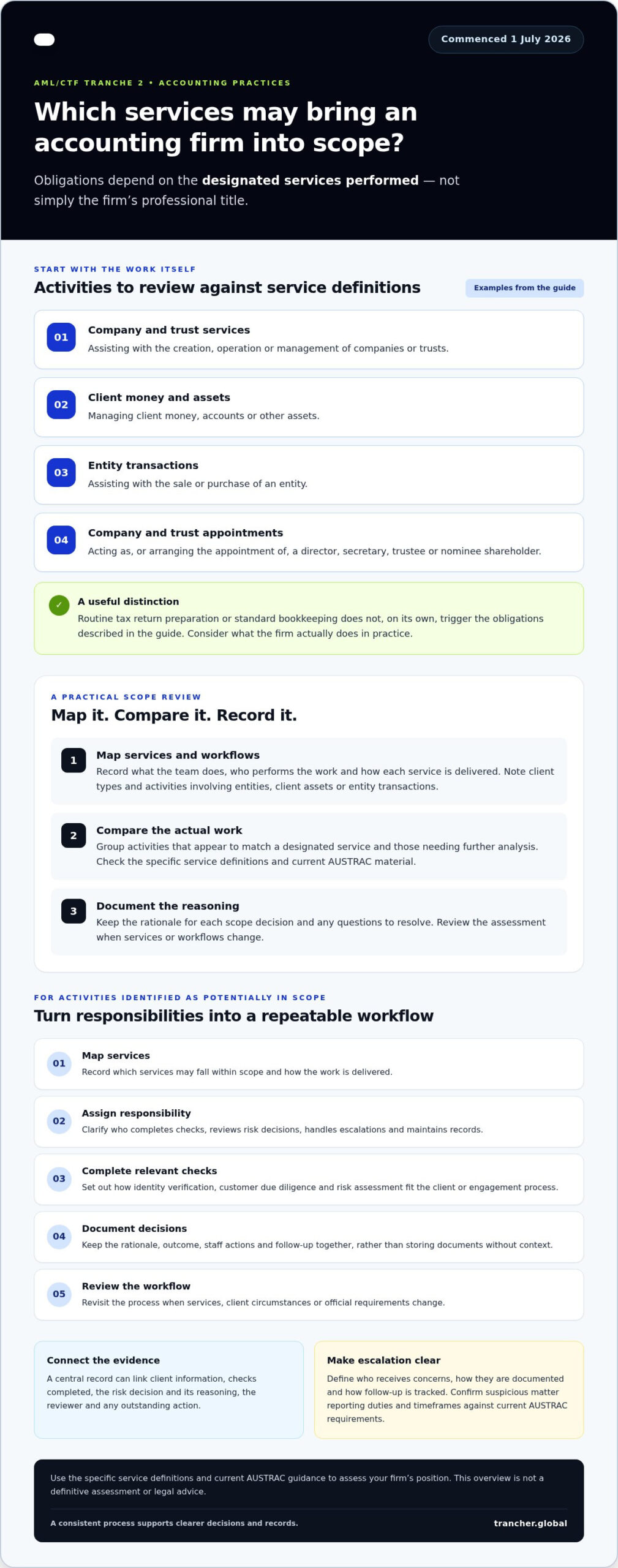
Examples relevant to accounting practices include assisting with the creation, operation or management of companies or trusts; managing client money, accounts or other assets; and assisting with the sale or purchase of an entity. Acting as, or arranging the appointment of, a director, secretary, trustee or nominee shareholder may also be relevant. Compare the actual work your firm performs with the specific service definitions and current AUSTRAC guidance.
By contrast, routine tax return preparation or standard bookkeeping does not, on its own, trigger the obligations described in the guidance. That distinction is useful, but it is not a substitute for examining what the firm does in practice. For a broader explanation, refer to the related guide on Tranche 2 obligations for designated entities.
How should a firm assess whether its work is in scope?
Start with a practical map of the firm’s services, client types and workflows. For each service, record what the team does, who performs it and whether the work involves activities such as establishing or managing an entity, handling client assets, or supporting an entity sale or purchase. This gives you a clearer way to distinguish routine work from activities that need closer review.
Next, group activities into those that appear to match a designated service and those that need further analysis. Compare the details of the work with current AUSTRAC material, including relevant definitions and guidance. Record the reasoning behind each scope decision, along with any questions to resolve, so the firm can review the assessment when its services or workflows change.
This structured approach helps your firm build an evidence base for confirming its position and deciding which operational steps are relevant. It is not a definitive assessment or legal advice.
How accountants can translate AML/CTF obligations into firm-wide workflows
Once your firm has identified activities that may be in scope, the next task is to make the relevant processes clear and repeatable. A useful workflow shows who does what, what information supports each decision and where the evidence is kept. That way, staff do not have to rely on memory or search through scattered files to understand what has happened.
Build the workflow around the client relationship
Use a consistent sequence, then tailor each step to the service and circumstances:
- Map services: Record which services may fall within scope and how the work is delivered.
- Assign responsibility: Name who completes checks, reviews risk decisions, handles escalations and maintains records.
- Complete relevant checks: Set out how identity verification, customer due diligence and risk assessment fit into the client or engagement process.
- Document decisions: Keep the rationale, outcome, staff actions and follow-up together, rather than storing documents without context.
- Review the workflow: Revisit the process when services, client circumstances or official requirements change.
A central record can connect the client information gathered, checks completed, risk decision and reasoning, reviewer and any outstanding action. This creates a clearer trail for the firm and helps team members see what has already happened and what still needs attention.
For a deeper implementation resource, use the AML program checklist Australia guide. For client due diligence and identity verification, the related CDD and KYC requirements in Australia guide can help inform your process. Use this additional AML/CTF reference as a prompt to verify details against current AUSTRAC guidance.
Build monitoring and escalation into everyday work
Monitoring is easier to manage when staff know their responsibilities, where to record concerns and how to escalate them internally. Define who receives an escalation, how it is documented and how follow-up is tracked. Confirm suspicious matter reporting obligations and applicable timeframes against current AUSTRAC requirements. The related guide on when to submit a suspicious matter report offers further context.
For firms managing aml ctf tranche 2 accountants workflows, the aim is a connected process that supports consistent action while leaving professional judgement with the firm. Explore structured AML/CTF workflow support to see how centralised compliance activity and records can support day-to-day operations.
Manual processes or structured AML/CTF systems: what should accountants assess?
There’s no single operating model that suits every accounting practice. A firm handling a small number of relevant services may have different workflow needs from one with a broader service mix, multiple teams or more complex client processes. The useful comparison is not simply “spreadsheet or software”. Assess whether your approach helps staff act consistently, trace decisions and locate evidence without unnecessary effort.
For aml ctf tranche 2 accountants, assess the process from the first client interaction through to review and follow-up. Count the handovers, identify where information is recorded and consider how easily the firm can see what remains outstanding. Any process should support the firm’s judgement; no tool or record-keeping method guarantees regulatory compliance.
Where can spreadsheets and disconnected records create friction?
Manual files can be workable, but several spreadsheets, folders and email trails may make coordination harder. Staff might enter the same information more than once, be unsure who owns the next step, or spend time searching for the latest version of a risk decision. These are operational issues to investigate, not proof that a firm has breached a requirement.
Check how your practice controls versions and captures review history. Can the team tell which record is current, who updated it and why? If staff have to piece that together, simplify the filing structure or clarify ownership before the process becomes harder to manage.
What should a structured AML/CTF workflow make easier?
A structured workflow should connect client checks with risk assessment, monitoring, decisions and record-keeping. Consider whether staff can see what is complete, what needs review and how to escalate a concern. Assess whether guidance is accessible at the point of work and whether the process fits naturally into existing client workflows.
For a practical comparison, map the steps your firm repeats and identify where information is handed over, re-entered or difficult to retrieve. Then consider whether a centralised process could improve consistency and traceability while reducing avoidable administration. The guide on AML risk assessment tools in Australia offers another reference point for reviewing how risk decisions are supported. This supporting AML/CTF reference can also help inform your review. Verify regulatory details against current AUSTRAC guidance.
Finally, track the time and staff activity involved in compliance work. This helps the firm understand where effort is going and consider whether particular tasks are recoverable under its engagement terms and billing approach. Do not assume every compliance activity is automatically billable; make that decision transparently and consistently.
How to prepare an accounting firm for consistent AML/CTF operations
AML/CTF Tranche 2 commenced on 1 July 2026. The practical focus for accounting firms is to understand which services are in scope, confirm current responsibilities against AUSTRAC guidance and make relevant processes consistent across the team. Use the steps below to organise the work, then verify the requirements that apply to your firm.
Start by mapping services and the workflows used to deliver them. Identify activities that appear relevant, note those that need further review and assign a clear owner for each step. Then document how staff complete and record the process, and train the people involved. Staff should know what to do, who reviews the work and where to find the evidence.
Build accountability, training and record-keeping into daily work
Clear roles reduce uncertainty at handover points. For example, one staff member might gather client information, while a nominated reviewer considers the recorded risk decision and confirms any follow-up. Set out responsibilities that suit your firm’s structure, and make sure staff know how to raise questions or concerns.
Keep useful evidence of the process, including checks completed, decisions made, responsible staff and follow-up actions. Training records can help show who received relevant guidance and when, without assuming that a particular record format is mandatory. For more on organising evidence, see the guide on audit-ready compliance records for Australian accounting firms.
| Activity | Responsible role | Evidence to retain | Review point |
|---|---|---|---|
| Map services and assess scope | Firm lead or nominated reviewer | Service map and recorded scope decisions | When services change or guidance is updated |
| Complete relevant client checks | Assigned team member | Checks completed and decision rationale | At the firm’s defined review point |
| Escalate a concern | Staff member and designated internal contact | Concern, escalation and follow-up record | When the matter is escalated and resolved |
| Deliver staff guidance | Training owner or team lead | Training content and participation record | When roles or workflows change |
Review readiness as an ongoing operating process
Use the table as a working reference, not a one-off exercise. Revisit processes when the firm changes its services, client workflows, staffing or systems. These are sensible continuous-improvement triggers; verify specific review duties and timeframes against current AUSTRAC requirements. Record changes so the team can follow the current process rather than relying on outdated instructions.
For aml ctf tranche 2 accountants, structured workflows can connect responsibilities, training and evidence while supporting the firm’s own judgement. Explore Trancher’s AML/CTF workflow support to see how compliance activities and records can be managed in a more organised way.
How Trancher supports accountants managing AML/CTF Tranche 2
Once your firm has mapped relevant services and established responsibilities, the next challenge is keeping the work connected. Trancher is an AML/CTF compliance platform designed to help Australian accounting firms manage Tranche 2 workflows and maintain organised evidence. It supports operational processes while the firm retains responsibility for its decisions and regulatory obligations.
Bring compliance tasks and supporting evidence into one workflow
Trancher brings together operational activities such as client verification and due diligence, risk assessment, ongoing monitoring, reporting, staff training and record-keeping. Connecting these tasks helps staff follow a consistent process and keep supporting information together, rather than searching across disconnected files to understand what was checked, decided or followed up.
For example, a firm can use structured documentation to connect a client check with the resulting risk decision and any subsequent monitoring or escalation. This makes records easier to review internally and helps the firm see how a workflow was followed. The platform supports the process; it does not guarantee AUSTRAC approval or determine whether a firm has met every obligation. Firms remain responsible for applying current requirements to their circumstances.
Assess operational value through tracked compliance activity
Compliance takes staff time. Tracking activity helps a firm understand where effort is being spent, identify repeated administrative steps and consider whether particular work may be recoverable under its engagement and billing arrangements. It does not mean every compliance task is automatically billable. Clearer activity records give the firm better information to make that decision.
Trancher guarantees AML/CTF compliance within 30 days of starting. This is Trancher’s company guarantee, not an AUSTRAC endorsement, and does not remove the firm’s responsibility to exercise judgement or verify its obligations.
Trancher offers a complimentary three-month trial to a limited number of accounting firms. Trial participants receive a formal ROI report at the end of the trial. Firms that continue after the trial receive 20% off their first 12-month subscription.
If your firm is looking to make its AML/CTF processes more organised and easier to track, explore Trancher’s AML/CTF workflow support and start a conversation about your firm’s operations and readiness.
Turn your AML/CTF processes into a consistent practice
For aml ctf tranche 2 accountants, effective compliance starts with clarity: identify which services may be in scope, assign responsibility and document how checks, decisions and follow-up are handled. Confirm specific requirements against current AUSTRAC guidance, then review workflows as your services and operations change.
Structured processes can keep verification, risk decisions and supporting records connected. Activity tracking can also help the firm assess the effort involved and consider whether work is recoverable under its engagement arrangements. Trancher provides AML/CTF workflows designed for Australian accounting firms, a 30-day compliance guarantee and a complimentary three-month trial for a limited number of firms. Trial participants receive a formal ROI report, and firms that continue receive 20% off their first 12-month subscription.
Make your next step a practical one. Start a conversation with Trancher about your firm’s AML/CTF readiness and explore how clearer workflows can support confident, consistent operations.
Frequently Asked Questions
Which accountants are affected by AML/CTF Tranche 2?
Accountants are affected when their firm provides a designated service covered by the AML/CTF framework. Relevant examples include helping create, operate or manage a company or trust; managing client money or other assets; assisting with an entity sale or purchase; or acting as, or arranging the appointment of, certain officeholders. A professional title alone does not determine scope. Routine tax return preparation or standard bookkeeping does not, by itself, trigger the obligations.
When did AML/CTF Tranche 2 obligations for accountants commence?
AML/CTF Tranche 2 obligations commenced on 1 July 2026. Firms providing relevant designated services should confirm their current position and applicable requirements against AUSTRAC guidance. Specific responsibilities depend on the services provided and the firm’s circumstances. When reviewing your position, distinguish between confirming whether services are in scope and establishing the processes needed to manage relevant obligations.
What should an accounting firm include in its AML/CTF program?
An accounting firm’s program should address the obligations relevant to its designated services and be based on current AUSTRAC requirements. Operationally, firms may need processes for assessing risk, conducting relevant customer due diligence, monitoring activity, escalating concerns, reporting where required, keeping records and guiding staff. The exact program content depends on the firm’s circumstances. Treat this as a practical starting point, not a definitive checklist, and verify current AUSTRAC guidance before finalising the program.
Do accountants need to conduct customer due diligence under Tranche 2?
Customer due diligence may be required where a firm provides a designated service that brings it within the regime. Checks should follow the requirements that apply to the service and client, rather than being applied indiscriminately to every accounting engagement. Confirm relevant customer identification, verification and ongoing due diligence requirements in current AUSTRAC guidance, then document the checks completed and the reasoning behind relevant risk decisions.
How can accounting firms manage AML/CTF compliance without excessive administration?
Map services and workflows first, then assign clear responsibility for relevant checks, review, escalation and record-keeping. Use consistent processes so staff can see what has been completed, what needs attention and where supporting evidence is stored. A structured AML/CTF platform can connect client verification, risk assessment, monitoring, reporting and records. For aml ctf tranche 2 accountants, the aim is reliable evidence and clear handovers, not extra paperwork without purpose.
Can an accounting firm recover the cost of AML/CTF compliance work from clients?
An accounting firm may choose to charge clients for relevant compliance work where its engagement terms and billing arrangements support that approach. Do not assume every compliance task is automatically recoverable. Track the activities and staff effort involved, then review the work against the firm’s client agreements and billing practices. Clear records can help the firm assess which work may be chargeable and explain the basis for any fees to clients.
Can AML/CTF compliance software guarantee that an accounting firm meets AUSTRAC requirements?
No software should be treated as a guarantee that a firm meets every AUSTRAC requirement. A platform can support workflows, checks, reporting and organised records, but the firm remains responsible for applying current requirements and exercising its judgement. Trancher guarantees AML/CTF compliance within 30 days of starting. This is a company guarantee, not an AUSTRAC endorsement or a guarantee of regulatory approval or outcomes.