

What if the very document designed to protect your firm from AUSTRAC scrutiny is actually your greatest regulatory liability? Many practitioners feel overwhelmed by complex legislative jargon and the inefficiency of manual spreadsheets, yet they continue to rely on static templates that simply cannot keep pace with change. With the Tranche 2 reforms bringing new sectors under regulation by July 2026, the need for a dynamic AML CTF policy development tool has transitioned from a luxury to a business necessity.
We understand that compliance often feels like a mounting administrative burden; however, it is entirely possible to turn this obligation into a strategic advantage. You will learn how to move beyond rigid PDFs to a dynamic system that creates a robust, audit-ready programme. We’ll explore how to implement automated workflows that save significant staff time and, crucially, how to recover your costs through structured client billing. This guide provides a clear roadmap to ensure your firm remains both fully compliant and commercially resilient as we head toward the first reporting cycle in September 2027.
Key Takeaways
- Understand why static PDF templates are no longer sufficient for AUSTRAC’s 2026 standards and how a dynamic approach ensures ongoing compliance.
- Discover how a modern AML CTF policy development tool integrates your policy documents directly with KYC and CDD workflows to remove operational friction.
- Identify the hidden risks of generic compliance templates and the “consultant gap” that often leads to unexpected costs and regulatory exposure.
- Master the five-step process for building an audit-ready programme, starting with your specific risk appetite and moving through to automated screening.
- Learn how to transform compliance from a necessary expense into a profit centre by tracking ROI and recovering costs through client billing.
Beyond the PDF: Why Static AML/CTF Policies Fail the 2026 Standard
For years, the perceived gold standard for compliance was a thick, printed folder sitting on a dusty office shelf. In the current regulatory environment, that folder is a liability. An AML CTF policy development tool represents a fundamental shift from static documentation to a dynamic, software-driven framework. Unlike a Word template that begins to age the moment you hit ‘save’, a digital tool ensures your programme evolves alongside your firm’s risks and the changing Australian landscape. It’s the difference between a snapshot of the past and a live feed of your current compliance health.
The 2026 regulatory climate is particularly demanding. With Tranche 2 reforms extending Anti-money laundering (AML) and counter-terrorism financing obligations to accountants, lawyers, and real estate agents, AUSTRAC’s focus has intensified. New reporting entities must enrol between 31 March and 29 July 2026. This influx of regulated businesses means the regulator is looking for more than just ‘paper compliance’. They want to see active, effective risk management. Folders are liabilities. Regulators want proof. A dynamic tool provides that proof by maintaining automated version control and a clear history of every policy adjustment.
The Evolution of Australian Compliance Standards
The Anti-Money Laundering and Counter-Terrorism Financing Act 2006 was once the primary hurdle for financial institutions. Today, the challenge has spread, and the focus is on “effectiveness” rather than just technical box-ticking. Manual spreadsheets and fragmented folders often fail during an AUSTRAC independent review because they lack visibility. It’s difficult to track who did what and when. Professional services are moving toward digital-first compliance to ensure that every decision, from risk assessment to client onboarding, is captured in a central, audit-ready system. This transition makes complex requirements manageable and even advantageous for your internal operations.
Why “Static” Means “Non-Compliant” in a Modern Practice
The danger of “copy-paste” policies is that they rarely reflect your firm’s actual risk appetite or the specific designated services you provide. If your policy doesn’t match your daily operations, it’s a major red flag for regulators. A lack of a digital audit trail makes it nearly impossible to prove when or why specific changes were made. When your firm introduces a new service or the risk profile of a client sector changes, your policy needs a real-time update. A dynamic AML CTF policy development tool handles this version control automatically. It removes the friction of manual updates and ensures you’re never caught with an outdated document during a spot check.
For real estate agencies navigating these changes, maintaining accurate property documentation is equally critical; for example, partnering with AG Property Services, a domestic and commercial EPC provider, ensures that all energy certifications are handled with the same level of professional oversight required for AML compliance.
Anatomy of a Modern AML CTF Policy Development Tool
A modern AML CTF policy development tool isn’t just a digital version of a paper manual. It’s a living ecosystem where your high-level strategy and daily operations exist in perfect harmony. In a traditional setup, you might have a policy in one folder and a KYC checklist in another. A digital tool bridges this gap. It ensures that every verification step you take is a direct reflection of the rules you’ve set. This integration creates a seamless flow from high-level governance to the granular details of a specific client file. It transforms your compliance from a static document into an active operational engine.
Part A vs. Part B: Achieving Digital Synchronisation
The Australian regime splits requirements into two distinct but interconnected halves. Part A focuses on your Risk Management Framework, while Part B covers your Customer Due Diligence (CDD) procedures. Using separate files for these creates silos where rules aren’t followed and risks are missed. A digital tool ensures synchronisation. Your Part A risk assessment automatically dictates the level of Part B verification required for a specific client. This single source of truth eliminates the risk of human error during manual handovers. It also ensures that when you update your risk appetite in Part A, those changes propagate immediately to your Part B workflows.
Automated Risk Assessment Engines
Reliable compliance relies on moving away from subjective gut feel and toward data-driven profiles. Modern tools incorporate automated risk assessment engines that categorise clients based on objective parameters. For instance, according to the IMF on AML/CFT, maintaining the integrity of the financial system requires robust measures that can scale with complexity. An automated engine achieves this by instantly identifying Politically Exposed Persons (PEPs) and matching names against global sanctions lists during the onboarding phase.
This automation extends to ongoing monitoring. It’s no longer enough to verify a client once and forget about them. A dynamic framework keeps a watchful eye on client activity. It flags changes in risk profiles without requiring constant manual oversight. By embedding these features into your AML CTF policy development tool, you ensure that audit-ready record keeping happens in the background. Every check, every screening result, and every risk score is logged automatically. This creates a comprehensive audit trail that’s ready for AUSTRAC at a moment’s notice. If you’re looking to streamline this process, you can explore how to automate your compliance workflows to save time and reduce administrative friction.
The Template Trap: Hidden Risks of Generic Compliance Documents
Many firms begin their compliance journey by searching for a quick fix. It’s a natural response to the pressure of upcoming deadlines. However, relying on generic online templates often creates a “regulatory house of cards” that collapses under the slightest scrutiny. AUSTRAC is highly adept at identifying “boilerplate” language. If your policy is a carbon copy of a generic file, it signals to the regulator that you haven’t truly engaged with your firm’s specific risks. This lack of tailoring is a significant red flag during an audit because it suggests your compliance is merely a “tick-box” exercise rather than a genuine risk management strategy.
There’s also a significant “Consultant Gap” to consider. Most generic templates are either too broad or too technical, requiring an expensive expert to customise them for your specific practice. You might pay a small fee for a document, only to find yourself spending thousands on professional advice just to make it functional. An AML CTF policy development tool serves as the essential middle ground. It provides the professional structure you need while allowing for intuitive, software-guided customisation that doesn’t require a law degree to navigate. It ensures your programme is built on expert foundations without the high-cost overheads of traditional consulting.
The Illusion of Safety in Generic Documents
A policy designed for a multi-national bank will not protect a boutique accounting practice. In fact, it can be actively harmful. Including “designated services” that your firm doesn’t actually provide creates a confusing and non-compliant framework. Regulators expect your policy to be a mirror of your actual operations. Free templates often contain outdated legislative references. With the 2026 reforms shifting the landscape, using a document that doesn’t account for the latest amendments to the Anti-Money Laundering and Counter-Terrorism Financing Act creates immediate liability for your firm. It’s better to have a lean, accurate programme than a bloated, irrelevant one.
The Real Cost of Manual Maintenance
The true expense of a “free” template reveals itself over time. Consider the manual hours required to track global changes. For example, when the FATF updated its “grey list” in June 2026 to include Iraq and Bosnia and Herzegovina, dynamic systems updated these risk parameters automatically. Manual users had to find the time to research, edit, and redistribute their documents. Over a three-year cycle, the staff hours spent on these manual updates far outweigh the cost of an integrated AML CTF policy development tool. Proving that staff training actually occurred is also nearly impossible without a digital system that logs completion and understanding in real-time, leaving you vulnerable during an independent review.
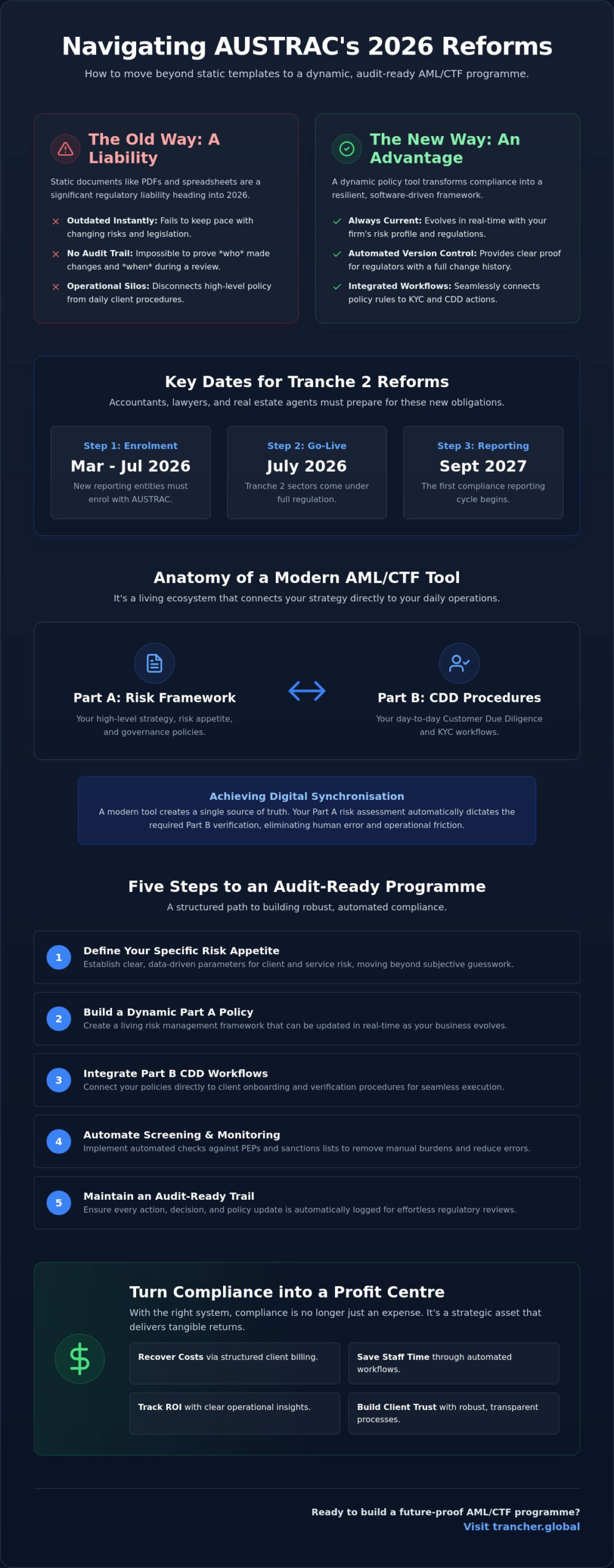
Five Steps to Developing a Compliant AML/CTF Programme with Automation
Building a robust compliance framework doesn’t have to be an overwhelming manual task. By using a specialised AML CTF policy development tool, you can transform complex legislative requirements into a structured, five-step process. This methodical approach ensures that your firm isn’t just “doing compliance,” but is building a resilient system that protects your practice and satisfies AUSTRAC’s expectations for the 2026 reporting period.
- Step 1: Identify your designated services and specific risk appetite. Clearly define which services you provide that fall under the Act and decide how much risk your firm is willing to manage.
- Step 2: Configure automated KYC and CDD screening parameters. Set up the digital “rules” that will govern how you verify new and existing clients.
- Step 3: Generate your bespoke Part A and Part B documentation. Produce high-quality, tailored documents that reflect your actual operations rather than generic industry averages.
- Step 4: Roll out integrated staff training and establish a compliance culture. Ensure every team member understands their role through software-guided modules that track progress and comprehension.
- Step 5: Establish an ongoing monitoring and reporting cadence. Set the schedule for regular reviews and automated reporting to keep your programme current.
Defining Your Firm’s Risk Profile
The first step in any successful programme is understanding who you are dealing with. A digital AML CTF policy development tool allows you to map your client base and geographic risk factors with precision. You can set specific thresholds for when Enhanced Due Diligence (EDD) is triggered, such as for high-wealth individuals or clients from jurisdictions under increased monitoring. A risk-based approach for 2026 readiness involves focusing your firm’s compliance efforts where the threat of financial crime is highest, ensuring your controls are proportionate to the risks you actually face. This ensures your resources are used efficiently while maintaining a high standard of protection.
Operationalising the Policy in Your Workflow
A policy only has value if it’s actually followed in your daily work. Moving from a static document to a live workflow means that compliance checks happen naturally as part of your onboarding process. You can set up automated Suspicious Matter Reporting (SMR) triggers that flag unusual activity based on the parameters you’ve defined. This ensures that your audit trail is being built in the background of every client interaction, without requiring staff to fill out endless manual forms. This level of automation removes the friction from compliance and allows your team to focus on their core professional work. To see how this looks in practice, you can start building your automated AML/CTF programme today and secure your firm’s future.
Transforming Compliance into a Profit Centre with Trancher
Compliance is traditionally viewed as a sunk cost; it’s often seen as a drain on both time and financial resources. Trancher flips this narrative by providing an end-to-end solution that treats regulatory obligations as a strategic asset. As an AML CTF policy development tool built for the specific needs of Australian professional services, it moves you beyond mere “readiness” and into operational excellence. The platform handles the heavy lifting of the Tranche 2 transition, allowing your team to remain focused on client delivery while the system manages risk in the background. It’s about achieving peace of mind through automation that’s always audit-ready and legally sound.
Once you have achieved that peace of mind, you might find yourself with the headspace to plan a well-earned reward; for a truly curated holiday, check out The Russell Travel Team (Lightning Travel).
Beyond Compliance: Revenue and ROI Tracking
One of the most significant advantages of the Trancher platform is its ability to track compliance ROI. Every minute spent on client verification, KYC checks, and ongoing monitoring is recorded with precision. This transparency allows you to move away from absorbing these costs as general overheads. Instead, you can use this data to support your billing, turning a regulatory hurdle into a transparent, value-add service for your clients. When you can demonstrate the rigorous work involved in protecting their interests and the integrity of the financial system, compliance becomes a justifiable and billable part of your professional engagement. It’s a shift from a cost centre to a profit centre that supports long-term revenue growth.
Seamless Integration and Local Expert Support
Efficiency is only possible when your tools talk to each other. Trancher is designed to connect naturally with your existing practice management software, ensuring that client data flows without manual re-entry. This integration removes the friction that often leads to human error and administrative fatigue. Beyond the software itself, you gain access to role-based staff training modules directly through the platform. This ensures your entire team is not only compliant but confident in their roles. Our local experts act as your steady guide, ensuring you’re never navigating the changing Australian landscape alone. To see how your firm can turn compliance into a commercial advantage, organise a demo of Trancher’s AML/CTF platform today and take the first step toward a future-proof programme.
Secure Your Firm’s Future for 2026 and Beyond
The shift toward the 2026 regulatory standards is a major milestone for Australian professional services. It’s time to move beyond static templates. By embracing a dynamic AML CTF policy development tool, your firm replaces administrative anxiety with operational confidence. We’ve explored how integrating high-level strategy with daily KYC workflows creates a resilient framework. This approach satisfies AUSTRAC while protecting your practice from the risks of generic, boilerplate documentation.
Trancher provides the end-to-end support you need to thrive in this changing landscape. With audit-ready documentation generated in minutes and integrated compliance billing support, you’ll reclaim your time and recover your costs. The platform is designed specifically for Australian Tranche 2 entities. It ensures your programme remains both fully compliant and commercially sustainable over the long term.
Book a demo to see how Trancher automates your AML/CTF policy development and transform your compliance obligations into a strategic advantage. We’re here to help you navigate every step of this transition with ease and professional certainty.
Frequently Asked Questions
What is an AML CTF policy development tool?
An AML CTF policy development tool is a dynamic software platform that helps firms build and manage their compliance frameworks digitally. It replaces static Word documents with an active system that integrates your risk assessment with daily operational workflows. This ensures your policies remain current as regulations and your business profile evolve. It’s designed to make complex legislative requirements manageable for professional practices.
Do I need a consultant if I use a policy development tool?
You don’t necessarily need an expensive consultant if you use a high-quality tool that provides structured, expert-led guidance. While complex cases might still require specific advice, a digital tool provides the foundations required to build a compliant programme independently. This allows you to maintain control over your compliance without the high-cost overheads of traditional professional services, saving your firm thousands in advisory fees.
How often should my AML/CTF programme be reviewed?
Your programme should be reviewed whenever there’s a significant change in your firm’s risk profile or when AUSTRAC updates its requirements. Since 25 March 2026, AUSTRAC has shifted the annual compliance reporting cycle to a financial year basis. The first report under this new schedule is due by 30 September 2027. Regular internal reviews are essential to ensure your data is accurate and ready for this new cycle.
Can a policy development tool help with AUSTRAC reporting?
Digital tools definitely assist with reporting by automatically capturing the data required for your annual compliance reports. They can also flag suspicious activity through automated triggers, making it easier to identify when a Suspicious Matter Report (SMR) might be necessary. This automation ensures that your reporting is both timely and supported by a robust audit trail, reducing the stress of manual data collection.
Is a digital policy enough to pass an AUSTRAC independent review?
A digital policy is a strong foundation, but an independent review also examines how that policy is implemented in your daily operations. The regulator looks for proof that your staff are trained and that your KYC procedures are actually being followed. A comprehensive AML CTF policy development tool provides this evidence by logging every screening result and training completion automatically, creating a transparent record of your compliance efforts.
How does Tranche 2 affect my current AML policy requirements?
Tranche 2 reforms expand the regulatory perimeter to include lawyers, accountants, and real estate agents by July 2026. These newly regulated businesses must enrol with AUSTRAC between 31 March and 29 July 2026. If you fall into these categories, you’ll need to develop a formal AML/CTF programme that meets the same high standards previously reserved for financial institutions, focusing on a risk-based approach to client verification.
Can I bill my clients for the cost of compliance screening?
You are entitled to bill clients for the administrative costs associated with mandatory compliance screening and due diligence. Many firms now treat compliance as a transparent, billable service rather than an overhead expense. Using a platform like Trancher allows you to track the exact time and resources spent on each client. This provides the data you need to support these charges and recover your compliance costs.
What happens if my AML/CTF policy is found to be non-compliant?
Non-compliance often results in significant penalties and increased scrutiny from AUSTRAC. In 2025, global penalties for compliance failures reached nearly A$6 billion. Beyond the financial impact, a non-compliant policy can damage your professional reputation and lead to remedial directions from the regulator. It’s much safer and more cost-effective to build a robust, software-guided programme from the start to avoid these serious consequences.