

Could two lawyers in the same firm have different AML/CTF obligations? Yes. For AML CTF lawyers, the key question is not simply whether they practise law, but whether their work involves a designated service in circumstances covered by the regime.
That distinction matters. Since 1 July 2026, Australia’s expanded AML/CTF regime has applied to specified legal services, not the legal profession as a whole. Work involving property transactions, managing client assets or setting up companies and trusts may warrant closer review. A firm needs to assess the services it actually provides rather than rely on job titles or broad assumptions.
This article explains how the service-based scope works and what to examine when assessing your practice. You’ll see which activities may bring a firm within scope, why the details of the work matter, and how to turn that assessment into practical next steps. A structured review of your firm’s services can clarify its position and identify where further compliance action may be needed.
Key Takeaways
- AML/CTF lawyers should assess the services their practice performs and the relevant circumstances, rather than assume a professional title determines scope.
- Use examples of potentially captured work as prompts for closer review, not as automatic answers about a firm’s position.
- Compare the activity performed and the circumstances around it with the relevant designated-service wording and current authoritative guidance.
- Map the firm’s services first, then distinguish scope assessment from procedures such as client due diligence, monitoring and reporting.
- Document the reasoning behind scope decisions and revisit them when the firm’s services or relevant guidance changes.
AML/CTF lawyers in Australia: why the work matters more than the title
These rules can be difficult to apply when a legal practice handles varied matters. Regulatory language does not always map neatly onto everyday work. The practical starting point is to examine the services the practice provides and the circumstances in which it provides them, rather than treating a lawyer’s title as the answer.
Australia’s expanded AML/CTF framework commenced on 1 July 2026, bringing specified professional services into the regulatory picture alongside existing regulated sectors. The commencement date does not mean every lawyer performs a service covered by the regime. For AML CTF lawyers, the task is to identify whether the practice carries out a relevant designated service, then assess the applicable requirements using current legislation and AUSTRAC guidance.
What the Tranche 2 change means for legal practices
Often called the Tranche 2 reforms, the changes extend Australia’s anti-money laundering and counter-terrorism financing framework to specified services in professional sectors, including legal, accounting and real estate services. The wider purpose of anti-money laundering (AML) measures is to help prevent financial systems and professional services from being misused for illicit activity. That context is useful, but it does not determine whether a particular legal task is captured.
AUSTRAC is Australia’s AML/CTF regulator, so its current materials are an important reference point for practices assessing scope and obligations. Because the reforms are now in force, firms should use current post-commencement guidance rather than rely on older consultation material or general summaries. The details of a service, including what the practice does for a client, remain central to the assessment.
Why a lawyer’s title is not a complete scope test
A professional title describes a person’s role. It does not, by itself, show what activities they undertake in a particular matter. A lawyer might provide advice, prepare documents, facilitate a transaction or perform another function. Those activities can have different regulatory significance, so a firm-wide assessment needs to look beyond job descriptions and practice-area labels.
The legislation uses the concept of designated services to identify relevant activities. Whether a service falls within scope depends on the applicable legal test and circumstances. A familiar label such as “conveyancing” or “commercial law” should not replace that analysis. Nor should an example be treated as a complete legal determination. Ask what the firm actually does, for whom and in what context.
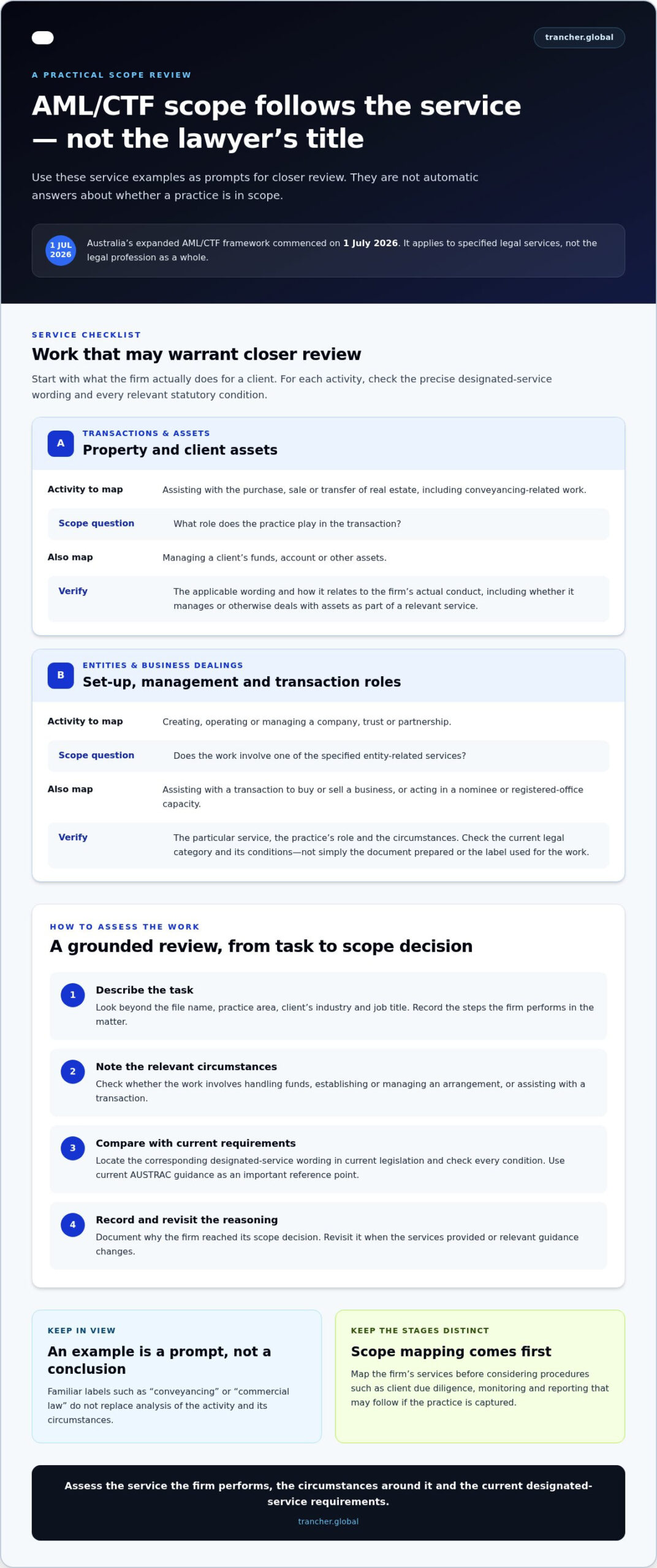
AML/CTF scope follows the designated service and its circumstances, not a lawyer’s title alone. That is the guiding idea behind “Are lawyers captured? Check the service, not the title.” Use service categories as prompts for a closer review, then distinguish initial scope mapping from the compliance procedures that may follow if a practice is captured.
Which legal services may bring a practice within AML/CTF scope?
Service categories can help a practice spot work that deserves closer review, but they are not a shortcut to a legal conclusion. The examples below are prompts for checking the current statutory wording and conditions, not a definitive list of captured work. Start with what the firm actually does for a client, then compare that activity with the relevant designated-service description.
How to assess a legal service against the designated-service framework
Begin with the task, not the file name, practice area or client’s industry. Record the steps the firm performs, including whether it handles funds, establishes or manages an arrangement, or assists with a transaction. Then locate the corresponding designated-service wording in current legislation and check every condition attached to it. This helps distinguish a potentially relevant activity from adjacent work that may need separate analysis.
Use the following as a practical review aid. Each entry identifies a service area and the point to verify, rather than declaring the work captured.
Activity: Assisting with the purchase, sale or transfer of real estate, including conveyancing-related work.
Scope question: What role does the practice play in the transaction?
Verify: The precise service description and any statutory conditions.
Activity: Managing a client’s funds, account or other assets.
Scope question: Is the firm managing or otherwise dealing with assets as part of a relevant service?
Verify: The applicable wording and how it relates to the firm’s actual conduct.
Activity: Creating, operating or managing a company, trust or partnership.
Scope question: Does the work involve one of the specified entity-related services?
Verify: The particular service and circumstances, not simply the document prepared.
Activity: Assisting with a transaction to buy or sell a business, or acting in a nominee or registered-office capacity.
Scope question: What assistance or role does the practice provide?
Verify: The precise category and conditions in current law.
Examples that require careful, current verification
Company formation, property-related work and business sales are sensible areas to map because they may involve activities described in designated-service categories. A formation matter could involve different tasks, from advice and document preparation to establishing or managing an entity. Work on a property or business sale can also vary in the firm’s role and handling of the transaction. Do not treat the matter label alone as the answer.
For category-level detail, consult “Table 6 designated services: Items 1-9 explained”, along with material on company formation and property or business sales. Recheck each example against current AUSTRAC guidance and legislation before recording a scope decision. A clear activity map can also support later compliance planning. For a general example of structured workflows and record keeping, explore Trancher’s AML/CTF platform for accounting firms.
Captured service or other legal work? Compare the activity, not the label
A useful first assessment compares the work performed with the relevant designated-service wording and circumstances. This can help a practice identify questions to resolve, but it is not a final determination or legal advice. If the statutory test is unclear, record the uncertainty and verify it against current legislation and AUSTRAC material before deciding how the service should be treated.
Do not assume automatic capture because a matter involves a company, property or client funds. Equally, do not assume automatic exclusion because the work is described as advice, document preparation or routine legal support. The task, the practice’s role and the applicable conditions all matter.
Compare client work by what the practice actually does
Use this comparison as a scoping prompt. The examples are neutral; the legal classification of each service needs to be verified against current AUSTRAC material and the legislation.
Activity: Advising on a transaction.
Scope question: Is the practice providing advice only, or also carrying out another function connected with the transaction?
Source to check: Current designated-service wording and any conditions relevant to the service.
Activity: Preparing documents for a company or trust.
Scope question: Does the practice’s role extend beyond preparing documents to creating, operating or managing an arrangement?
Source to check: The relevant statutory category and current AUSTRAC guidance.
Activity: Supporting a property or business transaction.
Scope question: What steps does the firm take, and does it handle funds, assets or transaction arrangements?
Source to check: The applicable service description, including its circumstances and limits.
A client’s industry, the transaction’s label or a document produced during the matter may provide context, but none should be treated alone as conclusive. For each service, note the task, who performs it, the practice’s role and the source used to check the relevant wording. That creates a reasoned starting point without turning an example into a blanket rule.
Compare practice models without assuming a blanket answer
A sole practitioner may deliver a service personally; a partnership may allocate related tasks across teams; a larger practice may have dedicated transaction or support functions. Those differences can help identify where relevant work occurs, but the firm’s size or structure does not replace assessment of the services actually provided.
For AML CTF lawyers, mapping work by team or service line can make review more precise. Also identify work carried out by employed lawyers or an in-house legal team. The treatment of those arrangements may depend on current legal provisions and circumstances, so verify the applicable position rather than infer it from employment status alone.
The same practice may need to assess each activity separately because one engagement can involve distinct services, roles and circumstances. Keep the comparison as an initial scope tool, document the questions it raises and update the assessment when the work or relevant guidance changes.
How a law practice can assess its AML/CTF position
A reliable scope assessment starts with a clear picture of the work the practice actually performs. Keep this stage separate from designing a full AML/CTF program: first establish which services may be relevant, then verify the requirements that apply to those services. Procedures such as client due diligence, ongoing monitoring and reporting belong in the next phase, informed by current law and AUSTRAC guidance.
Map services, matters and decision ownership
Bring together the people who understand how work moves through the practice. A matter partner may know the client relationship, while administration or finance staff may understand how funds and records are handled. Their combined view can reveal activities that are not obvious from a practice-area name alone.
- List the services. Describe the tasks the practice performs across its service lines, including work delivered by different teams or employed lawyers.
- Trace the workflow. For potentially relevant services, note the steps taken, who performs them and the practice’s role in the engagement.
- Record the scope question. Set out the designated-service wording being considered, the circumstances that may matter and the current source used to assess it.
- Identify gaps. Record unresolved interpretations or missing facts rather than forcing an early yes-or-no conclusion.
- Assign ownership. Choose a review owner and an escalation route for questions that need further legal or regulatory verification. These are practical governance choices, not titles prescribed here.
Documented service mapping gives a practice a consistent basis for internal scope decisions and makes it easier to revisit the reasoning when work changes. Keep the record proportionate and usable: a concise activity description, source reference, decision rationale and open question can be more valuable than a broad label with no supporting detail.
Turn the assessment into a workable preparation plan
Once the service map is assembled, separate conclusions supported by current sources from items that still require verification. Resolve the highest-priority questions first. Then use the confirmed position to guide a review of relevant procedures, rather than building processes around activities that may not fall within scope.
For services that require further compliance planning, examine existing client onboarding, identity and due-diligence processes, staff guidance, record keeping and systems for monitoring or reporting. Compare these with current requirements. This is a high-level sequence, not a substitute for the full program obligations. “AML/CTF program requirements: A practical overview” may help structure that later review. “Simplifying Law Firm Onboarding” can inform consideration of onboarding workflows, while “CDD and KYC Requirements Australia: The 2026 Accountant’s Guide” provides background from an accounting context, not a law-firm-specific interpretation.
For an example of structured AML/CTF workflows in an accounting setting, explore Trancher’s compliance platform. Use your documented service map and current legal guidance to shape the practice’s next steps.
Next steps for lawyers preparing for AML/CTF obligations
A clear scope assessment gives a practice a sound basis for deciding what to do next. Keep the response proportionate: distinguish services that appear to meet a relevant test from questions that still need authoritative clarification, then plan follow-up around the evidence rather than assumptions. This approach helps AML CTF lawyers prepare methodically without treating every legal task as automatically captured.
Prioritise a proportionate response
Sort the assessment into two groups: conclusions supported by current sources, and issues that remain open. For each open question, note what fact or interpretation needs resolution, who will follow it up and which authoritative source will inform the decision. Use current AUSTRAC materials and relevant professional guidance to validate legal interpretations, especially where a service involves several activities or the practice’s role is not straightforward.
Avoid building a plan around generalised claims about penalties, exemptions, transition periods or reporting deadlines. Those details can depend on the applicable law and circumstances, and should be checked against current sources rather than carried forward from older commentary. If a decision has material consequences for a particular practice or engagement, this article cannot replace advice based on the relevant facts.
Keep the operating model clear and reviewable
Turn the assessment into a record that staff can use consistently. For each service reviewed, preserve the decision, the reasoning and the sources relied on. Note who owns follow-up, where unresolved matters should be escalated and when the assessment should be revisited. A review date is useful, as are practical triggers such as a new service line, a changed workflow, a different role in a transaction or updated authoritative guidance.
Keep scope decisions distinct from later operational procedures. Where the assessment indicates further requirements may apply, review the relevant processes for client onboarding, staff guidance, record keeping and other applicable controls against current requirements. Do not treat a high-level scope note as a completed compliance program. It is a working record that supports consistent decisions and helps the practice identify what needs more detailed review.
Trancher was founded and is led by compliance specialist Aaron Soh. Its platform provides structured AML/CTF workflows, client verification, risk monitoring, reporting and record keeping for accounting firms. The general information here can help frame an assessment, but it cannot determine the position of a particular practice or engagement. Validate the facts and applicable requirements with current authoritative material and seek advice suited to the circumstances.
For a view of how structured AML/CTF workflows can support compliance management in an accounting-firm setting, explore Trancher’s compliance approach.
Make your next scope review a practical one
For AML CTF lawyers, a useful next step is to make scope review part of how the practice manages change. When a service, workflow or team responsibility shifts, revisit the assumptions behind the firm’s assessment. That keeps decisions connected to the work being done and gives staff a clearer basis for raising new questions.
Keep the process grounded in current authoritative guidance, and distinguish general information from advice about a particular practice or engagement. Where interpretation depends on specific facts, seek advice suited to those circumstances. A thoughtful review can turn a complex regulatory question into a manageable, ongoing practice.
Trancher’s structured approach offers an example of how AML/CTF compliance activity can be organised for accounting firms. Explore Trancher’s approach to AML/CTF compliance. If your accounting firm is preparing for Tranche 2, start a conversation with Trancher about organising its compliance workflows and getting ready for the obligations. With a measured review process, your practice can move forward with greater confidence.
Frequently Asked Questions
Do sole practitioners need to assess AML/CTF obligations differently?
Sole practitioners should assess the services they provide using the same service-based framework, while keeping the review proportionate to how their practice operates. For example, one person may handle client instructions, transaction steps and records, so map those responsibilities together rather than assuming a small practice is outside scope. Check any potentially relevant service against current legislation and AUSTRAC guidance, and document the reasoning behind the practice’s position.
Are in-house lawyers covered by the same AML/CTF rules?
Not necessarily; an in-house role alone does not settle whether the regime applies. The relevant questions include which entity provides the service, what activity the lawyer performs and whether the legal test covers that arrangement. For instance, advising an employer on a transaction may differ from carrying out a designated service for a client. Because employment structures can be complex, verify the position against current law and guidance before drawing a conclusion.
Do the AML/CTF changes apply to existing legal clients?
An existing client relationship alone does not answer whether requirements apply. Consider the particular service being provided after the reforms commenced, whether it falls within scope and any applicable rules for ongoing matters or existing relationships. A firm might have a long-standing client but begin a different type of work for them. Review current AUSTRAC guidance on transitional or ongoing-client arrangements, rather than assuming either that every existing file is covered or that none is.
How should lawyers consider confidentiality and suspicious matter reporting?
Lawyers should treat confidentiality, legal professional obligations and any applicable AML/CTF reporting rules as connected issues requiring careful, current analysis. If a matter raises a potential reporting question, preserve relevant facts and seek guidance through the practice’s appropriate legal or compliance escalation process. Do not assume that confidentiality automatically resolves the reporting issue, or that a reporting obligation removes every other professional consideration. Verify the applicable law before acting or communicating with a client.
Can a law practice rely on identity checks completed before the new obligations?
Prior identity checks may provide useful information, but a practice should not assume they automatically satisfy requirements for a later designated service. Review what was collected, how it was verified, whether it remains accurate and whether the current rules permit reliance on that work. A check completed for another purpose may not address every relevant requirement. Keep a record of the review and follow current AUSTRAC guidance for the specific service and client circumstances.
What should a legal practice do when it is unsure whether work is captured?
Pause before treating uncertainty as either a yes or a no. Describe the actual task, the practice’s role and the circumstances, then compare them with the current designated-service wording and AUSTRAC guidance. Record the source consulted, the facts still needed and who will resolve the question. AML CTF lawyers can use this documented approach to support consistent decisions, and seek advice tailored to the matter where interpretation remains uncertain.