

AUSTRAC enrolment is a starting point, not the finish line. If you’re asking, “how do I enrol with AUSTRAC?”, first check whether your firm provides a designated service. AML/CTF obligations apply to specific activities, not automatically to every accounting practice or service.
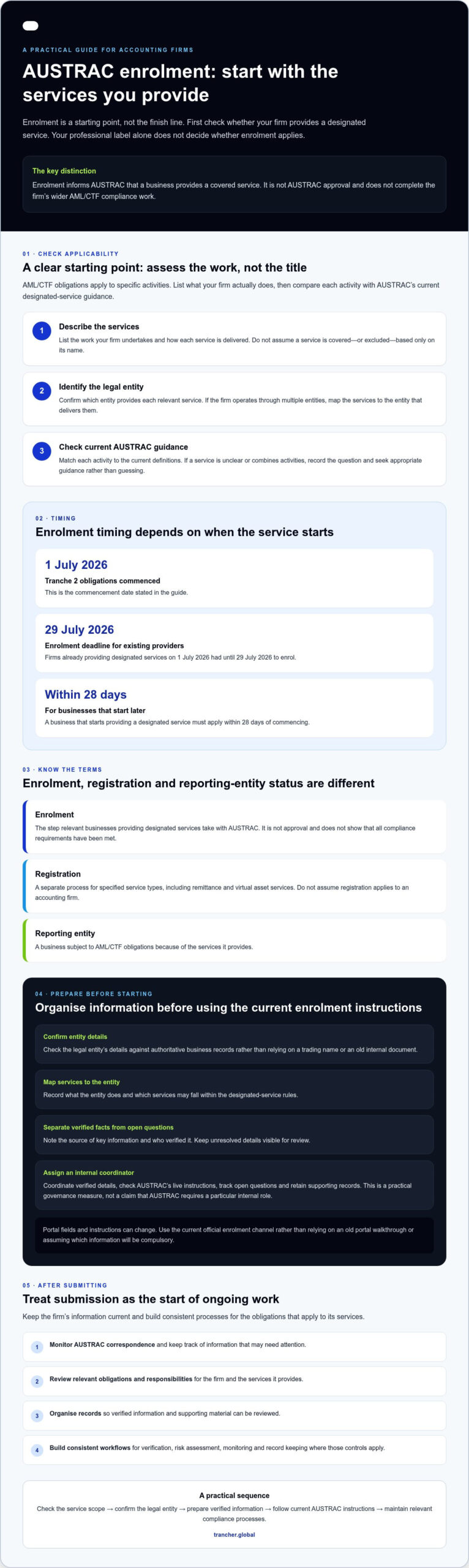
Enrolment, registration and ongoing AML/CTF compliance are related, but they aren’t interchangeable. Firms already providing designated services on 1 July 2026 had until 29 July 2026 to enrol. Businesses that start providing a designated service must apply within 28 days of commencing.
This guide explains how to assess whether enrolment applies, what to prepare and how to approach the process. Enrolment isn’t AUSTRAC approval, and it doesn’t complete your firm’s wider compliance work. The steps below clarify the difference between enrolment and registration, then outline practical ways to organise verification, risk assessment, monitoring and record keeping. Preparing these processes alongside enrolment can give your firm a clearer operational foundation.
Key Takeaways
- Check the services your firm actually provides before deciding whether AUSTRAC enrolment applies. Your profession alone doesn’t determine the answer.
- Confirm the legal entity providing the relevant services, and assign someone to coordinate and verify the enrolment information.
- If you’re asking “how do I enrol with AUSTRAC?”, follow the current instructions through AUSTRAC’s official enrolment channel rather than relying on an old portal walkthrough.
- After submitting, monitor AUSTRAC correspondence and review the obligations, responsibilities and records relevant to your firm.
- Build consistent workflows for verification, risk management, monitoring and record keeping where those controls apply.
Does your accounting firm need to enrol with AUSTRAC?
Enrolment depends on whether your firm provides a designated service covered by the AML/CTF regime. Being an accounting firm doesn’t, by itself, determine whether you need to enrol. The key question is what services your firm actually provides and whether any fall within the legal definitions. Tranche 2 obligations commenced on 1 July 2026. Check AUSTRAC’s current guidance against your service offering before deciding whether the requirements apply.
Enrolment informs AUSTRAC that your business provides a covered service. It isn’t approval, and it doesn’t replace the wider AML/CTF program and other obligations that may apply. For background on the Australian Transaction Reports and Analysis Centre (AUSTRAC), you can read more about the agency. Use AUSTRAC’s own guidance to confirm your firm’s requirements.
What is a designated service for an accounting firm?
A designated service is an activity specified under the AML/CTF framework. The rules focus on particular services a business performs, rather than its professional label. List the work your firm undertakes, including how each service is delivered, then compare it with AUSTRAC’s current information on designated services. Don’t assume a service is covered, or excluded, based only on its name.
If a service is unclear or combines different activities, document what the firm does and seek appropriate guidance before deciding whether it is covered. This scope review gives you a more reliable basis for deciding whether enrolment applies.
Enrolment, registration and reporting-entity status
These terms are related, but not interchangeable. Enrolment is the step relevant businesses providing designated services take with AUSTRAC. Registration is a separate process that applies to specified service types, including remittance and virtual asset services. Don’t assume it applies to an accounting firm. A reporting entity is a business subject to AML/CTF obligations because of the services it provides.
To work out how these terms apply to your firm, match each service to AUSTRAC’s current definitions and instructions. Enrolment doesn’t show that all compliance requirements have been met. It begins a broader operational process that may include setting responsibilities, controls and record keeping. If you’re asking, “how do I enrol with AUSTRAC?”, start by confirming the firm’s service scope. This helps you identify which official instructions to follow and what further work may be needed.
What should you prepare before starting AUSTRAC enrolment?
Preparation can make enrolment easier to coordinate and reduce the chance of submitting incorrect information. First, confirm which legal entity provides the relevant services. Then document what that entity does and check AUSTRAC’s current instructions for the information required. Keep verified information separate from internal working notes. For broader preparation, see this AML program checklist for Australia.
Confirm the firm and its services
Check the legal entity’s details against authoritative business records, rather than relying on a trading name or an old internal document. If the firm operates through multiple entities, identify which entity delivers each service that may fall within the designated-service rules.
Next, map the firm’s actual services against AUSTRAC’s current designated-service guidance. Describe what the firm does in practical terms, including the scope of each service. If you can’t confidently match an activity to the guidance, note the question and seek confirmation rather than guessing. This review is a sensible preparation step. It doesn’t replace AUSTRAC’s definitions or establish that a particular enrolment field is mandatory.
Organise information and assign responsibility
Create a working record that separates confirmed facts from details still to be checked. For key information, note its source and who verified it. This gives the firm a reference point if information needs to be reviewed or corrected.
Assign someone internally to coordinate the process. They can gather verified details, check AUSTRAC’s live instructions, track unresolved questions and retain supporting records. Make sure they know who can confirm the entity and service information. These are practical governance measures, not a claim that AUSTRAC requires a particular internal role for enrolment.
Portal fields and instructions can change, so don’t rely on an old checklist or assume which information will be compulsory. Review the current AUSTRAC enrolment channel before starting. Use its instructions to distinguish required information from material your firm has gathered for its own records. Note the guidance consulted and when you checked it.
If you’re asking “how do I enrol with AUSTRAC?”, this preparation helps you begin with a verified service scope, accurate entity details and clear responsibility. Once the enrolment preparation is in order, consider how structured AML/CTF workflows could support verification, risk assessment, monitoring and record keeping after submission.
How do I enrol with AUSTRAC, and what does enrolment not do?
Once you’ve confirmed that your firm provides a designated service, follow AUSTRAC’s official instructions to complete enrolment. Submit details for the correct legal entity and check the information before sending it. Portal screens and instructions can change, so use the live guidance rather than an old walkthrough.
A practical sequence for completing enrolment
Use this sequence to prepare, then follow the current instructions on AUSTRAC’s official website and in AUSTRAC Online. Check the live process, including its current fields and confirmation steps.
- Confirm applicability and the entity. Check the service against AUSTRAC’s current designated-service guidance. Confirm which legal entity provides it and make sure the enrolment relates to that entity.
- Follow the official instructions. Access AUSTRAC’s enrolment channel and provide the information requested in the live process. Use details your firm has verified. Resolve discrepancies rather than guessing.
- Review and retain a record. Check the information before completing the process. Save any confirmation or other outcome provided, note follow-up instructions and retain supporting records where the firm can access them.
This creates a clear record of what your firm submitted and what AUSTRAC communicated. Don’t assume a draft, submission screen or saved form means the process is complete. Check the live instructions to confirm how AUSTRAC communicates the outcome and whether any further action is required.
What enrolment does not replace
Enrolment doesn’t mean AUSTRAC has approved or licensed your firm, and it doesn’t by itself fulfil the firm’s AML/CTF obligations. Those obligations depend on the designated services provided and the rules that apply. Where relevant, your firm may need to establish and maintain an AML/CTF program, conduct customer due diligence, manage risk and keep supporting records. Confirm the scope and requirements against current AUSTRAC guidance rather than treating this list as universal.
For a practical overview of customer checks, see this CDD and KYC requirements guide. Then consider how each applicable control will work day to day, who is responsible and where evidence will be kept. This follow-through makes enrolment part of a consistent compliance process rather than a one-off administrative task.
What should your firm do after submitting its AUSTRAC enrolment?
Submitting the form is a milestone, not a reason to stop checking. Monitor the firm’s AUSTRAC correspondence and follow current instructions before treating the enrolment process as complete. Keep a record of what was submitted, any confirmation received and any follow-up action requested. If you’re asking “how do I enrol with AUSTRAC?”, remember that after submission you need to verify the outcome and organise the controls that apply to your firm.
Turn regulatory requirements into firm workflows
Start by reviewing the obligations that apply to the services your firm provides. For each applicable requirement, record who is responsible, what action they take and what evidence the firm will retain. This gives staff a clear process to follow and helps the firm identify gaps without assuming every control applies to every practice.
Depending on the services involved and current requirements, workflows may include client verification, risk assessment or monitoring. Define when each process applies and how staff should record its completion. A firm providing one type of designated service may need a different approach from a firm providing another. Tailor procedures to your actual scope and check them against AUSTRAC’s current guidance.
Maintain records and keep staff prepared
Keep compliance decisions, actions and supporting documents in a central, reviewable location. Make clear where staff should save evidence, how the firm tracks outstanding tasks and who reviews the records. Check current official sources for any applicable record-keeping periods or staff training requirements instead of relying on assumptions or an outdated checklist.
Give staff guidance suited to their responsibilities. People involved in client checks, risk decisions or escalation should understand the relevant steps and know where to find current procedures. A dated task entry or other firm-approved evidence can help show that a process was followed. Review the workflow when services, responsibilities or official guidance change.
For practical ideas on organising supporting documentation, see the audit-ready compliance records guide. Where those controls apply, consistent workflows can connect verification, risk assessment, monitoring and record keeping with day-to-day operations. Explore structured AML/CTF workflows for accounting firms to support ongoing compliance activity.
How can an accounting firm stay organised after AUSTRAC enrolment?
Keep the next steps clear: confirm which designated services your firm provides, follow AUSTRAC’s current instructions, then organise the controls that apply to those services. Portal instructions and regulatory requirements can change. Check live AUSTRAC guidance instead of relying on a saved copy or an older process description.
A practical readiness review for accounting firms
Use a short review to check whether your arrangements work in practice, not just on paper. Ask:
- Have we reviewed the services we provide and recorded which ones may be covered?
- Are responsibilities for relevant compliance tasks assigned and understood?
- Are documented workflows clear enough for staff to follow consistently?
- Can we locate and review relevant client verification, risk and other supporting records where these apply?
- Have we listed outstanding questions for AUSTRAC or an appropriately qualified adviser?
This review can uncover practical gaps, such as a process with no clear owner or records that are difficult to retrieve. Resolve questions against current official guidance before treating an assumption as a requirement.
When structured compliance support may help
As recurring tasks build, a consistent system can help coordinate responsibilities, workflows and evidence. Depending on the firm’s applicable obligations, this may include client verification, risk assessment, monitoring, reporting and record keeping. The right setup depends on your firm’s services. A generic workflow shouldn’t be assumed to suit every accounting practice.
Trancher supports Australian accounting firms with structured workflows for ongoing AML/CTF activity, including verification, risk assessment, monitoring, reporting, training and records. Its platform is one option for organising this work, with dedicated Australian onboarding support available. It doesn’t replace AUSTRAC’s guidance or legal advice, and using a platform doesn’t guarantee that enrolment or compliance requirements are satisfied.
If you’re still considering “how do I enrol with AUSTRAC?”, keep the sequence practical: confirm your scope, use the official live instructions, then maintain the controls that apply to your firm. For support in organising ongoing compliance workflows, start a conversation with Trancher.
Build a clear path to ongoing AML/CTF readiness
If you’re asking “how do I enrol with AUSTRAC?”, confirm whether your firm’s services are covered, then follow AUSTRAC’s current instructions. Keep verified firm details and submission records organised. Enrolment is one step; the controls that apply to your services also need clear owners and repeatable processes.
Ongoing work is easier to manage when responsibilities, workflows and supporting records are connected. Trancher is designed for Australian accounting firms, with structured workflows for verification, risk management, monitoring and record keeping, alongside dedicated onboarding and Australian support. These systems can help organise compliance activity, but they don’t replace AUSTRAC guidance or make a firm compliant simply by enrolling.
Start a conversation about practical AML/CTF readiness and explore how structured support could fit your firm’s operations. With a clear scope, current guidance and workable processes, your team can approach its obligations with greater confidence.
Frequently Asked Questions
Is my accounting firm required to enrol with AUSTRAC?
It depends on whether your firm provides a designated service covered by the AML/CTF framework. The accounting-firm label alone doesn’t determine whether enrolment applies. Review the services your firm actually provides and compare each one with AUSTRAC’s current designated-service guidance. If you’re unsure how a service fits, note the question and confirm it with AUSTRAC or an appropriately qualified adviser before deciding whether your firm needs to enrol.
How do I enrol with AUSTRAC?
First, confirm that enrolment applies to the correct legal entity and its relevant services. Then access AUSTRAC’s official enrolment channel and follow the current instructions, using verified entity information. Portal fields and steps can change, so check the live process before submitting. Review the details and keep a record of the submission and any confirmation or follow-up instructions. Then address separately the AML/CTF obligations that apply to your firm.
What information do I need to enrol with AUSTRAC?
The information required depends on AUSTRAC’s current process and your entity’s circumstances, so don’t rely on an unverified checklist. Before starting, confirm your legal entity details, identify the services that may be covered and assign someone to coordinate the process. Check AUSTRAC’s current instructions for required fields, supporting information and confirmation steps. Keep a record of the information submitted and where it was verified.
Is AUSTRAC enrolment the same as AML/CTF compliance?
No. Enrolment is a regulatory step, but it doesn’t by itself establish that your firm has met every applicable AML/CTF obligation. Confirm which requirements apply to the designated services your firm provides, then organise the relevant responsibilities, workflows and records. Depending on your circumstances, controls may include client due diligence, risk management and record keeping. Check current AUSTRAC guidance rather than assuming enrolment completes the wider compliance work.
Can an accounting firm enrol with AUSTRAC before 1 July 2026?
Tranche 2 AML/CTF obligations commenced on 1 July 2026, so that date is now in the past. The commencement date alone doesn’t establish whether a firm could enrol earlier or what timing applies to your circumstances. Check current AUSTRAC guidance for the relevant enrolment process, timing and any transitional arrangements. If you’re reviewing historical timing, identify the period in question and verify the applicable information before relying on it.
What should I do if I’m unsure whether my services are designated services?
List the services your firm actually provides, then compare each one with AUSTRAC’s current designated-service guidance. Don’t assume an activity is covered or excluded based only on its name or because it’s performed by an accounting firm. Note any unclear services and seek confirmation from AUSTRAC or an appropriately qualified adviser. Once the scope is clearer, use it to guide enrolment decisions and your firm’s broader AML/CTF preparation.
What should I do after AUSTRAC enrolment is submitted?
Follow any confirmation or further instructions provided through AUSTRAC’s current process, and retain a record of the submission and outcome. Then review the AML/CTF obligations that apply to your services, assign responsibility and organise the relevant workflows and documentation. Enrolment doesn’t replace ongoing compliance work. Check current official guidance for any specific follow-up deadlines or reporting requirements that apply to your firm, and continue monitoring AUSTRAC correspondence.