

What if AML training could protect your firm and strengthen the service you provide to clients? With Tranche 2 obligations in effect since 1 July 2026, accounting firms need more than a completed course. They need effective AML training for employees that supports confident decisions and stands up to scrutiny.
The pressure is understandable: non-compliance can carry serious consequences, while recording and tracking staff training can quickly become another administrative burden. A tick-box exercise won’t show whether your team can recognise a concern, follow your procedures and escalate it appropriately.
This guide explains how to build a risk-based, documented training programme that reflects your firm’s activities and each employee’s role. You’ll learn what practical training should cover, how to maintain clear evidence of completion, and how to make the process easier to manage over time. The aim is a team that can act with confidence, an audit-ready record of your programme, and a way to turn compliance into a professional service capability.
Key Takeaways
- Build effective AML training for employees around your firm’s risk profile and each person’s responsibilities, rather than relying on generic content.
- Cover the core learning areas that help staff recognise suspicious activity and understand how to escalate concerns.
- Use a training needs analysis and a suitable delivery method to create a programme that fits your practice.
- Keep training records and supporting materials organised so you can demonstrate that your programme is documented and audit-ready.
- Trancher’s training and record-keeping capabilities can help reduce administration, supported by a 30-day AML/CTF compliance readiness guarantee.
Beyond Tick-Box Exercises: Why Effective AML Training is Non-Negotiable in 2026
For Australian Tranche 2 firms, AML/CTF compliance is no longer a future task. Obligations commenced on 1 July 2026, so the focus is now on maintaining an effective programme and showing how it works in practice. Staff training is central to that effort. A completed course may document attendance, but it won’t necessarily help someone recognise an unusual transaction, follow internal procedures or raise a concern promptly.
Generic training can leave a gap between knowing the terminology and responding confidently to the risks a firm actually faces. Client-facing staff may encounter different warning signs from colleagues who handle documents or transactions. Effective AML training for employees connects each role to the firm’s risk assessment, policies and escalation process. It should also make clear that staff must not disclose to a client that a suspicious matter report has been, or is being, made. Tipping off is a criminal offence, so awareness needs to translate into careful day-to-day behaviour.
The Evolving Regulatory Landscape for Australian SMEs
A practical AML program checklist for Australia brings together the elements a firm needs to manage, including staff education, procedures and records. Training helps people understand how their responsibilities fit within that programme. For a high-level overview of the global anti-money laundering (AML) framework, broader context can be useful, but it doesn’t replace training on your firm’s own risks and processes.
Preparing before the July commencement date gave firms time to identify training needs and establish reliable records. That preparation remains valuable: compliance is ongoing, and procedures or risks may change. Make training part of normal operations so staff build capability instead of treating education as an administrative task to complete and file away.
The Real Cost of Training Gaps: Penalties and Reputational Damage
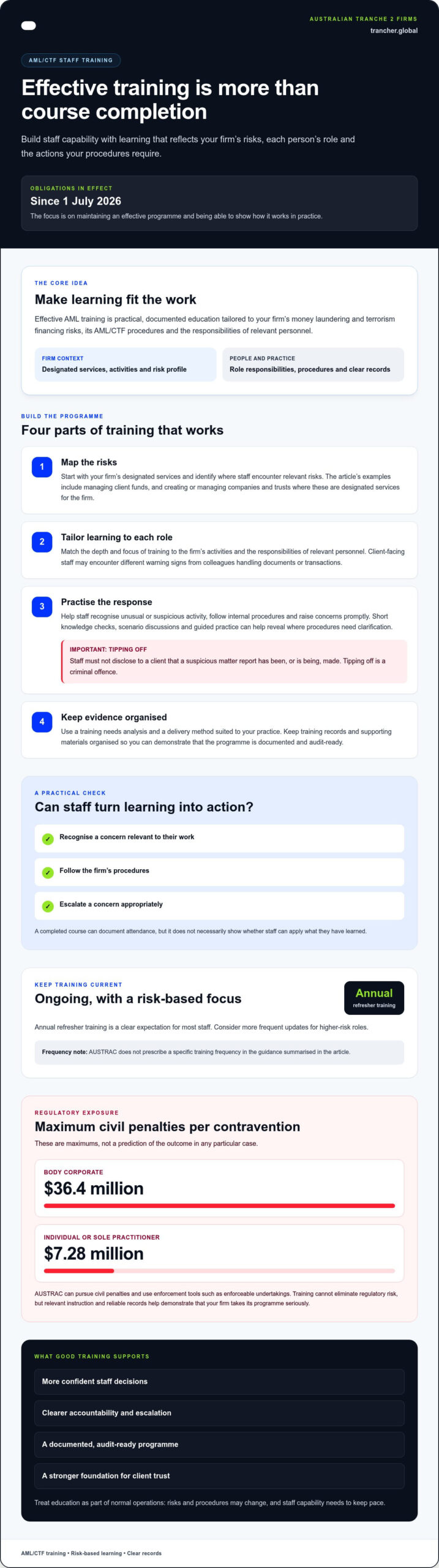
AUSTRAC can pursue civil penalties and use enforcement tools such as enforceable undertakings. Maximum civil penalties are $36.4 million per contravention for a body corporate and $7.28 million for an individual or sole practitioner. These are maximums, not a prediction of the outcome in any particular case. Training can’t eliminate regulatory risk, but relevant instruction and reliable records help firms demonstrate that they take their programme seriously.
There’s also a business case. Clients look for professional advisers who handle sensitive matters responsibly and can explain their controls with confidence. A strong compliance culture can support that trust and help distinguish a firm in a competitive market. Think of effective training as an investment in better decisions, clearer accountability and a more resilient practice, not a guarantee against problems.
Decoding AUSTRAC Standards: What Constitutes ‘Effective’ Employee Training?
Effective AML training is practical, documented education tailored to a firm’s money laundering and terrorism financing risks, its AML/CTF procedures and the responsibilities of relevant personnel. That’s a more useful measure than course completion alone. Staff need to understand what applies to their role and how to respond when a situation raises concern.
A risk-based approach means matching the depth and focus of training to the firm’s activities and the risks attached to them. A one-size-fits-all module may miss details that matter in your practice. A compliance toolkit should therefore support role-based learning, clear procedures and records that show what training staff have received.
Defining the Risk-Based Training Framework
Start with your firm’s designated services, then identify where staff encounter relevant risks and what they need to do at each point. For example, training may need to address risks linked to managing client funds or creating or managing companies and trusts, where those activities are designated services for the firm. Check that staff can apply what they’ve learned, not just recall it. Short knowledge checks, scenario discussions or guided practice can reveal where procedures need clarification.
Training should continue beyond induction. AUSTRAC doesn’t prescribe a specific training frequency in the guidance summarised here, but annual refresher training is a clear expectation for most staff, with more frequent updates considered for higher-risk roles. Revisit content when your services, risks or internal procedures change.
Role-Specific Obligations for Accounting Staff
Different roles call for different emphasis. Client-facing professionals may need practice identifying unusual activity and escalating concerns. Senior management needs to understand its oversight responsibilities and how the firm’s controls operate. Administrative staff, including receptionists who handle client documents, need clear guidance on relevant procedures and when to refer a concern. Everyone should know the correct escalation route and understand the prohibition on tipping off.
For practices involved in trust accounts or company formations, training should connect those activities to the firm’s risk assessment and procedures, rather than assume every service carries the same exposure. Make expectations accessible: explain the relevant steps, identify the appropriate internal contact and check understanding. This makes effective AML training for employees part of daily practice, not a box to tick once a year.
To make role-based learning and training records easier to manage, explore how Trancher’s AML/CTF training and compliance platform may fit into your firm’s workflow.
Structuring Your Curriculum: Essential AML Modules for Modern SME Firms
A useful AML curriculum connects the rules to decisions staff make in practice. For accounting firms, that means covering the firm’s own services, client interactions and escalation pathways, not just broad concepts. These four modules provide a practical foundation for effective AML training for employees.
- Module 1: ML/TF fundamentals and the Australian regulatory environment. Explain how money laundering and terrorism financing can affect professional services, and introduce the firm’s AML/CTF programme, policies and relevant responsibilities.
- Module 2: Red flags and suspicious matter reporting. Teach staff to recognise activity that doesn’t fit the client or expected purpose, record relevant facts and promptly follow the firm’s escalation process.
- Module 3: Customer due diligence and KYC. Cover how the firm verifies clients, understands the purpose of a relationship and follows its procedures when ownership or control is unclear.
- Module 4: Records and internal escalation. Show staff what information to record, where it belongs and who to contact when a concern arises. Reinforce the prohibition on telling a client that a suspicious matter report has been, or is being, made.
Identifying Money Laundering Red Flags
A red flag isn’t proof of wrongdoing. It’s a prompt to pause, record what appears unusual and escalate through the firm’s process. In an accounting practice, examples might include a transaction with no clear connection to the client’s stated business purpose, instructions that change unexpectedly, or a complex ownership arrangement that the client can’t readily explain. Staff should avoid making accusations or alerting a client to a report. Use scenarios drawn from the firm’s services, and clarify who assesses the concern and what information to preserve.
Mastering Customer Due Diligence (CDD)
Training can explain CDD levels in plain language: standard checks establish the client and relevant ownership information; simplified measures involve fewer or less intensive checks where the firm’s procedures allow; enhanced measures involve closer scrutiny where risk is higher. These descriptions are learning aids, not a substitute for confirming when each approach applies under the firm’s current programme and requirements.
For a trust or company structure, staff should know how to follow the firm’s process to understand who ultimately owns or controls the client, identify gaps and escalate complexity. Don’t let uncertainty become an informal workaround.
Onboarding is also a chance to set expectations. Explain what verification involves, why the firm needs the information and how any applicable compliance charges are communicated under its usual engagement and billing arrangements. Be transparent and consistent; don’t promise that checks will be waived if a client objects. Together, these modules help staff act consistently and give clients a clear, professional explanation of the process.
A Step-by-Step Guide to Delivering and Documenting Audit-Ready Training
A clear process makes training easier to manage and easier to evidence. The goal isn’t to collect paperwork for its own sake. It’s to show what staff were taught, how the learning reflects your firm’s risks and whether people completed it.
- Step 1: Assess training needs. Use your firm’s risk assessment to identify relevant services, staff roles and knowledge gaps. Prioritise situations employees are likely to encounter in their work.
- Step 2: Choose a delivery method. Online modules can help deliver consistent content; workshops allow staff to discuss realistic scenarios; a hybrid approach can combine both. Match the method to your team’s size, roles and learning needs.
- Step 3: Record participation. Maintain a training register and store materials, completion dates and assessment results together. Structured, audit-ready compliance records make evidence easier to retrieve when needed.
- Step 4: Schedule refreshers. Use regular training to keep procedures familiar and reinforce how staff should respond to concerns. Annual refresher training is a clear expectation for most staff, with more frequent updates considered for higher-risk roles.
- Step 5: Review the programme. Revisit training at least annually as a sound practice, and update it when your services, risk assessment, procedures or relevant regulatory guidance changes.
The Importance of Defensible Record-Keeping
During a compliance review or audit, a firm may need to demonstrate that relevant personnel received appropriate training. Keep a register, copies of learning materials, completion dates and assessment results, and make sure each record can be linked to the relevant employee and training. Retain these records for seven years. Spreadsheets can be difficult to maintain as staff, modules and completion status change, creating room for missed updates or inconsistent entries.
Leveraging Automation to Reduce Administrative Friction
A suitable digital system can centralise training records and, where the platform supports it, send reminders about upcoming or overdue learning. Automation can reduce manual follow-up, but it doesn’t replace oversight. Assign someone to review completion reports, resolve gaps and keep materials current. This creates a more dependable process than relying on memory or scattered files, without treating compliance as “set and forget”.
For a more streamlined approach, explore Trancher’s AML/CTF training and record-keeping platform and consider how it could support your firm’s workflow.
Transforming Compliance into Capability: The Trancher Approach to Staff Education
Training works best when it supports the way a firm actually manages compliance. Trancher combines training modules with audit-ready record keeping and workflow automation, helping Australian accounting firms bring learning and compliance tasks into a more organised process. Firms can align training with staff responsibilities and their own procedures, then keep completion evidence with other relevant records.
This approach can help make effective AML training for employees part of ongoing operations rather than a standalone course to complete and forget. Staff build familiarity with the procedures they need to follow, while managers have a clearer view of training activity and outstanding tasks. Trancher’s ROI reporting can also help firms identify billable compliance work and assess how compliance activity contributes to the practice.
Turning Compliance Work into Recoverable Revenue
Compliance training doesn’t automatically create a new service or make every activity billable. It can, however, help a firm recognise the expertise and work involved in client verification, monitoring and record keeping. With a clearer view of that activity, partners can assess which services are appropriate to offer and how to explain relevant fees under their normal engagement and billing arrangements. Trancher’s ROI reporting is designed to identify billable compliance work, helping firms consider compliance as a potential professional capability, not just overhead.
Any service offering remains the firm’s decision. Training can support staff knowledge, while clear processes and appropriate expertise help the firm determine what it can responsibly deliver to clients.
Support for Your Readiness Journey
Trancher offers a 30-day guarantee for AML/CTF compliance readiness and a complimentary 3-month trial for accounting firms. The trial provides full platform access with no cost or obligation and is currently available to a limited number of firms. Trial participants receive a formal ROI report at the end of the three-month period. The readiness guarantee relates to compliance readiness, not a particular AUSTRAC decision or a substitute for maintaining your own programme.
Firms can also draw on local Australian support from Aaron Soh and the team. This guidance can help make the transition from training requirements to practical workflows more manageable. Firms that continue after the trial receive 20% off their first 12-month subscription.
Tranche 2 obligations commenced on 1 July 2026, so the focus now is on maintaining effective training and compliance processes. Start a conversation with Trancher about training, record keeping and workflow support for your firm.
Make AML Training a Capability Your Firm Can Build On
Effective AML training for employees is more than course completion. It gives staff role-relevant guidance, helps them recognise and escalate concerns, and supports a documented programme that can be reviewed and improved over time.
Start with your firm’s risk profile, tailor learning to what each person does, and keep clear evidence of participation and understanding. With Tranche 2 obligations now in effect, an organised approach can help turn ongoing compliance work into a stronger professional capability.
Trancher offers a complimentary 3-month trial for accounting firms, a 30-day AML/CTF compliance readiness guarantee and local Australian support from Aaron Soh and the team. Trial participants receive a formal ROI report at the end of the trial, and firms that continue after the trial receive 20% off their first 12-month subscription.
Start your 30-day journey to Tranche 2 readiness with a complimentary 3-month trial of Trancher. With clear processes and steady support, your firm can take its next steps with confidence.
Frequently Asked Questions
What are the minimum AML training requirements for staff under Tranche 2?
Training should be documented, ongoing and tailored to your firm’s risks, services and staff responsibilities. Cover the firm’s AML/CTF programme, relevant procedures, how to identify and escalate suspicious matters, and the prohibition on tipping off. Provide training to relevant personnel, including client-facing and administrative staff whose work touches client documents or transactions. AUSTRAC guidance and e-learning can help, but don’t treat them as a substitute for training specific to your firm.
How often do my employees need to undergo AML/CTF refresher training?
AUSTRAC doesn’t prescribe a specific training frequency in the guidance summarised here. Annual refresher training is a clear expectation for most staff, while people in higher-risk roles may need more frequent updates. Revisit training sooner if your firm’s services, risk assessment or procedures change, or if reviews reveal knowledge gaps. Set a schedule that reflects your actual risks, and keep a record of refresher completion and any assessments.
Does AUSTRAC require a specific training certificate for compliance?
The information here doesn’t establish a requirement for a particular AML training certificate. A certificate alone also won’t demonstrate that training was suitable for your firm or that staff understood how to apply it. Keep evidence of the programme instead, including training materials, a staff register, completion dates and assessment results. AUSTRAC’s learning resources can support staff education, but they don’t replace a tailored programme addressing your own risks and procedures.
Can we use generic, international AML training materials for our Australian firm?
Generic or international materials can provide useful background, but they shouldn’t be your whole training programme. Your content needs to reflect your Australian regulatory context, the designated services your firm provides and its internal AML/CTF procedures. Add practical examples relevant to your staff’s work, such as how to raise a concern internally or handle a client interaction without tipping off. Review materials regularly so they remain consistent with current procedures and guidance.
What happens if our firm fails to document staff training properly?
Without reliable records, it may be harder to demonstrate during a compliance review that relevant staff received appropriate training. AUSTRAC can take enforcement action for AML/CTF breaches, including seeking civil penalties and using enforceable undertakings; the outcome depends on the circumstances. Training records must be retained for seven years. Keep a register, copies of materials, completion evidence and assessment results in an organised, retrievable format.
How do I train staff to identify suspicious matter red flags without “tipping off”?
Use role-relevant scenarios to teach staff to recognise unusual activity, record objective facts and follow the firm’s internal escalation process. Make clear that staff must not tell a client that a suspicious matter report has been, or is being, made. For example, if activity doesn’t fit the known client profile, employees should raise it with the designated internal contact rather than accuse the client or discuss a possible report with them.
Is online AML training as effective as face-to-face workshops for SMEs?
Either format can support effective AML training for employees if the content is tailored, practical, assessed and documented. Online learning can provide consistent modules and completion records; workshops allow staff to discuss scenarios and ask questions. A hybrid approach may combine these strengths. Choose based on your team’s roles, learning needs and available processes, then check understanding through knowledge questions or scenario discussions rather than relying on attendance alone.
Should new employees receive AML training before they start handling client matters?
As a sound risk-management practice, provide relevant AML/CTF training before a new employee handles work that could expose them to your firm’s designated services or client information. This helps them understand the procedures, escalation route and limits of what they should communicate to clients. If immediate training isn’t practical, define supervision and access controls until it’s completed. Record the training and check that the employee can apply the relevant steps.