

What if the most complex part of your 1 July 2026 compliance transition actually became your firm’s most efficient revenue stream? For many Australian accounting practices, managing KYC for non-resident clients feels like a looming administrative bottleneck. You’re likely familiar with the frustration of chasing certified paper documents across different time zones or the underlying fear of AUSTRAC penalties if an international onboarding process falls short of the mark.
We understand that navigating the shift to Tranche 2 standards can feel overwhelming, but it doesn’t have to be a burden on your resources. This guide provides a clear, defensible workflow to verify international clients securely while eliminating manual paperwork. You’ll learn how to meet the 1 July 2026 deadline with total confidence, ensuring your practice remains compliant without sacrificing operational ease.
We’ll walk you through the practical application of electronic “Safe Harbour” rules, the necessity of automated PEP and sanctions screening, and the steps to transform mandatory due diligence into a professional, billable service. By the end of this article, you’ll have a blueprint for a modern compliance programme that protects your firm and supports your global growth.
Key Takeaways
- Understand the 1 July 2026 Tranche 2 requirements and why international identity verification is now a high-priority focus for Australian accounting firms.
- Master AUSTRAC’s “Safe Harbour” provisions to verify non-resident identities using reliable electronic data sources rather than outdated manual methods.
- Streamline KYC for non-resident clients by replacing slow, paper-based processes with modern biometric digital checks that enhance security and reduce friction.
- Implement a structured, step-by-step workflow for overseas onboarding, moving from initial risk assessments to secure, encrypted document collection.
- Learn how to transform mandatory compliance into a billable service and achieve full audit-readiness within a guaranteed 30-day implementation timeframe.
Why KYC for Non-Resident Clients is a Critical Tranche 2 Focus in 2026
Defining KYC for non-resident clients is simple in theory: it’s the process of verifying the identity of any individual or entity residing outside Australia. In practice, however, it serves as a sophisticated pillar of Know Your Customer (KYC) frameworks aimed at safeguarding the financial system. Since the Tranche 2 reforms commenced on 1 July 2026, this process has transitioned from an optional “best practice” into a mandatory legal requirement for Australian accounting firms.
The significance of this date cannot be understated. AUSTRAC now requires professional service providers to implement a formal, risk-based approach to onboarding. Because non-residents operate outside Australian domestic databases, they’re often classified as medium to high risk by default. This classification isn’t an indictment of the client, but rather a recognition that international jurisdictions present unique complexities that require a more robust level of scrutiny than a local resident would.
The Impact of Tranche 2 on International Onboarding
Your obligations are triggered whenever you provide “designated services” to an overseas client. These services include facilitating property transfers, managing bank accounts, or establishing complex trust structures. When dealing with high-risk international entities, you must also manage the risk of “tipping off.” It’s a serious offence to disclose that a suspicious matter report is being filed, which makes a structured, discreet onboarding process vital. Ensuring you have Audit-ready compliance records allows your firm to demonstrate full adherence to AUSTRAC standards without disrupting the client relationship.
The High-Risk Nature of Non-Resident Entities
Geographic risk factors mean that basic identity checks are rarely enough for international clients. You must consider the regulatory environment of the client’s home country and whether it aligns with international standards. This is why automated PEP (Politically Exposed Person) and Sanctions screening have become non-negotiable tools for the modern firm. Under the 2026 rules, a client’s non-resident status frequently acts as a primary trigger for Enhanced Due Diligence (EDD), requiring you to investigate their source of wealth and obtain senior management approval before the business relationship begins.
Understanding AUSTRAC Standards for International Identity Verification
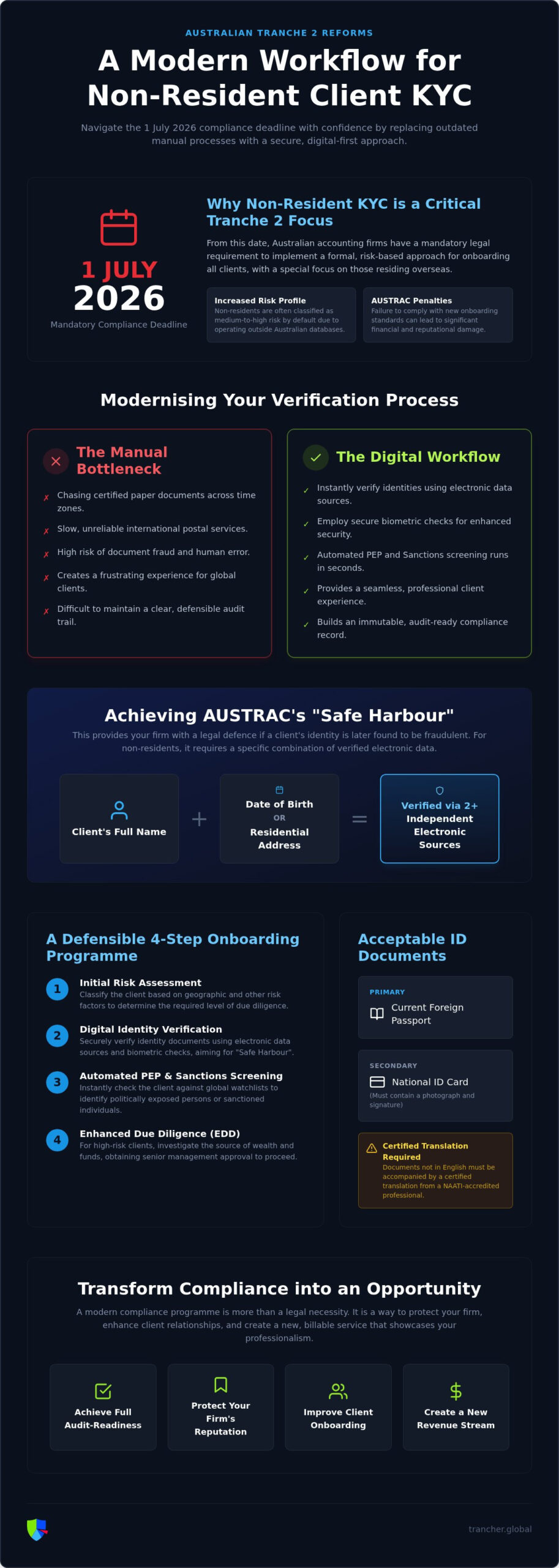
AUSTRAC provides clear pathways for identifying individuals who don’t reside in Australia. The primary objective is to verify that the person is who they claim to be using reliable and independent documentation. For KYC for non-resident clients, the most robust evidence is a current foreign passport. If a passport is unavailable, a national identity card containing a photograph and signature is the next acceptable tier.
When documents aren’t in English, they must be accompanied by a certified translation. In Australia, this usually means a translation from a NAATI-accredited professional. This ensures that your firm isn’t just “collecting” papers but actually understanding the information provided. It also creates a defensible audit trail that demonstrates you’ve taken reasonable steps to verify the client’s identity accurately.
The Safe Harbour Framework for Overseas Clients
Achieving “Safe Harbour” status provides your firm with a legal defence if a client’s identity later proves to be fraudulent. To reach this standard for non-residents, you must verify the client’s full name and either their date of birth or residential address using at least two independent data sources. This creates a redundant layer of security that simple document collection cannot match.
This is where many firms encounter a hurdle. The Australian Document Verification Service (DVS) is highly effective for domestic drivers’ licences and passports, but it often lacks connectivity to international databases. Relying on manual certified copies sent via post is slow and high-risk. Instead, firms are moving toward remote client verification software Australia wide that can verify international biometric chips. For a deeper look at these requirements, see our CDD and KYC Requirements Australia 2026 Guide.
Documenting Source of Wealth (SoW) and Source of Funds (SoF)
Verifying a non-resident’s identity is only the first step. You must also understand the origin of their financial standing. Source of Wealth (SoW) refers to the activities that generated the client’s total net worth, while Source of Funds (SoF) focuses on the specific capital used for a transaction. Implementing KYC for non-resident clients effectively means looking beyond the passport to the underlying economic profile.
- Request bank statements from foreign institutions that clearly show salary or investment income.
- Obtain copies of property titles or inheritance records for large lump sums.
- Identify the Ultimate Beneficial Owners (UBOs) for any offshore companies or foreign trusts.
Handling these complex structures requires a methodical approach to record-keeping. Storing this evidence in a secure, encrypted environment ensures you can meet AUSTRAC’s seven-year retention rule without administrative stress. If your firm is looking to streamline these requirements, you might consider how automated screening tools can simplify your international onboarding.
Digital vs. Manual Verification: Navigating the Non-Resident Challenge
The transition to the 1 July 2026 standards marks the end of the era where “near enough is good enough” for international onboarding. Historically, firms relied on the “Old Way” of managing KYC for non-resident clients, which involved requesting physical certified copies of passports via international courier. This manual approach is inherently flawed. It relies on the ability of staff to recognise the legitimacy of foreign stamps and signatures from jurisdictions they may never have encountered. If a document is fraudulent, a manual check is unlikely to catch it, leaving your firm exposed to significant regulatory risk.
Beyond the security concerns, the administrative friction is immense. Physical files are difficult to search, easy to misplace, and challenging to present during an AUSTRAC audit. Modern identity verification (IDV) replaces these filing cabinets with secure digital records that are instantly accessible and fully encrypted. This shift doesn’t just improve security; it transforms a slow, fragmented process into a streamlined workflow that respects both your team’s time and the client’s experience.
The Hidden Costs of Manual International KYC
The administrative burden of manual processes often goes unrecognised until it’s too late. Chasing a client in London or Singapore to find a local “authorised witness” creates significant friction that can stall an engagement for weeks. This isn’t just a nuisance; it’s a direct drain on your firm’s profitability. When you factor in the staff hours spent on follow-ups and manual data entry, the efficiency gains of automation become clear. Reviewing the AML software vs consultant cost Australia reveals that digital systems often pay for themselves by reclaiming billable time and reducing the need for expensive external audits.
The Security Advantage of Biometric IDV
Digital verification offers a level of certainty that no physical document can match. Modern systems use “liveness testing” to ensure the person providing the ID is physically present and not using a high-resolution photo or deepfake. This is particularly vital for remote, non-face-to-face onboarding common with international clients. Implementing robust KYC for non-resident clients now requires this level of biometric assurance to meet the defensibility standards expected by AUSTRAC. Firms seeking a structured approach to this challenge can benefit from understanding how remote client ID verification works under Australia’s 2026 AUSTRAC framework before selecting a platform.
Automated optical character recognition (OCR) technology can instantly scan and verify the security features of thousands of foreign passport types. This removes the guesswork for your team and provides a timestamped audit trail. By adopting these tools, your firm shifts from a reactive stance to a proactive one, satisfying the 2026 requirements with a system that is both robust and scalable.
A Step-by-Step Workflow for Verifying Overseas Clients Securely
Implementing a defensible workflow for KYC for non-resident clients starts long before you receive a passport scan. You must begin with an initial risk assessment to determine if the engagement requires Standard or Enhanced Due Diligence (EDD). Because international jurisdictions present higher inherent risks, your process should be robust enough to handle the additional scrutiny required by AUSTRAC under the 2026 reforms.
Once you’ve determined the risk level, follow this structured operational sequence to ensure compliance:
- Digital Document Collection: Use a secure, encrypted portal to gather identity documents. This protects sensitive data and eliminates the security risks associated with unencrypted email attachments.
- Global Screening: Run the client’s details against real-time PEP and Sanctions watchlists. This step must be automated to capture updates in global sanctions regimes as they happen.
- Entity Verification: If your client is a corporate entity, you must identify the natural persons who ultimately own or control the business.
- Final Approval: Your firm’s Compliance Officer should review the complete profile, assign a final risk rating, and document the approval in your audit trail.
This methodical approach ensures that no detail is overlooked. It replaces fragmented, manual habits with a repeatable system that protects your firm from regulatory oversight. If you want to see how this workflow can be automated for your firm, you can explore our end-to-end compliance solutions.
Managing Beneficial Ownership for Foreign Entities
Identifying the “natural person” behind an overseas company is often the most challenging part of international onboarding. You must look through layers of corporate shareholders until you find the individuals who own more than 25% of the entity or exert significant control. It’s equally important to document control structures in complex foreign trusts, ensuring you understand who the settlors, trustees, and beneficiaries are. For specific steps on navigating these requirements, our Beneficial Ownership 2026 Guide provides a comprehensive roadmap.
Ongoing Monitoring for International Clients
Compliance is a continuous obligation, and KYC for non-resident clients is not a “one and done” activity. You should set up triggers for re-verification based on changes in the client’s jurisdiction, business activity, or transaction volume. Integrating these international monitoring requirements into your standard AML risk assessment methodology allows you to maintain an up-to-date risk profile for every client. This proactive stance ensures that your firm remains audit-ready, even as global regulatory landscapes shift.
How Trancher Simplifies Complex Non-Resident Compliance for SME Firms
Trancher acts as a steady hand for Australian accounting firms navigating the complexities of the 1 July 2026 Tranche 2 commencement. We’ve designed our platform to remove the friction from international onboarding, providing an end-to-end solution that replaces fragmented manual habits with a single, audit-ready system. Even for practices managing high volumes of KYC for non-resident clients, we provide a 30-day compliance guarantee. This gives your firm the certainty it needs to meet regulatory deadlines without disrupting your daily operations or client relationships.
Our platform is specifically built for the needs of small to medium-sized firms. We understand that you aren’t just looking for a software tool; you’re looking for a partner that understands the Australian regulatory landscape. With local support and a focus on operational ease, we help you transition from the “Old Way” of chasing paper to a modern, automated workflow. By integrating automated PEP and sanctions screening with secure document collection, you can ensure every international file is defensible and complete from day one.
Transforming Compliance into a Billable Professional Service
One of the most significant advantages of using Trancher is the ability to turn KYC for non-resident clients into a recoverable compliance activity. In the past, the hours spent chasing international documents were often absorbed as a firm overhead. Our platform changes this by tracking the time and resources dedicated to complex due diligence. You can use these insights to generate ROI reports and justify compliance fees as part of your professional engagement.
This shift allows your firm to position AML advisory as a new revenue stream. Rather than viewing the 2026 requirements as an administrative hurdle, you can frame them as a high-value service that protects both your firm and your clients. We provide the tools to monitor client activity and manage risk effectively, ensuring that your compliance programme contributes to your firm’s financial health rather than detracting from it.
Start Your 30-Day Compliance Journey
We’re committed to helping Australian firms achieve readiness with total confidence. To support your transition, we’re offering a complimentary 3-month trial for eligible firms, followed by a 20% discount on your first 12-month subscription. This allows you to experience the efficiency of automated international onboarding without an immediate financial commitment.
Don’t let the 1 July 2026 deadline create unnecessary stress for your team. You can contact Aaron Soh today to organise an operational readiness review for your practice. We’ll help you assess your current workflows and show you how a structured, digital approach can simplify your most complex compliance challenges.
Securing Your Practice for a Global Future
The transition to 1 July 2026 standards doesn’t have to be a source of stress for your practice. By moving away from manual, paper-based verification and embracing automated biometric checks, you ensure your KYC for non-resident clients is both secure and audit-ready. This shift protects your firm from AUSTRAC penalties. It also transforms a complex administrative requirement into a structured, billable professional service.
We’re here to act as your expert compliance companion through every step of this transition. With expert local support from our founder, Aaron Soh, we ensure your firm is equipped with the right tools to navigate international onboarding with total ease. You can Get Tranche 2 ready in 30 days; start your free trial with Trancher today. Our platform offers a complimentary 3-month trial for SME accounting firms and a guarantee of full AML/CTF compliance within just 30 days.
You’ve built a successful practice by providing expert guidance to your clients. We’re ready to provide that same steady hand for your compliance journey, turning regulatory obligations into a strategic advantage for your firm’s growth.
Frequently Asked Questions
Is KYC mandatory for non-resident clients under Tranche 2?
Yes, it’s mandatory. Since the Tranche 2 reforms commenced on 1 July 2026, all accounting firms providing designated services must perform identity verification. This applies regardless of where the client lives. Because non-residents are often classified as medium to high risk, they usually trigger Enhanced Due Diligence (EDD) requirements. Ensuring your firm has a structured process for KYC for non-resident clients is now a core legal obligation under AUSTRAC regulations.
Can I use a copy of a foreign passport for KYC if it is not certified?
No, a simple uncertified photocopy is insufficient for manual verification. AUSTRAC standards require you to use an original document or a certified copy from an authorised witness. However, modern digital platforms offer an alternative. By using biometric liveness checks and OCR technology, you can verify a foreign passport electronically. This method often satisfies “Safe Harbour” requirements more efficiently than chasing physical paperwork across international borders, which is a common pain point for many firms.
What happens if an international client is on a global sanctions list?
If a client appears on a sanctions list, you must immediately cease providing designated services and file a Suspicious Matter Report (SMR) with AUSTRAC. You have a hard deadline to submit this within three business days of forming the suspicion. It’s vital to avoid “tipping off” the client, as this is a criminal offence. Automated screening tools are essential here, as they provide real-time alerts against global watchlists before you inadvertently engage with a sanctioned entity.
How do I verify the “Source of Wealth” for a non-resident client?
Verifying the Source of Wealth (SoW) involves documenting how a client accumulated their total net worth over time. For international clients, you should request evidence such as foreign tax returns, audited financial statements, or documentation of property sales and inheritances. It’s about building a clear picture of their financial history. This process is mandatory for any client deemed high risk, ensuring your firm isn’t facilitating the movement of funds derived from illicit activities overseas.
Do I need a separate AML program for my international clients?
You don’t need a separate program, but your existing AML/CTF Program must specifically address the risks associated with international engagements. Your program should outline the different workflows for domestic versus overseas clients. This includes specifying when to use Enhanced Due Diligence (EDD) and how you’ll perform KYC for non-resident clients. A single, comprehensive program that categorises risks by jurisdiction is the most effective way to maintain audit readiness while managing a diverse client base.
How often must I re-verify the identity of a non-resident client?
The frequency of re-verification is determined by your firm’s risk-based approach rather than a fixed calendar date. High-risk clients, which often include non-residents, require more frequent reviews than low-risk domestic individuals. You should also trigger a review if there’s a significant change in the client’s activity, such as a large unusual transaction or a change in beneficial ownership. Staying proactive ensures your records remain accurate and defensible during any future AUSTRAC regulatory review.
Can I charge my clients for the cost of AML compliance checks?
Yes, you can and should treat compliance as a billable professional service. Many Australian firms now include a compliance fee in their engagement letters to cover the costs of identity verification and ongoing monitoring. Trancher is specifically designed to help you track the time and resources spent on these activities. This transforms what was once a non-billable administrative burden into a transparent, recoverable cost that reflects the professional value of your due diligence work.
What is the “Safe Harbour” provision for non-resident identity verification?
The “Safe Harbour” provision is a regulatory protection that applies when you verify a client’s identity using specific electronic methods. To achieve this for a non-resident, you must verify their full name and either their date of birth or residential address against at least two independent and reliable data sources. Following these steps provides your firm with a legal defence, demonstrating that you’ve met the required standard for identity verification in a non-face-to-face environment.