

By 1 July 2026, the traditional handshake and physical document check will no longer be enough to shield your accounting firm from the rigorous demands of AUSTRAC’s Tranche 2 regulations. You’re likely feeling the weight of this transition, balancing the need for strict compliance with the desire to keep your client onboarding smooth and professional. It’s a significant shift, yet it’s also an opportunity to modernise your internal systems for the better.
Adopting the right remote client verification software Australia wide allows you to replace manual KYC burdens with a seamless, automated workflow. This guide provides the clarity you need to master secure remote verification and ensures your firm is fully AUSTRAC-ready within 30 days. We’ll show you how to build a defensible AML/CTF programme that protects your practice while turning administrative obligations into recoverable professional fees. We will start by breaking down the core requirements of the AML/CTF Amendment Act 2024 and then move into practical steps for creating an efficient, audit-ready onboarding process that your clients will actually appreciate.
Key Takeaways
- Understand why the 1 July 2026 deadline makes digital onboarding essential for SME accounting firms to remain AUSTRAC-compliant.
- Master the ‘Safe Harbour’ framework to ensure your remote identity checks are legally defensible and meet the rigorous AML/CTF Act 2006 standards.
- Discover how implementing remote client verification software Australia helps eliminate manual administrative burdens while reducing client friction.
- Learn to establish a consistent, firm-wide workflow that balances regulatory urgency with a professional, supportive client experience.
- Transform your compliance programme from a cost centre into a recoverable activity by tracking and billing for AML/CTF readiness services.
Preparing for 1 July 2026: Why Remote Verification is Non-Negotiable
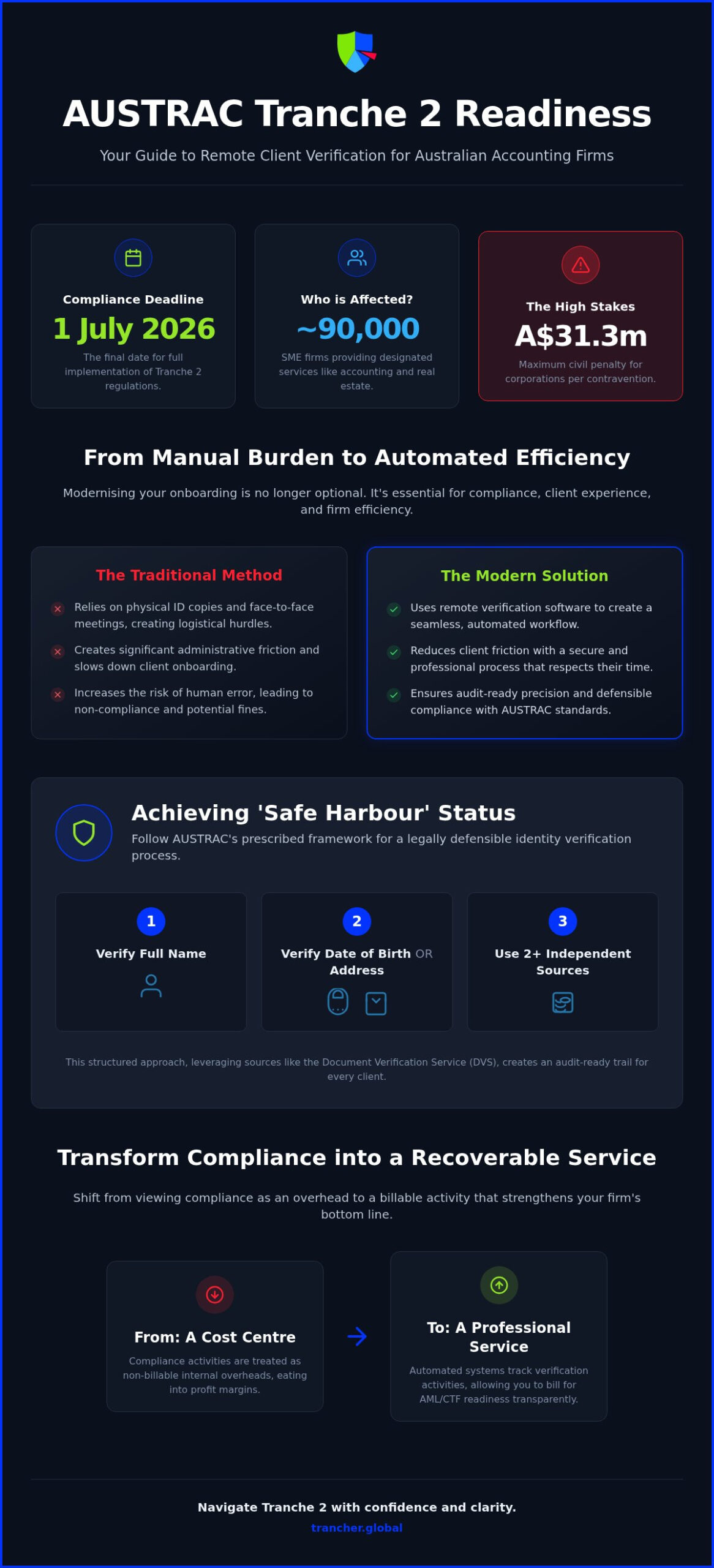
The evolution of Australian AML/CTF regulations marks a significant milestone for SME accounting firms. While larger financial institutions have managed these obligations for years, the expansion of the regime via the Tranche 2 reforms brings approximately 80,000 to 90,000 new businesses into the regulatory fold. This isn’t a minor tweak to your workflow; it’s a fundamental shift in how you identify and verify the people you serve. The 1 July 2026 deadline is the final date for full implementation, making the adoption of reliable remote client verification software Australia an essential step for any forward-thinking practice.
The Impact of Tranche 2 on SME Firms
Under the updated legislation, firms providing “designated services” must enrol with AUSTRAC and maintain a formal AML/CTF programme. These services include managing client funds, property transactions, or the creation of trusts and companies. If your firm handles these tasks, manual document collection is no longer a viable strategy. Relying on physical ID copies or face-to-face meetings creates significant administrative friction and increases the risk of human error. With civil penalties for corporations reaching up to A$31.3 million per contravention, the cost of an oversight is simply too high. AUSTRAC is actively monitoring these newly regulated sectors, and they expect a level of precision that manual systems rarely achieve.
Moving from Burden to Business Opportunity
The transition to digital onboarding shouldn’t be viewed as a mere cost of doing business. It’s an opportunity to refine your internal systems and improve the client experience. Implementing remote client verification software Australia wide allows you to remove the administrative burden that often stalls new engagements. Instead of chasing paperwork, you can offer a seamless, secure process that respects your client’s time. This shift is part of the broader evolution of Digital Identity in Australia, moving towards more reliable and independent electronic data sources.
By adopting automated systems, you’re also setting the foundation for tracking compliance as a billable activity. You can transform what was once an overhead into a transparent, professional service. This business-minded approach ensures your firm remains profitable while meeting every regulatory hurdle with confidence. It’s about being proactive rather than reactive, ensuring you’re fully AUSTRAC-ready well before the deadline.
AUSTRAC Standards for Verifying Client Identity Remotely
Under the AML/CTF Act 2006, remote verification relies on the use of “reliable and independent” electronic data. This isn’t simply a matter of looking at a scan of a passport; it requires a structured approach to matching client details against verified databases like the Document Verification Service (DVS). The Australian Government’s Digital ID initiatives, such as myID, have paved the way for these secure processes. For SME firms, using purpose-built remote client verification software Australia wide ensures these standards are met without the administrative headache of manual checks.
Identification documents are categorised by their reliability. Primary documents, such as an Australian passport or driver licence, provide the highest level of assurance. Secondary documents, like utility bills or rates notices, can supplement these when necessary. A risk-based approach allows you to tailor the level of verification to the specific threat profile of the client or the service provided. This flexibility is key to managing diverse client bases while maintaining strict compliance standards.
The Safe Harbour Provisions Explained
To achieve a defensible position, firms should aim for “Safe Harbour” status. This framework provides a legal shield by prescribing exactly how to verify an individual’s identity using electronic data. To qualify, you must verify the client’s full name and either their date of birth or their residential address across at least two independent sources. This matching process must be documented meticulously. If your firm can demonstrate it followed these steps, you’ve created a robust defence against potential AUSTRAC audits. Our platform helps automate this documentation, ensuring every check is audit-ready from day one.
KYC vs. CDD: Building a Complete Profile
The best remote client verification software Australia offers will distinguish between the initial identification and the ongoing relationship. KYC is your first “handshake” where you establish who the client is. However, your obligations don’t end there. Continuous monitoring, or Customer Due Diligence (CDD), is a requirement for tracking changes in client risk over time. This involves periodic reviews and monitoring for suspicious activity. You can find more detail on these specific CDD and KYC requirements Australia in our dedicated guide. By integrating these processes into your daily workflow, you turn a complex regulatory hurdle into a manageable, professional routine that protects both your practice and your clients.
Evaluating Remote Verification Methods: Manual vs. Automated Systems
Selecting the right verification method is a strategic decision that shapes your firm’s operational efficiency. You generally have three paths: traditional in-person checks, “DIY” digital methods like video calls, or purpose-built remote client verification software Australia wide. While manual processes might feel familiar, they often carry hidden risks and administrative costs that can hinder your firm’s growth. It’s essential to assess how each method aligns with your specific risk assessment and the expectations of your client base.
Manual verification is frequently perceived as “free,” but the reality is quite different. The time your staff spends chasing clients for certified copies, follow-up emails, and physical filing adds up quickly. These hours are often unbillable, eating into your profit margins. Furthermore, manual systems lack the robust audit trails required for modern compliance. If an AUSTRAC auditor requests proof of your verification process, pulling together disparate emails and paper files is a stressful and time-consuming ordeal.
The Risks of Manual ‘DIY’ Remote Verification
Many firms attempt to bridge the gap by using standard video conferencing tools like Zoom or Microsoft Teams. While these are excellent for meetings, they often fail the authenticity test for identity verification. These platforms aren’t designed to detect sophisticated document forgeries or deepfakes, which are becoming increasingly common. Relying on a low-resolution screen image to verify a passport is a significant security gap. For clients who lack standard documentation, AUSTRAC’s official guidance allows for flexibility, but documenting these exceptions manually is difficult to do consistently across a firm.
The Case for Biometric Automation
Transitioning to automated systems offers a higher level of assurance through biometric technology. Modern remote client verification software Australia provides “liveness” checks, ensuring the person on the other side of the camera is real and present. This technology matches a real-time selfie against the photo on a scanned ID with mathematical precision, far exceeding the capability of the human eye. This process doesn’t just verify individuals; it also streamlines the screening against PEPs and Sanctions lists in real-time.
Automated systems also excel at handling more complex structures. Identifying the individuals behind a company or trust is a core requirement of the new regulations. You can explore how to manage these requirements effectively in our guide to beneficial ownership verification software Australia. By moving away from DIY methods, you ensure your firm is protected by the latest technology while providing a seamless, professional experience for your clients.
A Step-by-Step Workflow for Verifying Clients Online
A consistent workflow is the backbone of a defensible AML/CTF programme. It ensures every client is treated with the same level of care and every regulatory box is ticked. Moving away from ad-hoc emails to a structured platform provides clarity for your staff and a sense of security for your clients. By following a methodical sequence, you can transition from initial contact to a fully verified profile without the usual administrative friction.
Step 1: The Initial Client Engagement
Begin the relationship with clarity and warm professionalism. Use pre-designed templates to explain that these identity checks are a standard professional safeguard required under the AML/CTF Act 2006. Reframe the request not as a hurdle, but as a commitment to protecting their personal identity and the integrity of your firm’s services. It’s essential to address data privacy upfront; tell your clients exactly how their sensitive information is handled and stored. This level of transparency builds immediate trust and significantly reduces friction before the digital process even begins.
Step 2: Executing the Digital Verification
Deliver the technical component of the check through a simple, secure link sent from your remote client verification software Australia platform. This allows your clients to capture their ID documents and complete biometric “liveness” checks on their own smartphone or computer at a time that suits them. The system then automatically cross-checks these details against the Document Verification Service (DVS) in real-time. If a client struggles with the technology or lacks standard documentation, have a clear exception policy ready to guide them. Modern remote client verification software Australia makes these exceptions easy to document, ensuring you remain compliant even in unique circumstances.
Step 3: Risk Profiling and Final Approval
Conclude the process with a thorough review of the findings. Examine the generated verification report for any “red flags,” such as a mismatch in residential address or a high-risk status on a PEP or Sanctions list. Assigning a risk rating isn’t just a checkbox; it’s a strategic assessment that informs how you’ll manage the client relationship moving forward. Once you’re satisfied, save the entire evidence pack in your audit-ready digital vault. Having this centralised record ensures that if AUSTRAC ever requests a look at your files, you can provide a complete, chronological history of your due diligence in seconds.
To see how this structured workflow can be automated for your firm, explore our end-to-end compliance platform.
Transforming Verification into a Profitable Professional Service
Many firms view the upcoming Tranche 2 obligations as a drain on resources. However, the most successful Australian practices are reframing this requirement as a professional service rather than a sunk cost. By implementing remote client verification software Australia, you gain the ability to track every minute spent on due diligence with precision. This data allows you to move away from absorbing compliance costs and toward a model where these activities are recognised as recoverable professional fees.
Transparency is the key to this transition. When you provide a structured, high-tech onboarding experience, clients recognise the value of the security you’re providing. Using ROI reporting, your firm can demonstrate exactly how much time is saved through automation and how much value is created through rigorous risk management. This business-minded optimism turns a regulatory hurdle into a steady avenue for firm growth and improved internal health.
The Business Case for Compliance Automation
Adopting an automated system does more than just tick a box for AUSTRAC. It significantly reduces the non-billable administrative hours that currently plague manual onboarding processes. When your staff aren’t stuck in a cycle of chasing certified copies, they’re free to focus on higher-value advisory work. Interestingly, the deep dive required during the CDD process often uncovers complex client structures or wealth management needs that might otherwise have gone unnoticed. You can see how similar efficiencies are being applied by simplifying client onboarding for law firms across the country.
Getting Started with the Trancher Platform
Our platform is specifically designed to act as your steady guide through this transition. We’ve built a system that automates the entire remote verification journey, from the initial digital handshake to the final audit-ready report. This ensures your firm achieves full operational readiness well before the 1 July 2026 deadline. We’re so confident in our methodical approach that we offer a compliance readiness guarantee of 30 days.
To help your firm experience these benefits without immediate capital outlay, we provide a complimentary 3-month trial. This allows you to integrate the remote client verification software Australia into your existing workflows and see the ROI first-hand. It’s a proactive, risk-free way to ensure your firm is protected, profitable, and prepared for the future of Australian regulation. Don’t wait for the deadline to arrive; start transforming your compliance burden into a strategic advantage today.
Securing Your Firm’s Operational Future
Navigating the shift to Tranche 2 obligations doesn’t have to be a source of anxiety for your practice. By adopting a structured digital onboarding process, you replace manual administrative burdens with efficient, automated workflows that align perfectly with AUSTRAC standards. The transition to remote client verification software Australia is a strategic move that protects your firm from significant penalties while simultaneously improving the experience for your clients. As you’ve learned, this evolution also allows you to track and bill for compliance activities, turning a perceived cost into a recoverable service.
We’re here to act as your expert compliance companion, providing the tools and support needed to manage these changes with ease. With our AUSTRAC-aligned workflows, ROI reporting, and dedicated Australian-based expert support, you can achieve full readiness with confidence. We’re so certain of our methodical approach that we offer a 30-day compliance guarantee.
Take the first step toward a more secure and efficient practice today. Start your complimentary 3-month trial and become Tranche 2 ready in 30 days. You’ve built a successful firm; let’s ensure it remains resilient and ready for the 1 July 2026 deadline.
Frequently Asked Questions
Is remote verification as secure as meeting a client in person?
Remote verification is often more secure than traditional in-person checks when using automated systems. Manual face-to-face identification relies on human observation, which can struggle to detect sophisticated forgeries. In contrast, remote client verification software Australia uses biometric liveness checks and direct matching against government databases. This provides a mathematically precise result and a defensible audit trail that physical checks simply cannot match, ensuring your firm meets AUSTRAC’s high standards for reliability.
What documents are required for a compliant remote identity check?
To achieve Safe Harbour status, you generally need to verify the client’s full name and either their date of birth or residential address. Common documents used in this process include:
- Primary photographic ID, such as an Australian passport or driver licence.
- Secondary documents, like utility bills or rates notices, if primary ID is unavailable.
Automated platforms match these details against independent electronic data sources to confirm the identity is current and legitimate.
Do I need to witness the client signing documents via a video call?
Not for the purposes of AML/CTF identity verification. While some legal documents require a witness for the signature itself, AUSTRAC’s focus is on confirming the individual’s identity. Modern remote systems replace the need for visual witnessing by using biometric technology to ensure the person providing the ID is the same person pictured. This provides a higher level of assurance than a standard video call, which can be vulnerable to low resolution or deepfake technology.
How long must my firm keep records of remote client verifications?
Your firm is legally required to maintain records of customer identification and verification for seven years after the relationship with the client ends. This includes the specific data collected, the verification methods used, and the results of any risk screening. Digital systems simplify this obligation by storing all evidence in a secure, audit-ready vault. This ensures you can produce a complete, chronological history for any AUSTRAC review without searching through disparate physical files or emails.
What should I do if a client refuses to provide identity documents remotely?
You should lead with warm professionalism and explain that these checks are a mandatory safeguard under the AML/CTF Act 2006. If the refusal continues, you must assess whether you can provide the designated service without breaching your compliance programme. Generally, if you cannot verify a client’s identity, you cannot provide the service. Many firms find that reframing the request as a standard security measure, similar to banking protocols, helps alleviate client privacy concerns.
Is digital KYC software mandatory under AUSTRAC Tranche 2 rules?
Digital software is not strictly mandatory, but it is highly recommended for managing regulatory risk and operational efficiency. While manual checks are technically permitted, the administrative burden and risk of human error are substantial for SME firms. Most practices adopt remote client verification software Australia to ensure they meet Safe Harbour provisions consistently. Automation provides the precision and record-keeping necessary to remain compliant as your client base grows and regulations evolve.
How do I verify the beneficial owners of a trust remotely?
Verifying a trust involves a two-step process. First, you verify the legal existence of the trust, typically through a trust deed. Second, you must identify and verify the beneficial owners, including trustees and any individuals who ultimately control the entity. Automated platforms streamline this complex task by allowing you to capture documents from multiple parties simultaneously. This ensures that every individual associated with the trust undergoes the same rigorous screening against PEPs and Sanctions lists.
Can our firm charge clients for the cost of remote verification?
Yes, many Australian practices are now positioning AML/CTF readiness as a billable professional service. By tracking the time and resources spent on due diligence, you can transform a regulatory overhead into a recoverable activity. Our platform includes specialised features for compliance billing support, helping you demonstrate the value of the security and risk management you provide. This approach ensures your firm remains profitable while meeting its obligations ahead of the 1 July 2026 deadline.