

What if the very regulations your firm once dreaded could actually become a new stream of billable revenue? Since the 1 July 2026 deadline for Tranche 2 entities passed, many Australian accounting firms have felt the immense pressure of tracing multi-layered corporate structures to identify ultimate beneficial owners. It’s a significant administrative burden to manually verify who holds a 25% stake or more, especially when a single oversight could lead to civil penalties reaching $36.4 million per breach. Adopting a specialised beneficial ownership verification software Australia platform is no longer just a luxury; it’s a vital step to ensure your firm remains defensible and efficient under AUSTRAC’s active oversight.
We know it feels challenging to explain these increased compliance costs to your loyal, long-term clients. You want to maintain those relationships while meeting your strict AML/CTF obligations. This guide will help you master the complexities of ultimate beneficial ownership (UBO) to ensure your firm remains fully compliant with the obligations that commenced in July 2026. You’ll learn how to streamline your onboarding to reduce client friction, turn administrative hurdles into billable professional services, and build a resilient program that protects your practice while supporting its growth.
Key Takeaways
- Understand that a beneficial owner must always be a natural person who ultimately owns or controls an entity, meaning you must look through every layer of a company or trust.
- Learn a structured identification workflow that begins with comprehensive ASIC searches and trust deed reviews to accurately map out complex ownership chains.
- Discover how beneficial ownership verification software Australia can replace time-consuming manual searches and eliminate the risks associated with human error in spreadsheet tracking.
- Ensure your firm remains audit-ready by consistently documenting the mandatory data points for every ultimate owner, including their full name, date of birth, and residential address.
- Transform your compliance obligations into a sustainable revenue stream by using frameworks that track and recover the professional time spent on essential due diligence activities.
What is a Beneficial Owner Under AUSTRAC Tranche 2?
A Beneficial owner is the human being who ultimately reaps the rewards or pulls the strings of a legal entity. Under the AML/CTF Act, this definition is precise: it must always be a natural person. You can’t simply list another company, a partnership, or a family trust as the owner. If your client is a proprietary company owned by another corporate entity, you’re required to “look through” those layers until you find the individuals at the top of the chain. This requirement became a non-negotiable reality for Australian accounting firms on 1 July 2026.
The shift occurred because Tranche 2 legislation now classifies many common accounting tasks as “designated services.” If your firm provides tax planning, creates legal structures, or manages client money, you’re now a reporting entity with specific obligations. This is why beneficial ownership verification software Australia has become a staple for modern firms. It helps you navigate these definitions with confidence, ensuring you don’t miss the human element behind complex corporate veils.
The 25% Ownership Threshold Explained
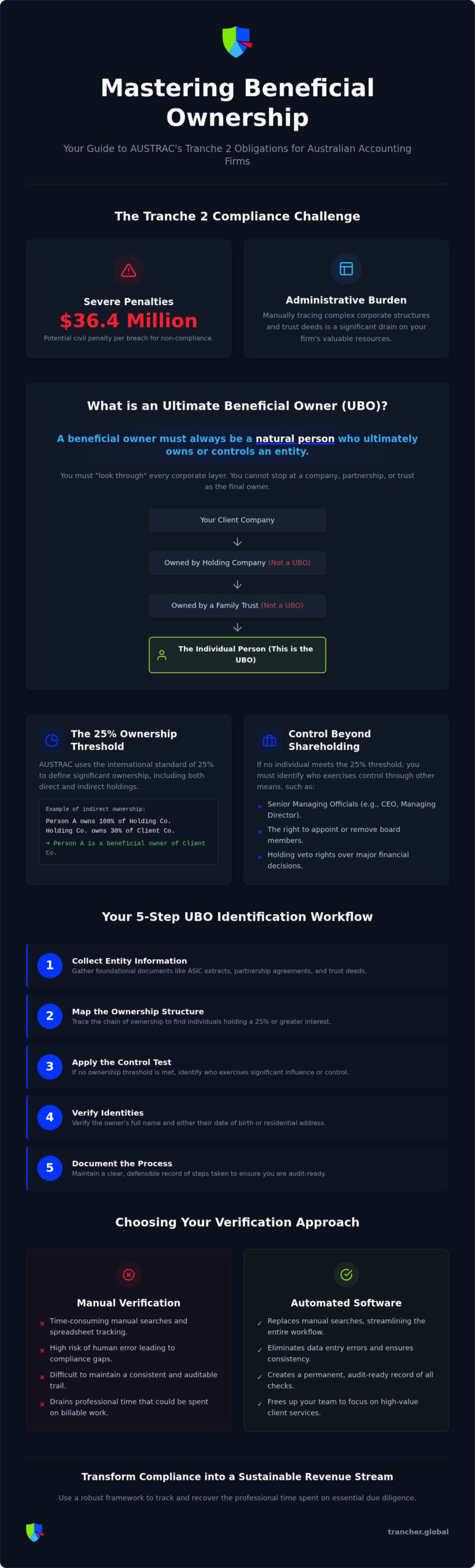
AUSTRAC uses a 25% threshold to define significant ownership, which includes both direct and indirect holdings. This 25% benchmark is the international standard for identifying who has enough “skin in the game” to exert influence over an organisation’s activities. To identify these individuals, you must account for every link in the chain. For instance, consider a simple two-tier structure: if “Person A” owns 100% of a holding company, and that holding company owns 30% of your client’s operating company, “Person A” is a beneficial owner of the client. Mapping these relationships manually is often where the administrative burden feels heaviest, making automated beneficial ownership verification software Australia a strategic asset for maintaining accuracy.
Control Beyond Shareholding
Ownership isn’t the only way to exert power. Sometimes, a corporate structure is so fragmented that no single person hits the 25% mark. In these cases, your focus must shift to who exercises control through other means. This typically involves identifying Senior Managing Officials, such as a CEO or a Managing Director, who make the high-level operational decisions. Control can also be informal, such as having the right to appoint board members or holding veto rights over major financial transactions. Understanding these nuances is a core part of meeting CDD and KYC requirements Australia. By looking beyond the share registry, you ensure your AML/CTF program is robust enough to withstand regulatory scrutiny while providing a clear, defensible record of your due diligence.
How to Identify Beneficial Owners: A Step-by-Step Workflow
Identifying the natural persons behind a client entity doesn’t have to be an overwhelming task. By following a structured, five-step workflow, your firm can meet the rigorous FATF global standards while maintaining operational pace. This methodical approach ensures no detail is missed and every decision is defensible.
- Step 1: Collect entity information. Start by gathering foundational documents such as ASIC company extracts, partnership agreements, or trust deeds.
- Step 2: Map the ownership structure. Trace the chain of ownership upwards to find any individual holding a 25% interest or more, whether held directly or through other entities.
- Step 3: Apply the control test. If no individual meets the ownership threshold, identify who exercises significant influence or control over the entity’s financial and operating policies.
- Step 4: Verify identities. Once the beneficial owners are identified, you must verify their full name and either their date of birth or residential address using reliable independent sources.
- Step 5: Document the process. Maintain a clear record of the steps taken and the evidence gathered to ensure your AML/CTF program is audit-ready.
While this process is straightforward in theory, the manual labour involved in tracing complex webs can quickly drain your team’s billable hours. Many firms are now choosing to automate these workflows using beneficial ownership verification software Australia to reduce administrative friction and improve data accuracy.
Tracing Multi-Layered Company Structures
When you encounter “shell” companies or international parent entities, the tracing process can become murky. If “reasonable measures” fail to uncover a natural person with 25% ownership, you must instead identify a Senior Managing Official. A Senior Managing Official is an individual who makes or participates in making decisions that affect the whole or a substantial part of the business, or who has the capacity to significantly affect the business’s financial standing. This ensure that even when ownership is hidden behind international borders, there is a clear point of accountability for the entity’s actions.
Identifying Parties to a Trust
Trusts require a deeper level of investigation because ownership isn’t always as clear-cut as a share registry. You’re required to identify the trustee, the settlor, and all beneficiaries. For discretionary trusts, you must identify the “class of beneficiaries” if the individuals aren’t specifically named in the deed. This means you identify the group of people who are eligible to receive distributions. If the trustee is a company, you must perform the same look-through process on that corporate trustee as you would for any other company client. Using beneficial ownership verification software Australia allows you to quickly pull these details and verify individual trustees without the need for manual data entry or endless email chains.
Documenting Beneficial Ownership for Audit Readiness
Since the Tranche 2 obligations took effect on 1 July 2026, the focus for Australian firms has shifted from simple identification to the rigorous standard of “audit readiness.” It isn’t enough to simply know who your clients are; you must be able to prove your due diligence through a clear, immutable record. According to the latest AUSTRAC guidance on beneficial ownership, your records must be comprehensive and easily accessible during a regulatory inspection. Disorganised files or missing data points are often the first red flags that trigger deeper scrutiny into a firm’s compliance culture.
To meet these standards, your documentation for every ultimate beneficial owner must include their full name, date of birth, and residential address. These records aren’t just for today; you’re legally required to keep this information for seven years after the client relationship ends. Using beneficial ownership verification software Australia ensures that this digital paper trail is automatically archived and time-stamped, creating a defensible AML compliance program that protects your firm’s standing.
Reliable and Independent Verification Sources
Verification requires using reliable and independent sources. Primary documents, such as an Australian passport or driver’s licence, remain the gold standard. If these aren’t available, you can use secondary documents like utility bills or council rate notices, provided they’re supported by other identifying data. In the 2026 landscape, electronic verification (eKYC) has become the preferred method for most SME firms. It allows you to verify identities in seconds against government and credit databases. For non-resident beneficial owners, the process is more complex. You’ll need to collect international documentation, often requiring certified translations or apostilles, which is where beneficial ownership verification software Australia becomes invaluable for managing cross-border data safely.
The Consequences of Poor Documentation
The risks of inadequate record-keeping are substantial. AUSTRAC has the power to impose significant civil penalties, with maximum fines for a body corporate reaching $36.4 million per breach. For individuals or partners, the cap is $7.28 million. Beyond the financial hit, the reputational damage can be irreparable. An enforceable undertaking or a publicised breach can erode the trust you’ve built with your clients over decades. Structured, automated records remove the stress of a potential audit by ensuring every box is ticked before a client is even onboarded. This proactive approach transforms a regulatory burden into a demonstration of your firm’s professional integrity and operational excellence.
Manual vs. Automated Verification: Choosing Your Approach
Deciding how to manage your UBO obligations is more than just a technical choice; it’s a fundamental business decision. You’re balancing heavy administrative overhead against your firm’s professional capability. For many SME accounting firms, the transition to Tranche 2 has highlighted a stark contrast between traditional manual methods and modern automated systems. While manual ASIC searches and paper-based mapping were once the norm, the 2026 regulatory environment demands a level of precision that is difficult to achieve without dedicated beneficial ownership verification software Australia. You can find a detailed breakdown of these investment choices in our guide on AML software vs consultant cost Australia.
The Hidden Costs of Spreadsheet Compliance
Relying on spreadsheets to track complex ownership structures often creates a false sense of security. The primary issue is the sheer volume of unbillable labour. Every hour a senior staff member spends manually tracing a three-tier company structure or cross-referencing a trust deed is an hour lost to higher-value advisory work. Beyond the time drain, manual systems are inherently prone to human error. A single typo in a residential address or a missed update to a share registry can render your entire record non-compliant. AUSTRAC’s “effectiveness” tests focus on whether your programme actually works in practice. If your risk monitoring schedule relies on a static spreadsheet that isn’t updated in real-time, it’s unlikely to meet the standard required for a defensible AML/CTF programme.
Benefits of Beneficial Ownership Verification Software
Transitioning to beneficial ownership verification software Australia transforms this administrative burden into a streamlined, high-speed workflow. These platforms provide real-time data integration with government registers, allowing you to pull accurate entity details and map ownership trees in seconds rather than hours. Automation also brings a proactive edge to your risk management. The system can provide automatic escalation for high-risk individuals or Politically Exposed Persons (PEPs), ensuring your team only spends time on the cases that truly require expert intervention. Perhaps most importantly for firm owners, modern compliance platforms allow you to generate instant ROI reports. You can finally see exactly how much time is being spent on “designated services,” turning a regulatory obligation into a transparent, billable professional service.
Ready to see how automation can protect your firm’s margins while ensuring total compliance? Explore how Trancher can organise your UBO workflows today.
Transforming Verification into a Profitable Service with Trancher
Trancher was built as a direct response to the specific needs of Australian SME accounting firms facing the 2026 Tranche 2 expansion. While many see the requirement to identify ultimate owners as a purely administrative burden, our platform reframes this obligation as a strategic opportunity. By using our beneficial ownership verification software Australia, your firm can move beyond basic compliance and start viewing these requirements as a core part of your professional value proposition. We’re so confident in our ability to streamline your operations that we offer a 30-day compliance-ready guarantee, ensuring your firm is fully prepared for AUSTRAC oversight without the typical stress of a major transition.
To help you transition smoothly, we provide a complimentary 3-month trial specifically for accounting firms. This period allows you to fully integrate the platform into your existing workflows and see the immediate impact on your efficiency. It’s an opportunity to assess your operational readiness without any upfront financial commitment, giving you the space to organise your client files and establish your new AML/CTF protocols at your own pace.
Turning Obligations into Billable Assets
Most traditional guides treat UBO verification as an unrecoverable cost centre. Trancher changes this narrative through its “Compliance as a Service” model. The platform tracks every “designated service” activity your team performs, from initial identity checks to complex structure mapping. This data is then used to generate detailed ROI reports that justify compliance fees to your clients. When you can show a client the exact professional steps taken to protect their business using beneficial ownership verification software Australia, the conversation shifts from questioning costs to valuing your expertise. This transparency allows you to identify new advisory revenue streams and ensures your firm remains profitable while meeting its regulatory duties.
Steady Guidance for Your Tranche 2 Journey
You don’t have to navigate the complexities of the 2026 landscape alone. Trancher provides local Australian expert support and a dedicated onboarding process led by Aaron Soh. We act as your expert compliance companion, offering the steady guidance needed to transform a perceived burden into a manageable, automated system. For firms that choose to continue with us after their trial, we offer a 20% discount to support your long-term growth. This is about more than just software; it’s about a partnership that values your time and your firm’s reputation. Start your 3-month trial and get Tranche 2 ready today to secure your practice’s future.
Securing Your Firm’s Future in the Tranche 2 Era
Mastering the identification of natural persons behind complex structures is no longer just a regulatory task; it’s a fundamental part of providing expert accounting services. By moving away from manual, error-prone processes and adopting beneficial ownership verification software Australia, you protect your firm from significant AUSTRAC penalties while reclaiming valuable billable hours. This transition isn’t just about avoiding risk; it’s about refining your internal systems to support long-term growth and transparency.
We’re here to act as your expert companion during this shift. Our platform offers specialist-led onboarding for Australian accounting firms and a guarantee to be compliance-ready in 30 days. If you’re ready to transform your approach, take advantage of our 20% discount on your first 12-month subscription. Secure your firm’s future with a complimentary 3-month Trancher trial and see how manageable these new obligations can truly be. You’ve built a respected practice; with the right tools, you’ll continue to thrive in this new landscape.
Frequently Asked Questions
Do I need to verify beneficial owners for all my existing clients by July 2026?
The 1 July 2026 deadline has passed, meaning your firm should already be enrolled with AUSTRAC. You’re required to verify beneficial owners whenever you provide a “designated service” to a client. While you don’t necessarily need to re-verify every client at once, you must do so when providing new services or when a triggering event occurs. Reviewing your entire client base now ensures your program is defensible against active regulatory scrutiny.
What happens if I cannot identify a natural person who owns 25% or more?
If no individual meets the 25% ownership threshold through direct or indirect holdings, you must apply the control test. This involves identifying the individual who exercises significant influence over the entity’s financial or operating policies. If this still doesn’t reveal a specific person, you’re required to identify and verify the Senior Managing Official. This ensures there’s always a natural person accountable for the entity’s activities under Australian regulations.
Is a trust deed considered a reliable source for beneficial ownership verification?
A trust deed is an essential primary source for identifying the parties to a trust, such as the settlor, trustee, and beneficiaries. However, for verification, you must use reliable and independent sources. While the deed confirms the structure, you still need to verify the identities of the natural persons involved using independent documents like passports or driver’s licences. Using beneficial ownership verification software Australia helps cross-reference these details against government databases to ensure compliance.
How often do I need to re-verify the beneficial ownership of a company?
Re-verification frequency is determined by your firm’s risk-based AML/CTF program. High-risk clients require more frequent reviews, while low-risk entities might only be checked periodically or when a significant change occurs. You should also re-verify if you suspect the previously obtained information is no longer accurate. Automated systems can monitor for changes in ASIC records, alerting you immediately when a share transfer or director change necessitates a fresh verification process.
Can I charge my clients for the time spent on beneficial ownership verification?
Yes, you can and should treat compliance as a billable professional service. The time spent on due diligence is a direct result of providing a “designated service” to your client. Trancher includes specific features to track these activities, providing you with clear evidence to support your billing. By framing this as a necessary part of your professional engagement, you transform an administrative overhead into a recoverable activity that reflects your expert advisory value.
What is the difference between a shareholder and a beneficial owner?
A shareholder is the legal owner of shares, which could be another company, a partnership, or a trust. In contrast, a beneficial owner must always be a natural person who ultimately owns or controls the entity. While a shareholder might be listed on a standard ASIC extract, you must “look through” every corporate layer to find the individuals at the top. Identifying these natural persons is a core requirement of beneficial ownership verification software Australia workflows.
How does Tranche 2 change the requirements for small accounting firms?
Before 1 July 2026, many small firms operated outside the AML/CTF net. Now, if you provide services like tax planning, business structuring, or managing client funds, you’re a reporting entity. This means you must have a formal AML/CTF program, conduct regular risk assessments, and verify beneficial owners for your clients. It’s a significant shift from simple identity checks to a structured, documented system that meets AUSTRAC’s rigorous standards for transparency and accountability.
Does beneficial ownership software integrate with my existing accounting tools?
Yes, modern platforms are designed to fit seamlessly into your current practice environment. Trancher offers integrations that allow you to sync client data and reduce manual data entry across your existing practice management systems. This connectivity ensures that your compliance workflows don’t sit in a silo. By linking your verification processes with your broader tools, you maintain a single source of truth and ensure that your audit-ready documentation is always current.