

What if the looming July 1, 2026, deadline wasn’t an administrative burden, but actually the catalyst for your firm’s most efficient service line yet? While the expansion of AUSTRAC regulations to include accountants feels like a heavy lift, the right approach to AML compliance workflow integration turns this obligation into a streamlined, billable asset. It’s a shift from reactive manual checks to a proactive system that protects your practice and your bottom line.
We understand that the fear of penalties, which can reach up to 100,000 penalty units for corporate bodies, often overshadows the operational benefits of these new requirements. You’ve likely felt the frustration of inconsistent processes or the dread of compliance becoming a massive non-billable overhead. This guide provides steady guidance on navigating the transition with confidence. We’ll show you how to automate client verification, establish clear audit trails, and implement a structure where compliance costs are recovered through smarter billing. By the time you finish reading, you’ll have a clear roadmap to operational readiness and a more resilient firm.
Key Takeaways
- Understand why 1 July 2026 is the critical “line in the sand” for Australian accounting practices and how to prepare without the stress.
- Discover how effective AML compliance workflow integration reduces administrative heavy-lifting from hours to mere minutes during client onboarding.
- Learn how to map your “Designated Services” and audit existing data silos to ensure your firm is fully operational for the Tranche 2 expansion.
- Transition compliance from a non-billable overhead into a professional, profitable service through automated billing and revenue tracking.
- Gain a clear roadmap for achieving full AUSTRAC readiness within 30 days while maintaining a calm, solution-oriented practice.
What is AML Compliance Workflow Integration for Australian Accountants?
In the simplest terms, AML compliance workflow integration is the seamless embedding of AUSTRAC-aligned checks into your daily client intake and management processes. It’s the transition from seeing compliance as a separate, manual hurdle to treating it as a natural, automated extension of your professional service. For Australian accounting firms, 1 July 2026 represents a critical line in the sand. On this date, the Tranche 2 reforms officially bring “gatekeeper” professions under the Anti-Money Laundering (AML) and counter-terrorism financing framework.
The difference between a siloed check and an integrated workflow is profound. A siloed approach involves stopping your work to manually verify a passport or run a PEP screening on a separate website. It’s disjointed, prone to human error, and easily forgotten. Conversely, a true AML compliance workflow integration ensures that these triggers happen automatically when a new client is created in your system. It moves with the rhythm of your firm, rather than interrupting it.
Integration also serves as a vital safeguard against revenue leakage. Many firms find that compliance tasks become a “hidden” overhead because they aren’t tracked or billed correctly. By integrating these steps into your digital workflow, you capture every verification and risk assessment as it happens. This allows you to transform a regulatory obligation into a transparent, recoverable professional service fee, ensuring your firm’s financial health remains as robust as its compliance posture.
The Role of AUSTRAC Tranche 2 in Your Practice
Under the new framework, many common accounting tasks become “designated services.” This includes everything from assisting with the purchase of real estate to managing client bank accounts or organising company structures. As firms look to modernise these services, you can discover Gemba and its banking infrastructure that helps non-banks launch branded financial services. Relying on manual spreadsheets to track these obligations will likely fail the “audit-ready” test in 2026. AUSTRAC requires a proactive monitoring system rather than reactive, one-off checks. A digital workflow provides the structured, time-stamped evidence needed to satisfy regulators that your firm is actively managing its risks.
Practice Management System (PMS) vs. Dedicated AML Hubs
While your Practice Management System is excellent for billing and tax lodgements, it often lacks the depth required for comprehensive Customer Due Diligence (CDD). Dedicated AML hubs act as a singular “source of truth” for all compliance documentation. They ensure that data flows effortlessly between your client list and your risk assessments. This integration removes friction, ensuring your team isn’t double-handling data or searching through email chains for identity documents during an audit. It’s about having the right information in the right place at the right time.
This focus on centralised data and efficiency can be applied to your entire practice; for instance, you can discover TrackMyBusiness to help manage and track broader business workflows alongside your compliance efforts.
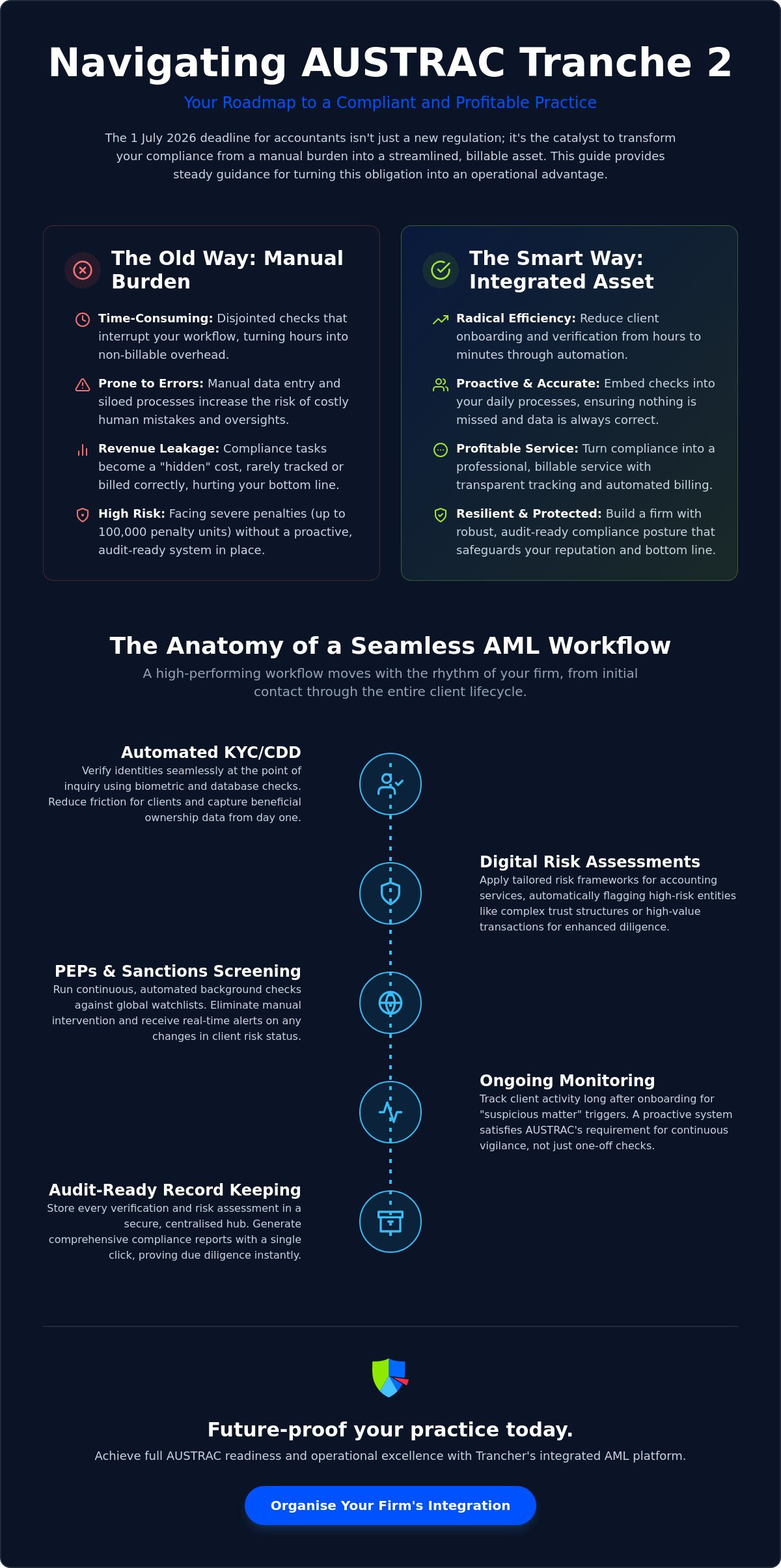
The Anatomy of a Seamless AML Workflow
A truly effective AML compliance workflow integration is more than just a digital checklist; it’s a cohesive sequence of events that begins the moment a prospect reaches out and continues throughout the entire client lifecycle. By breaking down the workflow into distinct, automated stages, your firm can maintain high professional standards without sacrificing billable hours. This structured approach ensures that no detail is overlooked, from the initial “hello” to the final audit report.
The standard architecture of a high-performing AML workflow includes five core pillars:
- Automated KYC: Verifying identities at the point of inquiry using biometric and database checks.
- Digital Risk Assessments: Applying frameworks specifically tailored to accounting services, such as evaluating the risks associated with trust structures or high-value transactions.
- PEPs and Sanctions Screening: Running continuous background checks against global watchlists without manual intervention.
- Ongoing Monitoring: Tracking client activity for “suspicious matter” triggers that may emerge well after onboarding.
- Audit-Ready Record Keeping: Storing every interaction and verification in a secure, centralised location that generates compliance reports at the click of a button.
Digital Onboarding and Initial CDD
First impressions matter. By using mobile-friendly verification tools, you reduce client friction, allowing them to complete identity checks in minutes from their own devices. This process is particularly vital for capturing beneficial ownership in complex trust and company structures. Your workflow should automatically flag high-risk entities for Enhanced Due Diligence (EDD), ensuring you focus your expertise where it’s needed most. Following the AUSTRAC guidance for accountants ensures your risk assessments are grounded in regulatory reality and best practice.
Ongoing Risk Monitoring and Reporting
Compliance doesn’t end once the engagement letter is signed. A robust AML compliance workflow integration sets up internal “triggers” for unusual transactions or changes in a client’s risk profile. If a suspicious matter arises, guided prompts help simplify the reporting process, ensuring you meet your legal obligations without the guesswork. For the firm principal, a live Compliance Dashboard provides a bird’s-eye view of the firm’s health, showing exactly who has been verified and where potential risks lie. Implementing these stages manually is a recipe for burnout, which is why many firms are turning to automated compliance platforms to handle the heavy lifting while maintaining a calm, organised practice.
Manual Processes vs. Automated Integration: A Commercial Comparison
For many Australian accounting firms, the decision to automate isn’t just about technology. It’s a fundamental commercial choice. When you rely on manual processes, a single client onboarding can easily consume up to 4 hours of administrative time. This includes chasing identity documents, manually checking PEP and sanctions lists, and filing paper records. By adopting a robust AML compliance workflow integration, that same process is condensed into approximately 15 minutes of automated activity. The efficiency gain isn’t just convenient; it’s transformative for your firm’s capacity.
Beyond the clock, there’s the hidden cost of “compliance fatigue.” When your professional team is bogged down by repetitive, low-value admin, morale and productivity suffer. Manual systems are also inherently vulnerable to human error. A missed box on a spreadsheet or an outdated screening result can lead to significant AUSTRAC penalties. Automation removes this friction by ensuring every check is performed with mathematical precision, every time. This shift also uncovers a significant revenue opportunity. Instead of viewing compliance as a non-billable overhead, integrated tracking allows you to treat these essential checks as a recoverable professional service, similar to any other specialised advisory work.
Addressing the “Administrative Burden” Objection
Many practice owners worry that new systems add complexity. In reality, integration gives time back to your senior accountants by removing them from the “paperwork loop.” For SME firms, this level of automation often eliminates the need to hire a dedicated, full-time AML officer, as the software handles the heavy lifting. Compliance ROI is the ratio of billable hours recovered to software cost. When you look at it through this lens, the investment in a streamlined AML compliance workflow integration pays for itself by freeing up your team to focus on high-value client advisory work.
The AUSTRAC Audit Trail: Peace of Mind
If AUSTRAC requests an independent review, “searchable” digital records are the gold standard. Relying on fragmented data scattered across emails, Excel sheets, and physical folders is a significant risk. Using the AML/CTF program starter kit provided by the regulator is an excellent first step for any practice. However, to truly future-proof your firm, you need a system that organises this information automatically. Trancher ensures your firm is “Audit-Ready” within 30 days, providing a steady hand and total transparency during regulatory inspections. This proactive approach replaces the stress of an audit with the calm confidence of a practice that’s already prepared.
5 Steps to Organise Your Firm’s AML Integration
Moving from a manual system to a digital one requires a methodical approach. It’s not about changing your entire practice overnight; it’s about layering efficiency into your existing habits. By following a structured five step plan, you can ensure that your AML compliance workflow integration is both thorough and sustainable. This process allows your team to adapt gradually while meeting every regulatory requirement with confidence.
- Step 1: Map your “Designated Services.” Identify which of your current offerings, such as company formations or large asset transfers, trigger AUSTRAC obligations.
- Step 2: Audit your data silos. Look at where client information currently lives, whether it’s in your PMS, scattered Excel sheets, or deep within email threads.
- Step 3: Select a strategic partner. Choose a platform that offers integrated compliance ROI tracking software to ensure your time is accounted for.
- Step 4: Roll out role-based training. Define exactly who handles verification and who manages risk escalations to avoid double-handling.
- Step 5: Launch a live pilot. Test the new workflow with a small group of new clients to refine the process before the full 2026 deadline.
Step 1: Identify Your Compliance Touchpoints
The journey begins the moment a prospect interacts with your firm. Whether they fill out a website form or make an initial phone call, these are your primary touchpoints. Integrating checks directly into your engagement letter process ensures that compliance isn’t an afterthought. By linking your AML compliance workflow integration to your billing system, you ensure that every minute spent on due diligence is captured. This transparency allows you to demonstrate value to your clients while protecting your firm’s profitability.
Step 4: Training Your Team for the 2026 Shift
Success depends on your team’s mindset. We need to move away from the idea that compliance is a nuisance and see it as a standard professional safeguard. Empowering junior staff to handle the bulk of digital verifications keeps your senior accountants focused on high-level advisory work. When “grey area” risk assessments arise, having access to expert support ensures you aren’t making critical decisions in a vacuum. This collaborative approach builds a resilient culture that’s ready for any regulatory change. To see how these steps work in practice, you can book a platform demonstration and explore the benefits of a guided integration.
Future-Proofing Your Practice with Trancher
As the July 2026 deadline approaches, the distinction between firms that struggle and those that thrive will depend on their choice of technology. Trancher is designed specifically to solve the “Tranche 2” headache for Australian SME accounting practices. We move beyond simple identity checks to provide a comprehensive AML compliance workflow integration that feels like a natural extension of your team. Our 30-Day Guarantee ensures your firm moves from zero to AUSTRAC-compliant in just one month, providing a steady hand during a period of significant regulatory change.
Beyond compliance software, a holistic approach to digital strategy is vital for long-term success. As Business Analysis & Solutions explains, establishing a strategic framework for 2026 allows firms to improve efficiency while meeting new sustainability and regulatory expectations.
One of the most common concerns for practice owners is the fear of compliance becoming a sunk cost. Trancher addresses this by providing detailed Revenue and ROI Reporting. You’ll be able to see the exact financial benefit of your compliance stack, tracking how much administrative time is saved and how those hours are successfully recovered as billable service fees. To ensure this fits your firm perfectly, we offer a 3-month complimentary trial. This allows you to test the full integration with zero risk, ensuring your processes are polished well before the mandatory compliance date.
Turning Compliance into an Advisory Service
Viewing AML data through a strategic lens allows you to offer deeper advice to your clients. When you understand the intricate beneficial ownership structures and risk profiles of your clients, you’re better positioned for complex tax planning and estate discussions. Communicating this value to your client base is essential. By positioning your firm as a trusted, compliant partner, you demonstrate a commitment to security that high-value clients appreciate—the same demographic that often values the remote exploration and community insights offered by Adventurerz. You aren’t just ticking a box; you’re protecting their interests in an increasingly regulated market.
Start Your 30-Day Readiness Journey
During the Trancher onboarding process, you’ll receive methodical guidance that respects your firm’s existing rhythm. We don’t just hand over a login; we provide access to local Australian support and expert guidance to help you navigate the nuances of the new framework. This proactive approach ensures that by the time July 2026 arrives, your firm isn’t just ready; it’s already leading the way. You can organise your complimentary 3-month trial and ROI report here to begin your transition with confidence and clarity.
Secure Your Practice and Your Bottom Line
The transition to AUSTRAC’s Tranche 2 framework doesn’t have to be a source of anxiety for your team. By implementing a robust AML compliance workflow integration, you transform a complex regulatory requirement into a streamlined professional asset. You’ve seen how moving from manual admin to automated systems can save hours of non-billable time, ensuring your firm remains both audit-ready and profitable well before the 1 July 2026 deadline.
Now is the time to act with confidence. We provide the steady guidance and technical expertise needed to make this transition seamless. With our 30-Day Compliance Guarantee, local Australian expert support, and detailed ROI and efficiency reporting, you’ll never have to navigate these changes alone. It’s about building a resilient, future-proof practice that your clients can trust. We’re here to help you turn compliance into a strategic advantage.
Start your complimentary 3-month Trancher trial today to begin your journey toward operational ease and regulatory readiness.
Frequently Asked Questions
What is the deadline for Tranche 2 AML compliance in Australia?
The mandatory deadline for Tranche 2 AML compliance is 1 July 2026. Enrolment with AUSTRAC for newly regulated entities opened on 31 March 2026, and firms must notify the regulator of their appointed compliance officer by 29 July 2026. Being proactive now ensures your systems are fully tested and operational before these regulatory requirements become enforceable.
Can I integrate AML checks into my existing Xero or MYOB workflow?
Yes, you can connect AML checks to your existing accounting software through platform integrations. While Xero or MYOB manage your books, a dedicated AML hub acts as the “source of truth” for compliance. This integration ensures data flows effortlessly between your client list and your risk assessments, removing the need for double data entry and reducing the risk of human error.
How much does it cost to implement an AML compliance workflow?
Implementation costs generally vary depending on the size of your firm and the level of automation required. Rather than viewing it as a flat expense, it’s more helpful to consider the return on investment. By automating manual admin, you recover billable hours that would otherwise be lost to non-billable paperwork. This makes the transition a financially sustainable move for most practices.
Do I need to hire a full-time AML officer for my small accounting firm?
Small firms typically don’t need a dedicated, full-time AML officer. By using an AML compliance workflow integration, the administrative heavy lifting is handled by the software. This allows your existing team to manage the program effectively. You can also access expert support for complex risk assessments, ensuring you have steady guidance without the overhead of an additional full-time salary.
What happens if my firm is not compliant by July 2026?
Failing to meet the July 2026 deadline exposes your firm to significant civil penalties. The Federal Court can impose fines of up to 100,000 penalty units for corporate bodies and 20,000 for individuals. Beyond financial costs, non-compliance carries a heavy reputational risk. Being proactive ensures you protect your practice’s standing as a trusted partner in the Australian financial landscape.
How does an integrated workflow help with AUSTRAC reporting?
An integrated workflow simplifies AUSTRAC reporting by maintaining clear, time-stamped audit trails for every client. If a “suspicious matter” trigger occurs, the system provides guided prompts to help you complete the report accurately. This level of AML compliance workflow integration replaces the stress of manual record-keeping with a reliable, searchable digital history that’s ready for independent review at any time.
Is it possible to charge clients for AML compliance activities?
It is absolutely possible and increasingly common to charge clients for compliance activities. Many firms choose to pass on the cost of verification as a professional service fee or a recovery charge. Since these checks are now a mandatory part of providing “designated services,” clients generally understand the necessity. Automated tracking helps you justify and bill for this work transparently.
What is the difference between KYC and a full AML workflow?
KYC, or Know Your Customer, is simply the initial step of verifying a client’s identity. A full AML workflow is much broader. It includes the initial KYC check, but also encompasses ongoing risk assessments, PEP and sanctions screening, transaction monitoring, and regulatory reporting. A complete workflow ensures you are managing the entire client lifecycle, not just the front-door entry.