

What if the ownership chart in a client file shows the structure, but not why your firm concluded that a particular person ultimately owns or controls the entity? Learning how to document beneficial ownership means linking each conclusion to the evidence behind it, especially when ownership runs through companies, trusts and individuals.
These records can be difficult to follow when information is captured differently across files or supporting documents are stored separately from the assessment. A consistent record helps another team member review the reasoning, identify gaps and see what needs follow-up.
This guide sets out a practical way to map ownership, link evidence, record analysis and plan review. Structured workflows can help organise the information, while your team remains responsible for applying professional judgement.
Key Takeaways
- A useful ownership record shows who ultimately owns or controls an entity and how the firm reached that conclusion.
- Learn how to document beneficial ownership by mapping ownership, linking evidence, recording analysis and assigning follow-up.
- For layered company and trust structures, show each link clearly and separate supported conclusions from assumptions or unresolved gaps.
- Dates, source references, decisions and firm-defined review prompts help make records easier to revisit and understand.
- Structured workflows can support consistent evidence capture and record keeping, while your team retains responsibility for professional judgement.
What beneficial ownership documentation should show in an Australian client file
For Australian accounting firms, beneficial ownership is a practical part of AML/CTF client work. Tranche 2 obligations commenced on 1 July 2026, bringing accounting firms providing designated services within the expanded regime. A useful client-file record should help a reviewer understand who the firm considers ultimately owns or controls the client entity, and what information supports that assessment.
In plain English, identifying beneficial ownership means looking beyond the company, trust or other entity named as the client to the individuals who ultimately own or control it. The global concept distinguishes the person who benefits from or controls an arrangement from the legal owner recorded on paper. Beneficial ownership is a helpful starting point. For Australian requirements and terminology, refer to current AUSTRAC guidance.
Beneficial ownership and control in plain English
Direct ownership is a visible link: an individual holds an interest in the client entity in their own name. Indirect ownership runs through one or more entities, so the individual may sit further up the chain and not appear in the client’s immediate ownership records.
Control is related to ownership, but the two are not always the same. An individual may influence or direct an entity without holding a direct interest in it. Consider ownership and control separately, and don’t treat a percentage threshold as a substitute for understanding the structure.
Why the reasoning belongs in the record
A conclusion such as “Person A is the beneficial owner” is difficult to review if the file does not explain what supports it. An identity document may help establish who a person is, but it does not, on its own, show their connection to the client entity.
Think of the file as a reasoned account, not a bundle of copied documents. A practical record can identify the entity assessed, the ownership and control links considered, the sources reviewed, the firm’s analysis and any uncertainty or follow-up. These are useful documentation practices, not a statement that AUSTRAC prescribes this exact sequence or set of fields. Check current AUSTRAC guidance for specific legal requirements.
In brief: A beneficial ownership record links evidence of ownership, analysis of control and the firm’s documented reasoning.
This connection helps another team member follow, question or update the assessment. It also makes it easier to distinguish what the available information supports from what remains unclear, rather than presenting an assumption as fact.
How to document beneficial ownership step by step
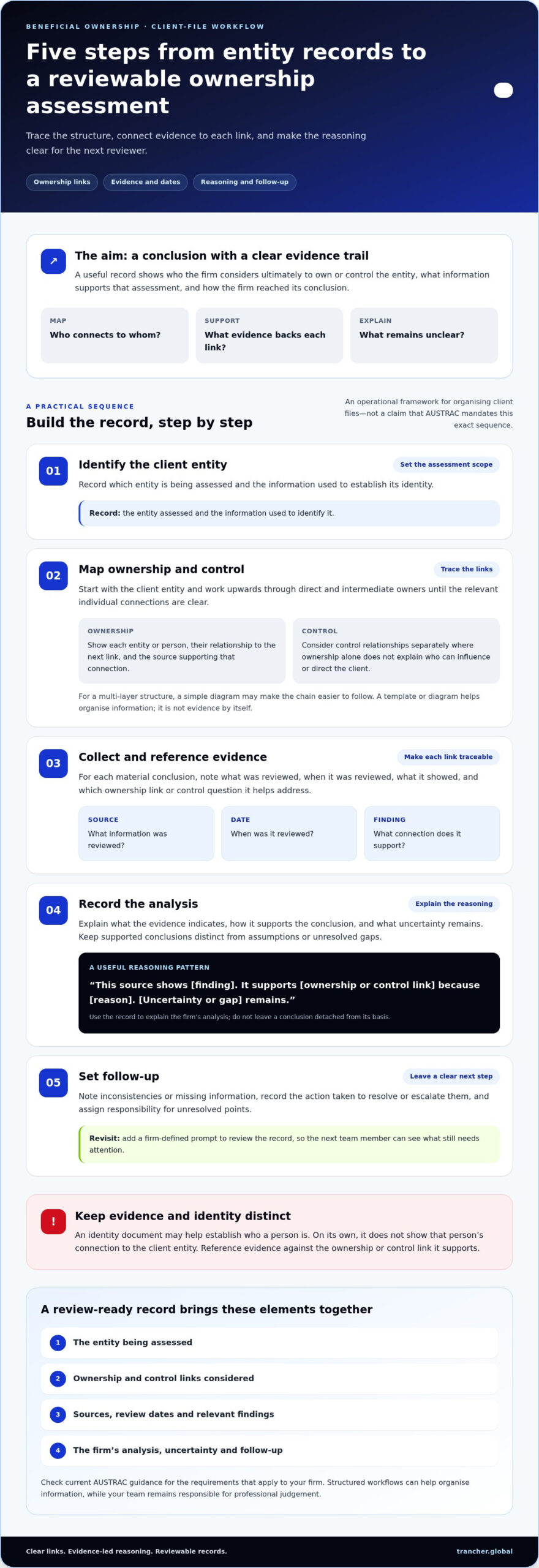
A repeatable process helps staff move from an entity’s records to a clear assessment linked to evidence. Use the sequence below as an operational framework for organising client files, not as a claim that AUSTRAC mandates these exact steps. Check current AUSTRAC guidance for the requirements that apply to your firm.
- Identify the client entity. Record which entity is being assessed and the information used to establish its identity.
- Map ownership and control. Trace direct and intermediate ownership links, then consider relevant control relationships separately.
- Collect and reference evidence. Note the source and date, and specify which ownership link or control question it helps address.
- Record the analysis. Explain what the evidence indicates, how it supports the conclusion and what uncertainty remains.
- Set follow-up. Assign an action for unresolved points and add a firm-defined prompt to revisit the record.
Map the ownership and control chain
Start with the client entity and work upwards through each direct and intermediate owner until the relevant individual connections are clear. A table can list each entity or person, their relationship to the next link and the source supporting that connection. For a multi-layer structure, a simple diagram may make the chain easier to follow. Show control relationships separately where ownership alone does not explain who can influence or direct the client.
For broader context on customer due diligence, refer to the guide to CDD and KYC requirements in Australia. Keep the ownership map specific to the client’s actual structure. A template or diagram helps organise information, but is not evidence by itself.
Connect evidence to the conclusion
Make each material conclusion traceable. Record what was reviewed, when it was reviewed, what it showed and how the staff member interpreted it. For example, if a company record identifies an intermediate entity as a shareholder, reference that record against the relevant link in the map. Then document what further information supports the next step in the chain.
Note inconsistencies, missing information and the action taken to resolve or escalate them. If the evidence does not support a firm conclusion, state what remains unclear and who is responsible for follow-up. This gives the next reviewer a useful account of the assessment, rather than a conclusion detached from its basis.
Evidence-linked record: “The record identifies the source, date and finding, then explains how that information supports the ownership or control conclusion.”
Structured client verification and due diligence workflows can help teams capture these details consistently. Explore Trancher’s compliance workflows to see how evidence, decisions and follow-up can be organised together while your team retains professional judgement.
How to document beneficial ownership in complex companies and trusts
Complex structures call for clear mapping, not unsupported assumptions. A layered chart can help your team see where the evidence leads, where a conclusion depends on analysis and where more information is needed. Keep those categories distinct, and check current AUSTRAC guidance before applying a specific ownership threshold, control test or trust-role rule.
Consider this illustrative example: Client Co’s records identify Holding Co as its owner. Holding Co’s records show an interest held through another company, while a trust deed refers to a trust connected with that intermediate entity. The file should trace each link in sequence, rather than jumping from Client Co to an individual based on a summary or assumption.
Trace layered company ownership without losing the chain
Record each entity and relationship in order: Client Co to Holding Co, Holding Co to the intermediate company, then the documented connection to the trust. For every link, reference the material reviewed and what it supports. A company extract might support one ownership connection, while another record may be needed to explain the next. A diagram or table can make the chain readable, but it should point back to the supporting sources.
If a link is not yet supported, mark it as unresolved. Note what information is missing, what steps have been taken and whether the matter needs follow-up or escalation. Do not fill a gap by treating an unverified connection as fact.
Record trust-related information carefully
For the trust in this example, record its identity and the parties or relationships evidenced by the material reviewed, such as the trust deed. Separate those documented facts from the firm’s analysis of ownership or control. A person’s appearance in a document or stated role does not, by itself, explain the full nature of their connection to the client.
Make clear what is known, what the evidence may indicate and what remains an open question. For instance, the deed may identify a trustee, while the available material does not resolve who ultimately controls the client through the wider structure. Record that limitation and the next action, rather than drawing a definitive conclusion from incomplete information.
That distinction is central to how to document beneficial ownership in complicated arrangements: make each step from source to conclusion visible, and label uncertainty plainly. For a focused discussion of trust structures, continue with the guide on beneficial ownership in complex trusts.
How to keep beneficial ownership records reviewable and current
An ownership assessment is easier to rely on when another staff member can follow its history without rebuilding the file from scratch. Keep dates, source references, findings, decisions and follow-up actions connected to the relevant ownership or control conclusion. This makes the record easier to understand and update when information changes.
Make each ownership conclusion traceable
For each conclusion, link the evidence reviewed to the relevant finding and explain how that finding informed the assessment. Include when the source was reviewed, who completed the assessment and who reviewed it, in line with your firm’s documented process. If information conflicts, record the discrepancy and any escalation outcome. Be precise about what the outcome establishes and what it does not.
A focused reference to the wider audit-ready compliance records guide can help connect ownership-file practices with your firm’s broader record-management approach.
Revisit the record when circumstances change
Set firm-defined workflow prompts for situations that may call for reassessment. These could include receiving updated ownership information, learning that an entity or relationship has changed, or obtaining new evidence that affects an earlier conclusion. Treat these as prompts for your own process, not mandatory review intervals unless current requirements confirm that.
When you update the file, preserve the earlier assessment and add a dated account of what changed, what was reconsidered and why the conclusion was retained or revised. For example, if a client provides an updated ownership chart, note whether it is consistent with the evidence already held, whether any link needs further support and what action follows. This creates a useful history instead of leaving reviewers to guess why the file now says something different.
A reviewable ownership record preserves the evidence, decision and reason for each update, so the assessment can be followed over time.
Make the process practical by defining who owns follow-up, where updates are recorded and how completed actions are reflected in the file. Consistent client verification and record-keeping workflows can help your team capture changes alongside the evidence and decisions they affect. Build a more consistent compliance record workflow with Trancher’s structured tools, while keeping professional judgement with your team.
Build a consistent beneficial ownership workflow with Trancher
A clear file method is more useful when it works consistently across the firm. Trancher supports Australian accounting firms with structured client verification and due diligence workflows to help teams capture ownership information, supporting evidence and assessment notes in an organised way. Consistent records can make files easier to review and reduce the need to piece together information from separate sources.
Turn individual file steps into a firm-wide process
Build beneficial ownership documentation into the wider client due diligence process. Staff can follow a consistent path from collecting client information to recording ownership links, evidence and relevant risk assessment details. If further information or review is needed, the workflow can keep the follow-up visible alongside the client record.
This approach supports consistency without assuming every client structure is the same. A straightforward ownership chain and a layered company or trust structure may need different analysis. A platform can organise evidence and record the steps taken, but it does not independently determine or verify beneficial ownership. Your team remains responsible for evaluating the information and applying professional judgement.
Move from documentation to operational readiness
Connected workflows for verification, due diligence, risk assessment, monitoring and record keeping can reduce fragmented manual administration. They also give a firm a clearer view of how client information and ownership assessments fit into its broader AML/CTF processes. Trancher’s platform supports these workflows and record keeping. It does not replace professional judgement or legal advice, and using it does not guarantee a particular regulatory outcome.
For firms establishing a consistent process, how to document beneficial ownership is part of a wider operational question: can staff capture the information, explain the assessment and keep the record useful as circumstances change? Structured workflows can support that readiness, with local Australian onboarding and support to help with practical implementation.
Explore Trancher’s AML/CTF workflows and start a conversation about practical compliance readiness for your firm. Discuss your firm’s AML/CTF readiness.
Make ownership records part of a consistent workflow
A reliable beneficial ownership record does more than name an individual. It connects ownership and control analysis to the evidence reviewed, explains the reasoning behind the assessment, and makes gaps or follow-up actions visible. For complex company and trust structures, clear mapping helps your team distinguish supported facts from analysis and unresolved questions.
Building a repeatable approach to how to document beneficial ownership can make client files easier to review and keep current. Structured AML/CTF workflows and audit-ready record keeping can bring evidence, decisions and follow-up together, while professional judgement remains with your team.
Trancher provides dedicated onboarding and local Australian support to help firms put practical workflows in place. It also offers a 30-day AML/CTF compliance guarantee. This does not constitute legal representation or a promise of a particular regulatory outcome.
Start a conversation about building a consistent AML/CTF workflow and take a steady, practical step towards stronger operational readiness.
Frequently Asked Questions
What is beneficial ownership?
Beneficial ownership concerns the individual or individuals who ultimately own or control an entity or arrangement. A useful client record explains how your firm reached its understanding, rather than stopping at the name of an immediate company owner. The legal definition and applicable tests depend on current requirements. Check AUSTRAC guidance before describing a particular test as mandatory, especially where ownership and control may involve different people.
How do you document beneficial ownership?
Start by identifying the client entity, then map the ownership and control chain using the information available. To understand how to document beneficial ownership in practice, connect each conclusion to the evidence reviewed, the link it supports and your reasoning. Note unresolved gaps and follow-up actions. Treat this as a practical documentation method, not a complete statement of legal requirements, and check current AUSTRAC guidance for the obligations relevant to your firm and designated services.
What evidence can support a beneficial ownership record?
Evidence should support the ownership or control links recorded in the client file. Depending on the structure and applicable requirements, relevant material may include company or trust documents and information gathered during due diligence. Record what you reviewed, when you reviewed it and what it establishes. No single document type should be treated as universally sufficient. Check current AUSTRAC expectations and clearly note any limitations, inconsistencies or missing information.
How should an accountant document beneficial ownership in a trust structure?
Map the trust and relevant ownership or control relationships so another reviewer can follow the assessment. Identify the evidence supporting each recorded relationship, then separate verified information from your analysis and any unresolved questions. Trust arrangements differ, so do not assume a particular role automatically determines beneficial ownership. Check current Australian requirements for the circumstances and document why the available information supports your conclusion, or what further action is needed.
Do accounting firms need to verify beneficial ownership under Tranche 2?
Whether an accounting firm has AML/CTF obligations depends on its activities and whether it provides a designated service. Tranche 2 obligations commenced on 1 July 2026, but this does not mean every accounting service is subject to identical requirements. Check current AUSTRAC guidance against your firm’s services and circumstances before stating that a particular verification step is legally required. Record the basis for your assessment of which obligations apply.
How often should beneficial ownership information be reviewed?
Do not assume one review interval applies to every client or structure. Establish a documented firm process for responding to changed information, inconsistencies and relevant risk developments, then record what was reviewed and why. Check current AUSTRAC guidance for any legally required timing that applies to your circumstances. If your understanding of ownership changes, preserve a traceable history showing what prompted the reassessment and how you reached the updated conclusion.
What should a firm do if it cannot identify the beneficial owner?
Record the steps taken, the information available, the specific gap and any follow-up or escalation. Do not fill an evidence gap with an unsupported assumption or present an uncertain conclusion as verified. The appropriate next step depends on the circumstances and current requirements. Consult applicable AUSTRAC guidance and follow your firm’s documented procedures, making sure the client file shows what remains unresolved and who is responsible for the next action.