

What if your next AML CTF independent audit preparation wasn’t a source of dread, but a genuine opportunity to strengthen your firm’s compliance foundations and sharpen your competitive edge? It’s a reframe that might feel counterintuitive right now, especially if you’re staring down a compliance deadline with more questions than answers.
You’re not alone in feeling that way. Many Australian accounting firms are grappling with the same uncertainty: What exactly does an independent evaluator expect to see? Are your records audit-ready? And where do you even begin when the regulatory landscape feels this complex? These are fair concerns, and they deserve clear, practical answers.
This guide is here to provide exactly that. You’ll walk away with a confident understanding of the key preparation steps, a clearer picture of what independent evaluators assess, and actionable strategies to streamline the entire process. Whether you’re approaching your first audit under AUSTRAC’s expanded tranche 2 obligations or refining an existing compliance programme, what follows gives you a structured, reassuring roadmap to get there with confidence.
Key Takeaways
- Thorough AML CTF independent audit preparation requires a clear understanding of what AUSTRAC’s independent evaluators are actually looking for – and this guide breaks that down into practical, manageable steps.
- A structured self-assessment and well-organised documentation are the twin pillars of audit readiness, and knowing exactly what to gather in advance can make the difference between a smooth evaluation and a stressful one.
- Real-world examples from Australian accounting firms reveal that the firms who navigate independent audits most successfully are those who treat compliance as an ongoing operational discipline rather than a last-minute exercise.
- Embedding AML CTF compliance into your firm’s daily workflows transforms audit readiness from a periodic scramble into a seamless, business-as-usual standard – one that also strengthens your firm’s professional reputation.
- A focused final-preparations checklist and confirmed evaluator engagement are the critical last steps that separate firms who feel confident on audit day from those who don’t.
Understanding Independent AML CTF Audits: What You Need to Know
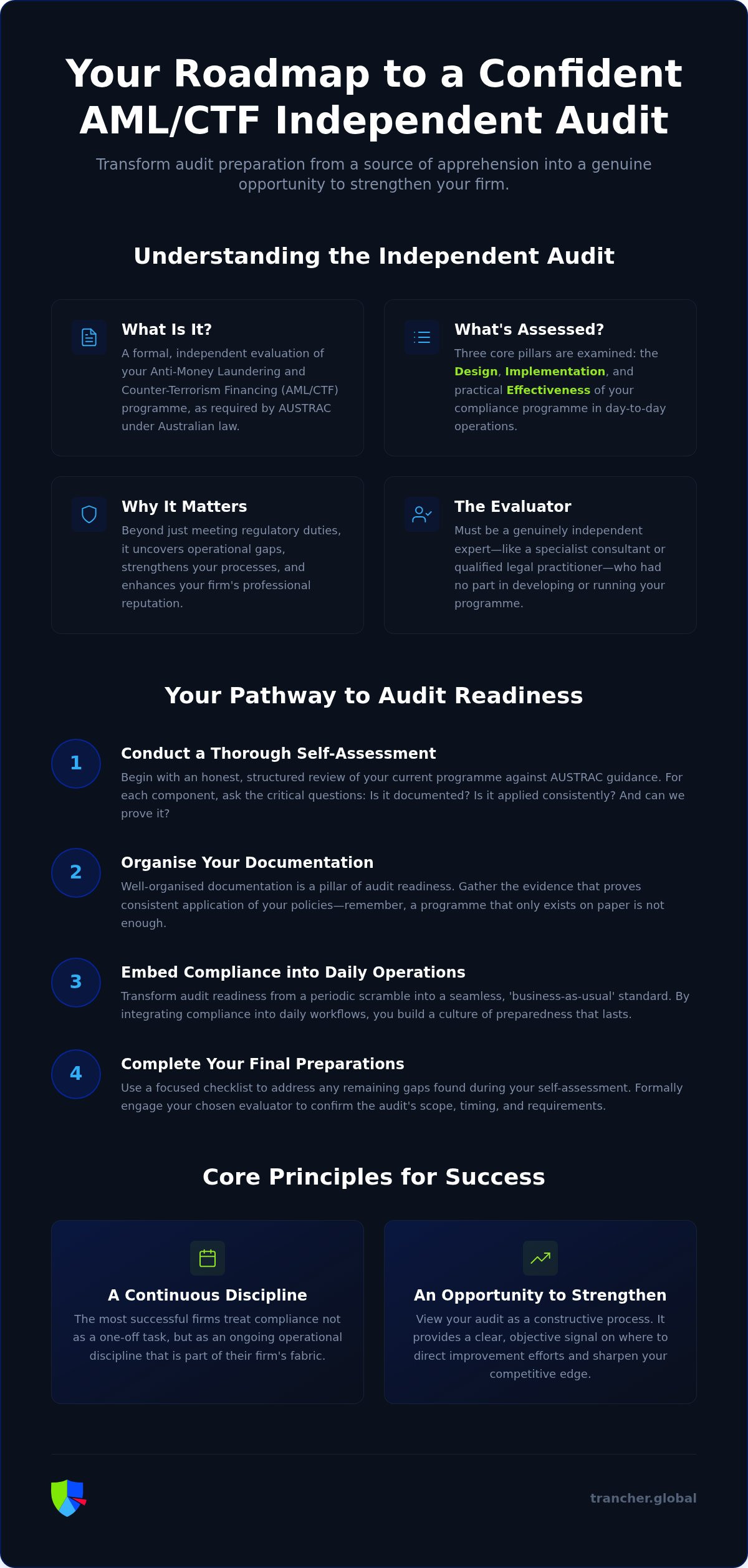
An independent AML CTF audit is a formal evaluation of your firm’s anti-money laundering and counter-terrorism financing programme, conducted by a qualified external party who has no operational involvement in your compliance activities. Under Australia’s Anti-Money Laundering and Counter-Terrorism Financing Act 2006, AUSTRAC requires reporting entities to periodically assess whether their AML CTF programme is operating effectively and meeting all regulatory obligations. For accounting firms now captured under tranche 2 reforms, understanding this requirement isn’t optional. It’s foundational.
The evaluation examines three core areas: whether your AML CTF programme is appropriately designed for your firm’s risk profile, whether it’s being implemented as intended, and whether it’s actually effective in practice. That last point is where many firms are caught off guard. A programme that looks good on paper but isn’t consistently applied in day-to-day operations will not satisfy an independent evaluator.
On frequency, AUSTRAC’s guidance indicates that independent evaluations should be conducted periodically and must reflect the size, nature, and complexity of your business. There’s no single fixed interval that applies universally, which is why risk-based judgement plays a central role in determining your audit schedule.
Why Independent Audits Matter for Your Firm
Beyond regulatory compliance, independent audits surface operational gaps that internal reviews often miss. An external evaluator brings objectivity that internal teams simply can’t replicate. They identify inconsistencies in customer due diligence records, weaknesses in transaction monitoring processes, and documentation shortfalls before AUSTRAC does. Firms that embrace this process tend to emerge with sharper, more defensible compliance frameworks.
Who Qualifies as an Independent Evaluator
Your evaluator must be genuinely independent, meaning they cannot have been involved in developing or implementing the programme being assessed. They should hold demonstrable expertise in AML CTF compliance within the Australian regulatory context. This might be a specialist compliance consultant, a qualified legal practitioner with relevant expertise, or an experienced compliance professional external to your firm. Choosing the right evaluator is not a formality; it directly shapes the quality and credibility of your audit outcome.
Preparing for Your First Independent Audit
Solid AML CTF independent audit preparation starts well before the evaluator arrives. Begin by reviewing your existing programme documentation, identifying any gaps between your written policies and actual practice, and ensuring your records are organised and accessible. Common pitfalls include underestimating how much documentation is required and assuming that having a programme in place is sufficient without evidence of consistent application. Set realistic expectations: a first audit may surface findings, and that’s a constructive outcome, not a failure. It’s a clear signal of where to direct your improvement efforts.
Essential Steps in Preparing for an Independent Audit
Preparation is everything. Firms that approach AML CTF independent audit preparation systematically, rather than reactively, consistently achieve stronger outcomes and experience far less disruption to their day-to-day operations. The steps below give you a structured path forward, beginning well before your evaluator’s first request lands in your inbox.
Conducting a Compliance Self-Assessment
Start by taking an honest, structured look at where your programme currently stands. A self-assessment isn’t about finding reasons to be concerned; it’s about generating clarity. Work through your AML CTF programme against AUSTRAC’s published compliance guide for reporting entities, using it as your primary benchmark. Ask three questions for each component: Is this documented? Is it being applied consistently? Can we prove it?
Effective self-assessment tools include internal gap analysis templates mapped to AUSTRAC’s requirements, risk-based reviews of your customer due diligence processes, and a line-by-line comparison of your written policies against actual staff practice. Where discrepancies surface, document them. Identified gaps addressed before an evaluation carry far more weight than gaps discovered during one.
Preparing Documentation and Record Keeping
Your evaluator will want to see evidence, not intentions. The documents you’ll need to have organised and readily accessible include:
- Your AML CTF programme, including both Part A (risk assessment) and Part B (customer due diligence procedures)
- Customer identification and verification records, demonstrating consistent application of your KYC and CDD processes
- Transaction monitoring logs and records of any suspicious matter reports lodged with AUSTRAC
- Staff training records, including dates, content covered, and attendance
- Board or senior management sign-off on programme reviews and updates
- Records of previous independent evaluations and any remediation actions taken
The most common documentation failure isn’t missing records; it’s records that exist but can’t be retrieved quickly. Audit-ready record keeping means your files are organised, version-controlled, and searchable before the evaluator asks. Platforms like Trancher’s audit-ready documentation system are designed specifically for this purpose, giving accounting firms a centralised, structured environment where compliance records are maintained in a format that’s immediately accessible when it matters most.
Building Your Preparation Timeline
Engage your independent evaluator early, ideally several months before your target audit date. This gives you time to address self-assessment findings, gather outstanding documentation, and brief your team without pressure. Assign clear internal responsibilities, set milestone dates for each preparation stage, and build in a review buffer before the evaluation begins. A realistic timeline transforms what can feel like an overwhelming undertaking into a series of manageable, sequential tasks.
Brief your staff clearly on their roles during the audit process. They should understand what questions they may be asked, where to direct evaluator requests, and how to present records calmly and accurately. Confidence in your team reflects the strength of your programme.
Case Studies: Successful Independent Audit Preparation
Theory is useful. Real-world experience is better. Examining how Australian accounting firms have actually navigated AML CTF independent audit preparation reveals patterns that no checklist alone can capture. The firms that come out strongest share a common thread: they treated the audit process as a diagnostic tool rather than a compliance hurdle to clear.
Learning from Success Stories
Consider a mid-sized accounting firm that had recently come under tranche 2 obligations. Rather than waiting for an evaluator’s request to surface gaps, the firm’s compliance lead initiated an internal programme review six months ahead of the scheduled audit. They mapped every client-facing process against their documented procedures and discovered that customer due diligence records for several long-standing clients were incomplete. Critically, they fixed those gaps before the evaluator arrived. The result was a clean audit outcome with only minor recommendations, and the firm’s senior management credited the early self-assessment as the single most valuable preparation step they took.
A similar story emerged from a boutique advisory practice operating across multiple states. Their team had historically managed compliance reactively, updating policies when issues arose rather than on a structured cycle. Ahead of their independent evaluation, they introduced a quarterly programme review schedule, assigned clear ownership to each compliance function, and centralised their documentation so records were retrievable within minutes. The evaluator noted the firm’s organised record-keeping as a standout feature of the assessment. What changed wasn’t the volume of their compliance activity; it was the discipline around maintaining and evidencing it.
The consistent lesson across these experiences is straightforward: proactive measures don’t just improve audit outcomes, they reduce the internal stress that comes with scrambling at the last minute. Firms that build continuous improvement into their compliance programmes, rather than treating audits as isolated events, find that each subsequent evaluation becomes progressively smoother.
Addressing Common Challenges Faced
The most frequently reported obstacle isn’t a lack of compliance activity; it’s a lack of visibility across the team. Staff often don’t know what records exist, where they’re stored, or who’s responsible for maintaining them. That ambiguity creates friction precisely when clarity is most needed.
Firms that navigated this well did three things consistently:
- Assigned a single internal point of contact to coordinate all evaluator requests and manage document retrieval
- Held structured briefing sessions with staff before the audit commenced, so everyone understood their role and knew how to respond calmly to evaluator questions
- Used a centralised compliance platform to maintain audit-ready documentation, removing the guesswork from record retrieval entirely
Collaboration was the defining factor. Firms where compliance was treated as one person’s responsibility consistently reported higher stress levels and more findings during evaluations. Those where the whole team understood the firm’s AML CTF obligations, even at a basic level, presented a far more cohesive picture to evaluators. That cohesion doesn’t happen by accident; it’s built through regular communication, clear role definitions, and the right operational infrastructure to support it.
Integrating Compliance into Daily Operations: Creating Audit Readiness
The firms that find AML CTF independent audit preparation least stressful aren’t the ones who work harder in the weeks before an evaluation. They’re the ones who’ve stopped treating compliance as a separate activity altogether. When AML CTF obligations are woven into the fabric of how your firm operates day to day, audit readiness stops being a destination you rush toward and becomes a condition you’re already in.
The shift is more achievable than it sounds. It starts with identifying the natural touchpoints in your existing workflows where compliance activity already occurs, and then formalising those moments so they generate the records and evidence an evaluator expects to see. Client onboarding, periodic file reviews, transaction assessments: these processes are already happening. The question is whether they’re happening in a way that’s documented, consistent, and retrievable.
Building a Compliance-Focused Culture
Compliance culture isn’t built through policy documents. It’s built through people. When staff understand why AML CTF obligations exist and how their individual roles contribute to meeting them, they stop seeing compliance as an administrative imposition and start treating it as a professional standard.
Three practices make the biggest practical difference here:
- Regular, role-specific training that goes beyond a once-a-year tick-box exercise. Short, focused sessions tied to real scenarios your team actually encounters are far more effective than lengthy generic modules.
- Clear communication channels for compliance updates, so staff aren’t left guessing when AUSTRAC guidance shifts or internal procedures change. A designated internal contact for compliance questions removes the ambiguity that leads to inconsistent practice.
- Visible leadership engagement with compliance responsibilities. When senior staff treat AML CTF obligations seriously, the rest of the team follows. That tone from the top is one of the most powerful culture-shaping tools available to any firm.
Firms that invest in staff engagement consistently present more cohesively during independent evaluations. Evaluators notice when a team is confident and informed, and that confidence reflects directly on the credibility of your programme.
Leveraging Technology for Efficiency
Manual compliance processes create friction, and friction creates gaps. When documentation is scattered across email threads, shared drives, and individual desktops, the risk of something being missed, misfiled, or simply irretrievable under pressure is real.
Purpose-built compliance technology removes that friction systematically. Trancher’s platform is designed specifically for Australian accounting firms, providing a centralised environment where client verification, ongoing risk monitoring, and audit-ready documentation are managed within a single, structured system. Automated tools handle documentation and reporting workflows that would otherwise consume significant staff time, and the platform integrates with existing firm systems so adoption doesn’t require rebuilding your operations from scratch.
The practical outcome is straightforward: when an evaluator requests records, your team isn’t searching. Everything is organised, version-controlled, and immediately accessible. That operational clarity is itself evidence of a well-governed compliance programme.
Embedding compliance into your daily operations is one of the most effective investments your firm can make, both for audit readiness and for long-term professional credibility. Explore how Trancher’s compliance platform supports accounting firms in maintaining ongoing audit readiness without adding operational burden.
Next Steps: Final Preparations for Your Audit
You’ve done the groundwork. Your programme is documented, your team is engaged, and your records are organised. What remains is the final stretch of your AML CTF independent audit preparation: the targeted actions that convert solid preparation into genuine confidence on audit day.
Final Checklist Items
In the weeks immediately before your evaluation, run a structured final review against AUSTRAC’s compliance requirements. Don’t rely on memory. Work through each component systematically:
- Verify your AML CTF programme documentation is current, signed off by senior management, and reflects your firm’s actual risk profile as it stands today, not as it was twelve months ago
- Confirm all customer identification and verification records are complete, consistently applied across your client base, and retrievable without delay
- Check that transaction monitoring logs and any suspicious matter reports are accurate, up to date, and properly filed
- Review staff training records to ensure they reflect recent sessions and cover the obligations most relevant to your team’s roles
- Conduct a final self-assessment pass focused specifically on the gaps identified in your earlier review, confirming each remediation action has been completed and evidenced
Confirm your evaluator engagement well before audit day. Agree on the scope in writing, clarify which documents they’ll need in advance, and establish a single internal point of contact to manage all incoming requests. Ambiguity at this stage creates unnecessary friction.
Preparing for the Audit Day
Audit day is rarely dramatic when preparation has been thorough. Your evaluator will typically begin with a programme walkthrough, then move to document review, and may conduct brief interviews with key staff. Brief your team clearly beforehand: they should know what questions to expect, where records are stored, and who to direct specific requests to. Calm, informed responses tell an evaluator far more about your programme’s strength than polished answers under pressure.
Maintain open, professional communication with your evaluator throughout. If a question surfaces something unexpected, don’t speculate. Acknowledge it, commit to clarifying the record, and follow through promptly. Evaluators respond well to transparency. It’s a sign of a mature compliance culture, not a weakness.
Firms that treat audit day as a collaborative process rather than an interrogation consistently report smoother outcomes. That mindset is itself a product of genuine preparation, and it’s entirely within reach when your operational infrastructure supports it. Discover how Trancher’s audit-ready documentation and compliance platform helps Australian accounting firms stay prepared year-round, so that when your evaluator arrives, you’re already ready.
Strengthening Your Firm’s Compliance Foundation
Success in your next evaluation depends on shifting from reactive scrambling to proactive, daily discipline. By conducting thorough self-assessments and centralising your documentation, you ensure that audit readiness is a constant state rather than a periodic hurdle. This structured approach doesn’t just satisfy AUSTRAC; it builds a more resilient and professional practice that’s ready for any regulatory shift.
You don’t have to manage these complexities alone. Trancher acts as your expert partner, providing end-to-end AML/CTF programme management and dedicated local support to guide you through every step of AML CTF independent audit preparation. We stand by our 30-day compliance guarantee, ensuring your firm meets its obligations with absolute confidence and minimal operational friction. When your systems are integrated and your team is informed, compliance becomes a source of strength rather than a source of stress.
Start your journey towards compliance readiness with Trancher today!
Take the next step toward a more secure and efficient future for your firm. You’ve got the expertise, and we’ve got the steady guidance to help you succeed.
Frequently Asked Questions About AML CTF Independent Audit Preparation
What is an independent AML CTF audit and why is it important?
An independent AML CTF audit is a formal, external evaluation of your firm’s anti-money laundering and counter-terrorism financing programme, conducted by a qualified party with no involvement in your compliance operations. It assesses whether your programme is appropriately designed, consistently implemented, and genuinely effective in practice. For Australian accounting firms under AUSTRAC’s tranche 2 reforms, it’s a regulatory requirement, not an optional exercise.
Beyond compliance, the audit delivers real operational value. An objective external review surfaces gaps that internal teams routinely overlook, giving your firm a clear, actionable picture of where your programme is strong and where it needs attention before AUSTRAC identifies the same issues itself.
How often should I conduct independent audits for my AML CTF programme?
AUSTRAC doesn’t prescribe a fixed interval that applies universally. Instead, your audit frequency should reflect the size, nature, and complexity of your firm’s operations and risk profile. A boutique practice with a narrow, low-risk client base may assess less frequently than a larger firm offering a broader range of designated services to higher-risk client segments.
The practical guidance is to build your audit schedule around a genuine risk-based assessment rather than defaulting to an arbitrary annual cycle. Document your reasoning for the frequency you choose; that rationale itself forms part of a defensible, well-governed compliance programme.
Who can perform an independent evaluation of my AML CTF programme?
Your evaluator must be genuinely independent, meaning they can’t have had any involvement in designing, implementing, or operating the programme they’re assessing. Beyond that core requirement, they should hold demonstrable expertise in AML CTF compliance within the Australian regulatory context. Suitable candidates include specialist compliance consultants, qualified legal practitioners with relevant AML experience, or experienced compliance professionals external to your firm.
Choosing the right evaluator matters more than many firms initially appreciate. The quality and credibility of your audit outcome is directly shaped by the expertise your evaluator brings. Don’t treat this selection as a formality; assess their track record and their familiarity with AUSTRAC’s expectations for firms in your sector.
What documents are needed for an independent audit?
Thorough AML CTF independent audit preparation requires you to have several categories of documentation organised and readily retrievable. These include your full AML CTF programme (both Part A risk assessment and Part B customer due diligence procedures), customer identification and verification records, transaction monitoring logs, suspicious matter reports lodged with AUSTRAC, staff training records, and board or senior management sign-off on programme reviews.
The most common documentation failure isn’t missing records; it’s records that exist but can’t be located quickly under evaluator scrutiny. Audit-ready documentation means your files are version-controlled, consistently named, and immediately accessible. Trancher’s audit-ready documentation system is built specifically for this purpose, giving Australian accounting firms a centralised, structured environment where compliance records are always evaluation-ready.
How can I prepare my team for the audit process?
Start with a structured briefing well before your evaluator arrives. Your team should understand what questions they’re likely to be asked, how to locate and present records calmly, and who the single internal point of contact is for directing evaluator requests. Confidence in your team reflects the strength of your programme, and evaluators notice the difference between a well-briefed team and one that’s uncertain about its own processes.
Role-specific training tied to real scenarios your staff actually encounter is far more effective than generic compliance modules. Keep communication channels clear so team members know where to direct questions, and ensure senior staff visibly engage with compliance responsibilities. That tone from the top shapes how the entire team approaches the audit.
What are the common challenges faced during independent audits?
The most frequently reported challenge isn’t a lack of compliance activity; it’s a lack of visibility across the team. Staff often don’t know what records exist, where they’re stored, or who holds responsibility for maintaining them. That ambiguity creates friction precisely when clarity is most needed, and it signals to an evaluator that your programme lacks consistent governance.
A second common challenge is the gap between documented procedures and actual practice. A programme that looks comprehensive on paper but isn’t consistently applied day-to-day won’t satisfy an independent evaluator. Firms that address this by embedding compliance into existing workflows, rather than treating it as a separate administrative layer, consistently report smoother audit experiences and fewer findings.
How does Trancher’s platform help in preparing for an independent audit?
Trancher’s platform is designed specifically for Australian accounting firms managing AUSTRAC obligations. It centralises client verification, ongoing risk monitoring, and compliance documentation within a single structured environment, so your records are organised, version-controlled, and immediately accessible when an evaluator requests them. Workflow automation handles documentation and reporting tasks that would otherwise consume significant staff time, removing the operational friction that creates gaps under pressure.
Backed by a 30-day compliance guarantee and dedicated local support, Trancher functions as an end-to-end AML CTF programme management partner rather than a standalone tool. For firms approaching an independent evaluation, the practical outcome is straightforward: when your evaluator arrives, you’re already ready.